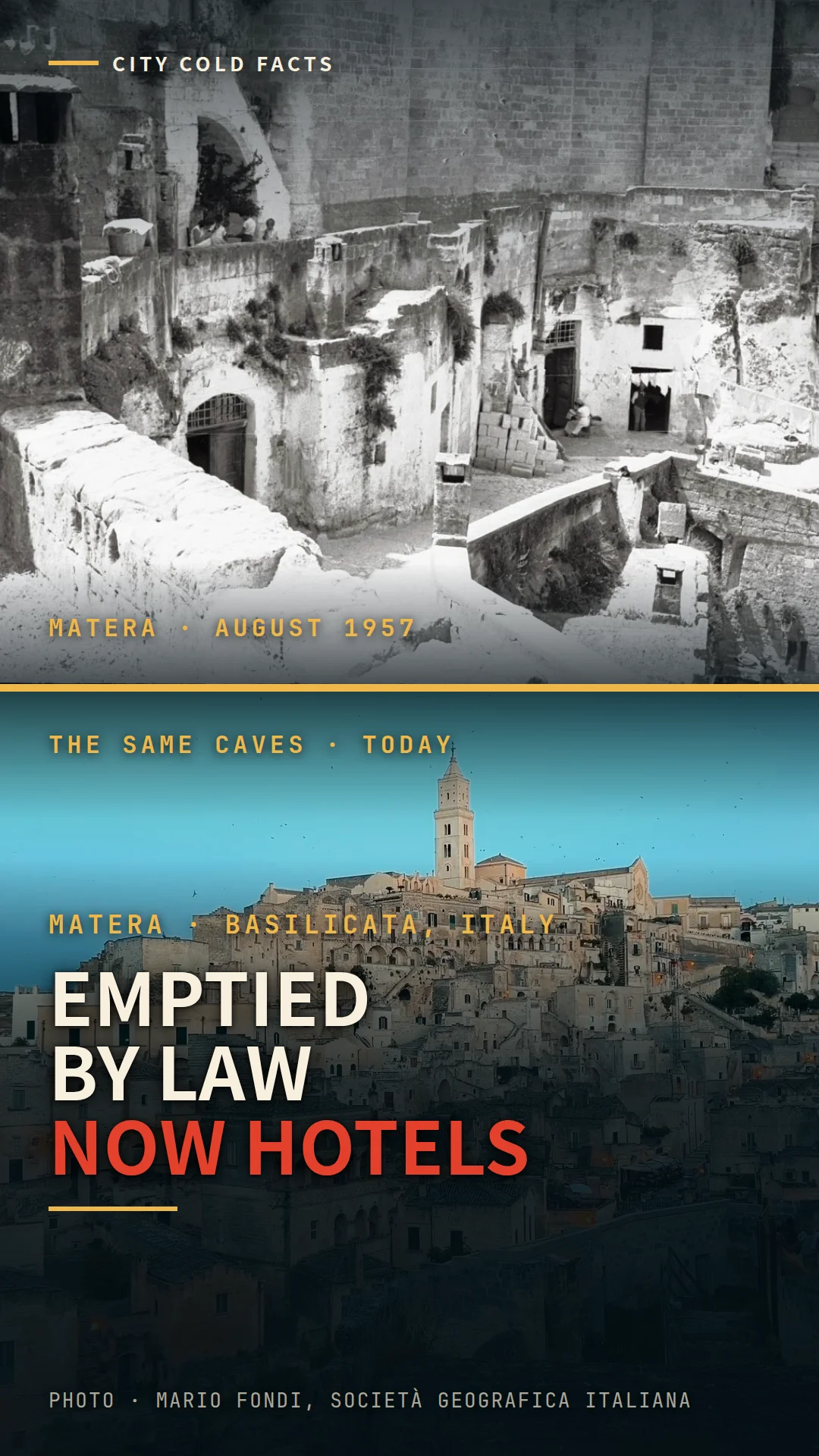
Matera: Italy Emptied This Cave City by Law — Now the Caves Are Hotels

Matera, in Italy's Basilicata region, is built out of the rock itself. Its two oldest districts, the Sassi, are houses dug into the limestone face above the Gravina ravine, and in places the street runs across the roof of the house below. 1
People have lived in those caves since prehistoric times, with evidence of habitation as early as 7000 BC. 1 UNESCO calls the Sassi and the Park of the Rupestrian Churches the most outstanding intact example of a troglodyte settlement in the Mediterranean, and listed the site in 1993. 2
By the early twentieth century about fifteen thousand people lived in the caves, with plumbing, electricity and telephones practically nonexistent, malaria endemic and waste burned on the cliffs. 3 Carlo Levi's 1945 book Christ Stopped at Eboli made the district notorious, and Italian newspapers began calling Matera a national embarrassment. 3
In 1950 Prime Minister Alcide De Gasperi visited the Sassi and said that "this sad remnant of past centuries should disappear". Two years later his party passed the first law for the risanamento, the clean-up of the district. The resettlement was paid for with Marshall Plan money, and the first families moved to the new village of La Martella in 1954. 3 Wikipedia dates the removal of the whole population to between 1952 and the 1970s. 4
By 1961 a reporter for La Stampa found the Sassi empty but for one man and his mule, and some locals wanted to bury the caves in concrete or blow them up. 3
The return took decades. Law 771 of 1986 set up the plans and the state subsidies that cut the cost of restoration in half, 2 and UNESCO listed the site in December 1993. 4 Cave dwellings were combined into restaurants and boutique hotels, and in 2019 Matera served as a European Capital of Culture. 3
No official apology has ever been given for the forced exodus. 3
The black-and-white photographs in the film were taken in the Sassi in August 1957 by the geographer Mario Fondi, and are published by the Società Geografica Italiana from the original negatives of its Fondo Mario Fondi. 5
References
- 1Wikipedia: Sassi di Matera
en.wikipedia.org
- 2
- 3The New Yorker: A Cave with a View
newyorker.com
- 4Wikipedia: Matera
en.wikipedia.org
- 5Società Geografica Italiana: Matera, Agosto 1957
societageografica.net
This story was produced automatically by a channel. One sentence is all it takes for Neodrop to keep producing for you.