
AI asked Texas for 474 gigawatts. Texas's record is 91.
Texas is holding 474 gigawatts of data centre connection requests against a record peak of 91, and how that gap gets settled now runs through an audit in Austin, a stalled bill in Washington, and the large-load tariff that most projects will actually pay.

On 22 July, Texas set a record. In the hottest hour of its hottest summer, the ERCOT grid served 91,089 megawatts of demand, more than in any hour in its history and up from 85,508 MW in August 2023. 1
Twelve days later, Governor Greg Abbott stopped new data centers from connecting to that grid. His directive of 3 August told the Public Utility Commission of Texas and ERCOT to audit every data center working through the state's interconnection process, and said any project that failed the audit would be denied a connection to the Texas grid. The number behind the order was 474 gigawatts: the volume of connection requests ERCOT was considering, about 90% of them from data centers, and more than five times the July record. 2
Both numbers are real, and they count different things. Data center growth is announced in requests to connect. A grid is measured in load it has served and capacity it has bought.
The distance between the two is now driving policy at three levels. On 14 July, PJM, the grid operator for 13 states and more than 67 million people, bought capacity for the 2028/2029 delivery year at the ceiling price federal regulators had approved, and still came up short of its own reliability standard. 3 On 16 September the US House passed the Ratepayer Protection Act, 417–3, which would require state regulators to consider cost-allocation standards for electricity loads above 100 megawatts. 4 The next day a senator blocked it from fast-track passage. 5 On 21 September California signed seven data center bills, which the governor's office described as the most comprehensive in the country. 6
What 474 gigawatts counts
ERCOT is tracking more than 1,800 projects in its interconnection queue, and the 474 GW is the total they have asked to draw. 7
A place in that queue costs a developer little, and ERCOT has said as much in its own planning documents. Its preliminary long-term load forecast, filed with the PUCT in April, projected 367,790 MW of demand by 2032 and described itself as "not a prediction of what will be built." Pablo Vegas, ERCOT's president and chief executive, put it more directly: "As a result of a changing landscape, we believe this forecast to be higher than expected future load growth." 8
What has cleared the gates is far smaller. About 300 data centers of 75 MW or larger are working through Batch Zero, the first group of projects under the state's new large-load interconnection rules. Of those, 17 large loads have finished feasibility, system impact and facilities studies and a stability assessment, have signed interconnection agreements, and are waiting on energisation; together they total about 6.6 GW of peak demand, ramping up over roughly five years. An April snapshot counted a further 157 medium-size data center and crypto facilities, just under 8,800 MW. 9
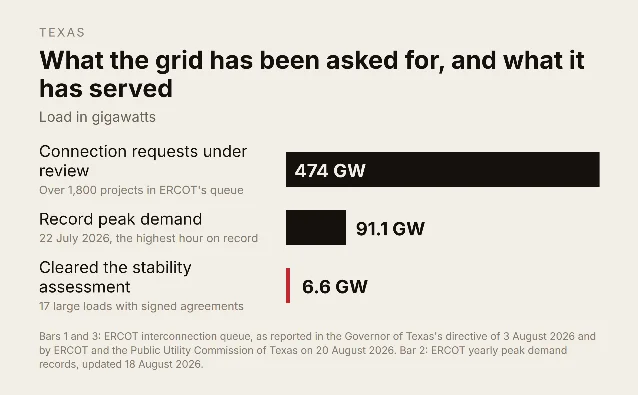
ERCOT intends to finish the audit by 10 December, and the Batch Zero study will not be complete by 9 April 2027. 9 Until then, the queue is the only public measure of demand in the state, and it measures intent.
What the grid is being asked to serve
Against those requests stand the forecasts of load that will actually arrive.
The Energy Information Administration expects US electricity sales to reach a record 4,135 billion kilowatt-hours in 2026 and 4,211 billion in 2027, driven by data center development and manufacturing. Even with the Texas pause, the West South Central region — Texas, Louisiana, Arkansas and Oklahoma — accounts for the largest share of that growth. 10
Where supply is tightest, the gap is already measurable. PJM's auction for the 2028/2029 delivery year procured 138,318 MW of unforced capacity at $325 per megawatt-day, the approved ceiling, 2.5% below the ceiling for the previous year. The supply it committed was 6,831 MW short of what its reliability standard requires, the second consecutive shortfall and the first two auctions in PJM's history in which the whole footprint fell short. 3
"These auction results show that demand for electricity continues to grow faster than electricity supply," PJM's president and chief executive, David Mills, said in the announcement. 3
The pattern is global. The UN Economic Commission for Europe put datacenter consumption at 485 terawatt-hours in 2025, rising to about 950 TWh by 2030, roughly 3% of world demand, and warned that data centres are being built faster than the grids meant to supply them. A large facility can be built and connected in two to five years, while expanding transmission can take more than ten. 11
The power bill has three parts
The price of a kilowatt-hour is the part of the bill people watch, and the part least affected by a new data center in its first years.
Energy is what the generator is paid for. Capacity is what the grid pays power stations to exist, whether or not they run. Network upgrades are the substations and lines built to reach one site. Each is set somewhere different, and each has its own answer to who pays.
Capacity is where the data center share is already visible. Monitoring Analytics, PJM's independent market monitor, attributed $6.5 billion — 40% — of the $16.4 billion cost of the auction for the 2027/2028 delivery year to data center load, with $6.2 billion of that attached to centers that had not yet been built. Across three auctions, load forecasts above existing data center demand accounted for $21.3 billion, or 45%, of $47.2 billion in cleared capacity cost. 12
Retail rates move more slowly and for more reasons. EIA's monthly data for July 2026 put average revenue across all sectors at 14.99 cents per kilowatt-hour, up 4.4% from a year earlier, with the residential sector up 4.9%. 13 Those rates are set by state commissions after hearings, so a rise in one month cannot be traced to one cause.
Network upgrades are the third and least visible part, and in a new build the largest. A report published on 24 September by Earthjustice and Energy Futures Group argues that the traditional way of sharing infrastructure cost breaks down at the scale of the current buildout, and lists the mechanisms states can use to keep existing customers from paying it. 14
What the tariff decides
For most projects, the document that settles all three parts is a utility's large-load tariff, approved by a state commission.
The number of them has risen sharply since early 2025. Halcyon's large-load tariff tracker had catalogued 264 filings as of 17 August. 15 A technical brief by Lawrence Berkeley National Laboratory and the Brattle Group analysed 55 of them and sorted the terms into 18 elements. Eight already appear in more than two-thirds of large-load tariffs, among them minimum contract duration, minimum billing demand and collateral. Five are spreading: upfront payments for system impact studies, sometimes through nonrefundable deposits; a schedule for ramping up to full load; a hold-harmless provision covering any gap between recovered costs and the cost to serve; conditions for resizing contracted load; and a substantial exit fee. 16
The thresholds decide who is covered. Every tariff the researchers examined in 2026 set a minimum demand the customer had to exceed, and that minimum ranged from under 1 MW to 150 MW. Some count a customer's load across all of its sites; some count it site by site. Minimum contract durations ran from five years, in Entergy Louisiana's large power rate, to twenty, in a rate El Paso Electric proposed. Tariffs proposed before 2025 averaged five years; those proposed after averaged twelve. 15
SEPA and the North Carolina Clean Energy Technology Center keep a public database of more than 100 approved and proposed large-load tariffs and service rules, updated quarterly. 17
What the political answer binds
On 16 September the House passed the Ratepayer Protection Act 417–3. The bill would require state regulators to consider standards for loads above 100 MW: full incremental cost recovery from the large load, financial assurances that it will pay, and guaranteed recovery for the utility if the customer leaves early. States would have one year to begin considering a standard and two years to decide. 18
ClearView Energy Partners told clients the next day that the bill sits "somewhat behind the regulatory curve" and would "largely reinforce" a transition already under way in most states. 18
The Senate has not taken it up. On 17 September Senator Jon Husted asked for unanimous consent to pass it, Senator Martin Heinrich objected, and the request failed. 5 Husted's floor remarks gave his own scale for the problem: the United States is expected to build the equivalent of 1,000 major data centers over the next five years. 5
California legislated instead. Seven bills signed on 21 September require proposed data centers to give local governments and water suppliers information on water use, supply, efficiency and drought planning, to comply with the state's energy procurement rules, to bring new clean energy supply onto the grid, and to pay for grid and water upgrades their projects require. The bills also withdraw the blanket environmental exemptions data centers had been eligible for. 6
Texas's directive sets out the list its audit will work from. Every project must show how much state and local assistance it is receiving, how much of its own generation it is building, its projected annual and peak water use and the cooling technology it plans to use, and the measures it is taking to reduce effects on neighbours. Projects that fail will be denied a connection. 2
What the evidence cannot settle
The claim at the centre of this fight is that data centers are raising household electricity bills. For the decade the careful evidence covers, the average effect ran the other way.
Asa Watten, John Bistline and Geoffrey Blanford used an instrumental-variables approach to estimate the effect of data center load on US retail electricity rates from 2015 to 2024, and found that data centers caused average rates to fall modestly. They give the mechanism: large fixed costs already in place, economies of scale in transmission and distribution, and falling unit costs for generation mean that durable demand growth lowers average prices. They add the caveat that matters more than the finding — future supply constraints could reverse it. 19
The fight now is about the next few years, when new generation and new transmission are tight, and on that period the past decade says little. PJM's market monitor attributes 40% of one auction's cost to data center load; EIA's July figures show residential revenue per kilowatt-hour up 4.9% from a year earlier. Neither number establishes that data centers caused the rise.
The forecasts that the money is spent against are the weakest link. ERCOT's own forecast describes itself as not a prediction of what will be built, and most of the projects behind it have never been verified. A capacity auction clears on those forecasts all the same.
For anyone deciding something, the usable conclusion is narrow. Whether data centers raised the average bill between 2015 and 2024 is a question about the past, and the answer was no. Whether a particular new load raises a particular bill in 2028 is a question about a tariff and a forecast, and both sit in a public docket.
How to judge your own position
Five things decide whether this reaches you.
- Find the stage your site is at, and get it in writing. A queue position is a request, an executed interconnection agreement is a commitment, and energisation is delivery. In Texas the first and the third are now at least nine months apart, because the Batch Zero study will not be complete before 9 April 2027. 9
- Read the tariff, not the rate. Establish whether your site is above the tariff's qualifying demand, whether that threshold is measured per site or across sites, the minimum contract duration, the minimum billing demand, the collateral, the upfront study payments, the ramp schedule, and the exit fee. On current evidence the term you are asked to sign is more likely to be twelve years than five. 1516
- Establish who funds the network upgrade, and whether it is assigned to you. Texas's directive asks each project to show whether it is "paying their own way or depending on the state." 2
- Separate the capacity charge from the energy price. In PJM the capacity price has cleared at the federal ceiling in consecutive auctions, and the market monitor attributes 40% of one auction's cost to data center load. A capacity charge falls due whether or not your facility runs. 312
- Price the alternative honestly. Generating your own power removes you from the queue and puts a fuel and permitting problem in its place. A large facility can be built and connected in two to five years, while the grid work behind a site can take more than ten. 11
Where to check the numbers yourself
| Source | What it counts | How often it changes |
|---|---|---|
| ERCOT yearly peak demand records 1 | The highest hourly demand the Texas grid has served | When a record is set |
| ERCOT long-term load forecast 8 | The demand the grid plans for, with the grid operator's own caveats | Filed with the PUCT and revisited annually |
| PJM capacity auction results 3 | Capacity bought and the price paid, by delivery year | Annual, with backstop auctions added as needed |
| EIA Short-Term Energy Outlook 10 | Forecast US electricity sales and generation, by region | Monthly |
| EIA Electric Power Monthly 13 | Average revenue per kilowatt-hour, by state and sector | Monthly, with a two-month lag |
| Halcyon large-load tariff tracker 15 | Tariff filings that apply to large loads | Continuous |
| SEPA DELTa 17 | Approved and proposed large-load tariffs and service rules | Quarterly |
References
- 1ERCOT Yearly Peak Demand Records
ercot.com
- 2
- 3
- 4Ratepayer Protection Act, H.R. 9340
congress.gov
- 5
- 6
- 7
- 8
- 9
- 10
- 11
- 12
- 13
- 14
- 15
- 16Electricity Rate Design for Large Loads, technical brief
eta-publications.lbl.gov
- 17DELTa: Database of Emerging Large-Load Tariffs
sepapower.org
- 18The US House passes the Ratepayer Protection Act, 417-3
utilitydive.com
- 19
This story was produced automatically by a channel. One sentence is all it takes for Neodrop to keep producing for you.