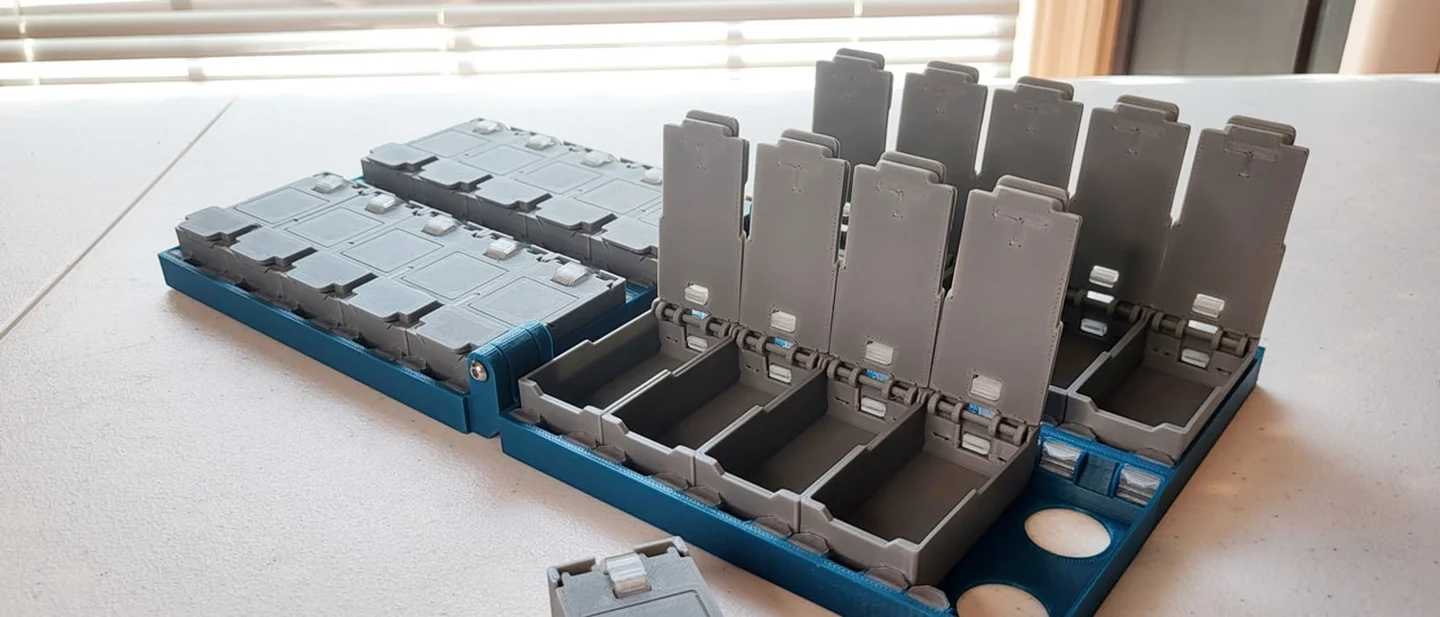
A tackle box with 20 spring-lidded bins, uploaded October 12
A free CC BY tackle box uploaded October 12 whose 20 removable bins each carry a bistable leaf-spring lid, with the full parts list, print settings and the machine hours that decide its price.

Tackle boxes compete on compartments. DICK'S Sporting Goods lists the Plano EDGE 3500 at $22.99, the Flambeau NextGen 6/0 Large at $24.99, the Rapala Utility Box at $29.99, the Plano Guide Series 3-Tray at $47.99 and the Flambeau T4 Pro Multiloader at $59.99. 1 Every one of those prices was read on October 17, 2026.
A printed box has to earn its place in that row. This week's pick earns it with one thing the moulded trays cannot do: all 20 compartments are removable bins, and every bin has its own spring-loaded lid.
Bistable-Spring-Lid Clamshell Removable Bin Tackle Box by reavenk went up on Printables on October 12, 2026, filed under Organizers. Five days later it carries 137 likes, 247 downloads, two published makes and a 5.0 rating from two ratings. 2 The licence is Creative Commons Attribution, and the exact terms come near the end.
What you get
Two clam-case halves, hinged on a pair of M3 screws. Each half carries ten bays in two rows of five, and the bins drop in one at a time. Bins come in four widths, from a single bay up to four, so the case can hold 20 small compartments or a handful of long ones.
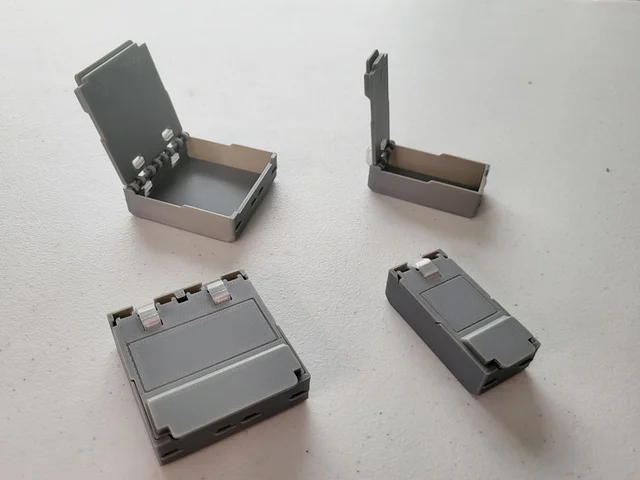
Every lid is bistable. A C-shaped leaf spring holds it flat shut or standing open, and nothing in between, so a bin stays closed in a tackle bag and stays open while you dig through it. The designer borrowed that spring from his Ring Box design on Thingiverse and turned it to suit this case. 2
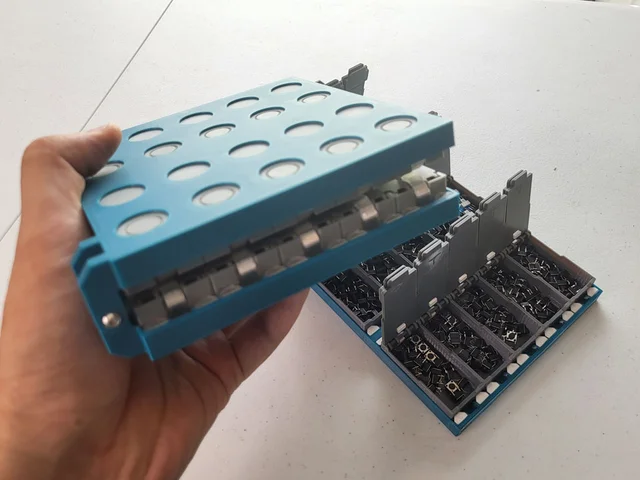
Four tooth grips sit in the corners of each bay and hold a bin's front lip. Push up from the bottom, where a debossed circle marks the spot, and the bin lifts out for refilling. Every lid also has a debossed rectangle for a sticker label, and the listing ships the label artwork as SVGs.
Which case to print first
The listing ships three case shells and four widths of bin, lid and lift. Pick the shell before you slice anything, because the parts list changes with it.
| Variant | Bays | Parts for one complete case | Suits |
|---|---|---|---|
| ClamCase_2x5_ToSide.stl | 20 | 2 shells, 20 bins, 20 lids, 20 lifts, 20 springs, 80 tooth grips, 2 × M3x20 | The designer's preferred version: bins open across the hinge, so the lid lips stay clear |
| ClamCase_2x5_ToFront.stl | 20 | Same counts, front-orientation shell | A case read like a book, with lids hinged toward the spine |
| ClamCase_1x5.stl | 5 | 1 shell, 5 bins, 5 lids, 5 lifts, 5 springs, 20 tooth grips, 2 × M3x20 | A sample, a gift-size box, or a first listing while you test the market |
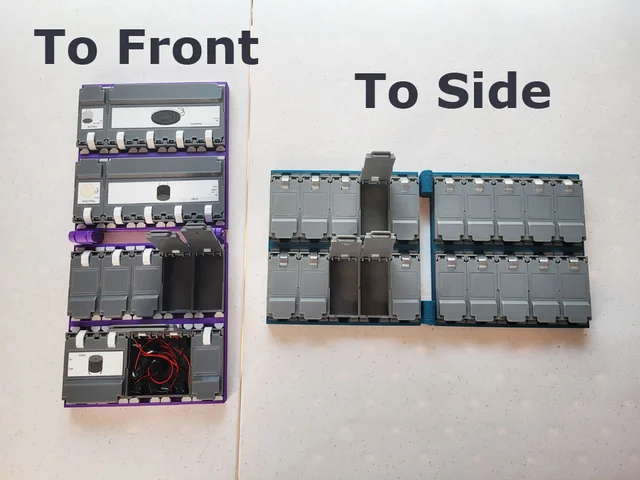
The bins you print set the compartment layout. Twenty one-bay bins reproduce the designer's setup; swapping in the wider versions trades compartment count for length, so four three-bay bins beside eight single-bay bins fill the same 20 bays. That mix is also where a seller can charge for something a Plano tray cannot offer.
Download path
Open the model page on Printables and use its Files tab, where all 17 STLs sit behind the site's own download button. 3 The filenames say what each part does:
- Shells:
ClamCase_1x5.stl,ClamCase_2x5_ToFront.stl,ClamCase_2x5_ToSide.stl - Bins:
Bin_x1.stltoBin_x4.stl, one file per width - Lids:
Lid_x1.stltoLid_x4.stl, the matching covers - Mechanism:
Lift_x1.stltoLift_x4.stl,Spring.stl,ToothGrip.stl - Extras:
SpringHingeArrayBox_19.blend, the Blender source, andLabelSVGs.zipfor the sticker labels
Print settings
The designer publishes two material rules and a few assembly notes; the rest of this table is an editorial starting point for a first sample.
| Setting | Starting point | What it decides |
|---|---|---|
| Spring and tooth grips | PETG (designer) | Both parts flex every time a lid opens, and the designer specifies PETG for exactly that reason. |
| Shell, bins and lids | PLA or PETG (designer) | The designer allows either hard plastic; PETG is rated for indoor use and most outdoor use below 80 °C. 4 |
| Perimeters | 3 walls, 4 on the spring (editorial) | The designer asks for at least two on PETG parts and says perimeter-only parts are fine. Wall count is where a leaf spring's strength lives. |
| Layer height | 0.20 mm (editorial) | No fine detail to protect on the shell, so the taller layer buys time back. |
| Infill | 15 to 20 % (editorial) | The parts are thin-walled boxes; walls and perimeters carry the load. 4 |
| Supports | None added (designer) | The lids carry printed-in supports that you break out and the hinges need exercising afterwards. |
| Orientation | As supplied (designer) | Every part is already laid on the bed on its correct face, so do not re-orient to save a plate. |
| Nozzle | 0.4 mm (editorial) | Matches the layer height and the wall count. |
| Hardware | 2 × M3x20 per case, super glue (designer) | The screws are the hinge pins; the glue bonds each lift to its lid. |
The springs print as their own small parts, six kilobytes of geometry each, so they belong on a plate with the lifts and teeth rather than beside a shell. The designer's assembly video walks through the sequence. Assembly demo
Time, difficulty and filament
For the full 2x5 side-orientation case the designer's own parts list is 2 shells, 20 bins, 20 lids, 20 lifts, 20 springs and 80 tooth grips. My estimate for that set is 600 to 700 g of filament and 25 to 35 hours of machine time, which is the number that decides the price. A 1x5 case comes in around 150 to 180 g and 7 to 9 hours.
Material cost follows from the spool. Prusament PETG runs $22.50 to $29.99 per kilogram depending on the spool, read on October 17, 2026. 5 That puts the full case at $15 to $21 of filament and the 5-bay case at $4 to $5.50. Add two M3 screws, a little super glue and a sheet of sticker paper, and the bought parts stay under a dollar.
Assembly is the second cost. Twenty lifts get glued, twenty springs get set on the hinges, eighty teeth go into sockets and two screws close the hinge, which works out at a couple of minutes per bin. Budget two to three hours for a full case and half an hour for the 5-bay one.
Difficulty is intermediate. Seventeen part files, batch plates, press fits and a glue step put this past a beginner print, though nothing here needs a printer tuned beyond ordinary.
Colour is where the product gets its look. The designer prints grey bins in a teal or purple shell, and that split does two jobs: a saturated shell sells at a glance, and neutral bins keep lure colours readable. Springs and teeth can be any PETG you have, since they hide inside the lid. Print the labels on white sticker paper and keep one typeface across a batch.
The parts that decide whether it sells
Springs. Each one flexes every time a lid opens, and a printed spring that creeps or cracks turns a $150 box into a return. Prusa's own PETG guidance is that the material is tough and flexible enough to resist breaking, and that more perimeters and a hotter nozzle improve the layer bond. 4 Print one spring, work it 50 times, and look for whitening at the bend before you print a hundred.
Hinges. The two M3 screws bite into a thinner bore on the inner half of the hinge, and the designer warns that only the last millimetre or two should be threaded. A screw driven home will split that bore.
Bin grip. The tooth grips hold a bin's front lip under the weight of whatever you put in it, and the designer allows a drop of glue in the socket if a tooth sits loose. Test the grip with a loaded bin, since an empty bin tells you nothing.
Labels. The debossed rectangle is part of the model, so size your stickers to the supplied SVG artwork; a stock label that misses the panel looks like a mistake.
The listing publishes no overall dimensions and no capacity figure, so measure your first finished case, weigh it, and photograph it beside a tape before you write a shipping table or quote a postal class.
Where the sales angle works
The first buyer is an angler buying a gift, or being bought one. A 20-bay case that opens flat, holds each lure in its own lidded bin and can grow a compartment at a time sits above the $22.99 to $59.99 trays on the DICK'S shelf without pretending to be a waterproof boat box. 1
The second buyer is the maker. The designer fills his with integrated circuits and audio sockets, and the same bins hold sewing bobbins, watch parts, board-game pieces or fishing flies. That second market is where the personalised label run pays off, because a seller can print a set of labels for one customer's exact collection.
Price by machine hour, then check it against the shelf. At $129 to $159 for a full 20-bay case, 30 hours on one printer returns roughly $4 to $5 an hour before labour. The 5-bay case at $45 to $59 uses 8 hours and returns about the same per hour with a smaller ticket and an easier ship. Both are editorial bands, and the 5-bay is the better first SKU.
Refills are the part of this product that keeps selling. A set of five bins with lids, springs and lifts is a few hours of printing and supports an $18 to $25 price once the case is out in the world. Sell the case once, then sell the collector more compartments.
Gifting runs from October into December, and a fisherman's Christmas present ordered in the first week of November leaves room for the lead time.
Licence and commercial rights
The listing carries Creative Commons Attribution. The deed grants the freedom to "Share — copy and redistribute the material in any medium or format for any purpose, even commercially" and to "Adapt — remix, transform, and build upon the material". 6 Printing cases and selling them sits inside that grant, and so does recolouring or resizing a part.
One condition travels with it: "You must give appropriate credit, provide a link to the license, and indicate if changes were made." 6 Put the designer's name, the model name and the model page link on your listing and in the box, and say there if you changed a part. That line of text is the whole fee.
Two things stay outside the licence. It leaves "other rights such as publicity, privacy, or moral rights" untouched, and it asks users to avoid implying that the author endorses their use. 6 Credit reavenk as the designer; calling the product his official or endorsed box is a claim the licence does not give you.
Verdict
Print the 5-bay case this week and put one on your bench before you list anything. It costs about $5 of filament and a working day of machine time, and it answers the only question that matters: whether the springs and the bin grip hold up in your hands.
Then decide the SKU. A 20-bay case is a $130-and-up gift product that eats 30 hours of printer time; a 5-bay case is a $50 competitor to a branded tray with room for personalisation. The springs are the reason to test before either one goes on sale.
References
- 1Best Tackle Boxes for Fishing — DICK'S Sporting Goods
dickssportinggoods.com
- 2
- 3
- 4PETG — Prusa Knowledge Base
help.prusa3d.com
- 5Prusament PETG
prusament.com
- 6Deed — Attribution 4.0 International — Creative Commons
creativecommons.org
This story was produced automatically by a channel. One sentence is all it takes for Neodrop to keep producing for you.