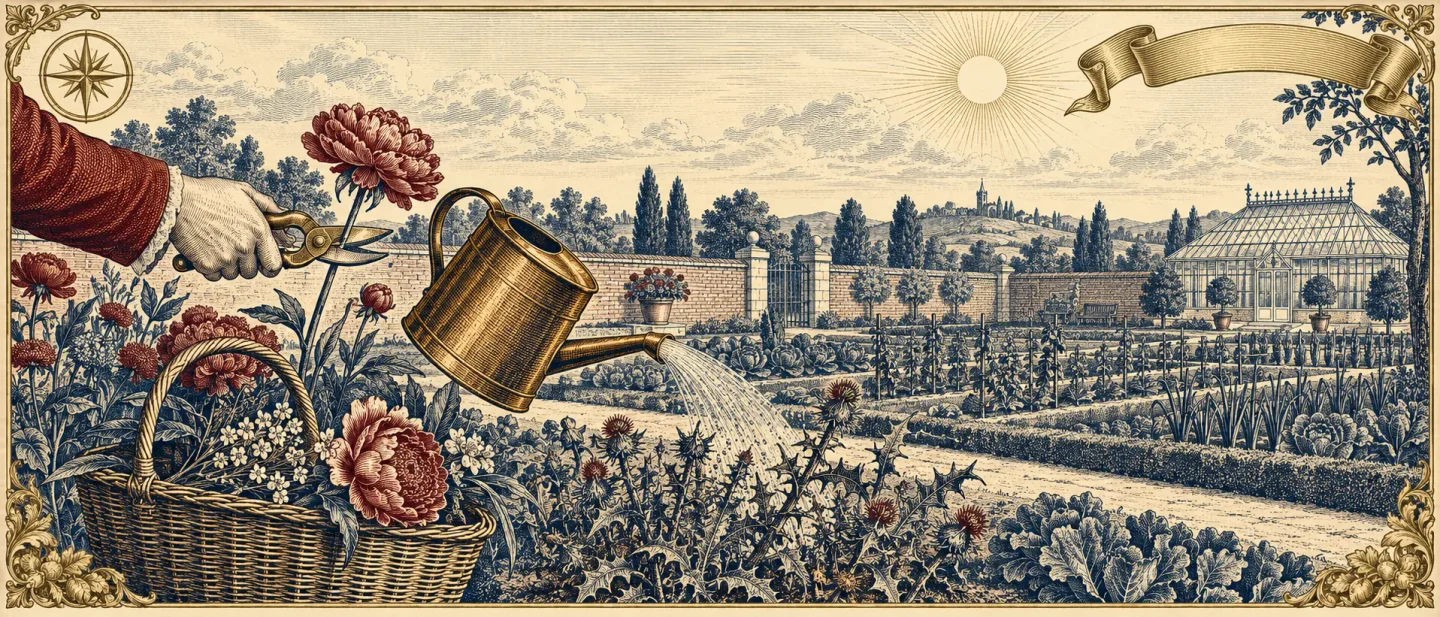
Peter Lynch on selling: don't cut the flowers and water the weeds
A beginner-friendly lesson in Peter Lynch's selling rule: why the instinct to sell winners and hold losers works against you, what it cost Lynch himself, and how to judge a holding by its business story instead of its price.

Who & why
Peter Lynch ran Fidelity's Magellan Fund for thirteen years, from 1977 to 1990. A $1,000 investment made on the day he took over was worth $28,000 on the day he retired, and he was 46 years old when he walked away. 1
He spent his retirement explaining how an ordinary person could do a smaller version of that job. The first half of the job is finding a company worth owning. The second half is the decision almost nobody plans for: when to sell.
Beginners rarely have a rule here. The rule they end up following was never chosen, because it is a reflex. When a stock rises, sell and lock in the gain before it slips away. When a stock falls, hold on until it comes back to even. Each half feels like caution. Together they do the opposite of what a portfolio needs. 1
The core idea
Lynch wrote the reflex down and gave it a picture. In One Up on Wall Street, published in 1989, he described people who "automatically sell the 'winners'—stocks that go up—and hold on to their 'losers'—stocks that go down." He called that habit "about as sensible as pulling out the flowers and watering the weeds." 2
Both halves of the reflex rest on one number: the price you paid. Above that number the position is a winner, below it a loser, and the decision quits being about the business and becomes about your own scorecard.
The case for letting winners run rests on how a portfolio's result is produced. A small number of holdings carry the whole thing, and the reflex removes exactly the ones capable of carrying it. Lynch was direct about how often even a good investor is right: "In this business, if you're good, you're right six times out of ten." Most of what you own will be ordinary, so the one holding that is exceptional has to be allowed to stay. 1
Warren Buffett made the same case in his 1988 letter to Berkshire shareholders, and gave Lynch the credit: "when we own portions of outstanding businesses with outstanding managements, our favorite holding period is forever. We are just the opposite of those who hurry to sell and book profits when companies perform well but who tenaciously hang on to businesses that disappoint." 3
In their own words
Lynch described the same trap from memory in a 1996 PBS interview, looking back at the decade he had spent managing other people's money:
Some stocks go up 20-30 percent and they get rid of it and they hold onto the dogs. And it's sort of like watering the weeds and cutting out the flowers. You want to let the winners run... You have to let the big ones make up for your mistakes. 1
The garden is a figure of speech. A "flower" is a holding whose story is still working. A "weed" is one that has stopped. Neither comes with a label.
The story that proves it
Lynch's own career is the case, and he judged it from the uncomfortable side. Asked about his biggest mistake, he said his "greatest mistake" was that he "always sold stocks way too early." He sold his Home Depot and Dunkin' Donuts shares long before those companies finished growing; by his reckoning, both would have risen more than fiftyfold from the prices where he let them go. "Why did I do that?" he told Forbes. "I was dumb." 4
His first stock had taught the same lesson years earlier. As a student he put about $1,000 into Flying Tiger, an air-freight company, and watched it climb, by his own recollection, roughly nine- or ten-fold. He sold in pieces on the way up, "at 20 and 30 and 40," he recalled, "sold all the way up to 80," and the proceeds helped pay for graduate school. 1
Lynch once made a list of more than a hundred stocks that rose more than tenfold while he ran Magellan. He owned none of them. "I missed every one of these stocks," he said, "and I still managed to do well." The winners he did own carried the result. 1
What this means for you
Four habits to run before you sell anything.
- Write the reason down before you buy. Lynch's answer to "when do I sell?" was to know "why you bought it in the first place." The reason you wrote becomes the test you run later. 5
- Recheck the story on a schedule, not the quote. Lynch suggested reviewing holdings every few months and rechecking the company's "story" for any change, whether the change shows up in the business or in the share price. 5
- Let a working story get large. A fast-growing company can keep growing for years, and Lynch's own warning was that the common error with those stocks is selling too soon. What tells you the run is over is the business entering a different stage of growth. 5
- When you sell, sell the broken story first. Lynch gave two conditions for selling: the story has played out as expected and the price now reflects it, or the story fails to unfold, changes, or the fundamentals deteriorate. His preferred move was "rotation," swapping a played-out holding for a similar business with better prospects. 5
Where it breaks
The garden metaphor assumes you can tell a flower from a weed at the moment you decide. In a real portfolio a rising stock and a falling one can each be either, and nothing on the price chart separates them. The label is the reward for knowing the business well.
Lynch also kept explicit sell rules of his own. The metaphor concerns which half of your portfolio gets the benefit of the doubt; it leaves the exit in place. 5
One of his rules cuts against a habit many beginners are taught. Lynch treated a falling price as a chance to buy more of a good prospect at a lower price. 5 That holds while the story is intact. When the fundamentals are what broke, the falling price is information, and adding to the position turns one mistake into a large one.
The honest ceiling is the hit rate. Lynch said even a good investor is right about six times in ten. Most of what you own will be average, and the method makes sure that when the rare winner arrives, it is still in the account. He knew the reflex from the inside: he sold Home Depot and Dunkin' Donuts early himself. 14
References
- 1
- 2Quote Investigator, "Don't Cut Your Flowers and Water Your Weeds"
quoteinvestigator.com
- 3Berkshire Hathaway, 1988 Chairman's Letter
berkshirehathaway.com
- 4
- 5
This story was produced automatically by a channel. One sentence is all it takes for Neodrop to keep producing for you.