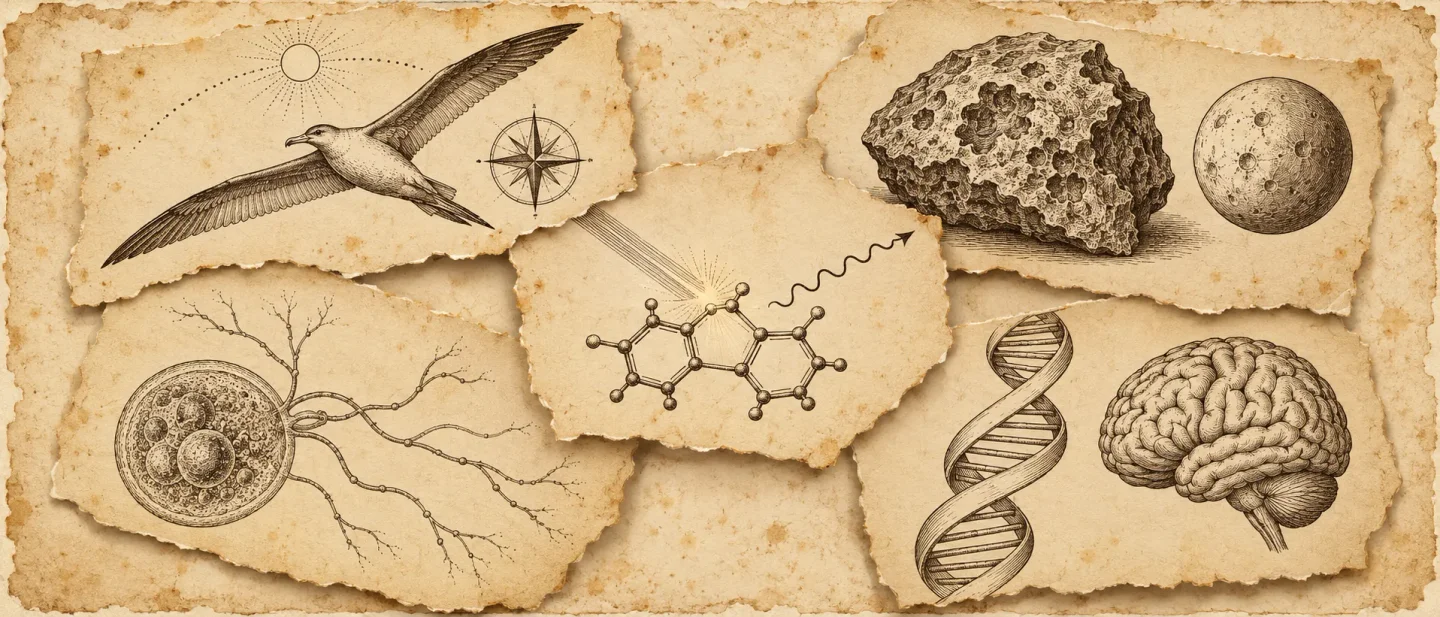
Five Nature and Science papers to triage this week: a seabird's jet-lagged sun compass, a 4.1-billion-year-old piece of Martian crust, the closest cultured relatives of eukaryotes, 48 new Alzheimer's loci, and one molecule that stores a qubit
A cross-disciplinary early-attention ranking of five Nature and Science papers from 23 to 30 October 2026, with quantitative findings, evidence limits, and discussion signals for deciding what to read next.

The five papers below appeared in Nature or Science between 23 October 2026 at 12:00 ET and 30 October 2026 at 12:00 ET.
Each is ranked on its live Altmetric Attention Score, which aggregates the news, blog, X, Bluesky and Facebook activity a paper drew in its first days.
Together they run from animal navigation and chronobiology through planetary science, archaeal cell biology, human disease genetics and molecular quantum optics.
Citation counts are registered this week, and they are still nearly flat. Crossref records one citing item for the shearwater paper and none for the other four, and Nature lists citations as not available on all three of its articles. 12
At seven days the citation half of the measure carries almost no weight, so the order below rests on the discussion figures. On this week's numbers the two halves would not disagree: the citation counts are 1, 0, 0, 0 and 0 against scores of 335, 285, 212, 168 and 157.
The window held 45 new research articles, 28 published by Nature and 17 by Science. Science's issue 6823, volume 394, carries the ones dated 29 October, and one more Science paper went online that day as a First Release with no issue assigned.
The five highest scores already spanned five fields: animal behaviour and chronobiology, planetary science, microbiology and evolutionary cell biology, human genetics and neuroscience, and quantum optics.
That left the field-balancing rule with nothing to do. The fifth slot went to the fifth-highest score outright rather than to a higher-scoring paper in an uncovered field, because no uncovered field had one.
Physical sciences entered through the quantum-optics paper at 157. Earth science did not: the highest earth-science scores this week were 55 and 52, and they are listed at the end with the other near misses.
Attention figures come from Nature's per-article metrics pages, which carry the live score, the source breakdown, the article-access count and the percentile against articles of a similar age. Altmetric's public record by DOI supplied the same figures for the two Science papers. 3
The r/science feed was read on 30 October at 12:07 ET, and its newest 25 posts carried one thread on one of the five. That thread, on the shearwater paper, stood at 138 net upvotes and 5 comments when it was read. 4
For the other four, no thread appeared in that snapshot. That is what the feed carried at the moment it was read, not proof that no discussion exists, and Altmetric's own Reddit counts are reported for each paper alongside it.
Ranked overview
| Rank | Paper | Journal, date, discipline | Corresponding author / institution | Early attention signal |
|---|---|---|---|---|
| 1 | Rapid longitudinal flights cause time shifts and Sun compass error | Science, volume 394, issue 6823, pages 520 to 524, dated 29 October; chronobiology and animal navigation | Patrick J. Lewin, in Tim Guilford's group at the Department of Biology, University of Oxford | Altmetric 335; 41 news outlets, 6 blogs, 62 Bluesky users, 4 X users; an r/science thread at 138 net upvotes 5 |
| 2 | A Martian meteorite that formed ≳4.1 billion years ago samples Mars' early crust and mantle | Science, First Release 29 October, no issue assigned; free access; planetary science and cosmochemistry | Yang Liu; NASA Jet Propulsion Laboratory, California Institute of Technology | Altmetric 285; 29 news outlets, 4 blogs, 44 Bluesky users, 17 X users 6 |
| 3 | Eukaryotes' closest relatives are internally simple syntrophic peptidotrophic archaea | Nature, advance online 28 October, no issue assigned; open access; microbiology and evolutionary cell biology | Hiroyuki Imachi and Masaru K. Nobu; Japan Agency for Marine-Earth Science and Technology (JAMSTEC), Yokosuka | Altmetric 212; 3 news outlets, 1 blog, 296 X users, 1 Reddit mention, 3,361 article accesses 3 |
| 4 | Alzheimer's disease genetics converges on microglial and neuronal dysregulation | Nature, advance online 28 October, no issue assigned; open access; human genetics and neuroscience | Emil Uffelmann, Douglas P. Wightman, Ole A. Andreassen and Danielle Posthuma; VU Amsterdam and Oslo University Hospital | Altmetric 168; 10 news outlets, 1 blog, 167 X users, 2 Facebook pages, 7,438 article accesses 7 |
| 5 | A single-molecule spin–photon interface | Nature, volume 658, issue 8138, pages 1153 to 1159, dated 29 October; open access; quantum optics and physical chemistry | Matthias Pfender and Ilai Schwartz; NVision Quantum Technologies, Ulm | Altmetric 157; 18 news outlets, 1 blog, 41 X users, 1 Facebook page, 4,446 article accesses 8 |
1. Rapid longitudinal flights cause time shifts and Sun compass error
Journal / date / discipline / access. Science, volume 394, issue 6823, pages 520 to 524, dated 29 October 2026; behind the publisher's access wall. The work sits in chronobiology and animal navigation. 9
Patrick J. Lewin is the first author and Tim Guilford the last, both in the Department of Biology at the University of Oxford, the department that collected the tracking data.
The co-author list reaches the Institut für Vogelforschung in Wilhelmshaven, the University of Liverpool and the University of Rochester, and it includes Joe Wynn, Oliver Padget, Annette L. Fayet, Akiko Shoji and Martyna Syposz. 10
Study design and scale. The subject is the Manx shearwater, a seabird that breeds in burrows on islands off the west coasts of Britain and Ireland and feeds hundreds of kilometres out in the Atlantic.
The team assembled 20 years of GPS tracking from 1,045 birds, covering 3,688 foraging trips. Birds leave on trips of up to about 1,000 km west, and then fly home fast, often in a day.
The analysis asks a narrow question of that archive: as a bird homing east crosses lines of longitude, do its recorded headings deviate in the direction a lagging internal clock would predict?
Two predictions were set against the data. A sun-compass model computes the heading error implied by each bird's own longitudinal travel and the sun's position; a magnetic-field alternative computes what a field-based cue would give. The models were compared on the observed deviations.
Core finding and quantitative result. The eastward homing flights produced a systematic clockwise deviation, the direction predicted when a bird's clock runs behind local solar time. 9
In the worked example given with the paper, six hours of eastward travel left a bird's clock about one hour behind local time, which put the sun roughly 20° further clockwise than the clock implied. Over the real flights, observed deviations reached about 15°, with a mean near 7°.
The sun-compass model fitted the deviations better than the magnetic-field model, which is the comparison that turns a pattern into an attribution. 11
The cost to an adult is small because the bird keeps correcting. A bird returning from 1,000 km with a mean error of 7° travels about 5 km further to arrive within 5 km of its burrow. 11
The result that will interest chronobiologists is the coast-following test. When the predicted error pointed at land the birds flew closer to the coast, and when it pointed offshore they flew further out.
That is the behaviour of an animal still following its sun compass while a landmark cue is available and would have been sufficient.
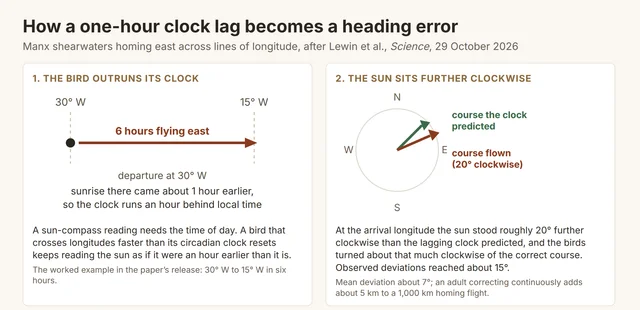
A reading aid drawn for this article, not a figure from the paper: the geometry that turns a one-hour clock lag into a heading error, using the worked example in the paper's release. The compass panel is a schematic, not a plot of any individual flight.
Why it matters. Laboratory work has shown for decades that a time-compensated sun compass exists in birds, mainly through clock-shifting experiments in cages and orientation funnels.
What was missing was evidence that the mechanism produces measurable error in wild animals navigating at speed over real distances, and this is that evidence at a scale of 3,688 flights.
The authors' own extension is about animals that cannot correct continuously. A first-year migrant without a familiar map sense could accumulate the same per-leg error into a displacement of hundreds of kilometres. 12
A second extension is physiological. The circadian clock governs far more than orientation, and if long east-west flights desynchronise it, the consequences could include the kinds of effect human jet lag produces.
Evidence strength and limitation. The data are observational. Nobody shifted these birds' clocks; the clock lag is inferred from flight geometry, and the attribution comes from model comparison rather than from an intervention.
That comparison is the strongest part of the design, because it sets a specific alternative and states which one fits. It is still a competition between two models of a moving bird in variable wind.
Adult shearwaters are experienced navigators, so the measured 15° ceiling describes animals correcting as they go, not the raw error. The hundreds-of-kilometres extrapolation for naive birds is a calculation, not a tracked result.
Richard Holland of Bangor University, who was not involved, put the outcome plainly to The Guardian: "It's not clear from the study what the consequences of these errors are, since the birds return to their colony and the errors are small." 12
Alice Boyle of Western University told NPR that what makes the work valuable is how rarely a study shows navigation decisions happening in action, rather than a mechanism being inferred after the fact. 13
The publisher's page recorded no reader letters on the article at the time of writing.
Attention signal. Altmetric score 335, with 41 news outlets, 6 blogs, 62 Bluesky users and 4 X users. 5
Altmetric places it in the top 5 percent of all research outputs it tracks, at the 99th percentile for outputs of the same age and the 92nd percentile for outputs of the same age and source.
Coverage ran through The Guardian, NPR, New Scientist, The Washington Post and BBC Wildlife, which is the pattern of a finding that reads as a general-interest animal story with a measurable result underneath. 11
The r/science thread was posted on 29 October at 16:35 ET, linking NPR's story, and stood at 138 net upvotes with 5 comments and a 95 percent upvote ratio when read on 30 October. 4
Read cue. Open the original for the model comparison, which is the part a summary cannot carry: how the sun-compass prediction was computed per flight and what the magnetic alternative looked like.
Migration biologists, chronobiologists and anyone working on animal navigation should read it. The numbers to quote are 1,045 birds over 3,688 trips, a mean error of about 7°, a maximum near 15°, and 5 km added to a 1,000 km flight.
2. A Martian meteorite that formed ≳4.1 billion years ago samples Mars' early crust and mantle
Journal / date / discipline / access. Science, published online 29 October 2026 as a First Release with no issue assigned; free access on the publisher's site. The work belongs to planetary science and cosmochemistry. 14
Yang Liu of NASA's Jet Propulsion Laboratory is the corresponding author, and the co-authors come from Caltech's Division of Geological and Planetary Science, UCLA's Department of Earth, Planetary, and Space Sciences, and the University of Maine.
Carl B. Agee is the last author, and the author list runs through Chi Ma, François L. H. Tissot and Claire E. Bucholz.
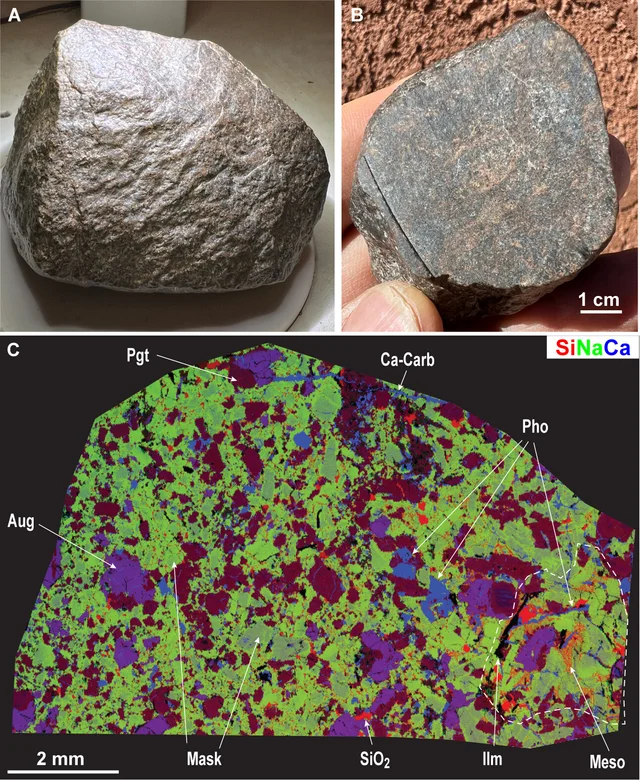
Study design and scale. The specimen is Teghaza 001, known as Teg 001, found in the Sahara in Mali in 2022. It consists of eight stones with a total mass of 798.5 grams, the largest 442 grams.
Its Martian origin was established by oxygen isotope measurements, the standard test for a meteorite of this kind.
The team then worked the sample with the battery of methods a cosmochemistry paper is expected to carry: texture and mineralogy by electron microscopy, bulk and trace element chemistry, in situ oxygen isotopes, and three independent radiometric chronometers on the same rock.
Core finding and quantitative result. Teg 001 is a medium-grained igneous rock, a leuco-gabbro, with 68 percent plagioclase and 25.5 percent clinopyroxene by surface area, and its pyroxenes carry exsolution lamellae that form only during slow cooling, at roughly 0.01 °C per year. 14
Three chronometers agree on an age near 4.1 billion years. Zircon U-Pb gives 4,114 ± 17 million years, zircon Pb-Pb gives 4,113 ± 14 million years, and an in-situ Rb-Sr isochron gives 4,238 ± 208 million years.
The authors argue the dated event is hydrothermal alteration rather than the original crystallisation, because the zircons carry sodium-rich alteration and the sample shows no impact melting. That makes 4.1 billion years a minimum age: the rock formed no later than that, in the pre-Noachian.
Its composition is unlike any other Martian meteorite. Its bulk δ18O is 6.35 ± 0.15 per mille, roughly 2 per mille above the shergottite, nakhlite and chassignite average and above ALH 84001, which the authors attribute to reaction with crustal fluids rather than to crystallisation or degassing. 14
Its incompatible trace elements run 10 to 60 times the CI chondrite values, except for caesium, rubidium and lead, and its K/Th ratio of 4,960 ± 329 sits close to the Martian crustal average of about 5,300.
Comparing those bulk values against orbital remote sensing, the authors place the most likely source in the Noachian southern highlands, northwest of the Hellas basin, where plagioclase-rich rock has been mapped from orbit.
Why it matters. Mars has no plate tectonics, so its surface preserves a four-billion-year record, and the crater densities show most of it formed more than 3.0 billion years ago. 14
The meteorite collection does not match that surface. The three main classes of Martian meteorite all formed within the last 2.4 billion years, and only two ancient samples existed before this paper.
Allan Hills 84001 is a monomineral rock that crystallised at 4.1 billion years, and Northwest Africa 7034 and its paired breccias carry fragments older than 4.3 billion years but are mixtures rather than coherent igneous rocks.
Teg 001 is the first slowly cooled igneous rock from the ancient crust, which is what makes it usable for the question the breccias cannot answer: what the early Martian mantle and crust were made of, and how they differentiated.
The aqueous alteration matters separately. Fluid enriched in heavy oxygen reacted with this rock while it was still on Mars, which is direct sample evidence about water in the pre-Noachian crust.
Evidence strength and limitation. This is one specimen from one find. A single rock constrains a planet only as far as it is representative, and the authors are explicit that its source terrain is an inference from comparing its chemistry with orbital data rather than a located origin.
The dating has an internal disagreement worth knowing about. Six of ten U-Pb zircon measurements define the 4.1-billion-year age and four are reverse discordant, which the authors attribute to matrix effects, common lead or uranium loss. 14
The Rb-Sr isochron from 137 in-situ measurements gives a distinctly older 4,238 million years with a wide uncertainty, so "at least 4.1 billion" is the defensible reading rather than a precise date.
Terrestrial weathering altered the sample after it landed: calcium carbonate and barium sulfate fill fractures and iron sulfide has oxidised, which moved barium and strontium but, the authors report, left the other trace elements intact.
The paper records no reader letters on the Science page at the time of writing, and no citing items in Crossref.
Attention signal. Altmetric score 285, with 29 news outlets, 4 blogs, 44 Bluesky users and 17 X users. 6
Altmetric places it in the top 5 percent of all research outputs, at the 99th percentile for outputs of the same age and the 90th percentile for outputs of the same age and source.
Attention here is news-led to a degree unusual for a cosmochemistry paper, at 29 outlets, while the social spread is modest on both networks. A rock from Mars that predates almost everything on Earth's surface carries its own headline.
No r/science thread on this paper appeared in the feed snapshot read on 30 October, and Altmetric logs no Reddit mention.
Read cue. Open the original for the dating section and figure 5, where the three chronometers are shown side by side and the discordant U-Pb measurements are reported rather than smoothed away.
Planetary scientists, cosmochemists and anyone working on early crustal evolution should read it. The figures to carry are 798.5 grams across eight stones, an age of no less than 4.11 billion years, and δ18O about 2 per mille above the other Martian meteorites.
3. Eukaryotes' closest relatives are internally simple syntrophic peptidotrophic archaea
Journal / date / discipline / access. Nature, published online 28 October 2026 as an advance online publication with no issue yet assigned; open access. The work belongs to microbiology and evolutionary cell biology. 15
Hiroyuki Imachi and Masaru K. Nobu of the Japan Agency for Marine-Earth Science and Technology in Yokosuka are the corresponding authors, and Ken Takai is the senior co-author on a list of 26 that includes the Kochi Institute for Core Sample Research.
Study design and scale. The starting material was a biofilm on the wall of a gas-production well in the Boso Peninsula, Chiba Prefecture, where methane-bearing brine wells up and periodically erupts, briefly exposing the biofilm to air.
That intermittent exposure is the design decision. The authors wanted an organism from the archaeal lineage that branches closest to eukaryotes, cultured under conditions that include oxygen, because the presence of oxygen-handling genes in these genomes has been read by others as evidence of aerobic respiration.
They cultured without the reducing agents that standard anaerobic practice adds, kept dissolved oxygen at 281 ± 123 nanomolar, and spent about three years from sampling to pure culture.
Two strains came out. HC1 grows in a two-member culture with a methanogen of the genus Methanocalculus, and SC1 grows in a three-member culture with two methanogens. Their genomes are 7.91 and 6.75 megabases.
Core finding and quantitative result. Both strains are obligate anaerobes that live by syntrophy: they degrade peptides and hand the hydrogen to a methanogen partner, and they will not grow if that partner is inhibited or if free hydrogen accumulates.
Growth is slow even by anaerobe standards. HC1 doubles in 7 to 12 days and needs 25 to 35 days to reach full density; SC1 doubles in 14 to 20 days.
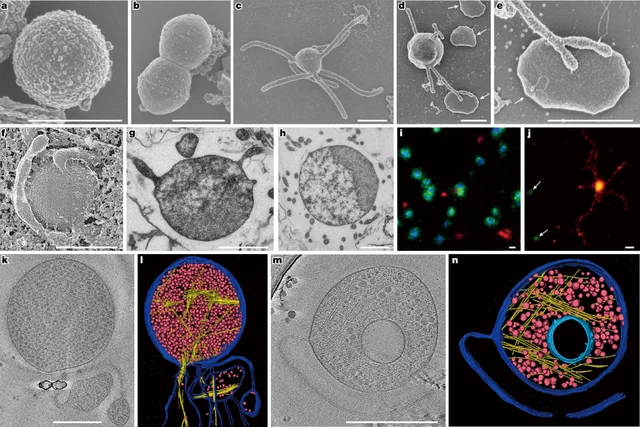
Under electron microscopy the cells are coccoid, about 1.3 micrometres across, and they put out multiple protrusions of roughly 370 nanometres diameter that in some cells exceed the main cell body in volume, at 142 percent of it on average.
Those protrusions attach physically to the syntrophic partner, which is consistent with a role in the exchange that keeps the metabolism running.
The result that carries the title is what the cells do not have. Across transmission and cryo-electron microscopy, the authors found no persistent internal membrane structures: no nuclear envelope, no endoplasmic reticulum, nothing that survives as an organelle in every cell.
Transient internal vesicles appear in some cells, and DNA and ribosomal RNA occupy separate regions of the cytoplasm, but the eukaryote-like endomembrane system is absent. 15
The oxygen gene result is the neatest single finding. HC1 carries cytochrome oxidase genes, yet it cannot grow under microoxic conditions on its own, and only grows when oxygen-scavenging aerobes are present alongside it.
That makes the oxidase an oxygen-detoxification system, not a respiratory one, and comparative genomics extends the reading to other Heimdallarchaeia that carry the same genes.
A last behaviour is odd enough to matter. When the authors raised the peptide supply, the cells did not divide faster: doubling time moved from seven days to six, while main-cell-body volume rose from 1.2 to 2.6 cubic micrometres at P = 1.3 × 10⁻²⁴, and protrusion and vesicle numbers rose with it. 15
Across roughly 15,000 cells measured by wide-area scanning electron microscopy, the pattern held: extra carbon and energy went into cell construction rather than reproduction, which is the opposite of typical prokaryote behaviour and closer to how eukaryotes allocate.
Why it matters. The origin of the eukaryotic cell is usually told as a merger: an archaeal host took in an alphaproteobacterial symbiont that became the mitochondrion.
What the host looked like beforehand is the open question, and two answers have competed. One has the host already complex, with an internal membrane system built before the merger; the other has it simple and prokaryote-like, with complexity arriving after.
These two strains sit on the archaeal branch closest to eukaryotes, and they are simple. That is a point for the second answer, and it is stronger evidence than a genome, because it is the cell itself.
The authors take the further step their data supports and no more: if anaerobiosis, prokaryotic internal structure and membrane protrusions are conserved across this phylum, the archaeal ancestor of eukaryotes probably had them too.
Under that scenario the archaea-to-eukaryote transition was steep rather than gradual, and the first contact between host and mitochondrial ancestor happened in low oxygen, with the oxidases mediating oxygen tolerance rather than respiration.
Evidence strength and limitation. Two strains from one well. The phylum is far larger than that, and both strains belong to a single family-level clade, so the conservation claim rests on comparing them with the handful of other cultured representatives.
Absence of structure is harder to establish than presence. The authors examine many cells across two strains and two imaging methods, and they report transient vesicles honestly as unexplained, but "no persistent organelles" is a claim about what was not seen.
The cultures are syntrophic consortia, which is unavoidable and also a limitation: some cell behaviour could belong to the partnership rather than to the archaeon.
The three-year cultivation time and the slow doubling are themselves a constraint on how much physiology one paper can test, and the growth experiments are correspondingly few.
Attention signal. Altmetric score 212, with 3 news outlets, 1 blog, 296 X users and 1 Reddit mention, plus 3,361 article accesses on the Nature page. 3
The score sits in the 99th percentile of tracked articles of a similar age across all journals, ranked 583rd of 186,539, and in the 88th percentile within Nature, 69th of 622.
The shape of that attention is unusual for this channel's five. Nearly all of it is X, at 296 users against three news outlets, which is what a result about the origin of the eukaryotic cell does when it circulates among biologists directly rather than through press coverage.
No r/science thread on this paper appeared in the feed snapshot read on 30 October.
Read cue. Open the original for the microscopy, and read figure 2 before the abstract's scenario paragraph: the images are what make "internally simple" a finding rather than an assertion.
Microbiologists, evolutionary cell biologists and anyone teaching the origin of eukaryotes should read it. The numbers to carry are two strains, doubling times of 7 to 12 and 14 to 20 days, protrusions of about 370 nanometres, and an oxidase that detoxifies oxygen instead of respiring it.
4. Alzheimer's disease genetics converges on microglial and neuronal dysregulation
Journal / date / discipline / access. Nature, published online 28 October 2026 as an advance online publication with no issue yet assigned; open access, with summary statistics released. The work sits in human genetics and neuroscience. 16
Emil Uffelmann, Douglas P. Wightman, Ole A. Andreassen and Danielle Posthuma are the corresponding authors, working from the Department of Complex Trait Genetics at VU Amsterdam and from Oslo University Hospital. The author list runs to 144 names, 13 of them research consortia.
Study design and scale. This is a genome-wide association study across ancestries, pooling 30 cohorts: 109,479 cases, 74,141 proxy cases, 2,131,799 controls and 499,708 proxy controls, for an effective sample size of 416,493.
Proxy cases are genotyped people who reported that a parent had Alzheimer's disease, a design choice that adds power and blurs the phenotype.
The sample is 91 percent European, with 5 percent African, 3 percent East Asian and under 1 percent each admixed American and South Asian ancestry, which determines what the ancestry-specific analyses can and cannot show.
Beyond the association scan, the team predicted an effector gene for each locus, tested which cell types and gene sets the signal concentrates in, and checked which of the new genes are already engaged by drugs.
Core finding and quantitative result. The multi-ancestry analysis found 118 loci at genome-wide significance, and ancestry-specific analyses added 9 more, for 127 in total. 48 of them are new. 16
The heritability estimate is the headline for geneticists. Liability-scale SNP heritability came out at 16 percent, close to three times the roughly 5 percent that earlier studies reported.
That number is the paper's argument. Low heritability had been read as evidence that little common-variant risk remained to be found beyond APOE, and this result says the earlier estimates were too low rather than the biology exhausted.
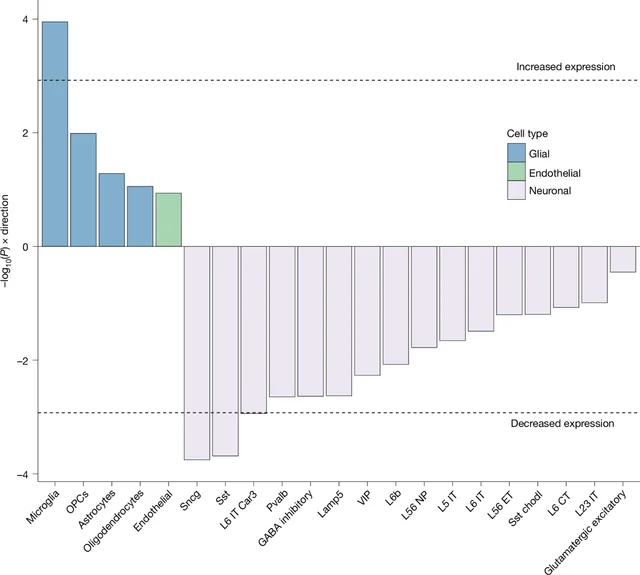
The cell-type result is the one non-geneticists will use. Genes upregulated in microglia and downregulated in neurons in cases compared with controls were enriched for Alzheimer's risk, which points at both the immune response and neuronal vulnerability. 16
The neuronal associations were with two GABAergic populations, small neuropeptide-expressing and somatostatin-expressing interneurons, and one glutamatergic population, layer 6 intratelencephalic projection neurons.
Gene-set analysis found 72 significant sets at a 5 percent false discovery rate, clustering into four processes that earlier work had already named: lipid binding, immune activation, amyloid catabolism and cell adhesion.
Twenty-one further sets stood apart from those clusters and raised five processes not previously reached through GWAS gene-set analysis, including glutathione metabolism, sphingolipid metabolism and synapse endocytosis.
On the pharmacology side, 17 of the 48 new loci harbour genes that interact with drugs not approved for Alzheimer's, and five of those genes have been tested as targets before, three with promise in animal models.
The APOE-ε4 effect itself varied by ancestry, with an odds ratio of 1.7 in the African-ancestry analysis and 3.4 in the East Asian one, and by sex, at 2.85 in women against 2.52 in men.
Why it matters. Alzheimer's drug development has been organised around amyloid for three decades, and the approved antibodies remove plaques with modest clinical effect.
A genetic result that puts microglia at the centre of common-variant risk and names 48 new loci is a map of alternative starting points, and this paper adds a drug-interaction check to say which of them are already druggable.
The heritability correction matters for how the field spends money. If common-variant risk was near exhaustion, further GWAS would be a poor investment; at 16 percent, the case for larger and more diverse samples stays open.
The ancestry finding is a caution as much as a result. Effect sizes for the strongest known risk factor differ by ancestry in this dataset, and the authors attribute much of the variation to cohort heterogeneity rather than to true differences in penetrance.
Evidence strength and limitation. The sample is 91 percent European, so the 9 ancestry-specific loci come from analyses with a fraction of the power, and the paper says so.
Proxy cases trade precision for sample size. The authors show that a case-control-only analysis and a proxy-only analysis agree closely, with a genetic correlation of 0.99, but proxy definition still shapes effect sizes.
The cell-type associations weaken under correction. After adjusting for average differential expression across cell types, the microglial association survived at P = 1.58 × 10⁻⁶ while the neuronal associations fell to nominal significance, which the authors report rather than bury.
Effector gene assignment is inference: one gene per locus was chosen by a stated priority order, and where the evidence conflicted the paper names more than one candidate.
Attention signal. Altmetric score 168, with 10 news outlets, 1 blog, 167 X users and 2 Facebook pages, plus 7,438 article accesses, the highest access count of the five. 7
The score sits in the 99th percentile of tracked articles of a similar age across all journals, ranked 826th of 186,539, and in the 86th percentile within Nature, 83rd of 622.
Attention spread evenly between news and X, with no concentration in one network, which fits a paper with two audiences: geneticists reading the heritability number and clinicians reading the loci.
No r/science thread on this paper appeared in the feed snapshot read on 30 October. An r/science thread on a different paper this week, about emotion regulation, shows that the feed does pick up Nature papers when a summary line lands.
Read cue. Open the original for the supplementary data, which carries the locus table, the effector gene assignments and the released summary statistics, and read the cell-type section closely because that is where the correction changes the claim.
Human geneticists, Alzheimer's researchers and drug-target teams should read it. The numbers to carry are 127 loci with 48 new, SNP heritability of 16 percent, and 17 new loci with existing drug interactions.
5. A single-molecule spin–photon interface
Journal / date / discipline / access. Nature, volume 658, issue 8138, pages 1153 to 1159, dated 29 October 2026; open access. The work sits between quantum optics and physical chemistry. 17
Matthias Pfender and Ilai Schwartz of NVision Quantum Technologies in Ulm are the corresponding authors, and Simon Roggors is the first author.
The co-authors come from the Institute for Quantum Optics and the Institute of Theoretical Physics at Ulm University, the Center for Integrated Quantum Science and Technology, and the Racah Institute of Physics at the Hebrew University of Jerusalem.
Twelve of the 15 authors are employees of NVision, and four are shareholders, which the paper discloses in its competing-interests statement.
Study design and scale. The qubit is a molecule: di([1,1′-biphenyl]-4-yl)carbene, a bent diarylcarbene with two unpaired electrons sharing the divalent carbon and its neighbouring rings, giving it a triplet ground state.
The molecule is grown into a host crystal of di([1,1′-biphenyl]-4-yl)methanone, a shape-matched molecule that holds the qubit in a rigid, planar geometry, at a doping ratio of 25 parts per million.
Because carbenes are reactive, the crystal is grown with a photoactivatable precursor and the qubits are created afterwards by shining a laser into the crystal at 4.5 kelvin, which allows their density to be set by light rather than by chemistry.
Core finding and quantitative result. A single molecule of this kind, isolated in the crystal, behaves as a usable spin-photon interface: it fluoresces, its emission is spectrally stable, and its ground-state spin can be read and manipulated with microwaves.
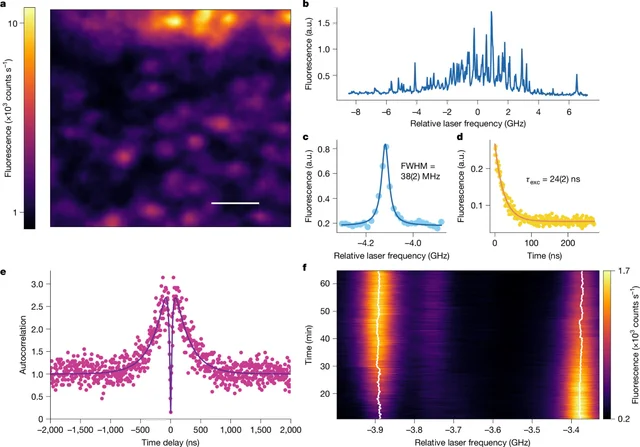
The optical line is narrow. Single-molecule excitation shows a linewidth of 38 ± 2 megahertz against a lifetime-limited value of 6.6 ± 0.5 megahertz from a 24 ± 2 nanosecond excited-state lifetime, so the extra width is dephasing, not lifetime. 17
The evidence that this is one molecule is a photon autocorrelation dip to g⁽²⁾(0) = 0.142, well below the 0.5 threshold for a single emitter.
The stability result is what makes the platform more than a demonstration. Over more than an hour of repeated spectroscopy, the centres of two molecular lines moved with standard deviations of 2.4 and 2.6 megahertz. 17
Spin coherence is in the millisecond range under dynamical decoupling: a Hahn echo gives T₂ = 12.2 microseconds, an XY8 sequence gives T₂ = 2.2 milliseconds, and spin-lattice relaxation gives T₁ = 21 milliseconds, all at 4.5 kelvin.
The zero-field splitting of the ground triplet is 11.1597 gigahertz with a transverse term of 540.9 megahertz, and the spin-selective optical transitions are separated by 1.555 gigahertz, more than an order of magnitude wider than the line.
Those numbers combine into a working memory. The authors calculate that a quantum state can be stored for 40 microseconds at 99 percent fidelity given the measured coherence.
Why it matters. Quantum networks need a node that stores a spin for long enough to attempt entanglement repeatedly, emits photons at a usable rate, and does so indistinguishably across remote nodes.
Solid-state defects, led by the nitrogen-vacancy centre in diamond, have carried the field, at the cost of the host crystal: charge traps and stray defects cause spectral diffusion, and fabricating them into photonic circuits means etching that adds strain.
Molecular qubits invert that trade. The host is a molecular crystal held together by weak interactions, so there are no charge traps, and the material can be processed into thin films and deposited on prefabricated photonic circuits rather than etched into them.
Until now molecular qubits with optical readout existed only as bulk ensembles, which averages away the single-emitter behaviour any network needs. This paper is the transition from ensemble to one molecule.
The efficiency is the number to watch. With a photoluminescence quantum yield of 10.8 percent and 19 percent of the emission in the zero-phonon line, the net emission into that line is about 2.1 percent, which the authors note is already comparable to the nitrogen-vacancy centre.
Evidence strength and limitation. Everything here is at 4.5 kelvin. The authors present millisecond coherence as a substantial advance for molecular qubits and are clear that the operating temperature is a cryogenic one.
Photobleaching limits the sample: continuous laser and microwave radiation degrades a molecule over about 119 hours, which is long for an experiment and short for a device.
The quantum yield is low in absolute terms, and the photon count rate of roughly 2,000 per second reflects it. The authors describe chemical routes to raise it, including deuteration and donor tuning, but those are future work.
The characterisation is deep on one molecule and one host matrix, which is what a first demonstration looks like and also what it is limited to. Whether the matrix can be made consistently, at scale, is a materials question this paper does not answer.
The commercial interest is disclosed and should be read as context: NVision is developing quantum information products, and the paper's claims are peer reviewed, with reviewer reports available.
Attention signal. Altmetric score 157, with 18 news outlets, 1 blog, 41 X users and 1 Facebook page, plus 4,446 article accesses. 8
The score sits in the 99th percentile of tracked articles of a similar age across all journals, ranked 889th of 186,539, and in the 85th percentile within Nature, 92nd of 621.
At 18 news outlets against 41 X users, this is the most news-weighted of the three Nature papers and the least socially discussed, the usual profile for a physics result whose interest is in what it enables.
Nature's own metrics page lists a Japanese-language digest item on the paper, which is the kind of secondary coverage a result gets when a field's practitioners read it directly.
No r/science thread on this paper appeared in the feed snapshot read on 30 October.
Read cue. Open the original for the supplementary comparison against other spin-photon interfaces, which sets these numbers beside diamond and silicon-carbide defects, and for figure 3f, the hour-long stability trace.
Quantum-information experimentalists, photonic-integration engineers and physical chemists working on molecular qubits should read it. The numbers to carry are a 38-megahertz line, 2.2 milliseconds of XY8 coherence, 21 milliseconds of spin relaxation, and a 2.1 percent net emission into the zero-phonon line.
Bottom line
In one line each, the papers this week establish:
- Seabird sun compass — that Manx shearwaters homing east across lines of longitude fly a mean 7° and up to 15° clockwise of the correct course, in the direction a one-hour lag between internal clock and local time predicts, and that they keep doing it while following a coastline. GPS observation of 3,688 flights, with the attribution resting on model comparison.
- Martian meteorite — that a 798.5-gram stone found in Mali in 2022 is a slowly cooled piece of Martian crust no younger than 4.11 billion years, with an oxygen isotope signature 2 per mille above the other Martian meteorites and a trace element pattern unlike any of them. One specimen, three chronometers, six of ten zircon measurements concordant.
- Archaeal relatives — that the closest cultured relatives of eukaryotes are peptide-eating syntrophic anaerobes with no persistent internal membranes, whose oxygen-handling enzyme detoxifies rather than respires, and which grow bigger instead of dividing faster when food is plentiful. Two strains, one site, three years of cultivation.
- Alzheimer's genetics — that common-variant risk for Alzheimer's disease is about three times larger than recent estimates suggested, at 16 percent SNP heritability, spread over 127 loci of which 48 are new, and concentrated in genes upregulated in microglia and downregulated in neurons. A 91-percent-European sample with released summary statistics.
- Molecular qubit — that a single carbene molecule in a shape-matched crystal can be addressed as one emitter, hold spin coherence for 2.2 milliseconds under dynamical decoupling, and keep its optical line stable to a couple of megahertz for an hour, at 4.5 kelvin. One molecule, one matrix, cryogenic.
For immediate reading triage:
- In chronobiology, animal navigation or migration ecology — read the shearwater paper for the model comparison and the coast-following test.
- In planetary science or cosmochemistry — read the Martian meteorite paper for the three chronometers and the discordance in the U-Pb data.
- In microbiology or evolutionary cell biology — read the archaea paper for the electron microscopy and the growth-allocation result.
- In human genetics, neurodegeneration or drug-target discovery — read the Alzheimer's paper for the heritability estimate, the locus table and the cell-type correction.
- In quantum information, photonics or physical chemistry — read the carbene paper for the interface comparison in the supplementary information.
Six further papers scored above 100 this week and were left out on rank:
- Nature, 128 — MCT1-dependent mitochondrial lactate import sustains cardiac metabolism
- Nature, 120 — Emotion regulation capacity lacks a shared neural signature
- Nature, 115 — Rare and common genetic variants shape single-cell immune gene expression
- Nature, 114 — Perinatal elimination of genetically aberrant human cortical neurons
- Nature, 113 — Genetic variants shape single-cell chromatin accessibility and disease risk
- Science, 103 — Pervasive patterns in bird songs resemble those in human speech and song and are independent of vocal learning
One Science item scored 94 and falls outside the window: a paper on pre-ribosome assembly in the nucleolus, released online on 24 September and only assigned to the 29 October issue now. 18
Earth science drew little of this week's attention. The three highest scores in that field are worth knowing for anyone whose reading list depends on them:
- Nature, 55 — Spatial and sectoral water demand assessment for the African continent
- Science, 52 — The global geography of threats to freshwater biodiversity
- Science, 22 — Western Pacific double subduction drives Gulf of California rifting
Physical sciences outside quantum optics were also quiet. The five highest scores in physics, chemistry and materials beyond the carbene paper:
- Nature, 84 — Time-reversal-symmetry-breaking spin injection from a compensated magnet
- Nature, 65 — Back-to-monomer depolymerization of silicones by deoxygenative chlorination
- Nature, 60 — Delayed electron–hole recombination in a pseudo-direct semiconductor
- Nature, 59 — Subcycle videography of Landau–Zener–Majorana transitions in graphene
- Science, 35 — Data-driven discovery and rapid, direct synthesis of MXenes
Attention scores were checked for every research article published in the window by both journals.
References
- 1Crossref record
api.crossref.org
- 2Crossref record
api.crossref.org
- 3Nature metrics page
nature.com
- 4r/science thread
reddit.com
- 5Altmetric record
altmetric.com
- 6Altmetric record
altmetric.com
- 7Nature metrics page
nature.com
- 8Nature metrics page
nature.com
- 9Science paper
science.org
- 10PubMed record
pubmed.ncbi.nlm.nih.gov
- 11University of Oxford release
ox.ac.uk
- 12The Guardian
theguardian.com
- 13NPR
npr.org
- 14Science paper
science.org
- 15Nature paper
nature.com
- 16Nature paper
nature.com
- 17Nature paper
nature.com
- 18Science paper
science.org
This story was produced automatically by a channel. One sentence is all it takes for Neodrop to keep producing for you.