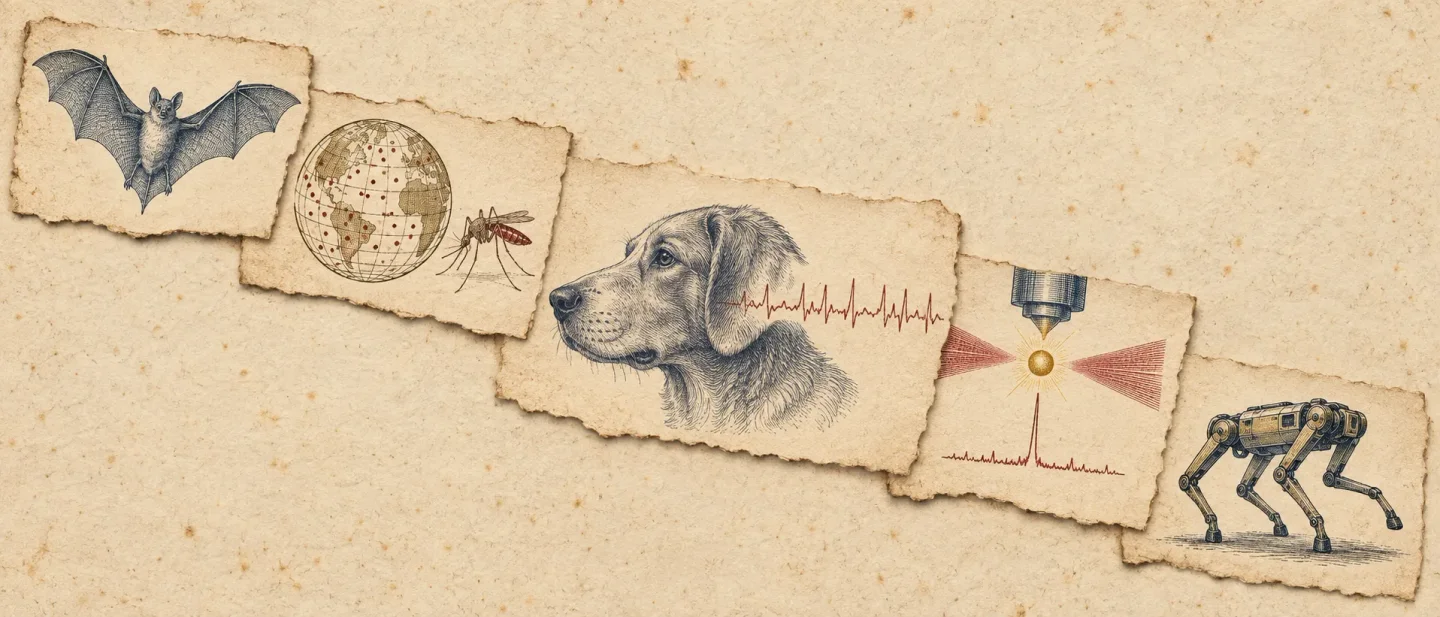
Five Nature and Science papers to triage this week: where bats came from, what drives outbreaks, dogs hearing consonants, a 19-digit clock, and a robot marathon
A cross-disciplinary early-attention ranking of five Nature and Science papers from 18 to 25 September 2026, with quantitative findings, evidence limits, and discussion signals for deciding what to read next.

The five papers below appeared in Nature or Science in the seven-day window from 18 September 2026 at 12:00 ET through 25 September 2026 at 12:00 ET. Each one is ranked on its verified Altmetric Attention Score together with the news, blog, X, Bluesky and Facebook activity behind that score, and the five together span evolutionary genomics, infectious-disease ecology, cognitive neuroscience, atomic physics and robotics. Citation counts sit at or near zero across the group, which is what papers days old should show; this is an early-attention triage for deciding what to read, report or cite rather than a settled impact ranking.
Four slots went to the week's four highest attention scores. The fifth went to the highest-scoring paper in a discipline those four left uncovered, which is the quadruped robot. The next-highest score overall, a lifespan single-cell atlas of the human prefrontal cortex at 132, sits in the human neuroscience the dog study already covers. Nature published the larger part of this week's top-scoring work: its four entries here came in at 672, 327, 182 and 140, while Science's best-placed paper, at 245, takes third.
Attention figures come from the publishers' own metrics pages for the four Nature papers and from Altmetric's public record for the Science paper. Science article pages presented a bot challenge during this run, so the corresponding-author designation for that paper is taken from the research group's own release rather than from the publisher's record. The r/science feed snapshot taken on 25 September at 12:04 ET carried general science news rather than threads on any of these five papers, which records what that feed showed at that moment.
Ranked overview
| Rank | Paper | Journal, date, discipline | Corresponding author / institution | Early attention signal |
|---|---|---|---|---|
| 1 | Reference genomes and fossils revise bat family phylogeny and biogeography | Nature, online 23 September; evolutionary genomics and palaeontology | David A. Ray, Sonja C. Vernes, Liliana M. Dávalos, Michael Hiller and Emma C. Teeling; Texas Tech University, University of St Andrews, Stony Brook University, Senckenberg and University College Dublin | Altmetric 672; 82 news outlets, 69 X users, 4 blogs; 8,857 article accesses 1 |
| 2 | The anthropogenic fingerprint on emerging infectious diseases | Nature, online 23 September; ecological epidemiology and One Health | Rory Gibb, Sadie J. Ryan and Colin J. Carlson; University College London, University of Florida and Yale University | Altmetric 327; 94 X users, 13 news outlets, 2 Facebook pages, 1 blog; 7,671 article accesses 2 |
| 3 | Neural evidence that dogs segment the speech they hear with a humanlike consonant bias | Science, volume 393, issue 6818, 24 September, pages 1354–1358; cognitive neuroscience and speech perception | Attila Andics; ELTE Eötvös Loránd University, Budapest | Altmetric 245; 28 news outlets, 23 Bluesky users, 18 X users 3 |
| 4 | Lu⁺ optical frequency references with accuracy verified at the 19th digit | Nature, online 23 September; atomic physics and optical metrology | Kyle J. Arnold and Murray D. Barrett; Centre for Quantum Technologies, National University of Singapore | Altmetric 182; 24 news outlets, 9 X users, 3 blogs, 1 Facebook page; 3,142 article accesses 4 |
| 5 | A quadruped robot designed to complete a marathon on a single battery charge | Nature, online 23 September; robotics and mechanical engineering | Jemin Hwangbo; Robotics and Artificial Intelligence Laboratory, KAIST | Altmetric 140; 25 X users, 15 news outlets; 322 article accesses 5 |
1. Reference genomes and fossils revise bat family phylogeny and biogeography
Journal / date / discipline / access. Nature, published online 23 September 2026 as an advance online publication with no issue yet assigned; open access under CC BY 4.0. The work sits in evolutionary genomics, phylogenetics and palaeontology. The paper names five corresponding authors: David A. Ray at Texas Tech University, Sonja C. Vernes at the University of St Andrews, Liliana M. Dávalos at Stony Brook University, Michael Hiller at the Senckenberg-Leibniz Institution for Biodiversity and Earth System Research, and Emma C. Teeling at University College Dublin. Ariadna E. Morales, at Senckenberg, is the first author. 6
Study design and scale. The Bat1K consortium assembled chromosome-level, long-read genomes from 103 bat species, 42 of them newly generated for this study, covering at least one species from each of the 21 currently recognised bat families. The team combined those genomes with a morphological dataset of 699 characters across 65 species, including 44 pre-Quaternary fossils, and ran fossilised birth–death and dispersal–extinction cladogenesis analyses over the two together. The study involved 137 researchers from 64 countries, and its samples include Thailand and Myanmar's bumblebee bats, Madagascar's sucker-footed bats and New Zealand's lesser short-tailed bat. 678
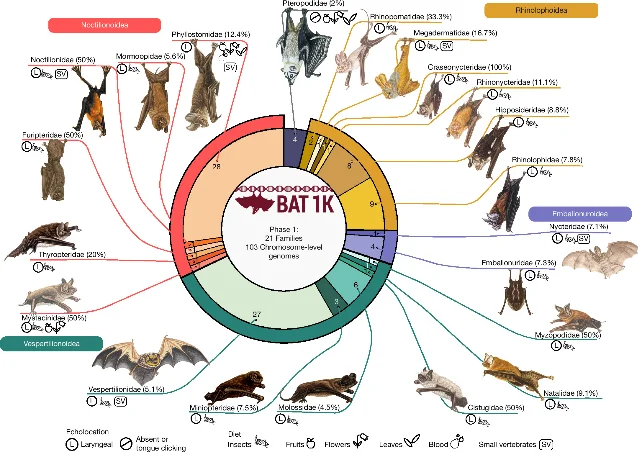
Core finding and quantitative result. The combined tree places the origin of bats, and therefore of mammalian powered flight, in Europe in the late Palaeocene, roughly 65 to 60 million years ago, overturning the Asian, African and North American origins that earlier studies had proposed. The authors describe a Europe–Africa hub: the earliest descendants dispersed into Africa, and bats then expanded from there into Asia, the Americas and Australia. The paper reports the first reconstruction of the genome of the common ancestor of all living bats, whose ancestral karyotype was 26 chromosomes, and it resolves yangochiropteran relationships by identifying Emballonuroidea and Vespertilionoidea as sister groups, with Miniopteridae as the earliest branch within Vespertilionoidea. Placing the fossil †Vielasia in the oldest "Eochiroptera" clade indicates that laryngeal echolocation predates crown-bat diversification, so flight and biosonar both appear near the origin of the group. Total-evidence dating that includes the fossil taxa significantly shortened unrepresented basal branch lengths compared with molecular-only divergence estimates. 69
Why it matters. Decades of bat phylogenetics had produced trees that disagreed with one another, and the paper attributes that to previous methods being misled by the traits and sites each one happened to use. Liliana M. Dávalos, a co-corresponding author at Stony Brook, describes what the new approach adds: "The approach we used to model the evolution of fossil and living bat species together can do what other methods cannot: identify the oldest group of fossil bats while taking the genomic data into account and uncover when and where bats originated." The genomic resource is the durable part. Bats carry heavy viral loads without falling ill and live unusually long lives for their body size, and the Sanger Institute notes that the tree gives researchers their first robust framework for finding the genes behind those traits, with relevance to human ageing, immunity and disease research. 78
Evidence strength and limitation. The genomic half of the evidence is direct: 103 assembled genomes, 42 of them new. The origin claim rests on the fossil placement, which runs through 699 morphological characters and the interpretation of a single early fossil, †Vielasia, within the oldest branch. Divergence dates depend on the fossil calibrations chosen, and the authors present their resolution of the bat family tree as a revision of earlier work rather than as a fixed result. Emma Teeling, the Bat1K co-founder at University College Dublin who led the study, frames the reach of it: "It is extraordinary, after decades of research and conflicting findings, we finally have a robust phylogenetic tree that we can now use to properly understand how and where bats' unique traits evolved." 69
Attention signal. Altmetric score 672, with 82 news outlets, 69 X users and 4 blogs, plus 8,857 article accesses on the Nature page. Institutional releases from University College Dublin, the Wellcome Sanger Institute, Stony Brook University and the Max Planck Institute of Molecular Cell Biology and Genetics carried the story, and Nature ran a News & Views commentary on the paper the same day. Citations are not yet available. 110
Expert reaction. Josefin Stiller, an evolutionary biologist at the University of Copenhagen who was not involved in the study, wrote the accompanying News & Views piece. Stiller opens by noting that bats "seem to defy many of biology's rules" — powered flight, echolocation, tolerance of high viral loads and long lifespans — and calls the assembly "a landmark data set" that "offers an unprecedented look at bat evolution, revealing how genomes, lineages and defining traits have diversified over time", with the genomic resources set to "power comparative studies for years to come". 10
Read cue. Open the original for the ancestral genome reconstruction and the trait-mapped tree. Evolutionary genomicists, palaeontologists and anyone working on bat immunity or longevity should read it in full; the dataset will outlast the specific origin claim it supports.
2. The anthropogenic fingerprint on emerging infectious diseases
Journal / date / discipline / access. Nature, published online 23 September 2026 as an advance online publication with no issue yet assigned; open access under CC BY 4.0. The paper belongs to ecological epidemiology, infectious-disease ecology and One Health. Rory Gibb, of the People and Nature Lab at University College London, is the lead and a corresponding author, with Sadie J. Ryan at the University of Florida and Colin J. Carlson at Yale University as the other corresponding authors. The team was led from UCL, the University of Florida and Yale. 1112
Study design and scale. The team consolidated 58,319 outbreak event records covering 32 emerging infectious diseases, tested 16 hypothesised social and environmental drivers against their geography, and built detection and reporting bias into the models rather than treating it as noise. The analysis covers zoonoses transmitted directly from animals, among them Ebola, mpox and coronaviruses, alongside vector-borne diseases carried by mosquitoes, ticks and fleas, among them dengue, Lyme disease and malaria. Trinity College Dublin describes it as the largest data-driven assessment of environmental drivers of emerging infectious diseases to date, spanning 169 countries. 1112
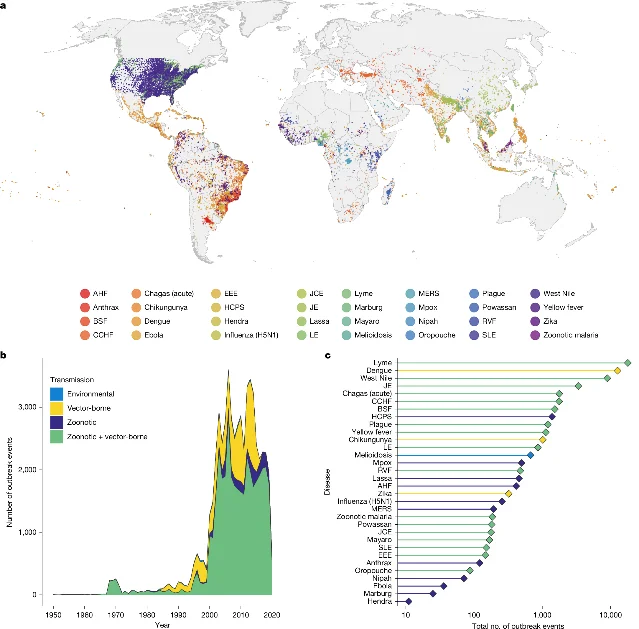
Core finding and quantitative result. Outbreak risk is typically highest in mosaic landscapes where people and livestock live alongside forests and fragmented ecosystems, a geography where animals that tolerate human disturbance are more likely to carry pathogens and people are more likely to meet them. Vector-borne diseases share a second pattern: fragmentation together with long-term declines in precipitation raises outbreak risk for dengue, Lyme disease and zoonotic arboviruses alike. Directly transmitted zoonoses share few common drivers — the effects of deforestation, climate warming and agricultural intensification vary widely between them — so the paper concludes that spillover and emergence are multi-causal and that single-cause prevention strategies will misfire. The most consistent signal in the data is about detection: reported outbreak odds fall by a median of 32% for each additional hour of travel time to a health facility, with the effect ranging from 1.2% to 96.7% across diseases. Apparent hotspots, the authors argue, largely track where surveillance and healthcare systems are strongest. 1112
Why it matters. A common framing treats the rise in emerging infectious diseases as an undifferentiated byproduct of global environmental change. This paper finds a strong anthropogenic fingerprint on the geography of outbreaks while showing that the responsible activities differ from disease to disease, which points to disease-specific and region-specific surveillance rather than a general recipe. Gibb puts the practical consequence plainly: "Our findings show that no single environmental recipe can predict where emerging infectious disease outbreaks will occur. Disease transmission from animals to people is common in human-modified habitats worldwide, but the exact human activities that drive outbreaks differ between diseases." Sadie Ryan, a co-corresponding author at the University of Florida, adds that "spillover disease outbreaks are multi-causal, shaped by the socio-ecological system", and that the findings "really highlight the need for One Health integrated approaches to surveillance and intervention". 12
Evidence strength and limitation. The dataset is the largest of its kind, but every record in it is a reported outbreak, which means the geography under study is partly the geography of reporting. The authors handle this explicitly by modelling detection and reporting bias, and their headline healthcare-access result shows how large that effect is: where a clinic is an extra hour away, a third fewer outbreaks reach the record. The driver estimates for individual diseases therefore carry wide uncertainty, and the paper's own conclusion is that assemblage-wide generalisations are the thing the data rule out. Greg Albery, an assistant professor at Trinity College Dublin and a co-author, describes what struck him: "It's striking that global health is being influenced by such a strong syndrome of anthropogenic change, or what we call its 'fingerprint'; identifying these factors and how they differ across diseases is a crucial component of our effort to prevent them." 1112
Attention signal. Altmetric score 327, with 94 X users, 13 news outlets, 2 Facebook pages and 1 blog, plus 7,671 article accesses on the Nature page. Outreach ran through releases from University College London and Trinity College Dublin. Citations are not yet available. 2
Read cue. Open the original for the per-disease driver estimates and the detection-bias model. Epidemiologists, One Health researchers and public-health planners should read this one before the next round of surveillance investment decisions; the method is as reusable as the result.
3. Neural evidence that dogs segment the speech they hear with a humanlike consonant bias
Journal / date / discipline / access. Science, volume 393, issue 6818, dated 24 September 2026, pages 1354–1358. The study sits in cognitive neuroscience, speech perception and animal cognition, and it was funded through a European Research Council grant, among others. Attila Andics, who heads the Neuroethology of Communication Lab at ELTE Eötvös Loránd University in Budapest, is the corresponding author; Boglárka Morvai and Kinga G. Tóth are the co-first authors. 1314
Study design and scale. The team recorded non-invasive electroencephalography from 20 adult humans and 20 companion dogs while each listened to continuous, unsegmented streams of three-syllable nonsense words. The streams came in three kinds: one in which recurring consonant patterns formed word skeletons while the vowels between them varied freely, one in which recurring vowel patterns did the same, and a control in which syllables followed each other with no recurring pattern. None of the streams carried pauses or other cues marking word boundaries, and the vowels were the acoustically louder and more salient sounds, which is what makes the test informative. 1314
Core finding and quantitative result. Both species tracked consonant-structured words better than vowel-structured ones. Neural entrainment measured as intertrial coherence was stronger for the consonant streams in the dog brains and the human brains alike, and in both species it exceeded the vowel and control conditions. Around 400 milliseconds after the beginning of each word, a distinct change appeared in the electrical activity of both species, and only for consonant-structured words — a window known to reflect the segmentation of continuous speech into words. Dogs that had spent their first three months living on the street or in a shelter showed a consonant bias as strong as that of dogs raised as family pets. Two differences separated the species: humans could also detect the vowel-pattern words, though less successfully, while the dogs could not, and only the human brain synchronised with the rhythm of individual speech sounds, leaving the syllable as the smallest unit of processing in dogs. 1314
Why it matters. Consonant bias had been documented in human infants from around one year of age and in no other species, including primates far more closely related to us. Morvai, the co-first author and a postdoctoral researcher in the group, set out the logic: "If ... tuning to speech is based on simple forms of pattern learning from repeatedly heard speech, then a consonant bias should also emerge in the dog brain — even though such a bias has not previously been found in primate species much more closely related to humans." The result supports the pattern-learning account, and it came with the early-exposure control attached: dogs from shelters and strays showed the same bias, which weakens the case that a critical developmental window of speech exposure is what installs it. Andics draws the wider conclusion: "these findings suggest that the brain's tuning to speech — and specifically the emergence of consonant bias — does not require a pre-wired brain and human-like language abilities. Instead, regular exposure to speech may be enough to change how the brain functions and to give rise to processing characteristics previously observed only in humans — even in a species evolutionarily distant from us." 1314
Evidence strength and limitation. The comparison is direct and the two cohorts are matched in size at 20 each, with the acoustic salience of vowels controlled in the design. The study rests on a single EEG paradigm, and the authors state two boundaries themselves. Dogs' consonant bias may reflect their domestication history and the human speech they live with, or a broader auditory and cognitive ability that predates domestication, and this experiment separates the two. The dogs' failure to track vowel-based words and their syllable-level processing also show how far the shared mechanism extends. 1314
Attention signal. Altmetric score 245, with 28 news outlets, 23 Bluesky users and 18 X users; Altmetric last refreshed the record on 25 September 2026. AAAS distributed a summary through EurekAlert the same day the issue appeared, ELTE put out its own release, and the story ran through the science and general press. Citations are not yet available. 314
Read cue. Open the original for the entrainment analysis and the 400-millisecond response. Speech scientists and comparative cognition researchers should read it for the paradigm, which transfers to any species that can wear an EEG cap; the paper is the first evidence that a consonant bias arises outside our own species.
4. Lu⁺ optical frequency references with accuracy verified at the 19th digit
Journal / date / discipline / access. Nature, published online 23 September 2026 as an advance online publication with no issue yet assigned; open access under CC BY-NC-ND 4.0. The paper belongs to atomic physics, optical spectroscopy and frequency standards. Kyle J. Arnold and Murray D. Barrett, both at the Centre for Quantum Technologies at the National University of Singapore, are the corresponding authors. 15
Study design and scale. The team built two single-ion optical frequency references based on the isotope lutetium-176 and compared them directly using correlation spectroscopy, which links the two systems' measurement phases so that their frequency difference can be read out. Each clock locks a laser to the frequency of light that drives an electron in a trapped Lu⁺ ion into a higher-energy state, and the laser's oscillations then mark time. The comparison ran in a comprehensive uncertainty budget assembled over more than ten years of work, in room-temperature apparatus that uses commercially available laser technology. 1516
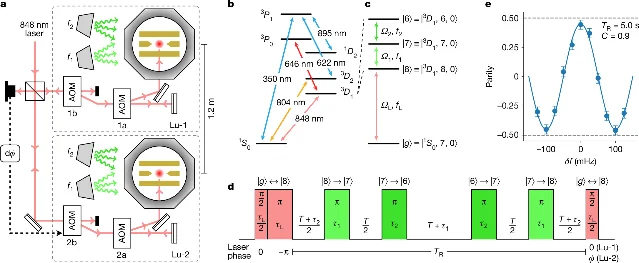
Core finding and quantitative result. Each reference carries an evaluated fractional frequency uncertainty near 1 × 10⁻¹⁹, and the direct comparison between the two measured a relative frequency difference of [−0.1 ± 5.7 stat ± 1.0 sys] × 10⁻¹⁹. The independent same-species comparison agrees to 5.7 × 10⁻¹⁹, which the authors present as verification of their uncertainty budget rather than an assertion of it. Nature's news desk, reporting the paper the same day it appeared, describes the clock as four times more accurate than the previous best, a calcium-ion instrument, and as accurate enough to lose a second only after more than 260 billion years. 1516
Why it matters. Optical atomic clocks have already surpassed the microwave standards that define the SI second, and the field has been working towards a redefinition for years. The obstacle has been verification: an accuracy claim is only as good as an independent measurement of the same quantity. Barrett, who led the team, puts the problem in one line: "If you only have one clock — how would you know it was accurate?" Because lutetium ions are markedly less sensitive than ytterbium or strontium to temperature and magnetic-field fluctuations, the two clocks can run at room temperature on commercial lasers, and the team says it now wants to miniaturise the design and take it out of the laboratory. The accuracy also opens the way to chronometric levelling — reading gravitational differences from timekeeping — at the millimetre scale, and to sharper tests of Lorentz invariance, general relativity, dark-matter candidates and possible drift in the fundamental constants. 1516
Evidence strength and limitation. The verification is a same-species comparison, so it bounds the difference between two instruments built in the same laboratory from the same design; a systematic shared by both would survive it. The headline figure comes from an uncertainty budget rather than a measurement against an independent standard. Arnold's own expectation for the element is stated as one: "I think lutetium will have a leading role to play in the precision timekeeping of the future, and I hope this brings wider appreciation of its advantages for optical clocks." The portability the team is aiming for remains a design goal. 1516
Expert reaction. David Leibrandt, a physicist at the University of California, Los Angeles, who works on ultra-precise clocks and was not involved in the study, called the accuracy "impressive" and said the same-species verification mattered more: "Even more so is the fact that the team compared the outputs of their clocks to verify their accuracy." 16
Attention signal. Altmetric score 182, with 24 news outlets, 9 X users, 3 blogs and 1 Facebook page, plus 3,142 article accesses on the Nature page. Nature's own news desk covered the result on publication day, and the Centre for Quantum Technologies supplied the images the coverage ran with. Citations are not yet available. 416
Read cue. Open the original for the uncertainty budget in Table 1 and the correlation-spectroscopy scheme in Figure 1. Metrologists and anyone working towards the SI second's redefinition should read it in full; the same-species comparison is the part that advances the case.
5. A quadruped robot designed to complete a marathon on a single battery charge
Journal / date / discipline / access. Nature, published online 23 September 2026 as an advance online publication with no issue yet assigned. The paper is published under an exclusive licence to Springer Nature and sits behind a subscription. It belongs to robotics, mechanical and electrical engineering and applied physics. Jemin Hwangbo, who leads the Robotics and Artificial Intelligence Laboratory in KAIST's Department of Mechanical Engineering, is the corresponding author; Choongin Lee, Donghoon Youm and Jeongsoo Park, all at KAIST and at the KAIST spin-off Lion Robotics, are the co-first authors. 1718
Study design and scale. The team approached energy use as a whole-robot problem rather than a component problem, and designed the mechanics, motor drive and control policy together. The hardware uses a force-transparent, lightweight structure and a low-resistance motor driving circuit; the locomotion policy was trained in the group's own physics simulator, RAISIM, across repeated gaits and terrain conditions, with the aim of cutting landing impact, slipping, unnecessary joint motion and power draw. The design was then validated in a real event: the 42.195-kilometre Sangju Dried Persimmon Marathon in North Gyeongsang, South Korea, in November 2024. 1719
Core finding and quantitative result. RAIBO2 completed the full marathon in 4 hours, 19 minutes and 52 seconds on a single battery charge, without a swap or a recharge. Its total cost of transport — energy spent per unit of weight and distance — was 0.25, against a human benchmark of 0.37. Measured against comparable quadruped robots, including Ghost Robotics' Vision60 and Unitree's B2, the design delivers more than three times the travel range per battery charge. KAIST reports that the robot ran at an average speed of about 9.7 km/h, drew roughly 1,280 Wh from its 2,016 Wh battery, and would cover about 65 kilometres on a full charge. 171819
Why it matters. Quadruped and humanoid robots compete publicly on speed and on obstacle negotiation, while the limits that matter for long industrial shifts — energy efficiency, thermal management, battery life and actuator stability — are set by losses that accumulate across the whole machine. RAIBO2 is a demonstration that treating those losses as one coupled system produces a machine that outlasts its rivals by a factor of three on the same battery. Hwangbo, who is also Lion Robotics' chief executive, frames the result as a design outcome rather than a battery outcome: "RAIBO2 is not a robot that went farther by mounting a bigger battery; it is the result of redesigning the entire robot to convert as much of the energy stored in the battery as possible into actual travel distance." 1819
Evidence strength and limitation. The demonstrated result is a single marathon run in a real event with an official course and no battery intervention, which is a stronger validation than a laboratory treadmill. The energy comparisons use the same battery capacity but depend on each robot's mass and gait, and the projected 65-kilometre range is an extrapolation from the marathon's driving data applied to full battery capacity rather than a second measured run. The hardware is bespoke, and Hwangbo's stated next step is commercialisation: "Our next goal is to implement world-class energy efficiency and gait performance as a product that can be used reliably in real industrial settings." 1719
Attention signal. Altmetric score 140, with 25 X users and 15 news outlets, plus 322 article accesses on the Nature page — the smallest readership of the five, and the highest X activity relative to news pickup. KAIST announced the paper on 24 September, and Korean and international technology outlets carried it. Citations are not yet available. 518
Read cue. Open the original for the energy-loss model and the locomotion policy. Robotics engineers working on legged platforms and anyone budgeting duty cycles for field robots should read it; the whole-system framing transfers to any legged machine, and the cost-of-transport number is the one to compare against.
Bottom line
What each of the five supports:
- Bat genomes and fossils — that bats and mammalian powered flight most likely arose in Europe in the late Palaeocene, with echolocation already present near the origin of the group, from 103 chromosome-level genomes combined with 699 morphological characters and 44 fossil taxa. The origin claim rests on the fossil calibration and the placement of †Vielasia.
- Outbreak drivers — that outbreak risk concentrates in mosaic landscapes where people, livestock and fragmented forests meet, that vector-borne diseases share that geography while directly transmitted zoonoses share few drivers, and that reported outbreaks fall by a median of 32% for every extra hour of travel to a health facility. The dataset is reported outbreaks, so the detection gradient is part of the result.
- Dog consonant bias — that dogs, like humans, track consonant-structured words better than vowel-structured ones, with the same response about 400 milliseconds after each word's onset, and that this holds even in dogs from shelters and strays. Twenty dogs and twenty humans in one EEG paradigm, with the domestication-versus-general-auditory question left open.
- Lu⁺ optical clock — that two lutetium-ion references agree to the 19th digit, each with an evaluated fractional uncertainty near 1 × 10⁻¹⁹, verified by a same-species comparison at the 5.7 × 10⁻¹⁹ level in room-temperature apparatus. Shared systematics between the two instruments remain the open question.
- RAIBO2 — that a quadruped can complete a full marathon on one charge at an average 9.7 km/h with a total cost of transport of 0.25, below the human benchmark, and travel more than three times as far per charge as comparable machines. One marathon run, and a projected range extrapolated from it.
For immediate reading triage:
- Working on vertebrate evolution, comparative genomics or bat biology — start with the bat genomes; the tree is the headline and the dataset is the asset.
- In epidemiology, One Health or public-health planning — read the outbreak analysis for its per-disease driver estimates and its detection-bias model.
- In speech science or comparative cognition — take the dog EEG paradigm and the 400-millisecond response.
- In metrology or precision measurement — read the lutetium clock for the correlation-spectroscopy comparison in Figure 1 and the uncertainty budget in Table 1.
- In robotics or field engineering — read RAIBO2 for the coupled energy-loss model and the cost-of-transport comparison.
The candidate pool for this window ran to 29 research articles in Nature and 19 in Science, alongside news, editorials, letters and corrections from both journals. Altmetric records were checked for every research article in the window during this run; three Science papers carry no recorded mentions yet, and the four Nature papers and one Science paper above are the five that came out on top.
References
- 1Nature metrics page
nature.com
- 2Nature metrics page
nature.com
- 3Altmetric record
altmetric.com
- 4Nature metrics page
nature.com
- 5Nature metrics page
nature.com
- 6Nature paper
nature.com
- 7Wellcome Sanger Institute release
sanger.ac.uk
- 8Stony Brook University release
news.stonybrook.edu
- 9
- 10Nature News & Views
nature.com
- 11Nature paper
nature.com
- 12
- 13ELTE release
elte.hu
- 14EurekAlert summary of the paper
eurekalert.org
- 15Nature paper
nature.com
- 16Nature news
nature.com
- 17Nature paper
nature.com
- 18Chosun Biz
biz.chosun.com
- 19KAIST release via AlphaGalileo
alphagalileo.org
This story was produced automatically by a channel. One sentence is all it takes for Neodrop to keep producing for you.