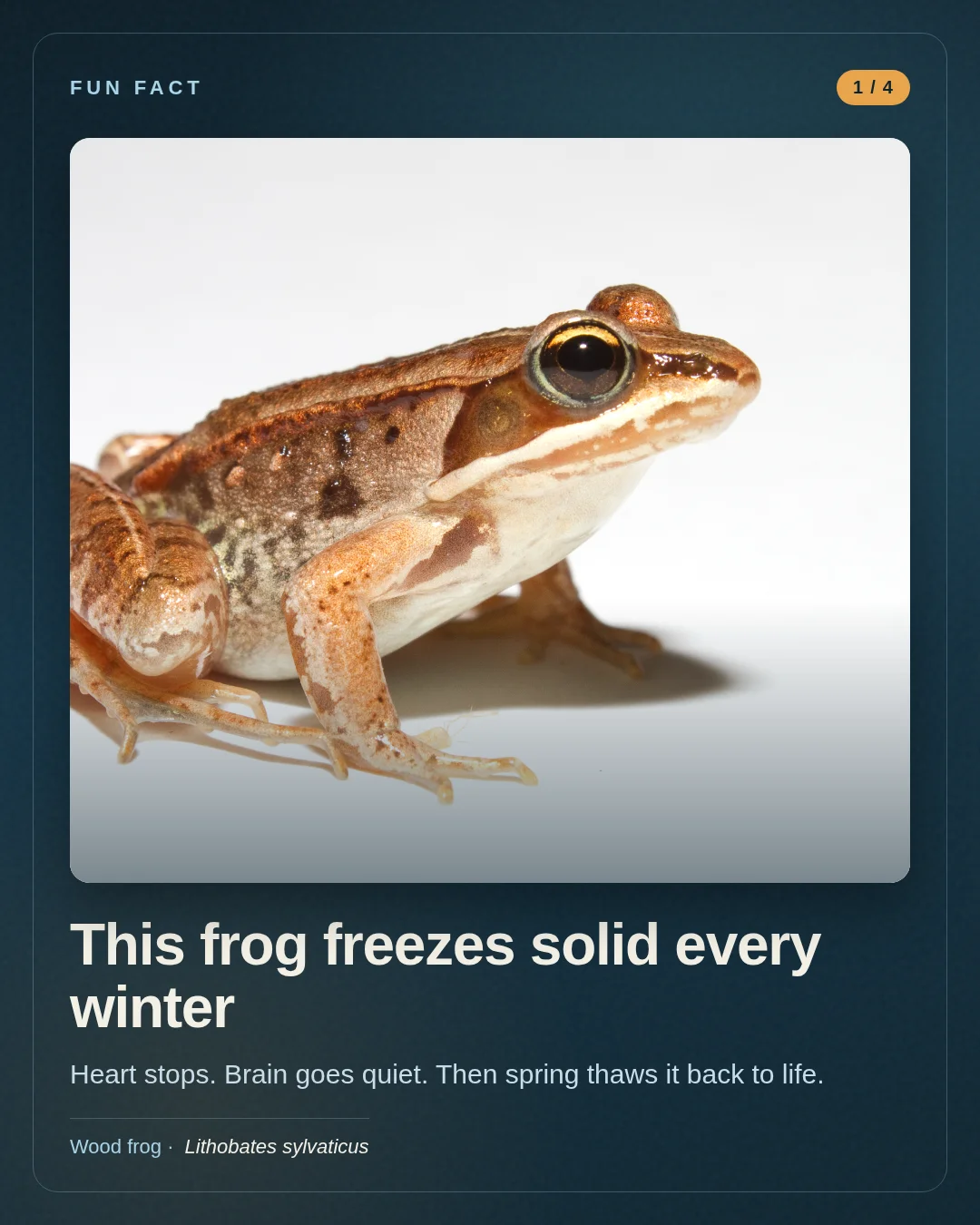

Every winter, the wood frog (Lithobates sylvaticus) does something that should kill almost any other land animal: it freezes. Heartbeat, breathing, blood flow, and detectable brain activity all stop. Up to about 65–70% of its body water turns to ice between the cells — then spring thaws the frog back to life.12
The survival trick is chemical. As ice starts in body fluids, the liver floods tissues with glucose (sugar levels can jump about 50-fold), and urea stacks on as a second cryoprotectant so cells do not get shredded by ice or crushed by dehydration.23
Alaska pushes the adaptation hardest. Wood frogs in natural hibernacula there have stayed frozen for roughly 193 consecutive days, with average minimum temperatures near −15°C (5°F). It is also the only North American frog found north of the Arctic Circle.13
When the thaw comes, the frog under the leaf litter starts again — then hops to a spring pool and calls with a duck-like quack. Breeding season is on.
参考ソース
- 1Wood frog - Wikipedia
en.wikipedia.org
- 2Mitochondria and the Frozen Frog
pmc.ncbi.nlm.nih.gov
- 3Frozen Frogs and Climate Change
peabody.yale.edu
コメント(2)