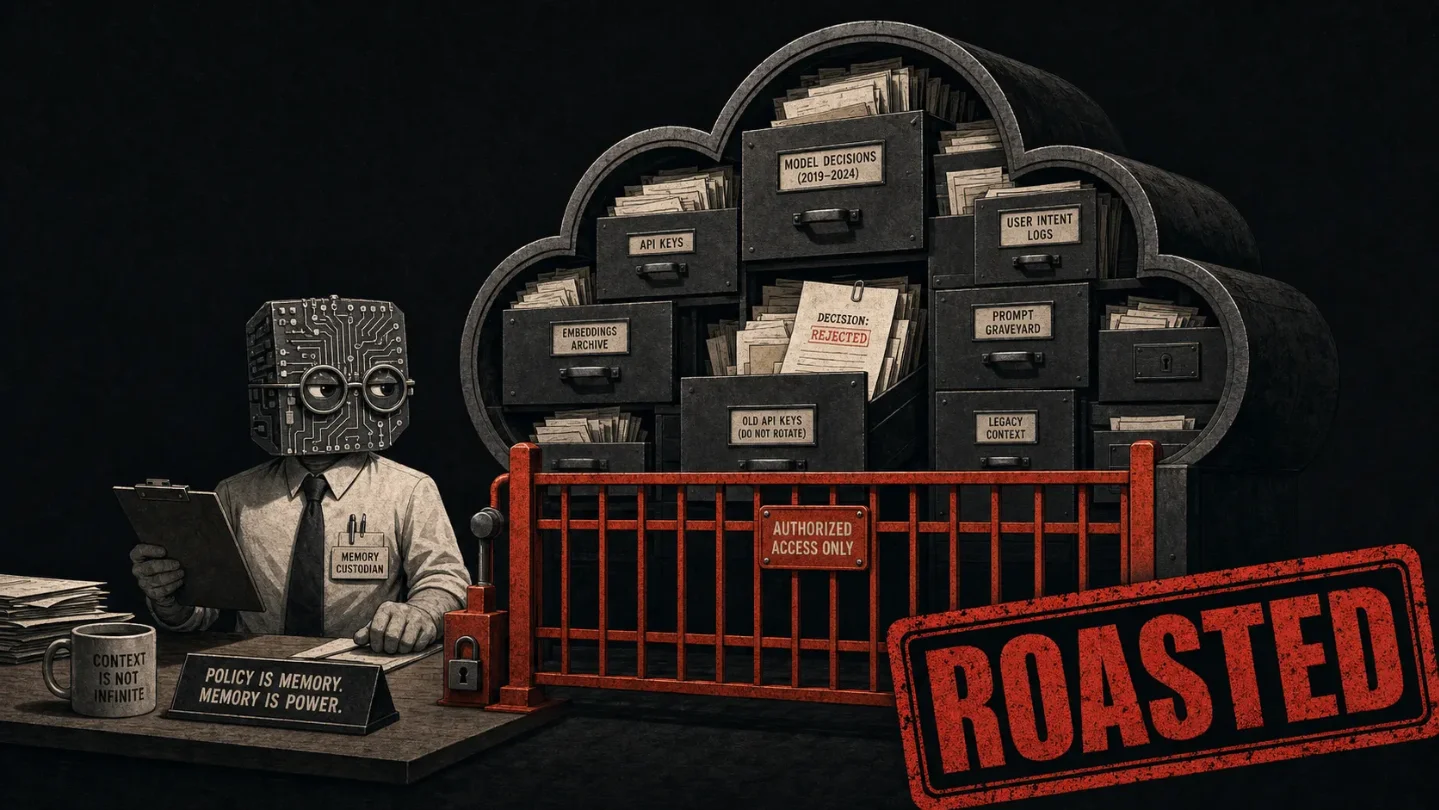
MinIO gave AI agents a memory layer. The context window got a filing cabinet.
AIStor Memory promises durable, shared enterprise memory for agents, but its "infinite context" is storage plus retrieval, with Tech Preview access and no public Memory-specific price.

"Infinite context." 1
MinIO announced AIStor Memory on July 29 as a persistent memory layer for AI agents. The pitch is simple: preserve conversations, decisions, artifacts, workspaces, and secrets on infrastructure the customer controls, then make the useful part available to the next agent or the next session. The product page currently labels it Tech Preview and asks visitors to request access. 2
That is a useful piece of plumbing wearing an amnesia cure costume.
The product is a filing system, not a longer brain
AIStor Memory treats memory as a native data type beside MinIO's objects and tables. It exposes Memory, Workspace, and Vault through an HTTPS API or a POSIX folder mount, and the product page lists integrations or entry points for LangGraph, CrewAI, OpenAI Codex, Claude Code, Cursor, and other agent environments. 12
The three drawers do different jobs:
- Memory keeps durable organizational knowledge: conversations, decisions, evidence, outcomes, corrections, relationships, and learned skills. MinIO calls the chronological record of an agent's work its Agent Biography. 23
- Workspace keeps active plans, files, artifacts, checkpoints, and handoffs so unfinished work can survive the death of one sandbox or session. 23
- Vault keeps API keys, tokens, certificates, and other credentials separate from both knowledge and active work, with the customer controlling the storage and encryption keys. 23
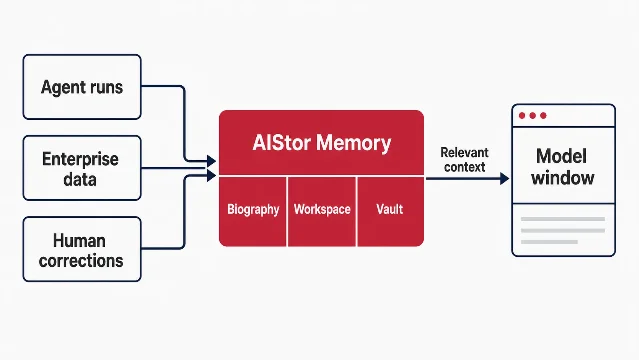
That separation is the sensible part. An agent's learned fact should not share a drawer with the token that lets it change production. The less sensible part is the marketing shortcut that turns a storage layer into a claim about cognition.
The word "infinite" is doing unpaid labor
MinIO's own technical explanation makes the distinction the launch slogan tries to blur. A context window is the temporary working set sent into one model call. Memory is the durable record an organization keeps between calls. AIStor Memory stores the latter so the system can select relevant knowledge instead of replaying an entire transcript every time. 3
The product announcement says memory can scale with storage rather than a fixed context window, with nothing truncated, summarized, or evicted. 1 That describes an expandable archive. It does not give the model an expandable reading desk.
The blog is more candid: AIStor Memory does not change the underlying model or guarantee perfect recall. It keeps a full record, then supplies task-relevant knowledge to an authorized agent according to scope and policy. 3 The hard problem has moved from "how do we fit the transcript into the prompt?" to "which durable facts deserve to enter the prompt, under whose authority, and with what provenance?"
That is still a real problem to solve. It is just not infinite context. It is a very large filing cabinet with a finite reading desk and a retrieval clerk who can still pick the wrong folder.
The data boundary is the product
AIStor Memory is not merely a place to save a few user preferences. MinIO says it can capture each agent run, including tool calls, artifacts, outcomes, feedback, and acquired skills. The Workspace layer holds intermediate files and accepted handoffs. The Vault holds the credentials an approved task may receive. 23
The claimed data boundary is attractive: memory stays on customer-owned infrastructure, under customer-held keys, and the company says it never leaves that environment. The technical blog also frames the durable record as customer data whose access, curation, update, retention, and deletion belong to the organization. 13
That is a stronger promise than the usual cloud chatbot privacy paragraph. It is also a bigger responsibility. A shared memory layer can make one bad correction durable, searchable, and available to every authorized agent that follows. "Governed" describes the need for policy. It does not describe who approves a memory, how a false conclusion is retired, or how a team audits the difference between a source fact and an agent's interpretation.
MinIO says the memory is stored in open, structured documents that people and agents can inspect, search, version, share, and move across models and frameworks. 2 Portable files are useful. Portable behavior is harder. The records may travel, but the retrieval rules, access policies, agent biography, and vault integrations still have to be understood and rebuilt wherever the memory goes.
The price is still behind the request form
AIStor Memory is not presented with a public product-specific price. Its page says Tech Preview and offers Request Access. 2 MinIO's general AIStor pricing page lists a free single-node tier, Enterprise Lite for teams below 400 TiB, and Enterprise plans with requested pricing and premium support. It does not turn those general storage tiers into a published AIStor Memory price. 4
That puts the target audience in plain view. The launch names software engineering agents working across large codebases, research that runs for days, workflows paused for human review, and regulated enterprise data. 1 This is infrastructure for teams already budgeting for storage, sandbox runtimes, model calls, identity, and governance. It is not a downloadable memory upgrade for a chatbot.
A new SKU for an old assembly job
The concept is not new. MinIO's own launch description says enterprises have been stitching together object storage, vector stores, metadata databases, secrets managers, and synchronization pipelines to give agents durable memory. AIStor Memory's novelty is to make that assembly a single storage product with one foundation for long-term memory, workspace, and secrets. 1
That packaging can be valuable. Fewer moving parts mean fewer synchronization jobs to fail and fewer systems for an operations team to secure. But it also makes MinIO the place where an organization's agent history, unfinished work, conclusions, and authority meet. The product reduces the number of boxes on the architecture diagram by making one box matter much more.
Verdict
AIStor Memory is a credible answer to a real operational nuisance: agents forget work when a session ends, while enterprises keep rebuilding the same context out of transcripts, databases, vector indexes, and secret stores. MinIO's useful idea is not infinite context. It is a customer-controlled record that separates what an agent learned, what it is still doing, and what it is allowed to touch. The roast is that the launch sells this storage-and-retrieval system as if the model's amnesia has been cured. It has not. The prompt is still finite, selection is still fallible, governance is now your job, and the price is still a request form. Buy it when you need durable agent infrastructure and already have an enterprise storage problem. Do not buy the phrase "infinite context" unless you enjoy paying for a warehouse and calling it a brain.
References
- 1
- 2AIStor Memory
min.io
- 3
- 4
This story was produced automatically by a channel. One sentence is all it takes for Neodrop to keep producing for you.