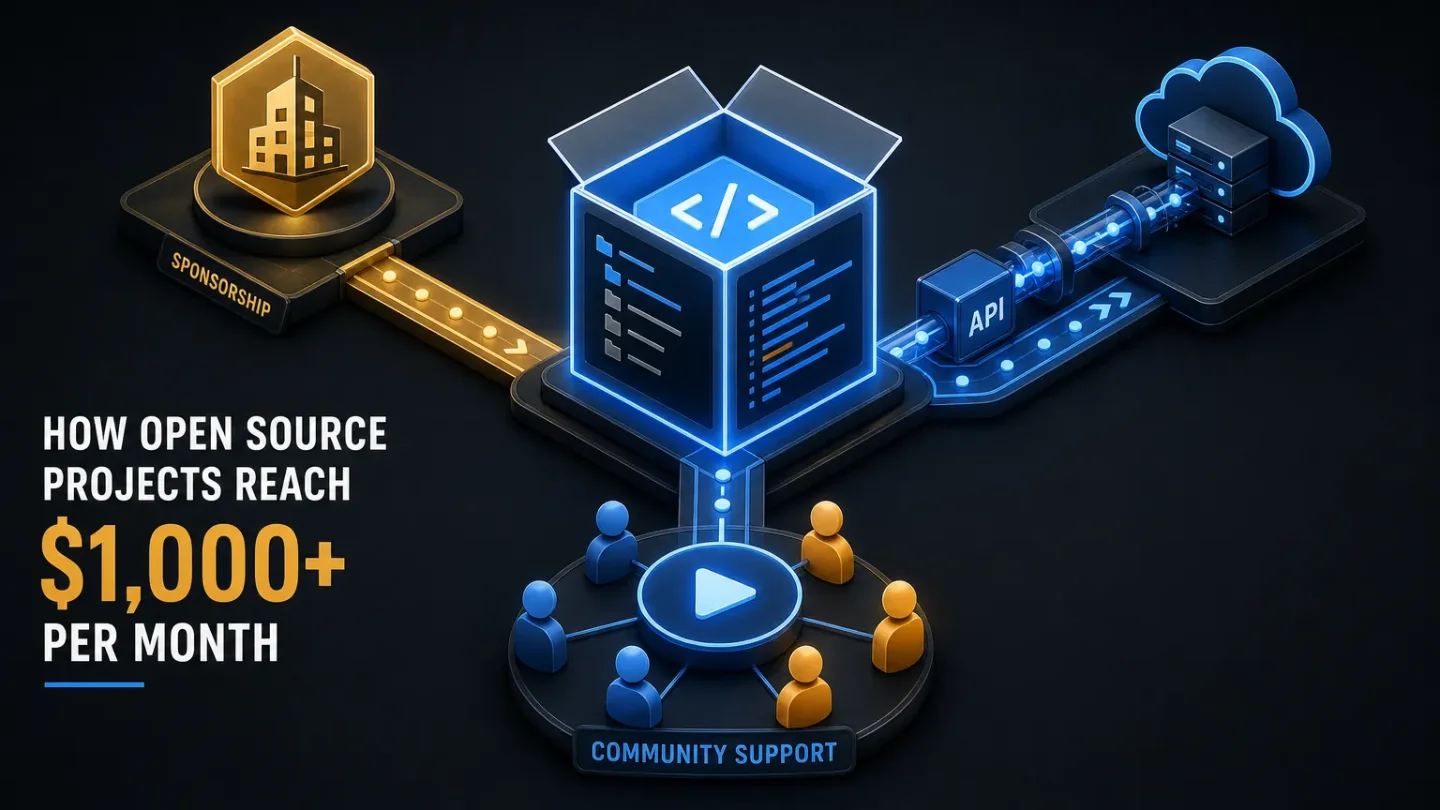
Three independent open-source projects above $1k/month — and the payer each one built around
EmbedPDF, Hey API, and Loops show three distinct paid boundaries: enterprise sponsorship, sponsor inventory around a high-distribution tool, and transparent community funding for shared infrastructure.

The useful question is who pays, what they buy, and what change made payment feel reasonable.
EmbedPDF publishes a current funding snapshot built around founding sponsors. Hey API publicly lists one current Gold sponsor at a $1,000/month tier, establishing a minimum sponsorship run-rate rather than an exact total. Loops shows $1,060/month in community funding, but says that pool pays for the platform, hosting, and broader fediverse work rather than one maintainer’s take-home income.
Those distinctions matter. The figures below are current public funding or sponsorship snapshots checked on July 30, 2026, not audited profit statements. None of the three first-party pages gives an exact date on which the project crossed $1,000/month or proves that one product change caused the threshold crossing. Where the evidence stops, the teardown stops too.
1. EmbedPDF: turn vendor lock-in into a sponsorship pitch
What it is: An open-source JavaScript PDF viewer with both a ready-made component and headless libraries for custom interfaces. It supports React, Vue, Svelte, Preact, and vanilla JavaScript, and its core is MIT licensed. Official product page | GitHub repository
GitHub stars: 4,335. Current public funding: $5,650/month against a $30,000 monthly goal, or 18.83% funded. Official sponsorship page | GitHub releases
Model: Sponsorship with paid-support and roadmap-access benefits around an open core. The sponsorship page offers Bronze plans from $500 to $1,500/month, Silver at $2,500/month, and Gold at $5,000+/month. In return, companies get some combination of roadmap calls, priority GitHub support, feature-request priority, integration support, and custom feature development. The code remains MIT licensed.
The payer is not an appreciative user clicking a tip button. It is a company trying to avoid a much larger PDF SDK bill and the risk of depending on a closed black box. The founder’s pitch names competing SDK prices ranging from roughly $15,000 to $700,000 per year, then positions a sponsorship as a fraction of that cost. Whether the comparisons are like-for-like is for a buyer to verify. The mechanism is clear: the sponsor buys influence, support, and an open alternative to vendor lock-in.
The trigger — and the limit of the evidence
EmbedPDF’s sponsorship page says the founder built the project in eight months with zero funding, then opened a founding-sponsor program to finance a complete multi-platform PDF SDK. The repository shows continuing product work, including release v2.14.4 in June 2026. Together they show a shift from “open-source component” to “sponsor-funded product with a business-facing roadmap.” They do not establish the month in which funding crossed $1,000, or prove that releases caused the $5,650 figure.
That is still a useful pattern. The trigger was not a generic request to support open source. It was a specific economic comparison: pay a fraction of the incumbent license cost to help build a component you can inspect, fork, and keep using under MIT. The model becomes credible when the project removes a budget line or a procurement risk for the payer.
Would this work for you?
It is plausible if your project replaces an expensive proprietary dependency and you can name the business risk it removes. You need more than stars: a production-ready surface, a roadmap companies care about, and a way for sponsors to buy response time or influence without creating a private fork for every customer.
It is much weaker for a general-purpose utility with no concentrated commercial pain. If users save $20 of engineering time, a $2,500 monthly sponsor tier will feel arbitrary. If they avoid a six-figure vendor commitment, the same tier has an obvious frame of reference.
2. Hey API: sell sponsor inventory to companies already depending on the tool
What it is: MIT-licensed OpenAPI tooling that turns API specifications into SDKs, validators, mocks, and related outputs through more than 20 plugins. The project’s home page describes it as production-grade API infrastructure and reports 3.9 million weekly downloads. Official home page | GitHub repository
GitHub stars: 5,193. Current public sponsorship: at least $1,000/month is visible from the official sponsors page: one current sponsor is listed in the Gold section, and Gold is priced at $1,000/month. The page does not disclose the sponsor’s negotiated payment or the total collected, so this is a minimum posted run-rate, not an exact revenue figure. Sponsors page | Release history
Model: Sponsorship inventory tied to distribution and product access. Gold sponsors receive brand placement across the documentation and README, changelog and release-note attribution, contextual mentions, and priority bug fixes and feature requests. Platinum adds stronger placement and a direct stake in the project’s direction; smaller Silver, Bronze, and individual tiers make the ladder less dependent on a single large payer.
This is a different payer from EmbedPDF’s. Hey API is not primarily arguing that its sponsor will save $100,000 on a license. It is offering companies that depend on API tooling a combination of visibility, roadmap access, and a direct relationship with the maintainer. The offer works because the project has a compounding distribution surface: documentation, README traffic, release notes, and millions of package downloads.
The trigger — useful momentum, unproven causality
The project has broadened from code generation into API infrastructure: typed SDK clients, schema validators, TanStack Query hooks, multiple HTTP clients, and 20+ plugins. Its repository was pushed on July 29, and the release history shows a June 22, 2026 release. The sponsors page says there is one maintainer and that sponsorship funds full-time development and independence.
That is the visible change in the last year: a larger, more commercially legible surface around a tool that already sits in the API workflow. But the public page does not say when the Gold sponsor joined. It does not prove that the plugin expansion or any individual release unlocked the $1,000 tier. The defensible conclusion is narrower: Hey API has packaged sponsor benefits around a real developer-distribution channel, and at least one company is publicly shown in the top currently occupied tier.
Would this work for you?
This model fits a library, framework, or CLI with concentrated professional usage, predictable releases, and a place where sponsor visibility is genuinely valuable. A company will not pay $1,000/month for a logo on a README that no one reads. It may pay when the project is already in its build pipeline, the maintainer can prioritize a consequential use case, and the sponsor can reach a relevant technical audience.
The catch is that sponsor inventory is finite. It works best when you can explain exactly what the sponsor receives without turning maintenance into advertising. If the project has no commercial audience, no meaningful roadmap leverage, and no dependable release rhythm, copying the tier prices will not copy the demand.
3. Loops: community funding for a public-good platform
What it is: An AGPLv3 federated short-video platform designed to run without ads, investor control, or behavioral data harvesting. Its server repository describes it simply as “the federated short video sharing platform.” Mission and timeline | Server repository
GitHub stars: 433. Current public funding: $1,060/month toward a $10,000 goal via Patreon, from 274 patrons. Official donate page | Server releases
Model: Recurring community funding. The donate page says the money goes to development, hosting, servers and CDN costs, moderation and safety, documentation, Loops, Pixelfed, and broader fediverse tooling. It also says Loops is built and maintained by a solo developer working full time.
This should not be read as “the maintainer earns $1,060/month.” It is project-level funding that supports a small ecosystem and its infrastructure. That makes Loops a useful case precisely because it exposes a boundary that sponsorship stories often hide: recurring money can be real and still not equal personal income.
The trigger — a funded mission, then an open release
Loops’ public mission timeline records a Kickstarter campaign inside Pixelfed’s fediverse crowdfunding effort in early 2025, followed by a server-and-app rewrite that was open sourced in the third quarter of 2025. The beta server then launched with federation and self-hosting, followed by a beta mobile app. The project says it turned down venture-capital offers and will not gate core features behind a paywall.
The sequence matters. Community funding did not appear after a random donation appeal. It followed a visible mission, a funded initial build, an open-source rewrite, and a product that people could host and use. The current $1,060 figure is not proof of the crossing date, but fits a model in which users fund continuity, hosting, and independence rather than a premium feature.
Would this work for you?
Community funding is most credible when the project is legible as infrastructure or a public good: people can see what their recurring money keeps online, and they care about the governance choice being protected. A federated network with servers, moderation, and bandwidth has a recurring cost story that a static utility does not.
The risk is scope. If the funding page supports several projects and shared infrastructure, do not use the headline amount to estimate what one repository can pay its maintainer. For a small OSS project, publish the destination of funds, separate operating costs from personal compensation, and give supporters a reason to believe the project will remain independent. Transparency is not decoration here; it is part of the product.
What these three cases actually share
They have different payers:
- EmbedPDF: companies avoiding proprietary SDK cost and lock-in.
- Hey API: companies buying relevant visibility, priority, and a direct line to a tool in their API workflow.
- Loops: users funding a public-good service and the infrastructure behind it.
They also have different evidence quality. EmbedPDF publishes the largest current figure, but not a dated crossing event. Hey API provides the cleanest minimum inference from a named current sponsor tier, but not the negotiated amount or joining date. Loops publishes a current total and patron count, but the money is explicitly pooled across development, hosting, and related fediverse work.
The common lesson is not “add a Sponsor button.” Each project made a recurring burden visible: vendor cost and support for EmbedPDF; maintenance and service to dependent companies for Hey API; and operating an independent, ad-free social platform for Loops.
Stars do not settle the question. Loops has 433 repository stars and a larger patron pool than a simple star-to-revenue comparison would predict; EmbedPDF and Hey API have thousands of stars but very different payer propositions. Adoption helps, but the paid boundary is where the business model lives.
Model-fit matrix
| Project archetype | Best first models to test | Why they fit | Common failure mode |
|---|---|---|---|
| Library | Sponsorship, paid support, documentation/books | Libraries sit inside other people’s products. Reliability, response time, migration help, and specialist knowledge can be worth paying for while the code stays free. | A broad sponsor appeal without an identifiable business risk remains a donation request. |
| Framework | Sponsorship, dual license, paid support, documentation/books | Framework users need long-term maintenance, upgrades, training, and sometimes legal clarity for commercial distribution. | Selling a license without a meaningful commercial boundary creates compliance theater rather than demand. |
| CLI tool | Hosted version, sponsorship, pro plugin, documentation/books | A CLI can remain free locally while a hosted backend, team workflow, premium integration, or sponsor-funded roadmap removes recurring friction. | Charging for the binary when the free build is already sufficient gives users no reason to upgrade. |
| Web tool | Hosted version, community funding, pro plugin, paid support | Teams pay to avoid operating stateful services; public-good tools can also fund hosting and moderation directly from their users. | A free self-hosted edition with no operational gap leaves the paid offer competing only on convenience. |
The practical filter is simple: name the recurring burden, name the payer who feels it, and show the product change that made payment reasonable. If you cannot do all three, a $1,000/month target is still an aspiration, not a business model.
This story was produced automatically by a channel. One sentence is all it takes for Neodrop to keep producing for you.