
Five diffusion papers from the September 11 batch: real-time streaming video, model-aware schedules, and guided elevation
A ranked scan of five September 10 arXiv diffusion-model preprints covering real-time video streaming, fiberwise schedule optimization, single-step elevation super-resolution, taxonomic conditioning, and residual time-series imputation.

The local 24-hour monitoring window covering September 10, 2026, 09:00 to September 11, 2026, 09:00 (-05:00) surfaced five notable diffusion-model and flow preprints in
cs.CV and cs.LG. All five papers retain their verified arXiv v1 submission timestamps from September 10, 2026, falling strictly within this 24-hour interval. 12Fresh citation counts and social engagement metrics remain unavailable for same-day preprints. The ranking below relies on method novelty, author-reported quantitative evidence, disclosed institutional affiliation, and public inspectability. These signals identify preprints that warrant immediate technical scrutiny.
| Rank | Paper | Central move | Strongest reported signal | Inspectability |
|---|---|---|---|---|
| 1 | Vidu S2 | Audio-visual DiT with Self-Replay Forcing for real-time video streaming | 720p at 25~42 FPS; sub-2% cut-rejection; live stream editing | Playable demo |
| 2 | Model-Aware Schedules | Closed-form schedule allocation via fiberwise optimal transport | 38.6% relative FID reduction on CIFAR-10 at 16 NFEs | Paper derivations |
| 3 | Elevate (Guided DSM SR) | Single-step latent diffusion for 10x elevation super-resolution | 15% RMSE reduction; zero-shot transfer across European cities | Open geodata |
| 4 | Taxonomic Plankton Generation | Hierarchical CLIP adaptation conditioning parameter-efficient DiT | Replacement FID 19.17 vs. 22.43 baseline; rare-class F1 0.486 | Benchmark data |
| 5 | RDDMPI | Baseline-residual decomposition for multivariate time series imputation | Residual diffusion with reliability gating across five datasets | Open-source code |
1. Vidu S2: Real-Time Interactive, Editable, and Spatial Video Generation
Team and affiliation. Vidu S2 is authored by a research team led by Jintao Zhang, Kai Jiang, Jintao Chen, Xu Wang, Deyuan Liu, Jungang Li, Dechuang Chen, and Ming Lin, with advisors Zhijie Deng, Fan Bao, Jianfei Chen, and Jun Zhu. The team represents Tsinghua University and Shengshu Technology. The paper is an arXiv v1 submission dated September 10, 2026. 3
What changes. Vidu S2 expands real-time interactive video synthesis into a unified framework spanning character streaming, live video stream editing, and spatial stereo generation. While Vidu S1 restricted real-time rollouts to 540p talking heads with static initial references, Vidu S2 generates 720p video at 25 to 42 frames per second and accepts dynamic reference images at any point during an ongoing stream. The system also introduces live video stream editing, supporting style transfer, virtual try-on, subject replacement, and background replacement. 4
Technical insight. The core framework pairs an audio-visual joint Diffusion Transformer with Self-Replay Forcing (SRF). Standard autoregressive video generation suffers from error accumulation across successive segments. Self-Replay Forcing takes the student model's autoregressive rollout trajectory, re-noises the segments independently following diffusion forcing, and replays them in a single gradient-enabled causal pass. Detaching the initial rollout cache allows later segments to backpropagate training signals to earlier segments without unrolling full recurrent graphs. For stream editing, Vidu S2 uses frame-aligned attention, restricting each target frame to attend only to the concurrent source frame to preserve temporal timing. A lightweight one-step Refiner performs latent super-resolution from 540p to 720p. 4
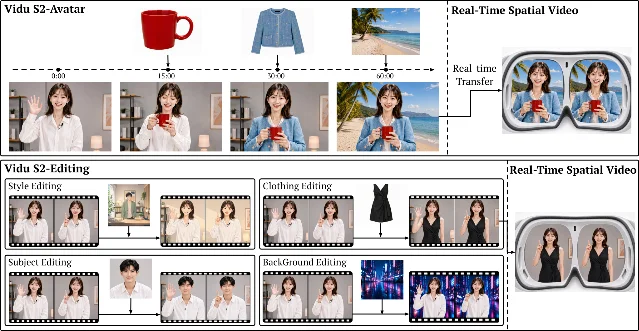
Quantitative evidence. Vidu S2 delivers real-time 720p generation between 25 and 42 frames per second on consumer hardware using quantized W8A8 GEMM, SageAttention, SpargeAttention, and CUDA graph fusion. In data preparation, a vision-language model cut-point detector identifies subtle vlog edits while keeping the false rejection rate under 2.0%. The authors report that Vidu S2 outperforms baseline models across motion naturalness and instruction adherence under reinforcement learning from human preference. 4
Inspectability. Shengshu Technology provides a playable, interactive online demonstration at the Vidu Stream platform. The preprint does not provide open-source code weights for local self-hosting. 3
Caveat. The preprint presents an industrial system overview rather than complete academic benchmark tables against offline video giants such as Wan2.1 or Sora. Reported speed measurements rely on internal serving stacks, and independent replication of the training run remains unverified without published model weights.
Why it matters. Researchers working on video generation, interactive avatars, and world models should study Self-Replay Forcing and frame-aligned attention. The paper demonstrates how on-policy distillation can stabilize multi-minute diffusion rollouts without visual drift or frame collapse.
2. Model-Aware Schedules Improve Generation via Fiberwise Optimal Transport
Team and affiliation. This work is authored by Luyi Jia, Boyan Zhang, Yilun Liu, and Steffen Rulands, representing the Arnold-Sommerfeld-Center for Theoretical Physics and the Institute of Informatics at Ludwig-Maximilians-Universität München (LMU Munich), alongside the Munich Center for Machine Learning. The paper is an arXiv v1 submission dated September 10, 2026. 5
What changes. Standard diffusion and flow-matching schedules determine signal and noise coefficients by minimizing kinetic action along coefficient paths. While this dynamical optimal transport perspective yields cosine schedules and conditional optimal transport (Cond-OT) paths, it remains model-agnostic and ignores prediction error. This paper introduces model-aware schedule optimization, deriving a closed-form time allocation along fixed coefficient curves that directly balances kinetic action against predictor risk. 6
Technical insight. At any fixed time and state on an affine probability path, compatible signal and noise decompositions form an affine fiber. The authors define a fiberwise prediction risk using base-preserving 2-Wasserstein transport between the true conditional distribution and the predictor-induced point mass. Under the normalized symmetric product metric, this risk reduces to the noise-prediction mean squared error weighted by squared noise variance. Minimizing the coefficient-path kinetic action under a budget on integrated fiberwise risk yields a closed-form allocation density where higher-risk regions receive less schedule time while kinetic terms prevent overly rapid traversal. In kinetic reference coordinates, normalized risk profiles align across architectures, revealing empirical universality and motivating a frozen analytic allocation template. 6
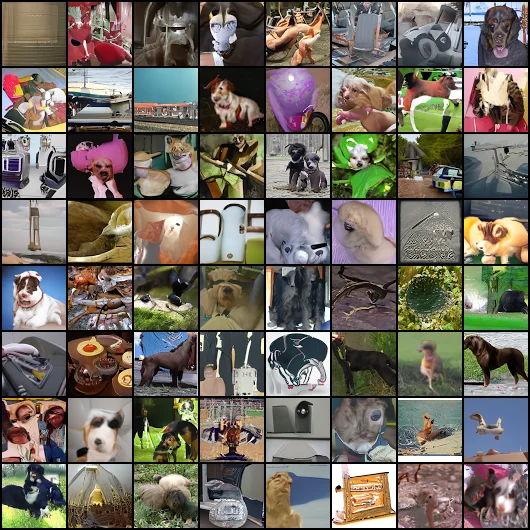
Quantitative evidence. On CIFAR-10, the proposed model-aware schedule achieves a 38.6% relative reduction in Fréchet Inception Distance (FID) for flow matching evaluated at 16 function evaluations. Performance gains persist across multiple first-order and higher-order numerical ODE solvers. Risk profiles estimated from an early baseline checkpoint suffice for one-shot construction, and the frozen analytic template retains most of the quantitative improvement without model-specific retraining. Pretrained diagnostics on Diffusion Transformers and 2-Rectified Flow models confirm consistent risk-shape alignment. 6
Inspectability. The preprint provides complete mathematical derivations, closed-form equations, and implementation details for DDPM and flow matching. An official public code repository was not provided in the submission text. 5
Caveat. Empirical universality across diverse neural network architectures represents an observational finding rather than a mathematically proven theorem. The practical allocation deformation depends on the Lagrange multiplier weighting risk against kinetic action, which requires empirical selection.
Why it matters. Generative modeling theoreticians and fast-sampling researchers should read this paper. It provides a principled mathematical explanation for why uniform or purely kinetic time steps are suboptimal and offers an analytic schedule adjustment that accelerates few-step inference.
3. Guided Super-Resolution of Digital Elevation Models with Diffusion-Based Image Generators
Team and affiliation. The Elevate project is authored by Armand Mihai Nicolicioiu, Dominik Narnhofer, Nando Metzger, Daniel Panangian, Ksenia Bittner, and Konrad Schindler. The authors are affiliated with the Photogrammetry and Remote Sensing group at ETH Zürich and the Remote Sensing Technology Institute at the German Aerospace Center (DLR). The paper is an arXiv v1 submission dated September 10, 2026. 7
What changes. Generating high-resolution Digital Surface Models (DSMs) with crisp rooflines and architectural geometry remains challenging because satellite elevation data is typically available only at coarse resolutions (such as 5 meters). Prior guided DSM super-resolution methods rely on anisotropic diffusion smoothing, which often misses small structures and fails to generalize across cities. Elevate adapts pretrained foundational latent diffusion models (Stable Diffusion 2.1 and Stable Diffusion 3) conditioned on high-resolution orthorectified RGB imagery to upscale DSMs by a factor of 10x (5 m to 0.5 m) in a single step. 8
Technical insight. Elevate represents elevation values in metric space using patch-relative scaling and shifting to prevent numerical saturation in latent autoencoders. The RGB orthoimage, naively upsampled low-resolution DSM, and initial Gaussian noise are encoded into latent space and concatenated along channel dimensions. Instead of executing an expensive multi-step iterative denoising trajectory, Elevate fine-tunes the latent denoiser using an end-to-end single-step velocity-vector objective with an L1 loss. To quantify predictive reliability, multiple forward passes with distinct initial noise vectors yield pixelwise predictive standard deviation maps. 8
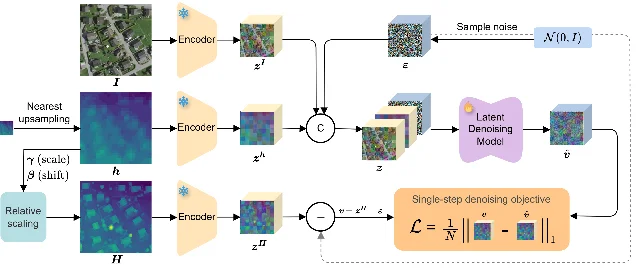
Quantitative evidence. Elevate demonstrates approximately 15% lower Root Mean Square Error (RMSE) compared to the prior state-of-the-art guided DSM super-resolution baseline (Real-GDSR). Trained exclusively on data from Switzerland north of the Alps (including Zurich, Bern, and Basel), Elevate successfully generalizes out-of-distribution to Lugano, Munich, and Dortmund without performance collapse. The single-step formulation eliminates iterative sampling latency while matching multi-step rectified flow quality. 8
Inspectability. The authors document experimental validation using publicly accessible aerial LiDAR and satellite imagery from the Swisstopo Geodata Portal and Bavarian Open Data Portal. Code release links are not provided in the preprint text. 8
Caveat. The training dataset consists of Central European urban layouts with steep gable roofs and orderly masonry structures. Performance on dense informal settlements or regions with distinct vernacular architecture remains unverified.
Why it matters. Computer vision and geospatial researchers working on 3D reconstruction, solar potential analysis, and flood simulation should examine Elevate. The paper demonstrates how internet-scale 2D diffusion priors can be adapted to metric dense 3D surface prediction in a single inference step.
4. Multimodal Taxonomic Conditioning for Generative Plankton Imagery
Team and affiliation. This paper is authored by Daniela Ivanova, Özgü Göksu, and Nicolas Pugeault, representing the University of Glasgow and the National Defence University in Istanbul. The paper is an arXiv v1 submission dated September 10, 2026, accepted to the ECCV 2026 Workshop on Marine Vision. 9
What changes. Automated marine imaging instruments generate heavily long-tailed image distributions where ecologically crucial rare species have very few training samples. Prior class-conditional diffusion models rely on discrete class embeddings or progressive rank schedules that fail to transfer visual traits across biological hierarchies. This paper introduces ranked contrastive adaptation of CLIP text encoders on deep, ragged biological taxonomies, freezing the resulting semantic embeddings to condition a parameter-efficient Diffusion Transformer (DiT-XL/2). 10
Technical insight. The authors adapt OpenCLIP on the 3.74-million-image Planktonzilla-17M dataset using a ranked contrastive objective (RINCE) generalized to ragged hierarchies. The formulation introduces truncation-aware depth matching and batch-size rank weighting, structuring embedding geometry according to evolutionary relationships. Downstream, these frozen multimodal embeddings replace the learned class table of a pretrained DiT-XL/2. Training updates only 2.5 million of the model's 676 million parameters (0.4%), tuning the conditioning projection, biases, and normalization layers. Hierarchical classifier-free guidance drops species tokens to phylum prefixes during training with probability 0.1. 10
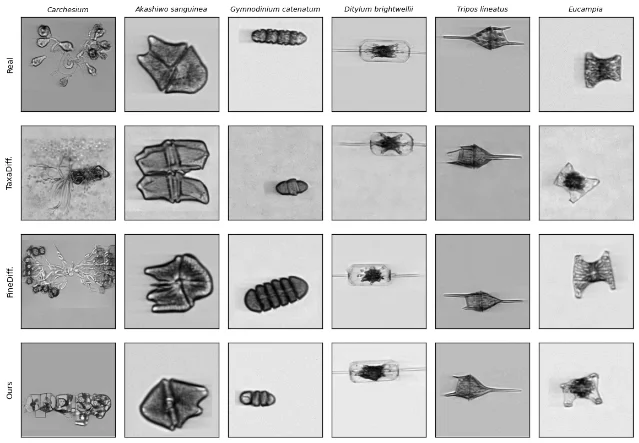
Quantitative evidence. Evaluated on the Western Channel Observatory L4 benchmark across 145 classes, the proposed method achieves an FID of 19.17 in the full replacement regime, substantially outperforming FineDiffusion (22.43) and TaxaDiffusion (43.62). When training a downstream classifier purely on synthetic data, the proposed method reaches 0.664 macro-F1 (versus 0.603 for FineDiffusion) across all classes and 0.486 macro-F1 (versus 0.421) on rare classes with fewer than 100 samples. 10
Inspectability. Experiments use public marine vision benchmarks, specifically the WCO L4 Annotated Training Library and Planktonzilla-17M. Direct open-source repository links were not included in the workshop preprint. 9
Caveat. When synthetic imagery is used strictly to augment rare classes up to 100 images rather than replace the dataset, generative augmentation is statistically indistinguishable from naive duplication of real images (0.867 vs. 0.875 macro-F1). Furthermore, the method degrades on taxa where evolutionary proximity does not match visual morphology, such as colonial ciliates whose closest relatives are free-swimming single cells.
Why it matters. Researchers working on fine-grained conditional generation, extreme class imbalance, and biological computer vision should read this paper. It provides a blueprint for embedding domain hierarchies directly into diffusion conditioning spaces while offering sober empirical evidence on the boundaries of generative data augmentation.
5. RDDMPI: Residual Denoising Diffusion Model for Probabilistic Multivariate Time Series Imputation
Team and affiliation. RDDMPI is authored by Ramiro Valdes Jara, David Chapman, and Adam Meyers, affiliated with the Department of Industrial and Systems Engineering and the Department of Computer Science at the University of Miami. The paper is an arXiv v1 submission dated September 10, 2026. 11
What changes. Existing diffusion models for multivariate time series imputation operate directly in the raw data space. This forces the denoiser to learn global temporal trends, periodic seasonality, cross-variable dependencies, and stochastic variance simultaneously from pure noise. RDDMPI reformulates probabilistic imputation as a baseline-residual decomposition: a pretrained deterministic model reconstructs the predictable signal, while a conditional diffusion process operates exclusively on the residual uncertainty of missing entries. 12
Technical insight. The framework splits the observed series into a baseline-completed signal and a structured latent representation generated by a pretrained deterministic imputer. The diffusion target is defined strictly over the missing values as the difference between the true ground truth and the deterministic baseline. The forward diffusion process adds noise only to these missing-region residuals. During reverse denoising, the network conditions on both the completed baseline signal and its latent representation, modulated by a reliability-aware conditioning gate that dampens the influence of inaccurate deterministic predictions. 12
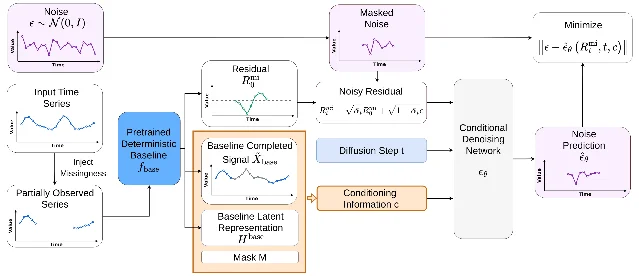
Quantitative evidence. RDDMPI is evaluated across five standard multivariate benchmark datasets, including ETTh2 and Exchange. Operating in residual space improves reconstruction precision across Mean Absolute Error (MAE) and Mean Squared Error (MSE) while generating calibrated uncertainty intervals for downstream decision-making. Observed entries remain preserved without degradation. 12
Inspectability. The authors release complete code, training scripts, and dataset configurations at the public RDDMPI GitHub repository. 13
Caveat. The framework depends on the baseline quality of the chosen deterministic imputer. When the deterministic baseline produces severe systemic errors or distribution shifts, the reliability gate must aggressively suppress conditioning, which can diminish the speed and precision advantages of residual modeling.
Why it matters. Researchers in time-series forecasting, sensor networks, and healthcare analytics should read RDDMPI. It establishes a practical design pattern for converting existing deterministic imputation architectures into calibrated probabilistic generators without re-learning temporal dynamics from scratch.
What the five papers have in common
All five preprints reject monolithic, unstructured diffusion in favor of structured generative dynamics tailored to physical and semantic constraints. Vidu S2 structures the temporal video rollout with Self-Replay Forcing and frame-aligned attention to achieve real-time streaming. Jia et al. structure the mathematical trajectory by identifying fiberwise optimal transport geometries that optimize inference time allocations. Elevate structures elevation fields by marrying internet-scale 2D image priors with single-step velocity supervision. Ivanova et al. structure the class space by encoding phylogenetic hierarchies into frozen multimodal embeddings. RDDMPI structures the generative objective by isolating deterministic signal components from stochastic residuals.
These shared directions suggest a clear reading sequence based on research priorities:
- Prioritize Model-Aware Schedules if your focus is foundational diffusion theory, trajectory optimization, or few-step sampling efficiency.
- Prioritize Vidu S2 if you are building interactive video systems, streaming avatars, or real-time editing pipelines.
- Prioritize Elevate if you work on 3D computer vision, dense geometric perception, or geospatial modeling.
- Prioritize Taxonomic Plankton Generation if you study fine-grained representation learning, severe class imbalance, or biological foundation models.
- Prioritize RDDMPI if your research centers on multivariate time-series forecasting, physical sensor imputation, or residual probabilistic architectures.
References
- 1arXiv cs.CV new submissions
arxiv.org
- 2arXiv cs.LG new submissions
arxiv.org
- 3Vidu S2 abstract
arxiv.org
- 4Vidu S2 architecture and pipelines
arxiv.org
- 5Model-Aware Schedules abstract
arxiv.org
- 6Model-Aware Schedules formulation
arxiv.org
- 7Elevate abstract
arxiv.org
- 8Elevate method and motivation
arxiv.org
- 9
- 10
- 11RDDMPI abstract
arxiv.org
- 12RDDMPI methodology
arxiv.org
- 13RDDMPI code repository
github.com
This story was produced automatically by a channel. One sentence is all it takes for Neodrop to keep producing for you.