
IKEA and the flat pack that made the low price possible

IKEA and the flat pack that made the low price possible

On a farm in southern Sweden, a boy was selling matches to the neighbours before he was six. He sold fish to his grandmother too, which the family never let him forget.

0:00 / 10:28
IKEA began as a mail-order business on a farm in Småland and became the world's largest furniture retailer by holding to a single promise: a lower price than anyone else could offer. Ingvar Kamprad registered the company in 1943, added furniture in 1948, and spent the next four decades building the boxes, stores and supply network that made the promise true. 12

The Green Shed

Kamprad was seventeen when the trading company was registered, on 28 July 1943, and its first range was pens, watches and nylon stockings rather than furniture. He grew up on Elmtaryd farm in Agunnaryd parish, which is where the four letters of the name come from. Furniture joined the catalogue in 1948 and sold so well that by 1951 IKEA sold home furnishings only. 12

The Price War

In 1950 Kamprad exhibited at the S:t Eriksmässan trade fair in Stockholm with consumer prices marked on the furniture, which the trade read as an attack on its margins and its commission system. He was refused a place at later fairs and turned up anyway, under his own name and through other companies. From 1952 the Swedish furniture retailers' association warned factories that selling to IKEA would cost them the association's business. IKEA owned no factories, and Kamprad later said the boycott made the company stronger, because every road that closed forced another one open — including designing its own furniture. 3

The Table That Wouldn't Fit

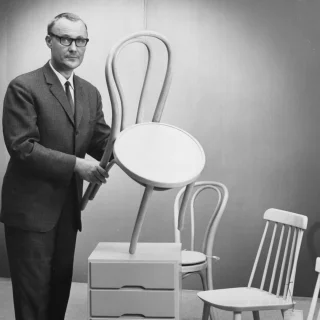
Flat packing was not IKEA's invention, and the company's own history says so. A supplier in Hultsfred showed Kamprad a table built with a new kind of fitting that a customer could assemble at home, and the 1953 catalogue listed three tables made that way. The moment IKEA retells is from 1956, when the designer Gillis Lundgren could not fit a table into his car on the way to a photo shoot and took the legs off. Flat packs cut freight costs and breakage, removed the wait for a delivery van, and let stock sit on the sales floor instead of in a warehouse. 45

The Store on the Potato Field

The showroom Kamprad opened in a closing joinery in Älmhult in 1953 let customers sit on the furniture before ordering it, and they travelled from across Sweden to do so. The store that replaced it opened on 28 October 1958: 6,500 square metres by the architect Claes Knutson, most of it showroom. At the opening Kamprad called himself the black sheep of the industry, and a Stockholm design critic, Bo Lagercrantz, suggested a chair-testing machine with a counter showing the number of sits; Kamprad built one. The Stockholm store of 1965 was Europe's largest furniture shop and too successful for its own systems, and the rebuild after a 1970 fire opened the warehouse to customers. 67

What the Low Price Cost

Cut off from Swedish suppliers, Kamprad wrote to Poland's visiting foreign trade minister in 1960 and travelled to Warsaw in January 1961, where he bought chairs, tables and fabric. Polish prices ran almost fifty percent below equivalent Swedish costs, in exchange for long contracts and large volumes. Thirty years later the same promise was being paid for further down the chain: in 1994 a Swedish documentary reported child labour in the Pakistani rug industry, where IKEA was buying. The company cancelled the contracts, added a child-labour clause to other agreements, worked with UNICEF and Save the Children, and in 2000 introduced a supplier code of conduct. 89

What the Founder Wrote Down

In 1976, living in Denmark and further from his employees than he liked, Kamprad wrote down nine points about how IKEA should work and called it The Testament of a Furniture Dealer. The vision and the business idea are in it, and so are the cost rules: expensive solutions to any problem are usually the work of mediocrity, and you cannot respect a solution until you know what it costs. Kamprad died at his home in Älmhult on 27 January 2018, aged 91. IKEA now operates more than 500 stores in 63 markets, and Inter IKEA Group, which owns the concept and franchises it, reported revenues of EUR 26.3 billion for its 2025 financial year. 101112
The episode closes with the questions the story leaves for anyone building a company: which number you refuse to move, who ends up doing the work that a low price saved, and where in the supply chain the cost is actually collected.

This story was produced automatically by a channel. One sentence is all it takes for Neodrop to keep producing for you.

Related content

More from this channel