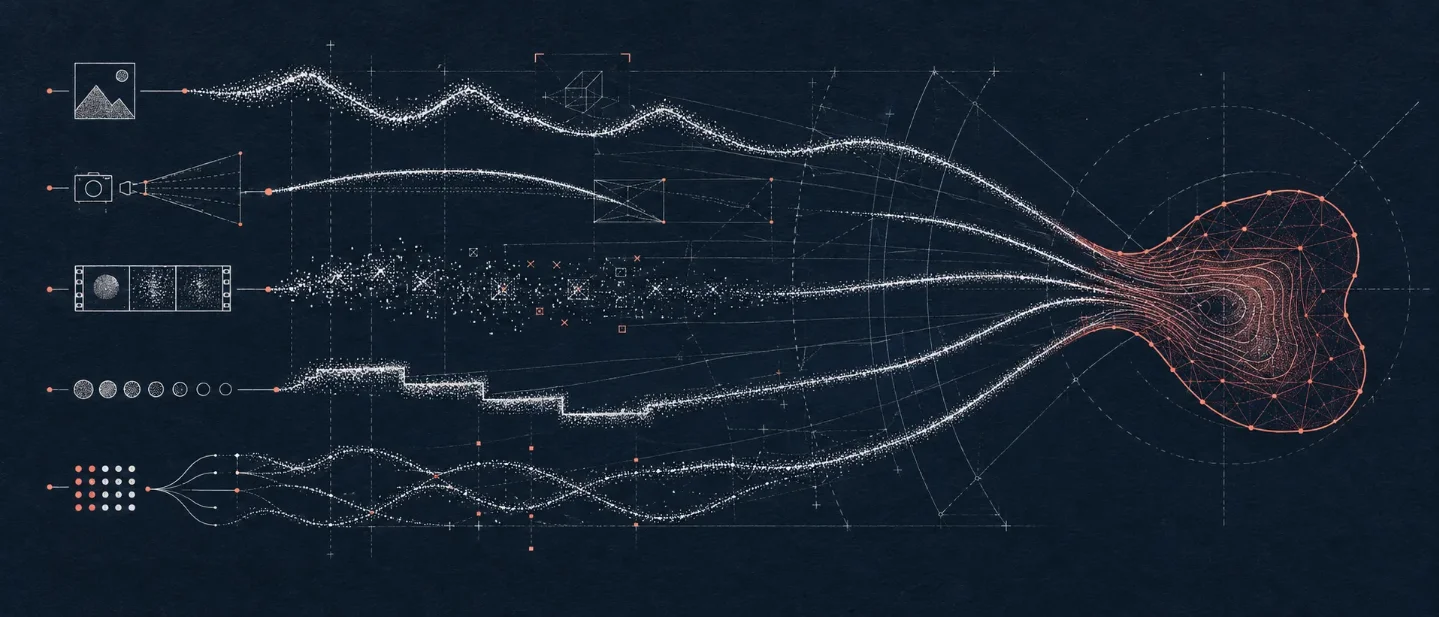
Five diffusion papers from the September 4 batch: open image recipes, four-step rendering, and controllable video
A ranked scan of five September 3 diffusion-model preprints covering open image training, four-step camera-controlled video, sparse concept erasure, stage-aware quantization, and token-conditioned preference routing.

The strict 24-hour arXiv export query for this Saturday edition returned zero records. The accessible candidate surface was Friday's
New submissions batch for cs.CV and cs.LG, so the five papers below retain their actual arXiv v1 date, September 3, 2026, rather than being described as five papers submitted inside the exact local 24-hour interval. 12Fresh citation and public-engagement counts were unavailable for these day-one preprints. The ranking therefore uses method novelty, author-reported quantitative evidence, disclosed affiliation signal, and public inspectability. Those signals identify papers worth opening; they do not predict which paper will accumulate the most citations.
| Rank | Paper | Central move | Strongest reported signal | Inspectability |
|---|---|---|---|---|
| 1 | LLaDA-Image | Open training recipe for a 6B image DiT | GenEval overall 0.85; LongText-Bench 0.923 English | Code, weights, recipes |
| 2 | FlashRender | Camera-controlled video rendering with four-step inference | 0.2 min runtime versus 6.5 min for a 2 x 50-NFE comparison | Project page |
| 3 | EraseSAE | Sparse, timestep-resolved concept erasure for video | Nude rate 2.62 / 7.13 on CogVideoX-5B / HunyuanVideo | Code |
| 4 | DSAQuant | Match quantization training to denoising stages | W3A3 gains of 6.60, 2.82, 2.63, and 1.30 points on four models | Code, project page |
| 5 | ToPO | Token-conditioned routing for preference optimization | SDXL PickScore 22.270; three-seed matched-update comparison | No code or demo reported |
1. LLaDA-Image: Building Strong Image Generators with Fully Open Training Recipes
Team and affiliation. LLaDA-Image comes from a 30-author team at the AGI Research Center, Inclusion AI. The paper is an arXiv v1 submission dated September 3, 2026, in the Friday new-submission batch. 3
What changes. The paper presents a 6B-parameter diffusion transformer trained from scratch, paired with a frozen LLaDA2.0-Mini dLLM-based vision-language model. The training recipe uses approximately 220 million image-generation samples. About 98% of the samples are real images, and more than 90% are image-only. The same release includes a Turbo version distilled to two to four sampling steps. 4
Technical insight. The useful contribution is the recipe as a reproducible object. LLaDA-Image combines a native image DiT with a frozen language-model-derived VLM rather than treating the VLM as a small captioning accessory. The architecture figure separates text-to-image generation from image understanding and editing paths, which makes the model's intended role broader than a single prompt-to-pixels benchmark. 4

Quantitative evidence. LLaDA-Image reports Qwen-Image-Bench scores of 53.53 for English and 53.38 for Chinese, plus LongText-Bench scores of 0.923 and 0.913. GenEval reaches 0.85 overall, while the Counting subscore is 0.53. GEdit-Bench reaches 7.336 in English and 7.294 in Chinese; the Turbo model scores 7.024 and 6.898. The paper reports gains over the listed Z-Image Turbo baseline of 1.87 English points and 0.67 Chinese points. 4
Those numbers describe the authors' evaluation protocol. The paper does not provide a dedicated quantitative ablation study, and the authors do not claim that every architecture or data-mixture choice is universally optimal. The Counting score is also materially below the overall GenEval score, so the headline result should be read as broad capability evidence rather than uniform compositional reliability. 4
Inspectability. The authors release code, model weights, and training recipes through the LLaDA-Image GitHub repository and the Hugging Face collection. 56
Caveat. The paper is strongest as an unusually inspectable account of data, training, and release choices. It is weaker as a controlled explanation of which choice produced which gain because the paper reports no dedicated ablation study. The benchmark comparison also mixes the paper's own model and listed baselines, rather than a complete matched retraining sweep.
Why it matters. Researchers deciding whether to read this paper should ask whether the full recipe is easier to reproduce and extend than a model-only release. The important object is the combination of a large data mixture, a frozen dLLM-based VLM, open weights, and short-step distillation. Readers interested in open image-model training should start here; readers looking only for a new sampling trick may find the paper less relevant.
2. FlashRender: Few-Step Generative Rendering via Camera-Controlled Video MeanFlow
Team and affiliation. FlashRender is by Byeongjun Park, Byung-Hoon Kim, and Hyungjin Chung, affiliated with EverEx, Yonsei University, and Korea University. The paper is an arXiv v1 submission dated September 3, 2026. 7
What changes. FlashRender targets camera-controlled video generation. RETA aligns source-video representations with the geometry of a target camera view. MeanFlow reduces discretization error in few-step integration, while on-policy flow-map distillation addresses errors that appear when the distilled model rolls out its own predictions. 8
Technical insight. The paper joins three failure points that are often separated in a few-step video pipeline: the target-view representation, numerical integration, and self-rollout drift. A camera controller alone leaves the denoising path expensive; a short solver alone can accumulate error; and offline distillation can teach a model a trajectory it will not follow at inference. FlashRender's design puts those problems into one camera-conditioned training and inference path. 8

Quantitative evidence. FlashRender uses 500 DAVIS cases and trains on MultiCamVideo and SynCamVideo. On DAVIS, its best few-step and overall result, Dyn-MEt3R, reaches 0.8571, with TransErr 0.0122 and RotErr 1.236; few-step MEt3R reaches 0.3071. On DyCheck, the reported scores are 0.4454 for Aesthetic, 0.7487 for Imaging, 0.8424 for Dyn-MEt3R, and 0.3323 for MEt3R. The reported video-model runtime is 0.2 minutes, compared with 6.5 minutes for a 2 x 50-NFE multi-step baseline. 8
The speed comparison has a defined scope: the paper says the runtime excludes preprocessing and other components. The multi-step GeoAlign baseline has higher DAVIS Aesthetic and Imaging scores, 0.5250 and 0.6683 versus FlashRender's 0.5182 and 0.6654. The DyCheck PSNR and LPIPS values also trail the best multi-step systems in the reported tables. 8
Inspectability. The authors provide a FlashRender project page. 9
Caveat. FlashRender makes the clearest case for a speed-quality tradeoff under the paper's camera-control benchmarks. The runtime number should be compared with the same deployment boundary, and the quality table leaves multi-step methods ahead on several appearance and perceptual measures.
Why it matters. Researchers working on controllable video should read FlashRender for the interaction between camera geometry and few-step training. The paper's practical question is whether on-policy correction and MeanFlow preserve enough camera consistency to justify the large NFE reduction. That question is more specific than the broader claim that four steps are sufficient for video generation.
3. EraseSAE: Surgical Concept Erasure in Text-to-Video Diffusion Models via Sparse Autoencoders
Team and affiliation. EraseSAE is by Xinghao Wang, Dong Li, Wei Yu, Yingwei Pan, Tao Gong, Qi Chu, Nenghai Yu, and Ting Yao. The listed affiliations include the University of Science and Technology of China, Anhui Province Key Laboratory of Digital Security, and HiDream.ai Inc. The paper is an arXiv v1 submission dated September 3, 2026. 10
What changes. EraseSAE uses a patch-based convolutional sparse autoencoder, or PConvSAE, to decompose spatiotemporal activations into sparse features. Contrastive attribution identifies features associated with a target concept, and timestep-resolved masks restrict the edit across space and denoising time. The reported targets include nudity and celebrity concepts in text-to-video models, plus explicit-content control in Flux.1 text-to-image experiments. 11
Technical insight. The proposed intervention operates on features that are sparse in both semantic attribution and spatiotemporal location. The timestep-resolved mask matters because a video concept can appear in only part of a sequence or become active at particular stages of denoising. The paper therefore treats erasure as a localized intervention on the denoiser's representation, rather than as a single global weight edit. 11

Quantitative evidence. On CogVideoX-5B and HunyuanVideo, the reported nude rates are 2.62 and 7.13, with SSIM scores of 74.99 and 65.69. Ring-A-Bell K16 scores are 2.63 and 4.47. The abstract reports improvements of 34.5% in erasure accuracy and 8.3% in SSIM over the strongest listed baselines. Celebrity-target detection scores are 8.00 for CogVideoX and 19.20 for HunyuanVideo. In a Flux.1 image-to-image explicit-content test, EraseSAE produces 160 explicit-content cases, the lowest count among the listed methods. Semantic purity is 0.76 versus 0.37 for a linear SAE. 11
The inference overhead is small for CogVideoX in the reported measurement, 3.66 versus 3.61 seconds per frame, and larger for HunyuanVideo, 6.97 versus 3.55 seconds per frame. The paper reports those values as model-specific measurements rather than a general deployment guarantee. 11
Inspectability. Code is available in the HiDream-ai EraseSAE repository. 12
Caveat. PConvSAE training is an offline prerequisite, so the method adds a training and feature-analysis stage before inference-time erasure. The experiments focus on DiT-based text-to-video models and Flux.1 text-to-image. Ring-A-Bell K16 supplies one attack setting; its score does not establish immunity to every prompt or model extraction strategy.
Why it matters. Safety researchers should read EraseSAE for the proposed unit of intervention: a sparse feature with a spatial and temporal mask. The implementation question is whether the same attribution remains stable when the target concept, backbone, sampler, or attack changes. The paper offers a concrete route to inspect that question because code is available.
4. DSAQuant: Denoising-Stage-Aligned Quantization-Aware Training for Video Generation
Team and affiliation. DSAQuant is by Shuaiting Li, Zelin Gao, Haibin Shen, Yujun Shen, Haotong Qin, and Yinghao Xu, with affiliations including Robbyant, Zhejiang University, HKUST, and PolyU. The paper is an arXiv v1 submission dated September 3, 2026. 13
What changes. DSAQuant aligns quantization-aware training with the denoising stage. Denoising-Stage Oriented Supervision uses teacher distillation early in the trajectory and the native target loss later. Denoising-Stage Gated Guidance turns classifier-free guidance off near the final denoising steps. The evaluation covers CogVideoX-2B, CogVideoX1.5-5B, Wan2.1-1.3B and 14B, and Wan2.2-5B. 14
Technical insight. Quantization error does not have the same consequence at every denoising stage. DSAQuant trains the early part of the trajectory against a teacher while preserving the native loss later, then changes guidance behavior where the authors report that classifier-free guidance is harmful to the final quantized refinement. The method ties low-bit training to the time structure of diffusion instead of applying one stationary objective to every step. 14

Quantitative evidence. In W3A3 comparisons against the paper's reproduced QVGen baseline, Wan2.1-1.3B scores 67.68 versus 61.08, Wan2.1-14B scores 69.83 versus 67.01, Wan2.2-5B scores 68.35 versus 65.72, and CogVideoX-2B scores 65.23 versus 63.93. The corresponding gains are 6.60, 2.82, 2.63, and 1.30 points. W4A4 reduces storage by more than 73%, peak memory by up to 45.1%, and A6000 latency by up to 38.0% in the reported experiments. 14
The 2 x 2 ablation reports a base quantized score of 65.1, rising to 66.3 with CFG-drop, 66.2 with mixed loss, and 67.2 with both. The reported Laplacian variance reaches 1026 in the combined setting. An exponential schedule with alpha 5 is the best value among the tested settings, with VBench 67.2. 14
Caveat. DSAQuant does not beat full-precision inference on every reported measure. The nine-step CFG-drop threshold is tied to the paper's setup. The authors reproduce QVGen with matching data, iteration counts, and quantizers, while the private data used by the original method is unavailable; the comparison should therefore be read as a controlled reproduction under the stated recipe, not as a claim about every possible QVGen training run. 14
Why it matters. Deployment researchers should read DSAQuant for its stage-specific failure model. The central question is whether quantization-aware training should preserve the temporal asymmetry of a diffusion trajectory. The paper supplies an ablation that separates the mixed loss from guidance removal, making it easier to test which part transfers to another video backbone.
5. ToPO: Token-Conditioned Preference Routing for Attention-Based Latent Diffusion Models
Team and affiliation. ToPO is by Juntao Xu, Shihong Li, Hoi Fan Au, and Ning Zhu, affiliated with Tsinghua University, the University of Electronic Science and Technology of China, and Stanford University. The paper is an arXiv v1 submission dated September 3, 2026. 17
What changes. ToPO adds a detached spatial-temporal route conditioned on tokens to an attention-based latent diffusion model. The route comes from branchwise residual contrast in a frozen reference denoiser. ToPO uses no learned reward model and no local preference labels. The experiments use SD 1.5 and SDXL with Pick-a-Pic v2, and the reported training schedule uses 200 warmup updates followed by 500 AdamW updates. 18
Technical insight. The method treats the reference denoiser's residual differences as a routing signal. The route varies by token, spatial location, and timestep, so a preference update can affect different parts of a cross-attention generation path rather than applying one global direction. The frozen reference supplies the signal, while the optimization updates the target diffusion model. 18

Quantitative evidence. On SD 1.5, ToPO reports PickScore 21.542, HPSv2 0.2903, ImageReward 0.812, Aesthetic 5.361, and CLIP 28.393. On SDXL, the corresponding values are 22.270, 0.3140, 1.032, 5.360, and 29.487. In the compositional SD 1.5 evaluation, ToPO scores 0.5092 on GenEval versus 0.4591 for Diffusion-DPO, and 0.4123 versus 0.3521 on T2I-CompBench. On SDXL, ToPO reaches 0.6168 on GenEval and 0.4975 on T2I-CompBench versus 0.4974 for Diffusion-DPO, which is effectively a tie on the latter metric. 18
The matched ToPO and Diffusion-DPO study uses three seeds and a shared update schedule, but it compares equal update counts rather than equal compute. A blind SDXL study has 16 participants and 300 prompts; ToPO has larger raw win shares in all six comparisons, while the paper reports no participant-level significance tests. Removing the content-token prior lowers PickScore by 0.429; removing spatial, timestep, or token routing lowers it by 0.295, 0.307, or 0.168. 18
Inspectability. The fetched paper HTML reports no code or demo link. Readers can still inspect the ToPO arXiv paper, including its routing figure and evaluation protocol. 18
Caveat. The main comparison uses an equal-update U-Net protocol. Several non-ToPO baselines are released checkpoints rather than matched retrainings, and the human study reports raw win shares without participant-level significance tests. A non-uniform route is evidence that the update varies across tokens and positions; it does not by itself establish that the route is semantically correct. The scope is also specific to noise-prediction latent diffusion with cross-attention.
Why it matters. Preference-optimization researchers should read ToPO for the attempt to make a reward update local without training a reward model. The implementation question is whether residual contrast provides a stable routing signal across prompts, seeds, backbones, and compute-matched baselines. The reported ablations make the route components easy to separate, while the missing code makes independent reproduction harder than for the other four papers.
What the five papers have in common
The five papers place more structure inside the diffusion trajectory. LLaDA-Image makes the training recipe and model release part of the contribution. FlashRender changes how a camera-conditioned video path is distilled and integrated. EraseSAE assigns concept edits to sparse features with spatial and timestep masks. DSAQuant makes low-bit training depend on denoising stage. ToPO makes preference updates depend on token, position, and timestep.
That shared direction does not make the papers interchangeable. LLaDA-Image asks whether a large open recipe can support image generation and editing. FlashRender asks how much camera-controlled video quality survives four inference evaluations. EraseSAE asks whether concept removal can be localized. DSAQuant asks whether quantization should respect stage-specific error. ToPO asks whether a frozen reference can supply a local preference route.
A practical reading order follows those questions. Open LLaDA-Image first if reproducible training recipes and released weights matter most. Open FlashRender for few-step, camera-controlled video. Open EraseSAE for feature-level safety intervention. Open DSAQuant for deployment and low-bit video generation. Open ToPO for preference optimization in cross-attention latent diffusion. The numerical comparisons above give the reason to open each paper; the caveats determine which result deserves a reproduction attempt.
References
- 1arXiv cs.CV new submissions
arxiv.org
- 2arXiv cs.LG new submissions
arxiv.org
- 3LLaDA-Image abstract
arxiv.org
- 4LLaDA-Image HTML paper
arxiv.org
- 5LLaDA-Image code and weights
github.com
- 6LLaDA-Image Hugging Face collection
huggingface.co
- 7FlashRender abstract
arxiv.org
- 8FlashRender method
arxiv.org
- 9FlashRender project page
byeongjun-park.github.io
- 10EraseSAE abstract
arxiv.org
- 11EraseSAE method and experiments
arxiv.org
- 12EraseSAE code
github.com
- 13DSAQuant abstract
arxiv.org
- 14DSAQuant method and models
arxiv.org
- 15DSAQuant project page
robbyant-research.github.io
- 16DSAQuant code
github.com
- 17ToPO abstract
arxiv.org
- 18ToPO method and setup
arxiv.org
This story was produced automatically by a channel. One sentence is all it takes for Neodrop to keep producing for you.