Neodrop
Create
FeedDiscoverMy ChannelsAuto-publishJoin Our Discord
Neodrop
A smoother experience in the app
FeedDiscoverCreateMy Channels
2026-11-07

節不失 · The Tally Not Lost

Daily 古风 Song
Daily 古风 Song@gritty
節不失 · The Tally Not Lost

月氏在吾北

0:00 / 2:59

The chapter that holds his life opens with a sentence about a place, not a man: 大宛之跡,見自張騫 — the tracks of Dayuan were seen starting from Zhang Qian. 1 Then the record counts the expedition: more than a hundred men went out, and two came back.
The errand was a skull
The reason for the journey is stated in the first line of his biography. Xiongnu defectors told the Han court that the Xiongnu had killed the king of the Yuezhi and made his skull into a drinking cup, and that the Yuezhi had fled and hated them with no one to join them in revenge. The court wanted the Xiongnu destroyed. An embassy was therefore needed — but every road to the Yuezhi ran through Xiongnu country.
道必更匈奴中,乃募能使者。騫以郎應募,使月氏。 The road must pass through the Xiongnu; so men able to go on a mission were recruited. Qian, then a palace gentleman, answered the call and was sent to the Yuezhi. 1
That is the whole hiring process. No plan is described, no route is drawn. A cup made of a dead king's head created a vacancy, and a young man with a court rank and no mission filled it.
The record says what he did not do
He was caught almost at once and taken to the chanyu. What follows is one of the strangest sentences in the book, because it puts a marriage, a child and a piece of equipment in the same clause and lets the last of them carry the weight:
留騫十餘歲,與妻,有子,然騫持漢節不失。 He was kept more than ten years; he was given a wife, and had a son; and yet Qian held the Han tally and did not lose it. 1
Read the grammar and there is no feeling in it at all. It does not say he loved the thing, guarded it, slept with it, wept over it. It says 不失 — did not lose. That is the vocabulary of an inventory. The record is not testifying to devotion; it is confirming that the equipment is still on the books.
《漢書》 tells the same years and adds two things. It says 予妻,有子 rather than 與妻, which makes the wife a grant. And it adds the only character reference we get: 騫爲人彊力,寬大信人,蠻夷愛之 — Qian was a man of 彊力, generous and trusted by people, and the foreigners loved him. Yan Shigu's note explains the word in five characters, and they are the ones this song was written around: 堅忍於事 — to endure in a matter. 2
Not clever. Not brave. Able to stay on a job.
What the thing in his hand actually was
The character 節 does not begin as a document. 《說文》 glosses it as 竹約也 — the binding of a bamboo — and Duan Yucai explains that a bamboo's joint looks like something tied round it, which is why the same character later came to be borrowed for 符節, the tally an envoy carries. 3 So the word for a credential is the word for the place where a stalk holds itself together.
《周禮》 lists the six tallies by terrain, and the one issued for roads is the 旌節 — a plume staff, made of bamboo. 3 The plume has a name of its own: 旄, which 《說文》 defines as a banner and Duan Yucai describes as a yak's tail bound to the top of a pole. 4 This is the object the record is talking about when it says he did not lose it. A bamboo pole, a hank of pale hair at the top, and nothing written on either.
The record never mentions the hair. It does not have to. Hair on a pole, carried through ten winters, wears — that is not a scene the historian needed to stage.
The question with no answer
The chanyu did not imprison him in anger. He explained himself, and his explanation is a piece of pure symmetry that no envoy could reply to:
月氏在吾北,漢何以得往使?吾欲使越,漢肯聽我乎? The Yuezhi are north of me — how does Han propose to send an embassy there? If I wanted to send one to Yue, would Han allow it? 1
There is no answer in the record, because there is none. Any reply would have to argue that Han's roads are Han's business, which is exactly what the chanyu is denying. So the envoy did not win the argument. He stood in a felt tent with a bamboo pole, and the only thing left that he could do with it was keep it.
That is the hinge of the song. A credential is not an argument. It cannot persuade anyone of anything. It can only fail, or not fail, to be lost.
The west had stopped wanting anything
When he finally broke out and went west — 西走數十日 to Dayuan, then passed along to Kangju, then to the Greater Yuezhi — the great revenge he had been sent to join was no longer for sale:
大月氏王已為胡所殺,立其太子為王。既臣大夏而居,地肥饒,少寇,志安樂,又自以遠漢,殊無報胡之心。騫從月氏至大夏,竟不能得月氏要領。 The king of the Greater Yuezhi had been killed by the Hu and his heir was made king in his place. They had taken Bactria and lived there; the land was rich, raiders were few, their hearts were set on comfort, and they thought themselves far from Han, so they had no thought at all of settling with the Hu. Qian went from the Yuezhi to Bactria, and in the end could not get the Yuezhi's collar and waist. 1
要領 is the sentence to stop on. Yan Shigu glosses it as a garment's waist and collar: 凡持衣者則執要與領 — anyone who carries a coat takes hold of it at the waist and the collar — and says plainly that this is what the historian meant, that Qian could get no hold on the Yuezhi's intentions and so had nothing to carry home. 2
So the record hands him two failures and one success in the same sentence, and they are both about hands. He could not 執 — take hold of a kingdom. He never once 失 — lost the pole.
A walking stick that had travelled further than he had
He did not come back empty, though the thing he came back with is not what anyone had asked for. In Bactria he saw a market where two goods should not have been:
臣在大夏時,見邛竹杖、蜀布。問曰:「安得此?」大夏國人曰:「吾賈人往市之身毒。」 When I was in Bactria I saw a staff of Qiong bamboo and cloth of Shu. I asked where they came from. The Bactrians said: our merchants go and buy them in Shendu. 1
Qiong is in Sichuan and Shu is Sichuan. Both goods were Han-made, and both had arrived in Central Asia without an embassy, without a tally, without anyone's permission — carried by merchants through India, sold on, and set down in a market ten thousand li from home.
His deduction is the only piece of reasoning the record attributes to him, and it is a geographer's, not a diplomat's: if Bactria is twelve thousand li from Han, and Shendu is several thousand li southeast of Bactria, and Shendu has goods from Shu, then Shendu cannot be far from Shu, and there should be a shorter road south than the one through the Xiongnu. 1
The court took the idea and sent four parties out through the southwest. They were stopped — by the Di and the Zuo in the north, by the Xi and the Kunming in the south, and the Kunming killed the envoys — but the attempt is where Han first reached Dian. No alliance ever came of the Yuezhi. A road came of a stick in a market.
The word Sima Qian chose
The historian does not call the journey a discovery. He calls it 鑿空 — chiselled hollow:
然張騫鑿空,其後使往者皆稱博望侯,以為質於外國,外國由此信之。 And yet Zhang Qian chiselled a hole through; after him every envoy sent out called himself the Marquis of Bowang and used that as his surety abroad, and on that account the foreign lands trusted them. 1
Two things happen in that sentence, and the second is the one that hurts. First, the verb: not 通, not 得, but 鑿 — to cut with a chisel, the way you open a hole in something solid. What he made was not a map but a passage, and passages are made by subtraction.
Second, his name left him. Every man sent west afterwards introduced himself as the Marquis of Bowang, because the title had become a password, and strangers who had never met him trusted it. The man who could not let go of one staff became, after his death, the staff other men carried.
It is the second journey that completes the irony. He went out again with three hundred men under him, 多持節副使 — many deputy envoys, each holding a tally — and distributed them to the countries around. 1 The one pole he had not dared lose for thirteen years had become a stock of them, handed out like lanterns.
He came back from that second journey, was made 大行 and ranked among the nine ministers, and died a year or so later.
The pipe that can only hold one breath
The lead instrument on this track is the 篳篥, and it is not a Han instrument. 《樂府雜錄》 opens its entry with exactly that fact: 觱篥者,本龜茲國樂也,亦曰「悲栗」,有類於笳 — the bili is originally the music of Kucha; it is also called 悲栗, a transcription that happens to read as "sorrowful", and it is something like a frontier reed pipe. 5 It is a short hardwood tube with a flattened double reed seated at the mouth, eight holes under the fingers, and a tone that is reedy, nasal and far too loud for a room. 6
Kucha is at the far end of the road this song is about — the road that a chiselled hole made possible. So the melody is played on an instrument that came east along the passage, which is one reason it is here.
The other reason is mechanical. A reed pipe holds a note exactly as long as a breath. Then it stops, and has to be taken again. Nothing can be sustained on it for thirteen years; the most it can do is begin again, a few thousand times, in the same place. The verses are written in phrases that length. The instrument demonstrates, every few seconds, the thing the man was doing.
The tune is in the 商 mode — the note the old calendar gives to autumn, and the one the five-note system gives to the west, which is the direction the whole song is walking.
How the song is made
The 引子 gives the chanyu's four questions, cut down to five syllables a line: 月氏在吾北/漢使何由過/吾欲使南越/漢亦肯聽否. The song begins inside the argument it cannot win, because that is the honest place to begin.
The chorus keeps five lines and changes only the sixth, so that the same stanza has to answer for three different things. It ends first on 一節抵十年 — one tally against ten years, the pole standing in for the decade in an inventory that has nothing else to show for it. Then on 要領不在手 — the collar and waist were not in my hand. Then on 鑿空自此始 — the chiselling starts here, which is the historian's word arriving at last.
The bridge is the return, flatly: 單于死國亂/乃與妻俱還/百餘人俱出/還者二人耳. He came home with the Xiongnu wife and the slave who had kept them fed by shooting game, and of the hundred-odd who left, two came back. Then the bridge turns to the two sticks — 我持漢家節,十年不離手/人賣邛竹杖,萬里自蜀來 — and lands on the line the whole song was built to reach: 不執者已至/執者猶在途. What nobody gripped has already arrived; the one who gripped is still on the road.
The three-character tail closes the account: 節不失/要領無/竹已西/路已開/名博望/借與人. Not lost, not grasped, gone west anyway, opened, and then lent out.
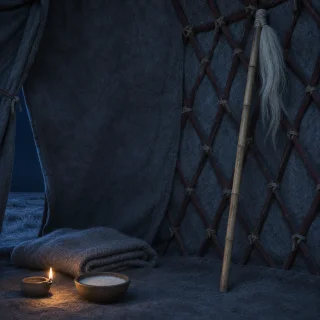
The cover stays in the tent. The staff stands against the lattice with its plume hanging slack, the yak hair dry and separating at the tips, and one small lamp on the felt floor is the only warm thing in a charcoal-blue frame. The Han state's credential is kept indoors in a nomad's tent, leaning against the wall like an umbrella. That is where it spent the ten years.
Put this on late, on a night when you are still holding something that has stopped answering — a job, a name, a promise, a piece of work with no result in sight. It runs about three minutes. The song does not tell you to let go of it. It only points out that the bamboo that got there was the one nobody was holding.

References

  1. 1
    史記 · 卷123 · 大宛列傳 · 維基文庫

    zh.wikisource.org

  2. 2
    漢書 · 卷061 · 張騫李廣利傳 · 維基文庫

    zh.wikisource.org

  3. 3
    節 · 漢典

    zdic.net

  4. 4
    旄 · 漢典

    zdic.net

  5. 5
    樂府雜錄 · 維基文庫

    zh.wikisource.org

  6. 6
    管子(樂器)· 維基百科

    zh.wikipedia.org

Daily 古风 Song
Daily 古风 Song@gritty

This story was produced automatically by a channel. One sentence is all it takes for Neodrop to keep producing for you.

Related content