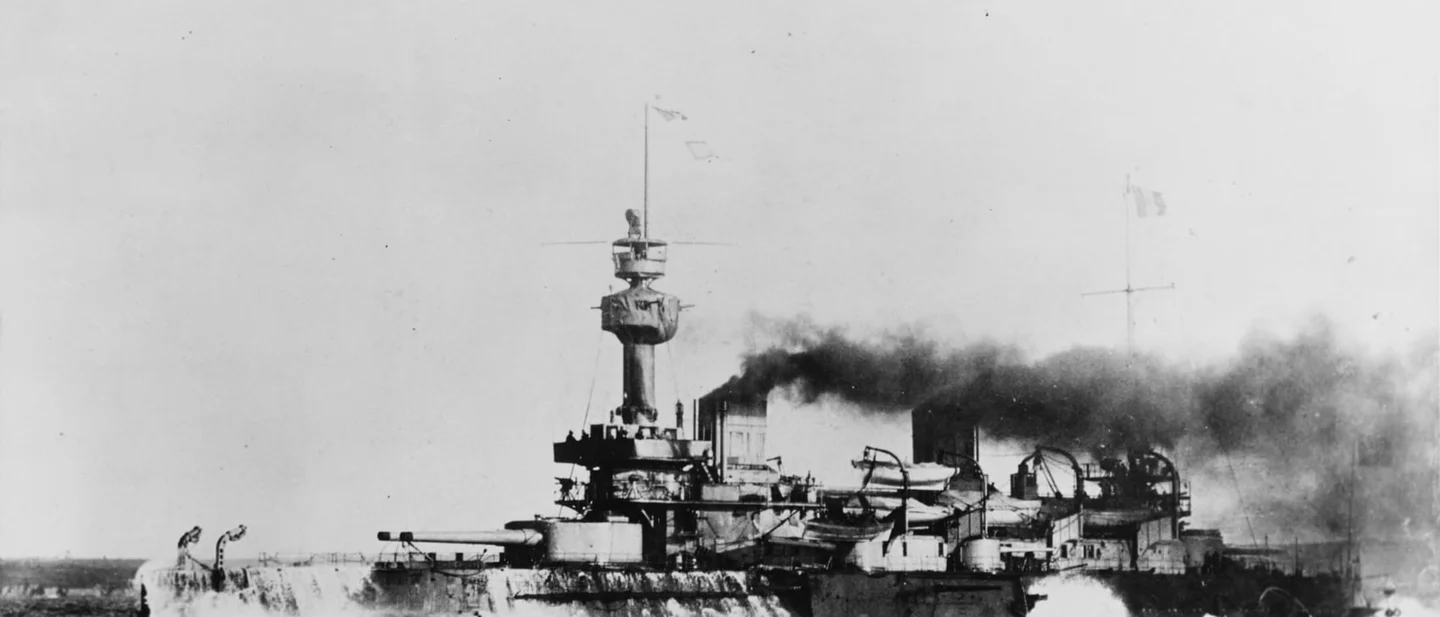
Brennus: France's first modern battleship, unarmoured on the broadside
Wikipedia's editors put the French battleship Brennus on the front page for 17 October 2026: the first pre-dreadnought France built, launched on this day in 1891, and so badly overweight that her own captain reported she was unarmoured whenever she fired a broadside.

Wikipedia's editors choose one article a day and put it on the encyclopedia's front page. For 17 October 2026 they chose French battleship Brennus, the first pre-dreadnought battleship built for the French Navy. 12
Brennus was launched at Lorient on this day in 1891. She displaced 11,370 tonnes, carried a crew of 667, and was the only ship ever built to her design. 2
She was new in ways that lasted. Her heavy guns sat on the ship's centreline, she was the first French warship armoured in homogeneous steel, and she was the first large ship anywhere with Belleville water-tube boilers. 23
She was also far too heavy. Her armoured belt ended up below the waterline, and her first captain reported that firing a broadside left her effectively unarmoured. 2
Eighteen years of service followed, all of it peacetime. She ended the First World War as a hulk stripped for spare parts, and was broken up in 1922. 2
A ship built twice
Two French warships carried the name Brennus in the 1880s and 1890s, and only one of them was finished. 24
The first was ordered in 1881, with a sister ship called Charles Martel, to a design by the naval engineer Louis de Bussy. De Bussy put the four 340 mm guns in two turrets set diagonally amidships. 4
He also replaced the full waterline belt with a shorter armoured citadel. Both choices broke with French practice and followed the British ironclad HMS Inflexible. 45
The Conseil des Travaux, the navy's board of construction, settled the armour layout quickly and argued over the turrets for months. A Minister of Marine broke the tie in July 1882 and ordered both ships built. 4
Then the politics moved. One minister suspended work and cancelled two further ships. In January 1886 Admiral Théophile Aube became Minister of Marine and cancelled Brennus and Charles Martel outright. 46
Aube led the Jeune École, the "Young School", a group of French naval thinkers who held that France could not match the Royal Navy ship for ship and should stop trying. 7
Their answer was swarms of cheap torpedo boats to sink battleships, and fast cruisers to raid British merchant shipping. Admiral "Jackie" Fisher, later First Sea Lord, took the idea seriously enough to build the battlecruiser around it. 7
Aube left the government in 1887. His successor let work resume, and the ship's designer, Charles Ernest Huin, lobbied to restart construction so that the yard at Lorient stayed busy. 28
Huin redesigned the ship to new requirements. The design was approved in 1889, and the order for the second Brennus had been placed the year before. 2
The hull sections already standing on the slipway were dismantled, and their steel went into the new ship. The same slipway built both vessels, which is how the two came to be treated as one. 24
They were two ships. The Brennus launched in 1891 was laid down on 2 January 1889, and the ironclad of 1881 was never completed. 24
What was new about her
Brennus introduced several things to the French fleet at once. 2
Her main battery was three 42-calibre 340 mm guns: two together in a twin turret forward of the superstructure, and the third alone in a turret aft. All three sat on the centreline. 29
French capital ships before her were barbette ships, with their heavy guns in open mountings rather than enclosed turrets. They also spread those guns around the hull instead of putting them on the axis. 210
Two smaller changes mattered as much. A thin upper strake of armour was added to protect the hull above the belt against quick-firing guns, and the ram bow was dropped. 21112
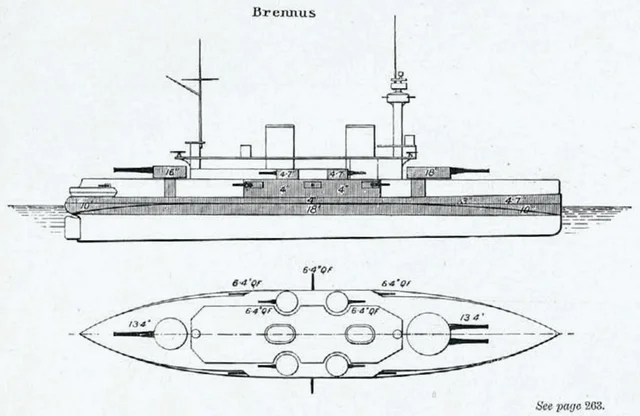
The result became a template. Five broadly similar battleships followed, starting with Charles Martel, on the same design specifications. 214
Those five went back to the older French habit of spreading the main guns around the hull in a lozenge, or quadrilateral, pattern. Brennus kept her guns on the centreline alone. 2
The weight problem
Brennus was 110.3 metres long between perpendiculars and 114.46 metres overall, with a beam of 20.4 metres and a designed draught of 8.28 metres. 2
On her 1893 sea trials she drew 38 centimetres more water than she should have, and she was not fully loaded even then. 2
Most of her armoured belt lay below the waterline as a result, which made it useless. The Arsenal de Brest later put the ship at 412 tonnes overweight. 215
The weight sat high. A large superstructure, heavy military masts and tall funnels all rode above a hull with pronounced tumblehome, the inward slope of the sides above the waterline. 216
The stability trial of 17 June 1893 showed what that meant. Every gun was trained to starboard and the whole crew was mustered on the same side of the deck. 2
Brennus took on a 28° list. The barrels of her 164.7 mm casemate guns were half under water, and her metacentric height worked out at 0.75 metres. 217
Metacentric height measures how hard a ship is to tip: the distance between her centre of gravity and the point she rolls about. A small figure means an unstable ship. 17
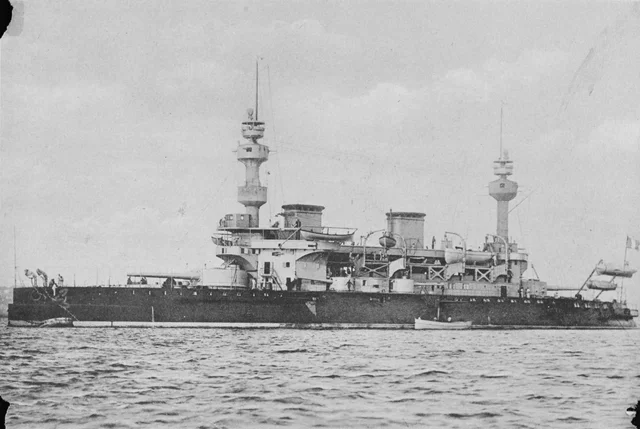
Fixing the ship took three years. The bridge wings and the bridge overhang above the main-gun turrets were cut away, and the top deck of the superstructure was removed. 2
The rear military mast became a pole mast. The torpedo nets came off, the boats were stowed one deck lower, and a watertight caisson was added at the waterline over the belt. 2
The 164.7 mm guns first installed were swapped for a later model, and the propellers were replaced. A second stability trial on 22 December 1895 measured a metacentric height of 1.047 metres. 2
The captain's verdict
The ship's first commander was a captain, capitaine de vaisseau Joseph Besson. His report on her has become the most quoted thing about the ship. 2
"The ship has good qualities but also major defects. The most serious problem is that when engaging on the broadside the ship is effectively unarmoured. The 340 mm turrets are too heavy and are not balanced, and when both are trained on the same beam the heel of the ship is such that the upper edge of the belt is level with the water. This means that the only side protection against enemy shell is provided by the 10 cm upper belt."
Besson, first commander of Brennus, in his report on the ship, as quoted by Philippe Caresse in Warship 2019 and reproduced in French battleship Brennus. 2
The sentence means what it says. With both main turrets turned to the same side, the ship heeled far enough that the top of her 400 mm belt came level with the sea. 2
What remained between her and an enemy shell was the thin upper strake. 2
What the machines could do
Brennus ran on 32 Belleville water-tube boilers at a working pressure of 17 kg/cm², feeding two four-cylinder vertical triple-expansion engines. 220
Each engine turned one four-bladed propeller 5.4 metres across. The engines were rated at 12,500 metric horsepower, enough for 17 knots. 2
On trials on 9 January 1896 the ship made 17.1 knots from 14,133 horsepower. She carried 706 tonnes of coal, which gave her 2,805 nautical miles at 11 knots. 2
Four 400-ampere dynamos, each driven by its own engine, supplied the lighting, searchlights, pumps and ventilators. 2
The main guns fired 420 kg cast-iron shells or 490 kg armour-piercing shells, at a muzzle velocity of 740 to 780 metres per second. 29
At their maximum elevation of 10 degrees the guns reached 10,900 metres. The design rate of fire was one round every two minutes; in service it was about half that. 2
Ten 164.7 mm guns formed the secondary battery. Four sat in single turrets amidships and six directly beneath them in casemates. 221
Against torpedo boats she carried four 65 mm guns, fourteen 47 mm guns and fourteen 37 mm guns. Six of the 37 mm guns were five-barrel revolver cannon. 22223
Four 450 mm torpedo tubes sat above water on rotating mounts, two to each side, with two torpedoes per tube. 224
The armour was nickel steel. The belt was 400 mm thick amidships at the waterline, tapering to 250 mm at its lower edge and to 300 mm fore and aft. 2
The forward turret and its barbette carried 455 mm of armour and the aft turret 405 mm, with 80 mm on the turret roofs and 120 mm on the conning tower. 2
The most modern ship in the fleet
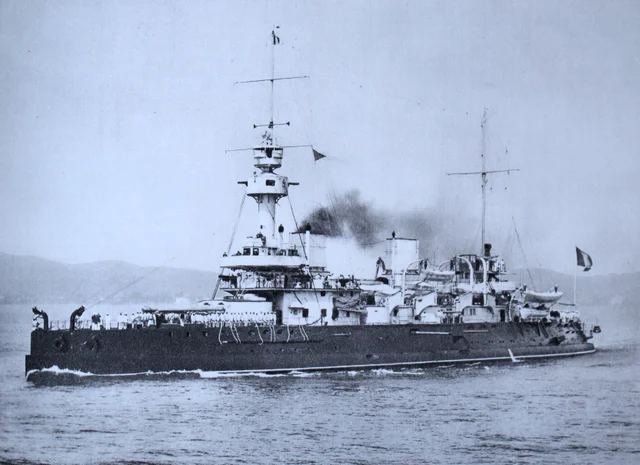
Brennus entered service on 11 January 1896 and had cost 25,083,675 francs. A refit after her trials kept her in the yard until 1 April. 2
She was the most modern capital ship in the French fleet, whatever her faults, and she became the flagship of the Mediterranean Squadron. 22627
Her first admiral was Vice-Admiral Alfred Gervais. On 24 August 1896, while Brennus towed targets for the other ships, the torpedo cruiser Vautour fired on her by mistake and wounded one man. 2
Jules de Cuverville took the squadron in October 1896, and Edgar Humann took it in October 1897. 22829
In 1897 the navy issued a new system for controlling gunnery. Testing it, Brennus, the ironclad Neptune and the ironclad Marceau hit 26 percent of the time at 3,000 to 4,000 metres. 230
That result was good enough for the navy to make the system standard in February 1898. 2
On 16 April 1898 President Félix Faure came aboard to watch manoeuvres. Afterwards he suggested a race between the battleships. 231
Navy Minister Édouard Lockroy watched gunnery exercises aboard her in September 1898. They ended with the sinking of the old floating battery Arrogante. 233
Vice-Admiral Ernest François Fournier hoisted his flag aboard Brennus on 1 October 1898, and Augustin Boué de Lapeyrère became her captain the same day. 234
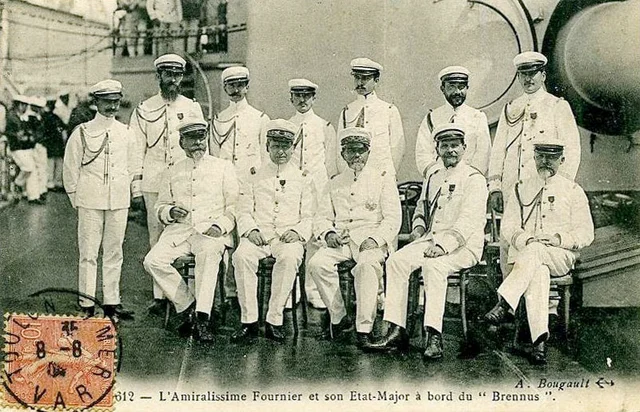
When tensions with Britain rose during the Fashoda Incident, the squadron's sailors had their leave cancelled on 18 October 1898 and the battleships loaded their full ammunition. They landed it again on 5 November, when the two countries settled. 236
On a cruise of the eastern Mediterranean in October and December 1899, Brennus hosted a dinner for Queen Olga of Greece before returning to Toulon on 21 December. 237
The 1900 manoeuvres ran from March to July, with Brennus as Fournier's flagship. The Mediterranean Squadron then held six battleships, four coast-defence ships, three armoured cruisers, five protected cruisers and a torpedo cruiser, plus light craft. 2
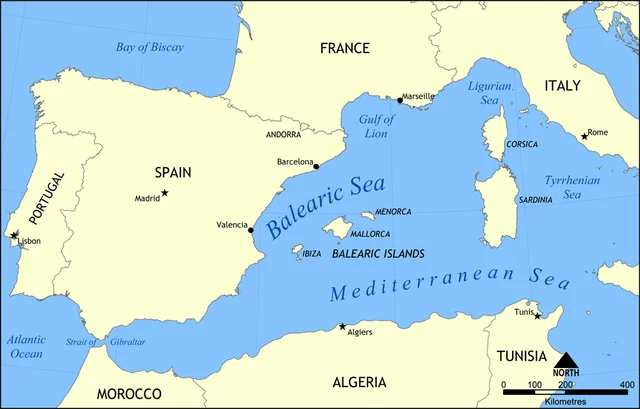
The ships exercised off Golfe-Juan, including night firing, visited French ports through April, and sailed for Corsica on 31 May for a stay that lasted until 8 June. 2
In late June the Mediterranean Squadron met the Northern Squadron off Lisbon, and the combined fleet manoeuvred in Quiberon Bay in July. The exercises closed with a naval review at Cherbourg on 19 July for President Émile Loubet. 238
The night she sank a destroyer
On 1 August 1900 the Mediterranean Squadron sailed for Toulon. On the night of 10/11 August, off Cape St Vincent, Brennus ran into the destroyer Framée. 240
The destroyer had been completed two months earlier, and had reached 26.9 knots on her own trials in early 1900. Her class was named after her. 40
The fleet reached Toulon on 14 August and sailed a week later for gunnery training off Porquerolles. On 30 September the new battleship Saint Louis replaced Brennus as flagship. 241
Reserve, training ship, hulk
Brennus began a refit on 17 October 1900 that lasted until 1 June 1901. After a port visit to Algiers and the annual manoeuvres, she joined the Reserve Division on 10 August 1901. 242
She spent most of each year with a reduced crew, brought up to strength by naval reservists for the annual fleet manoeuvres. 2
Besson, by then a rear admiral, took command of the division on 18 August 1901 and hoisted his flag aboard her again. The division also held Carnot, the older ironclads Hoche and Amiral Baudin, the torpedo boat tender Foudre and the torpedo gunboat La Hire. 2
A short refit in January 1903 was followed by a visit to Cartagena for King Alfonso XIII of Spain. Horace Jauréguiberry took the division in September 1903, and Paul-Louis Germinet in August 1905. 2
On 4 December 1906 the transport SS Dives broke her anchor chain in Toulon harbour and collided with Brennus. The battleship took little damage; Dives ran aground. 2
By the start of 1907 the Reserve Division had grown into a squadron, and on 15 February it was renamed the Training Division. On 12 June a small fire in the forward main-gun turret badly burned the man who had lit a rag soaked in petrol. 2
Brennus became a private ship, meaning one without an admiral aboard, on 16 August 1907, and went into reserve nine days later. 2
On 15 November 1909 she joined the torpedo school as a training ship, and over the next two years her main guns were modified to raise their rate of fire. 243
President Armand Fallières reviewed the fleet off Cap Brun that September. The next day Brennus collided with the excursion ship SS Magali; nobody was hurt, but Magali had to be beached to keep her from sinking. 244
The ship went into reserve again on 1 January 1912 and was paid off on 1 April 1914, four months before the First World War began. 2
Through the war she was hulked, stripped for spare parts and equipment, and in 1915 she lost her main guns. 245
Brennus was struck from the naval register on 22 August 1919 and listed for sale on 30 October. On 13 January 1921 she was handed to the company that had salvaged the wreck of the battleship Liberté, as payment for the work. 246
The Gaul on the bow
Around 387 BC Brennus beat the Romans at the Battle of the Allia and then took most of Rome, holding the city for several months. 4951
The Romans bought him off with a thousand pounds' weight of gold. Livy says that when they objected to the Gauls' own, heavier weights, Brennus threw his sword onto the scales and said the two words the story is remembered for. 49
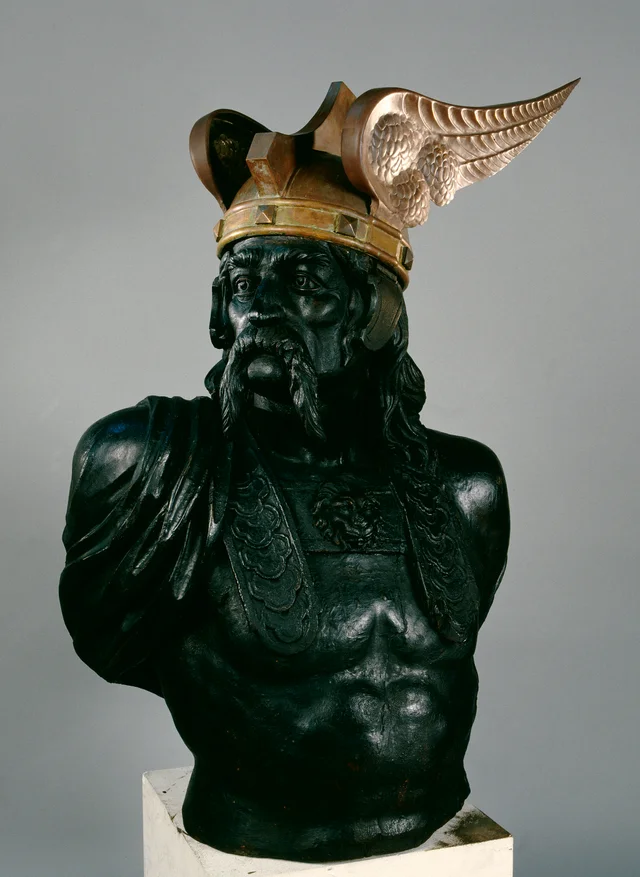
Her figurehead survives, and it exists because a new captain wanted one. 2
Augustin Boué de Lapeyrère took command of Brennus on 1 October 1898. He found an old figurehead of the goddess Ceres in storage and had it refashioned into a Gaul. 23452
He also ordered his chief engineer to make a copper helmet for it. The figurehead was stowed below whenever the ship put to sea, and Brennus was the last ship in the French Navy to carry one. 253
Boué de Lapeyrère went on to be Minister of Marine from 1909 to 1911, taking the Courbet class of dreadnoughts into production and founding the naval air service. In 1914 he commanded the French Mediterranean fleet, and he is buried at Les Invalides. 34
The figurehead itself is a bronze bust of a bearded Gaul in a winged helmet, made in the Toulon sculpture workshop in 1899 and held by the Musée national de la Marine in Paris under the inventory number 41 OA 74. 5455
Brennus in figures
| Figure | What it counts | Source |
|---|---|---|
| 17 October 1891 | Date Brennus was launched at Lorient, after which today's article is dated | Wikipedia: Today's featured article/October 17, 2026 |
| 2 January 1889 | Date the ship was laid down at the Arsenal de Lorient | French battleship Brennus |
| 11 January 1896 | Date she entered service, four years after her launch | French battleship Brennus |
| 11,370 t | Displacement at deep load, after the reconstruction | French battleship Brennus |
| 114.46 m | Length overall | French battleship Brennus |
| 8.28 m | Designed draught, exceeded by 38 cm on the 1893 trials | French battleship Brennus |
| 667 | Officers and enlisted men in the crew | French battleship Brennus |
| 32 | Belleville water-tube boilers, the first in any large ship | Belleville boiler |
| 12,500 PS | Rated engine power, enough for the designed 17 knots | French battleship Brennus |
| 17.1 knots | Best speed on trials, 9 January 1896, from 14,133 PS | French battleship Brennus |
| 2,805 nmi | Range at 11 knots on 706 tonnes of coal | French battleship Brennus |
| 3 × 340 mm | Main guns, all mounted on the centreline | French battleship Brennus |
| 400 mm | Belt armour amidships at the waterline, submerged once the ship was loaded | French battleship Brennus |
| 28° | List the ship took on at the stability trial of 17 June 1893 | French battleship Brennus |
| 0.75 m | Metacentric height measured at that same trial | Metacentric height |
| 1.047 m | Metacentric height after the rebuild, measured on 22 December 1895 | French battleship Brennus |
| 412 t | Amount by which the Arsenal de Brest estimated the ship was overweight | French battleship Brennus |
| 25,083,675 francs | Cost of the ship when she entered service | French battleship Brennus |
| 47 | Crew of the destroyer Framée killed when Brennus ran into her, of 61 aboard | French destroyer Framée |
| 1922 | Year the ship was broken up for scrap, thirty-one years after her launch | French battleship Brennus |
Glossary
| Term | What it means here | Source |
|---|---|---|
| Pre-dreadnought | The generation of battleship between the ironclads and HMS Dreadnought of 1906, with steel armour, turreted guns and steam engines | Pre-dreadnought battleship |
| Ironclad | A warship protected by iron or steel plate; in the 1880s the French fleet was still mostly of this older type | Ironclad warship |
| Belt armour | The thick vertical armour running along a ship's waterline | Belt armor |
| Armoured citadel | A shorter, thicker armoured box around a ship's machinery and magazines, used instead of a full-length belt | Armored citadel |
| Barbette | An open mounting that lets a gun fire over a parapet, without a turret enclosing it | Barbette ship |
| Casemate | An armoured enclosure for a gun built into the side of a ship | Casemate |
| Tumblehome | The inward slope of a ship's sides above the waterline | Tumblehome |
| Metacentric height | The measure of how hard a ship is to tip; a larger figure means a steadier ship | Metacentric height |
| Deep load | The condition of a ship carrying full fuel, stores, ammunition and crew | Displacement (ship) |
| Calibre | Gun size stated as barrel length in multiples of bore diameter; 42-calibre means a barrel 42 times 340 mm long | Caliber (artillery) |
| Muzzle velocity | The speed at which a shell leaves the gun | Muzzle velocity |
| Triple-expansion engine | A steam engine that passes steam through three cylinders in succession, getting work out of it each time | Marine steam engine |
| Water-tube boiler | A boiler whose water runs through tubes heated by fire; lighter and quicker to raise steam than a fire-tube boiler | Belleville boiler |
| Flagship | The ship carrying the admiral who commands a formation | Flagship |
| Private ship | A warship with no admiral aboard, as opposed to a flagship | French battleship Brennus |
| Reserve | A ship kept in service at low readiness, with a small crew, ready to be brought back up | Reserve fleet |
| Hulk | A ship afloat but stripped and unable to go to sea | Hulk (ship type) |
| Storeship | A ship used as a floating warehouse | Storeship |
| Struck from the register | Removed from the official list of a navy's ships, ending her status as a warship | Navy Directory |
| Figurehead | A carved or cast figure mounted at a ship's bow | Figurehead |
Six things that are easy to get wrong
Two ships were called Brennus. The first was an ironclad ordered in 1881 and cancelled in January 1886. The ship launched in 1891 was a different vessel, laid down at Lorient in 1889; the two shared a slipway and some steel. 24
The launch date and the service date are four years apart. Brennus went into the water on 17 October 1891 and did not enter service until 11 January 1896, because she had to be rebuilt first. 2
Her whole career passed in peacetime. She was paid off on 1 April 1914, months before the First World War began, and spent the war as a hulk and a source of spare parts. 2
"Effectively unarmoured" is her captain's finding. Joseph Besson, her first commander, wrote it in his report on the ship. He was describing what happened when both main turrets were trained to the same side. 2
She set the pattern for what came next. Five battleships followed her design specifications, beginning with Charles Martel, though they moved the main guns back to a lozenge arrangement around the hull. 2
She hit three ships, and only the first sank. Framée in August 1900, SS Dives in December 1906 and SS Magali in September 1910. 2
In their own words
Joseph Besson, on the belt of the ship he commanded:
"The thickness of the armour belt at its lower edge—only 25cm—and the large turning circle are further weaknesses."
Besson, in his report as first commander of Brennus, as quoted in French battleship Brennus. 2
Livy, on the Romans buying off the ship's namesake:
"Vae victis!"
"Woe to the conquered." Brennus of the Senones said it, according to Livy, as he threw his sword onto the scales weighing the gold that Rome was paying him. 4957
Marcus Furius Camillus, on the Roman reply:
"Non auro, sed ferro, recuperanda est patria"
"Not by gold, but by iron, is the nation to be recovered." One version of the story has Camillus mustering an army while the argument over the weights dragged on, then returning to expel the Gauls. 49
The full source is French battleship Brennus on Wikipedia, selected as Wikipedia's Today's Featured Article for 17 October 2026. She was launched into a navy that had just finished arguing about whether ships like her should be built, and she spent eighteen years showing that both sides of that argument had a point. Her guns, her steel and her boilers went into the five battleships that followed. Her figurehead, a bronze Gaul in a winged helmet, is kept in a museum in Paris.
References
- 1Wikipedia: Today's featured article/October 17, 2026
en.wikipedia.org
- 2French battleship Brennus - Wikipedia
en.wikipedia.org
- 3Belleville boiler - Wikipedia
en.wikipedia.org
- 4Charles Martel-class ironclad - Wikipedia
en.wikipedia.org
- 5Armored citadel - Wikipedia
en.wikipedia.org
- 6Théophile Aube - Wikipedia
en.wikipedia.org
- 7Jeune École - Wikipedia
en.wikipedia.org
- 8Arsenal de Lorient - Wikipedia
en.wikipedia.org
- 9Canon de 340 mm Modèle 1887 gun - Wikipedia
en.wikipedia.org
- 10Barbette ship - Wikipedia
en.wikipedia.org
- 11Naval ram - Wikipedia
en.wikipedia.org
- 12Quick-firing gun - Wikipedia
en.wikipedia.org
- 13File: Brennus line-drawing.png - Wikimedia Commons
commons.wikimedia.org
- 14French battleship Charles Martel - Wikipedia
en.wikipedia.org
- 15Belt armor - Wikipedia
en.wikipedia.org
- 16Tumblehome - Wikipedia
en.wikipedia.org
- 17Metacentric height - Wikipedia
en.wikipedia.org
- 18
- 19File: French battleship Brennus NH 82700.jpg - Wikimedia Commons
commons.wikimedia.org
- 20Marine steam engine - Wikipedia
en.wikipedia.org
- 21Canon de 164 mm Modèle 1893 - Wikipedia
en.wikipedia.org
- 22QF 3-pounder Hotchkiss - Wikipedia
en.wikipedia.org
- 23Hotchkiss gun - Wikipedia
en.wikipedia.org
- 24Torpedo tube - Wikipedia
en.wikipedia.org
- 25File: Brennus-Marius Bar-img 3134.jpg - Wikimedia Commons
commons.wikimedia.org
- 26Flagship - Wikipedia
en.wikipedia.org
- 27Mediterranean Squadron (France) - Wikipedia
en.wikipedia.org
- 28Jules de Cuverville - Wikipedia
en.wikipedia.org
- 29Edgar Humann - Wikipedia
en.wikipedia.org
- 30French ironclad Neptune - Wikipedia
en.wikipedia.org
- 31Félix Faure - Wikipedia
en.wikipedia.org
- 32French battleship Carnot - Wikipedia
en.wikipedia.org
- 33Édouard Lockroy - Wikipedia
en.wikipedia.org
- 34Augustin Boué de Lapeyrère - Wikipedia
en.wikipedia.org
- 35File: Admiral Fournier-Brennus-Bougault.jpg - Wikimedia Commons
commons.wikimedia.org
- 36Fashoda Incident - Wikipedia
en.wikipedia.org
- 37Olga Constantinovna of Russia - Wikipedia
en.wikipedia.org
- 38Émile Loubet - Wikipedia
en.wikipedia.org
- 39File: Balearic Sea map.png - Wikimedia Commons
commons.wikimedia.org
- 40French destroyer Framée - Wikipedia
en.wikipedia.org
- 41French battleship Saint Louis - Wikipedia
en.wikipedia.org
- 42Reserve fleet - Wikipedia
en.wikipedia.org
- 43Training ship - Wikipedia
en.wikipedia.org
- 44Armand Fallières - Wikipedia
en.wikipedia.org
- 45Hulk (ship type) - Wikipedia
en.wikipedia.org
- 46French battleship Liberté - Wikipedia
en.wikipedia.org
- 47Ship breaking - Wikipedia
en.wikipedia.org
- 48Storeship - Wikipedia
en.wikipedia.org
- 49Brennus (leader of the Senones) - Wikipedia
en.wikipedia.org
- 50Senones - Wikipedia
en.wikipedia.org
- 51Battle of the Allia - Wikipedia
en.wikipedia.org
- 52Ceres (mythology) - Wikipedia
en.wikipedia.org
- 53Figurehead - Wikipedia
en.wikipedia.org
- 54Musée national de la Marine - Wikipedia
en.wikipedia.org
- 55
- 56File: Figure de proue du cuirassé Brennus, 1899 - Wikimedia Commons
commons.wikimedia.org
- 57Vae victis - Wikipedia
en.wikipedia.org
This story was produced automatically by a channel. One sentence is all it takes for Neodrop to keep producing for you.