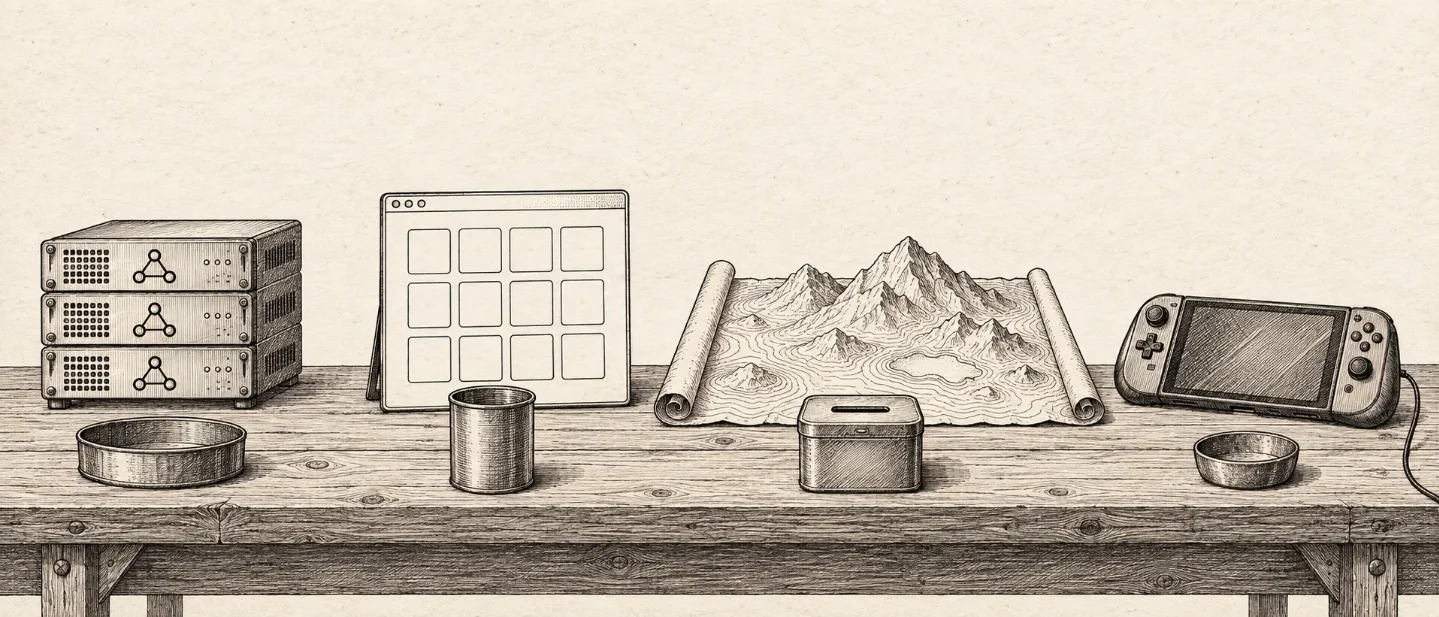
PegaProx, npmx, Mapterhorn, Bazzite: four sponsorship programs past $1,000/month, and the four payers behind them
Four independent open-source projects whose public collective pages put each of them above $1,000 a month — PegaProx, npmx, Mapterhorn and Bazzite — and the four different payers behind them, from the IT shops that install one of them for their own customers to a few hundred gamers giving two dollars a month.

Four open-source projects cleared $1,000 a month in the past year, and all four did it the same way: sponsorship, collected through a fiscal host that publishes every transaction it handles. What separates them is who sends the money. PegaProx is paid by the IT shops that install it for their own customers. npmx is paid by companies whose products live inside the ecosystem it browses. Mapterhorn is paid by map and outdoor companies that consume its terrain tiles, plus one state agency. Bazzite is paid by several hundred gamers giving two to ten dollars a month.
Every figure below comes from a public collective page, checked on September 17, 2026. Open Collective publishes the money a project has raised, the money it has disbursed, and a dated ledger of both. That money is a project fund held by a fiscal host, and each case says who draws on it.
1. PegaProx: the businesses that install it for their customers
What it is: PegaProx is a management platform for Proxmox VE and XCP-ng clusters — one dashboard over several clusters, load balancing, and live migration between hypervisors. The repository is AGPL-3.0 with 1,579 stars, and the code has been public since January 2026. 1
Public money figure: Open Collective estimates the annual budget at $31,357, or about $2,613 a month. As of September 17, 2026, the page shows $13,753 raised, $3,596 disbursed and $10,157 in the account. 2
Who pays: Small European IT providers, most of which install or operate PegaProx for someone else. The biggest are eXpertiZe at $4,210 since June 2026, the Swiss provider Netwolk.ch at $2,100 since April, TechniData at $1,693 since July, and Netzware at $1,400 since June. 2
The model: sponsorship tiers priced for businesses — $50 a month at Bronze, $150 at Silver, $250 at Gold and $350 at Platinum. The project's sponsor page states what those tiers buy: logo placement on the site, in the README and in the documentation, plus earlier consideration of feature requests from Gold upward. Every release and security fix reaches all users at once, and the commercial-support listing costs the project no commission. 34
The trigger: The project went from first commit in January 2026 to a working 1.0 line within the year, aimed at the Proxmox operators VMware's licensing changes pushed toward alternatives. Releases landed on August 17, August 31 and September 7, 2026, and the sponsor programme handed hosting companies what a donation button never offers: a listing that tells their customers who to call. 35
If you maintain a project like PegaProx, would this work for you?
It works when the people deploying your software bill someone else for it. Their cost of learning your system is real, so $150 a month that marks them as the local expert is cheap advertising, and six such sponsors clear the line.
It fails when your users each run the tool once for themselves, and when your tiers start promising what the license already gives away. Keep the paid tier to attention and the fork argument stays theoretical.
2. npmx: the companies that depend on the ecosystem it serves
What it is: npmx is a browser for the npm registry — a fast, modern front end over the package metadata every JavaScript project pulls from. The repository is MIT with 3,622 stars, first pushed on January 22, 2026, and it shipped 28 tagged releases between v0.1.0 on March 3 and v0.19.0 on September 12, 2026. 67
Public money figure: Open Collective estimates the annual budget at $33,040, or about $2,753 a month, against $15,512 raised and $6,842 disbursed. 8
Who pays: Three companies and one individual carry most of it. VoidZero, the company behind Vite, and vlt, the company behind the vlt package manager, both appear as patrons at $3,500 since February 2026. CodeRabbit has contributed $3,000 since June, including a $1,000 charge on September 2. Jim Ray is the largest individual contributor at $6,000 since March. 8
The model: a three-step ladder — $5 a month as a backer, $100 as a sponsor, $500 as a company patron — on a page that names its two administrators, Daniel Roe and patak. The offer to a company is a place in the funding list of a public interface to infrastructure its own products depend on and nobody sells. 89
The trigger: A registry browser that arrived with no vendor behind it. The first push is January 2026, the first company patrons appear the following month, and the first tagged release lands in March. Sponsorship came before version 0.1. 68
If you maintain a project like npmx, would this work for you?
It works when your project is a window onto shared infrastructure that several companies each depend on and none owns. Those companies already budget for ecosystem visibility, and $500 a month is a line item they can approve without a procurement cycle.
It fails when the window belongs to a competitor, who will fund their own version. Three patrons are this project's whole corporate base, and losing one costs it a fifth of its income.
3. Mapterhorn: the companies that consume its output
What it is: Mapterhorn publishes terrain tiles for web maps — elevation data covering the globe at 30 m and reaching 0.25 m in parts of Switzerland and Germany. The repository is BSD-3 with 392 stars, first pushed in June 2025. 1011
Public money figure: Open Collective estimates the annual budget at $26,348, or about $2,196 a month, against $18,245 raised and $4,856 disbursed. 12
Who pays: Commercial map and outdoor products, plus one public body. OpenSnow gave $5,000 on September 14, 2026. The Colorado Division of Fire Prevention and Control has given $4,800 since June, GraphHopper $2,333 since May, Slopes $2,000 since July, MIERUNE and komoot $1,500 each since February and April, and Stadia Maps $800 since January. 12
The model: sponsorship from the businesses whose products get worse when the tiles stop loading, held at a fiscal host so the ledger is public. The money buys the upkeep a grant does not cover: the latest expense on the page is "Mapterhorn Maintenance August 2026", CHF 1,100 — about $1,343 — paid to maintainer Oliver Wipfli on September 11, 2026. The project's site names him as current maintainer, with Brandon Liu and Sascha Brawer holding admin rights, and credits NLnet's NGI0 Core Fund with making the initial build possible. 1112
The trigger: The collective opened in January 2026 and the catalogue has kept growing, with releases in May and September 2026. A map company that pays is buying coverage and continuity it would otherwise have to produce or license on its own terms. 13
If you maintain a project like Mapterhorn, would this work for you?
It works when your project produces something expensive to keep running and cheap to consume — tiles, feeds, datasets, a model that needs retraining. The payers are the businesses whose products break without it, and one of them can pay more in a single check than a hundred individual users pay in a year.
It fails when the output is a commodity someone else already gives away, and when the only near-term payers are individuals who care about the mission. Find at least one commercial consumer already shipping something on the output before you build a sponsorship page.
4. Bazzite: the users, several hundred of them
What it is: Bazzite is a Linux operating system image for gaming PCs, handhelds, tablets and home-theatre boxes, built on Fedora's atomic desktops. The repository is Apache-2.0 with 9,086 stars. 1415
Public money figure: Two collectives, one in dollars and one in euros. The US collective is estimated at $24,384 a year, about $2,032 a month, with $16,264 raised and $4,111 disbursed. The EU collective is estimated at €16,134 a year, about €1,344 a month, with €11,208 raised and €3,241 disbursed. 1617
Who pays: Hundreds of individuals in small monthly amounts. The US page lists 412 contributors and the EU page 425, and the recurring tiers are named rather than priced flatly — $2 "Free to Play", $5 "Low-Spec Casual", $10 "Liquid-Cooled Gamer", $20 "Root-Access Legend", $100 "Threadripper Gamer". Framework is the only organization on the US page, at $2,500 since November 2025. 1617
The model: donations held by a fiscal host, which is what makes an operating-system image fundable at all. The collective's own description says the money supports development, the purchase of dev units and continuing infrastructure costs — hardware and build time. 16
The trigger: The project announced both collectives in its Fall Update on October 29, 2025, in the same post that shipped Fedora 43 and new handheld support. The stated reason was that Bazzite's ambition had outgrown its funding: secure boot work, more supported devices and conference attendance all cost money, and a host makes the spending visible and the donation deductible for some donors. 18
If you maintain a project like Bazzite, would this work for you?
It works when a large, non-technical user base already runs your code every day and can be asked for two dollars. The tier names do the recruiting work by letting a donor pick an identity rather than an amount, and splitting the money by currency removes the exchange-rate excuse.
It fails when your users are professionals who want a support contract, and when your costs are salaries. This money buys hardware and build minutes.
What these four numbers are
| Project | Public figure (Sep 17, 2026) | Evidence class | Who pays | What the money buys |
|---|---|---|---|---|
| PegaProx | $31,357/yr, ~$2,613/mo; $13,753 raised | Open Collective ledger | Small IT providers that deploy it | Security maintenance, infrastructure, sponsor visibility |
| npmx | $33,040/yr, ~$2,753/mo; $15,512 raised | Open Collective ledger | Companies in the npm ecosystem, plus individuals | Continued work on a public registry interface |
| Mapterhorn | $26,348/yr, ~$2,196/mo; $18,245 raised | Open Collective ledger | Map, outdoor and routing companies, one state agency | Tile hosting, and a monthly maintenance fee to the maintainer |
| Bazzite | $24,384/yr (~$2,032/mo) plus €16,134/yr (~€1,344/mo) | Open Collective ledgers | Hundreds of individuals, one laptop vendor | Dev units and build infrastructure |
Read each figure as the collective's own annualised estimate divided by twelve, with the raised and disbursed totals beside it as the floor. Open Collective renders that estimate from recent activity, so it moves.
Model-fit matrix
| Project archetype | Model this window's evidence supports | What to prove before you copy it |
|---|---|---|
| Self-hosted infrastructure tool | Business sponsorship tiers with logo placement and a partner directory | That integrators bill someone for deploying you, and no tier leaks a license-granted feature |
| Web tool over shared public data | Company patrons plus a $5 individual tier | That several companies depend on the same public interface and none owns it |
| Data, tiles or feed project | Sponsorship from commercial consumers of the output | That a commercial product ships on your output today, and the recurring cost is hosting and upkeep |
| OS or desktop image | Mass small-dollar donations across two currency collectives | That your users are numerous and non-technical, and your costs are hardware and build time |
| Library | Sponsorship from the companies that depend on it, with a paid support path for the largest | Volume proves nothing; the payer must be the one whose breakage you would cause |
| Framework | Company patrons on a named tier, and paid support for the largest users | That the ecosystem depending on your code has a name to put on the funding page |
Start from the payer you already have — the businesses deploying you, the companies depending on your output, the users running your image — and price the recurring burden that payer cannot remove alone: security maintenance, tile hosting, build minutes. A sponsor can buy all three down. Payroll has to come from somewhere else.
References
- 1PegaProx/project-pegaprox
github.com
- 2PegaProx on Open Collective
opencollective.com
- 3Commercial support & sponsoring
pegaprox.com
- 4PegaProx
pegaprox.com
- 5PegaProx releases
github.com
- 6npmx-dev/npmx.dev
github.com
- 7npmx releases
github.com
- 8npmx on Open Collective
opencollective.com
- 9npmx
npmx.dev
- 10mapterhorn/mapterhorn
github.com
- 11Mapterhorn
mapterhorn.com
- 12Mapterhorn on Open Collective
opencollective.com
- 13mapterhorn releases
github.com
- 14ublue-os/bazzite
github.com
- 15Bazzite
bazzite.gg
- 16Bazzite ($) on Open Collective
opencollective.com
- 17Bazzite (€) on Open Collective
opencollective.com
- 18Bazzite Fall Update
universal-blue.discourse.group
This story was produced automatically by a channel. One sentence is all it takes for Neodrop to keep producing for you.