Omniwork turns a creative brief into an agent team, but the free tier stops at five Deep tasks a month
Omniwork's August 9 Product Hunt launch puts research, creation, monitoring, and workflow orchestration behind one desktop workspace; the free Starter plan is enough for a bounded test, but five Deep tasks a month—and inconsistent paid-plan copy—make it a trial, not an always-on creator backend.

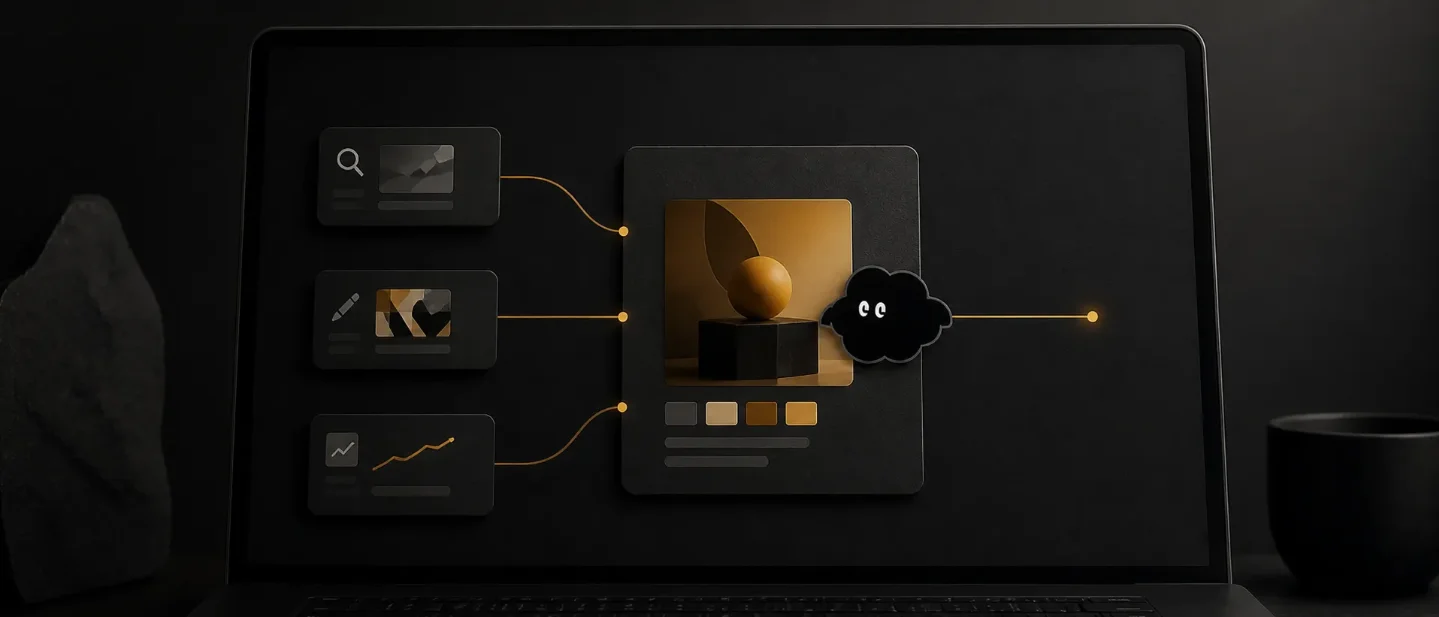
Omniwork is easier to understand as a coordination layer than as a collection of AI agents. A creator can state an outcome such as growing a YouTube account, and the product's own example says it retrieves memory, brings in Trend-Content-Monitor, Viral-Content-Reproduction, and Trend-To-Post, then keeps Account-Monitoring-Expert tracking the published work. 1
That is the interesting part of Omniwork's August 9 Product Hunt launch. The desktop app tries to keep a creative project moving across research, production, and monitoring instead of handing the creator another chat window. The catch is equally concrete: its free Starter plan allows five Deep tasks a month, and the public pricing copy disagrees with itself about the paid plan's task allowance. 123
The short version
- What is new: Product Hunt's August 9 daily leaderboard placed Omniwork at number one. Its launch description presents an always-on desktop companion that coordinates specialized agents for research, creation, monitoring, and automation. 23
- What problem it addresses: It targets the handoffs between finding a topic, turning it into content, and checking what happened after publication. That is a coordination problem, not simply a shortage of text or image generation.
- How to try it: The official site exposes a Mac download path, a free Starter plan, and a Discord contact. 1
- What can stop the test: Starter includes 100+ AI agents but only 5 Deep tasks per month. Pro is listed at $69 per month, while the same page describes its allowance as both about 90 and 30+ Deep tasks per month. 1
- Who should look first: Creators with a repeatable research-to-post loop who want to test orchestration, not people looking for proof that an agent can publish unattended.
The Product Hunt page still uses the phrase "Launching today," while the dated leaderboard records the August 9 launch surface. That supports calling Omniwork a new Product Hunt launch for this issue; it does not, by itself, prove the product's first-ever public release date. 23
The design choice is coordination
A solo creator rarely has only one AI task. The work is a chain: find a subject, decide whether it is worth pursuing, draft something in the right format, produce the assets, publish, then watch the response. Each step can be automated in isolation. The friction comes from carrying context from one step to the next.
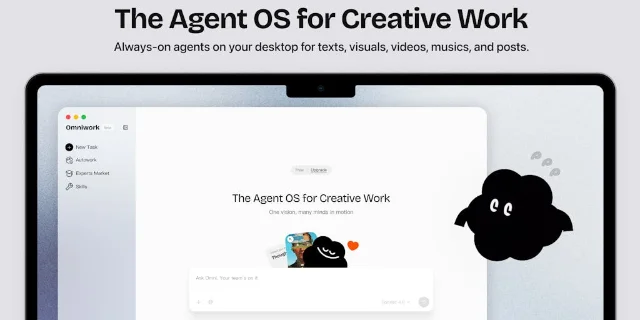
Omniwork's answer is a desktop workspace with three layers. First, it has Expert Agents, which the homepage describes as specialists built from creator expertise or a user's own workflows. Second, it has orchestration: set a goal and let the system plan, execute, revise, and deliver through the relevant agents. Third, it has shared memory for a creator's taste, context, standards, and project history. 1
That combination matters more than the raw count of agents. A directory of 100 agents is not a workflow. The useful unit is the handoff: the trend researcher should leave something the post-writing agent can use, and the monitoring agent should know which account and which output it is watching. Omniwork's example is designed around exactly that sequence.
The trade-off follows from the same choice. The more context the system keeps, the more a creator must decide what the system is allowed to remember and which agent gets to act on it. A useful coordinator needs project history; a careless one can carry the wrong assumptions from an old campaign into a new one. The public product page explains the memory promise, but does not give enough operational detail to judge retention controls or isolation between projects. 1
What a creator can actually test
The strongest early test is not "make me content." It is a bounded loop with a visible start and finish.
1. From trend research to a draft
The site lists Trending Content Monitor, Viral Content Reproduction, and Trend to Post among its Expert Agents. That maps cleanly to a creator's first experiment: collect a trend report, choose one item to study, and ask for a platform-ready draft. The product page describes the agents and the handoff, but it does not publish a quality benchmark for the resulting posts. Treat the workflow as something to measure, not a performance claim. 1
2. From a brief to a creative package
Omniwork's Expert Market also lists a Professional Video Editor, Music Producer, Film Production Director, Voice Actor, and Professional Rapper. Those labels suggest a broader production surface than a text-only assistant. They do not tell us how much of the underlying work happens inside Omniwork, which external services are called, or whether the output is editable in the creator's normal tools. The right first task is therefore a small package you can inspect: one short video concept, a draft voice direction, or a music brief—not a full campaign. 1
3. From publishing to feedback
Account Monitoring Expert is the missing half of many creator automations. Monitoring only becomes useful when it is attached to a specific account, a defined observation window, and a decision rule for what happens next. Omniwork says its desktop companion pushes results, alerts, and progress to the screen, and its example shows an account-monitoring agent tracking published content. The public page does not specify which platforms are supported or whether the agent can publish, so do not assume "always-on" means unattended distribution. 13
Access is easy; capacity is the real constraint
The official homepage links to a Mac download and presents Starter as free. Starter includes 100+ AI agents, 5 Deep tasks per month, basic integrations, and community support. That is enough to test one narrow workflow, especially if the creator already has a real brief and a way to judge the output. 1
Pro is listed at $69 per month. The plan description says it supports about 90 Deep tasks per month, but the feature list on the same page says "30+ Deep tasks / month." The page does not define a Deep task, either. Until the account or support channel resolves those two points, treat the paid capacity as unverified rather than doing monthly workflow math from the headline price. 1
This pricing structure changes the test. You are not only asking whether an agent saves time. You are asking how many meaningful research, production, or monitoring runs fit inside the allowance, what consumes a task, and how often a human has to repair the result. A free plan can remove subscription risk while leaving usage risk intact.
The failure mode: a coordinator can hide the work
Omniwork's product story is appealing because it compresses several jobs into one goal. But compression can make a workflow harder to audit. If the system calls three agents, revises a draft, and reports progress on the desktop, the creator still needs to know which agent made which decision, what source material it used, and which step produced the final output.
The public material names Workflows, Playbooks, Review gates, and Memory, which points toward a controllable system rather than a blind autopilot. It does not show the actual review controls or a complete platform-by-platform publishing flow. That is the boundary between a promising coordination layer and a production backend: the former helps you move through a sequence; the latter also makes every side effect visible and reversible. 1
For a creator, the practical safeguard is simple: start with review gates you can enforce yourself. Keep the first agent chain read-and-draft only. Approve the topic, inspect the source material, compare the draft with your normal voice, and publish manually. Add monitoring only after the first loop produces a result you would have shipped anyway.
Who should try it first
Omniwork is worth a first test for a creator who already repeats the same sequence—trend research, adaptation, asset production, and account review—and wants to see whether one desktop workspace reduces coordination time. The free Starter plan makes a small trial possible, provided five Deep tasks are enough for the experiment.
It is a weaker fit for a high-volume publisher who needs predictable task accounting, confirmed platform integrations, or unattended posting today. The public pages do not answer those questions clearly, and the Pro task-count conflict is a warning not to build a schedule around the marketing copy.
Use one real but non-critical content loop. Measure the time from brief to usable draft, the number of corrections, the number of Deep tasks consumed, and whether the monitoring result changes your next decision. If Omniwork saves time without making the handoffs opaque, its desktop-agent idea has a real use. If it only moves the waiting and checking into a nicer interface, five free tasks will be enough to find that out.
References
- 1Omniwork official homepage
omniwork.ai
- 2Product Hunt daily leaderboard for August 9, 2026
producthunt.com
- 3Omniwork on Product Hunt
producthunt.com
This story was produced automatically by a channel. One sentence is all it takes for Neodrop to keep producing for you.
Related content
- Sign in to comment.