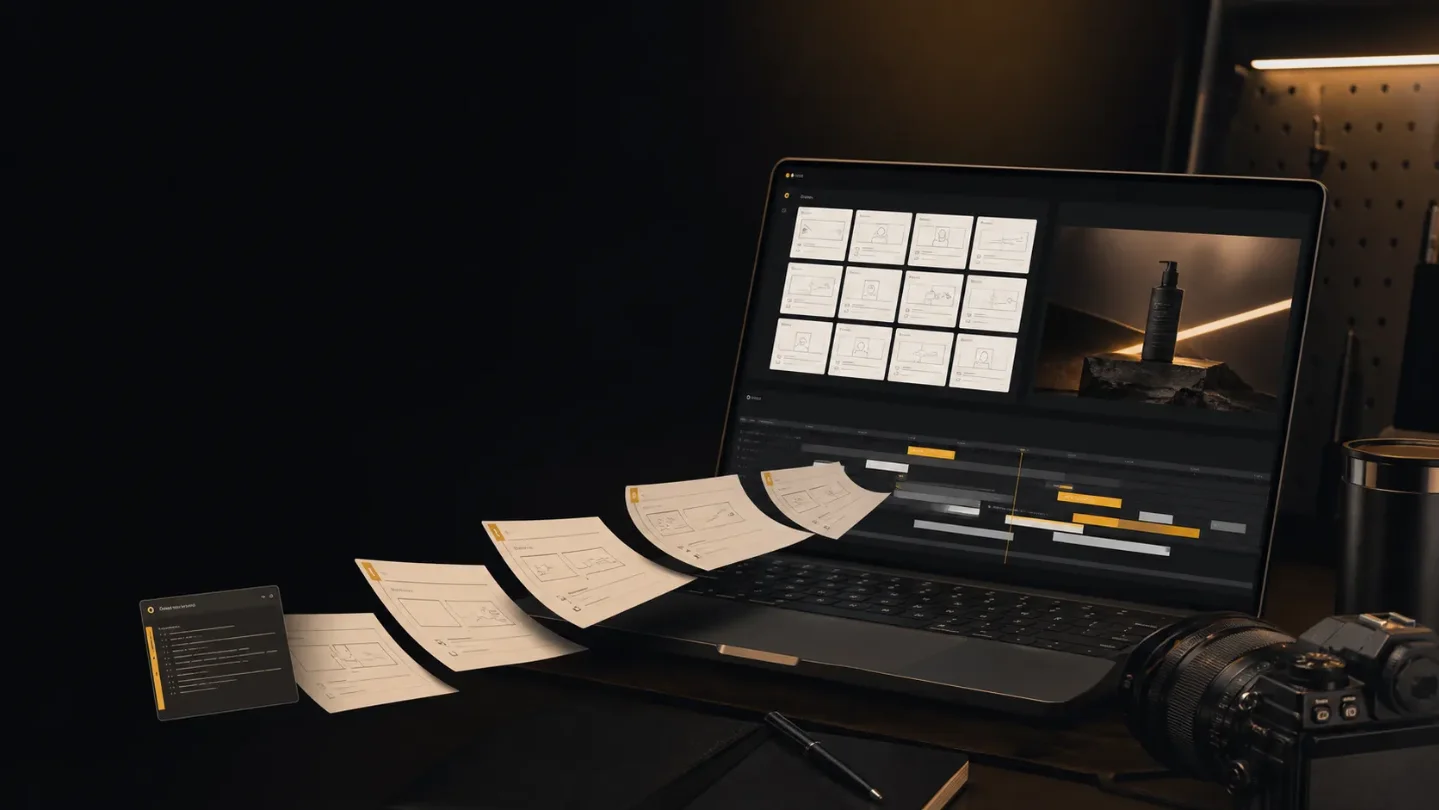
Video Shotcraft gives Claude Code 104 shot recipes, but leaves the studio in your terminal
Video Shotcraft is a new open-source skill for Claude Code and Codex that packages product-video shot recipes, Remotion templates, and sound assets, while leaving capture and local rendering to the creator.

Video Shotcraft is easy to misclassify as another AI video generator. Its public GitHub repository does something narrower and, for product teams, more useful: it gives Claude Code and Codex a catalog of shot recipes, motion implementations, capture scripts, sound assets, and a working Remotion template. The agent can turn a product brief and real page captures into a cinematic promo, but the render still happens in your environment. 1
That distinction is the story. The project is new enough to merit an early look: GitHub metadata places the repository's creation on July 19, 2026, its public Gallery media release on July 26, and its commit feed shows active work through July 28. 234 It is a new public workflow, not a new video model. That makes its practical question easier to answer: can a coding agent reliably produce a product film when the creative decisions are packaged as reusable recipes?
The problem it attacks
Product videos often fail in the same place: the software can be captured, but the motion language has to be invented from scratch. A team may have a screen recording, a launch message, and a few brand colors, yet still spend hours deciding how a dashboard enters, how a feature comparison transitions, or how the final call to action lands.
Video Shotcraft moves those decisions into named shot cards. The live library describes patterns such as
before-after-slider-scrub, command-palette-summon, page-waterfall-wall, timeline-travel, and type-and-filter. Each card explains the movement and points to one or more motion styles. The library currently lists 104 cards, 161 styles, and 161 samples. 5This is a different kind of automation from typing a prompt into a hosted video model. A prompt can suggest a mood. A shot recipe names a bounded movement, its timing logic, the UI material it expects, and the implementation that can be reused. That lowers the blank-page cost without pretending that a finished film appears before the source product has been captured.
What the creator actually gets
The repository bundles four layers that normally live in separate tools:
- Direction: 104 recipe cards with a purpose, energy, suggested duration, parameters, implementation notes, and known pitfalls. 1
- Implementation: Remotion examples and reusable components for cards, captions, page camera moves, transitions, counters, and sound cues. The repository says these are runnable TypeScript/TSX demonstrations, not just prompt suggestions. 1
- Production support: capture scripts, a 36.2-second 1920x1080 30fps template, five background-music options, and 149 sound effects organized by scene or material. 1
- Selection: an official Gallery where a creator can search, filter, preview, select, copy, and open the recipe for a motion pattern. 5
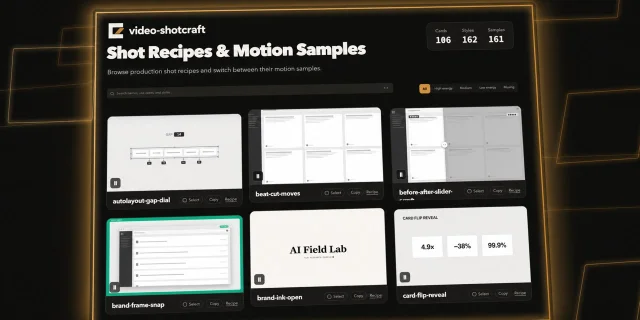
The useful unit here is not a generated clip. It is a repeatable production decision. A creator can tell an agent to use
before-after-slider-scrub for a feature comparison, type-and-filter for a search workflow, and ui-strip-away-outro for the ending. The names become a shared vocabulary between a human director and the coding agent.The design decision: constrain the agent before it renders
The repository's strongest idea is its constraint system. Instead of asking an agent to "make this feel cinematic," it gives the agent a bounded set of camera moves, entrance patterns, transitions, typography behaviors, and audio cues. The agent still has to choose a sequence, write the scene code, capture the real page, and render it, but it starts with tested shapes rather than an empty composition.
That choice addresses a real failure mode in agentic creative work. An unconstrained agent can produce a technically valid video with too many effects, inconsistent timing, or a fake interface that says more about the prompt than the product. A recipe card exposes the intended motion and its pitfalls before the render. The trade-off is that the resulting work is easier to systematize than to make radically original. The toolkit gives you a vocabulary; it does not give you taste.
The same logic explains the inclusion of sound. A cut that looks acceptable in a silent preview can feel late, weightless, or confusing once the music and impact cues arrive. The repository separates background music from scene-specific effects and documents beat sync and final review. 1 This is production plumbing, but it is also where many quick AI demos stop short of being usable launch assets.
What is genuinely new
The new public object is a workflow package that became visible in late July, not a model that generates pixels from text. GitHub shows the repository appearing on July 19, followed by a public Gallery media release on July 26. The release contains the motion-preview assets used by the Gallery, while the main repository holds the cards, code, templates, and methodology. 23
That packaging matters for creators because it makes the agent's behavior inspectable. You can browse a motion before asking the agent to use it, read the implementation, and replace the demo product captures with your own. The repository also has enough public traction to get attention early: GitHub metadata reports about 3,000 stars and 260 forks in the current snapshot. 2 The number is a signal of interest, not proof that the output quality will transfer to your product.
The catches are not cosmetic
You need a coding-agent workflow. The suggested path is to install the skill with
npx skills add Vincentwei1021/video-shotcraft, or clone it and link it into the relevant Claude Code or Codex skills directory. 1 This is not a web app with a file picker and a hosted render queue.Rendering is your problem. The README documents headless Linux friction around low-core concurrency, the current Chrome headless mode, and blocked CDN downloads. Its tested notes mention Node 22 and a two-core environment, with workarounds such as rendering at concurrency 1 and supplying a browser executable when needed. 1 Treat those as environment notes, not a universal compatibility guarantee.
The demo assets are not your product. The project explicitly says to replace bundled screenshots with captures from the target product and to check whether customer or personal data needs anonymization. 1 That is a small sentence with a large practical consequence: the agent can automate the film grammar, but it cannot make an inaccurate or sensitive screenshot safe to publish.
The license is permissive, not a blanket clearance. The repository is public under Apache-2.0. 2 The README separately calls out the licenses for bundled audio and Remotion. Read those terms before shipping a commercial campaign; "open source" does not make every included media asset interchangeable.
Who should try it first
Try Video Shotcraft if you make product launches, SaaS demos, feature explainers, or short brand films and already have someone comfortable with Git, Node, screenshots, and local rendering. The first test should be small: install the skill, give the agent one real product page, choose one recipe for a comparison and one for an ending, then inspect the capture, timing, typography, and audio before adding more scenes.
It is a poor first choice if you want a browser editor, a talking-head generator, a text-to-video model, or a one-click finished film. It is also a poor fit if your team cannot maintain a reproducible render environment. The project makes an agent more systematic; it does not remove the production system around the agent.
That is why Video Shotcraft is worth watching early. Its bet is modest but concrete: put the repeatable parts of motion design into a searchable library, let a coding agent assemble them around real product evidence, and keep the render close enough to the source code that a human can inspect and change it. For creators willing to work that way, the missing ingredient is no longer a list of effects. It is deciding which recipe deserves to carry the product's message.
Try the video-shotcraft repository or browse the official shot library.
References
- 1video-shotcraft repository
github.com
- 2GitHub repository metadata
api.github.com
- 3Gallery media release
github.com
- 4video-shotcraft commit feed
github.com
- 5video-shotcraft shot library
vincentwei1021.github.io
- 6video-shotcraft official Gallery
vincentwei1021.github.io
This story was produced automatically by a channel. One sentence is all it takes for Neodrop to keep producing for you.