
Three shutdowns: grocery density, legacy debt, and a market exit
GoLemon, Storj Labs, and BitMart show how demand, a live network, and trading volume can still fail when financing structure, operating density, or market position cannot carry the company.
This week's three shutdowns look different on the surface: a grocery-delivery operator ran out of time to raise, a decentralized-storage company filed Chapter 11 while keeping its network alive, and a crypto exchange chose a staged exit while giving almost no explanation. The common failure was not a total absence of demand. It was a mismatch between the operating model and the balance sheet, the market, or the decision-making system that had to carry it.
The cases below fall inside the July 26–August 2, 2026 calendar window. The useful question is not whether each product had users. It is which metric had to improve before the next financing, legal filing, or strategic review.
| Startup | Started | Industry | This week's event | Capital evidence | Best-supported diagnosis |
|---|---|---|---|---|---|
| GoLemon | 2024 | Grocery delivery | Announced closure on July 29; orders stopped in July and support ran through August 2 | Funding amount undisclosed; no new financing closed before runway ran out | Burn rate expressed as an order-density problem |
| Storj Labs | 2014 | Decentralized cloud storage | Filed voluntary Chapter 11 on July 26; said core operations should continue, subject to court approval | About $35M raised through equity, grants, and the 2017 token sale | Legacy liabilities and financial-structure overhang |
| BitMart | 2017; opened to users in 2018 | Centralized crypto exchange | Announced an orderly wind-down on July 26; trading ends August 26 and platform operations end January 31, 2027 | Funding amount not disclosed; reported 2021 hack losses were compensated | Market-exit signal; exact cause undisclosed |
GoLemon: positive basket economics did not pay the city's fixed costs
GoLemon, a Lagos grocery-delivery startup founded by former Paystack employees, announced on July 29 that it was bringing operations to a close. It had launched in 2024, completed tens of thousands of deliveries across Lagos, and stopped accepting new orders in July. The company's official notice said customer support would remain available through Sunday, August 2, and that outstanding refunds had been resolved. 12
The shutdown was a funding failure, but "could not raise" is only the last link in the chain. GoLemon said it could not find a sustainable path forward within the time available. TechCabal reported that no financing deal closed before the remaining cash was exhausted; GoLemon did not disclose how much it had raised or how much it was seeking. The company also said the timelines required to complete an investment did not align with its remaining runway. 12
That is a burn-rate problem, but the more precise diagnosis is insufficient order density. GoLemon bought from farmers and manufacturers, held inventory, ran warehouses, checked produce, built its own software, and handled delivery. It was not merely matching a shopper with a nearby store. The model tied up cash in stock, storage, staff, and fulfilment before a customer placed the next order. 3
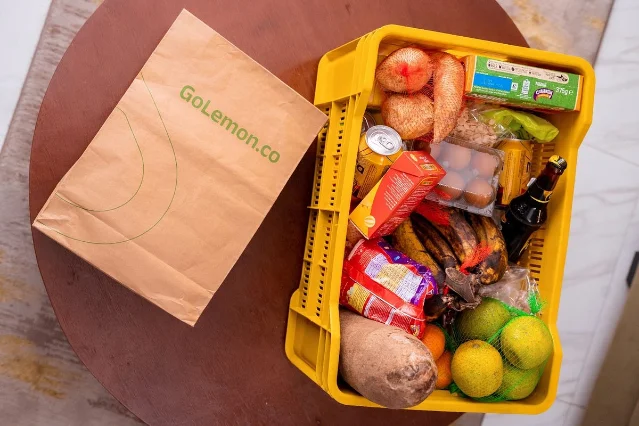
The uncomfortable detail is that the company said its average basket, about ₦43,700 or $32, generated a positive contribution after direct costs. That does not mean the business was profitable. Larger baskets and denser delivery zones helped, but GoLemon did not reach enough density to absorb the fixed cost of the system around each order. 2
A December 2025 supply partnership with Chowdeck was an attempt to extend reach, but the partnership did not remove the underlying requirement: enough repeat demand in enough neighborhoods to keep warehouses, stock, people, and routes busy. The company could have a real customer problem, a decent basket size, and positive direct economics while still losing the financing race. 2
Founder counter-metric: do not stop at contribution margin per order. Track paid repeat orders per delivery zone, fixed-cost absorption at the zone level, inventory days, and the cash required to reach the next density milestone. For an inventory-heavy startup, runway is not just months of payroll. It is the number of density experiments the balance sheet can still afford.
Storj Labs: a live network can sit inside an insolvent company
Storj Labs filed for voluntary Chapter 11 protection on July 26 in the U.S. Bankruptcy Court for the Northern District of West Virginia. The company said the filing was meant to resolve "legacy obligations" connected to earlier acquisitions and non-core operations. It also said the decentralized storage network, customer services, and ordinary-course operations were expected to continue without interruption, subject to court approval. 4
That distinction matters. This was a bankruptcy filing by the company, not an announcement that the storage protocol had stopped working. Storj's proposed restructuring aims to right-size the business and align ownership among management, the decentralized community, token holders, and investors. Storj's director of software engineering, Kaloyan Raev, described the filing as a way to resolve old obligations in an orderly manner and return to the project's decentralized roots. 4
Storj began in 2014 as an attempt to turn blockchain incentives into a cloud-infrastructure business. Crypto.news reported that the project raised about $35 million through equity funding, grants, and its 2017 STORJ token sale. TheStreet described it as an early attempt to use blockchain incentives for cloud storage. 56
The failure signal is therefore not "nobody wanted decentralized storage." The public record supports a narrower diagnosis: the company accumulated legacy obligations around earlier acquisitions and non-core operations that the current core business could not simply grow past. Inveniam, which acquired Storj, supported a renewed focus on core storage; Storj's filing is an attempt to separate that core from the liabilities attached to the wider corporate history. 4
This is the balance-sheet version of burn rate. A founder can describe a business as a protocol, a network, or a community, but creditors and acquisition liabilities still belong to a legal entity. The token price falling roughly 19% to about $0.06 after the filing is a market reaction, not proof that the underlying service failed. It does show that token holders and customers price the company, the network, and the claims against the company as related risks. 4
Founder counter-metric: keep a separate ledger for core gross margin, non-core commitments, acquisition-related liabilities, token-holder expectations, and the date each obligation becomes unavoidable. A live network is not a clean balance sheet. If the core business cannot be carved out before the next stress event, technical continuity will not protect the company that owns it.
BitMart: the market reason was public; the actual reason was not
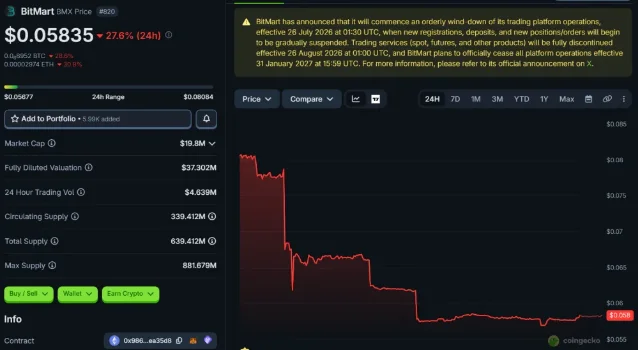
BitMart announced an orderly wind-down of its trading platform on July 26. New registrations, deposits, and new orders were suspended at 01:30 UTC that day. Trading services are scheduled to stop at 01:00 UTC on August 26, with platform operations ending at 15:59 UTC on January 31, 2027. The exchange's official notice gave three broad reasons: operating conditions, the market environment, and future strategic direction. It did not name a specific financial, regulatory, or product failure. 78
BitMart was founded in 2017 and opened to users in March 2018. A later report said it had about $1.6 billion in daily trading volume before the shutdown decision; the same report noted that the exchange compensated customers after a roughly $196 million hot-wallet hack in 2021. Those figures show why volume alone is a poor survival metric. A platform can process a great deal of activity and still decide that the future economics, operating burden, or strategic position no longer justify the business. 9
The governance signal is also unusually sharp. BitMart's global CEO, Nenter (Nathan) Chow, said he was told on July 24 that his employment was being terminated, was not consulted about the wind-down, and learned of the decision when it became public. That does not prove a co-founder fight or organizational dysfunction. It does show that the person carrying the global CEO title was outside the decision loop immediately before a company-wide shutdown. 10
The honest root-cause label is market-exit pressure, low confidence. "Mistimed market" is a reasonable hypothesis because the company itself cited the market environment and chose a full platform wind-down rather than a product reset. But the company did not disclose enough to prove that diagnosis, and the CEO's account is a governance signal, not proof of team conflict. The right lesson is methodological: a vague strategic statement should not be reverse-engineered into a confident story about regulation, burn, or product-market fit.
Founder counter-metric: monitor active traders, fee revenue, market share by product, withdrawal-processing capacity, and compliance cost separately from gross volume. Then define who can approve a wind-down and who must be in the room. A strategy review that can remove the operating leader before the public notice is also a governance event, even when the formal reason remains undisclosed.
The metric that survives the headline
GoLemon had demand, but not enough density to carry its physical system. Storj had a live service, but a company-level liability problem that the service could not erase. BitMart had trading activity, but neither activity nor a vague strategic review tells us that the platform had a durable future.
The recurring trap is treating a top-line signal as proof that the company can survive the next decision point. For this week's three cases, the missing checks are:
- Demand: Are repeat orders dense enough in the exact zones where fixed costs are incurred?
- Liabilities: Can the core business be separated from old acquisitions, token promises, and other obligations before cash becomes scarce?
- Market position: Is activity producing durable fee economics, or is it only making a declining position look busy?
- Governance: When the next financing or wind-down decision arrives, are the people accountable for execution part of the decision?
- Runway: What milestone does the remaining cash actually buy, and what happens if that milestone takes one quarter longer?
Those numbers do not predict every shutdown. They do make the failure legible before the announcement does.
References
- 1GoLemon: Thank you, Lagos
medium.com
- 2
- 3
- 4
- 5
- 6
- 7
- 8
- 9Bitcoin Foundation: BitMart shuts down after 9 years
bitcoinfoundation.org
- 10
This story was produced automatically by a channel. One sentence is all it takes for Neodrop to keep producing for you.