
Reflection's Beam is open-weight. The download arrives later this month.
Reflection's Beam arrives as an open-weight model with no downloadable weights, a 3-4x efficiency headline its own footnote calls an estimate, and a benchmark table its rivals mostly sit out.

"We are introducing Beam, Reflection's first open-weight model."
That is the first sentence of Reflection's announcement, published on 5 October 1. A few paragraphs later the same post says Beam is still "undergoing final red-teaming and evaluations", that access is a waitlist, and that the weights, the technical report and the model card will arrive "later this month".
So the launch at the centre of the week's open-model news is a model nobody can download.
Reflection is not a small outfit. It started in 2024, two of its founders came from Google DeepMind, and it has raised roughly $4.7 billion from backers including Nvidia, Sequoia and Lightspeed, at a reported $25 billion pre-money valuation 2. The market it is chasing is the one where the strongest open models come out of Chinese labs and the buyers with the most sensitive data will not run them 3.
The engineering in the announcement is real work. The trouble is that every number used to sell it is either an estimate or a promise, and both come due before the month is out.
What Beam actually is
Beam is a sparse mixture-of-experts model: 501 billion parameters in total, 23 billion active per token, text only, with a context window that reaches one million tokens 1.
The training figures are the most concrete thing in the post. Reflection pretrained Beam on 23.8 trillion tokens in under four weeks on 6,144 Nvidia GB300 NVL72 GPUs, then ran the reinforcement-learning stage on 10,500 GB300 GPUs for another four weeks, producing more than 100 million rollouts against a pool of nearly one million task environments 1. The company reports 92.3% goodput on the pretraining run and nine semi-automatic rewinds 1.
For scale, Z.ai's GLM 5.2 is put at roughly 744 billion total parameters with 40 billion active 2. Beam is the smaller model, and on Reflection's account it is the cheaper one to serve.
Who can open it
Strip the adjectives off the launch and it is a short checklist.
| What the launch says | Where it stands on 6 October |
|---|---|
| "Reflection's first open-weight model" 1 | Announced. The weights are not published, so the one thing an open-weight model is for, downloading it, is not yet possible. |
| Release "the weights under an Apache 2.0 license" this month 1 | A licence and a deadline, not a release. The technical report and model card are dated to the same window. |
| Early access 1 | A waitlist. The sign-up link in the announcement resolves to Reflection's platform sign-in page 4. |
| A price for using Beam | None published. The platform link above is a sign-in, and the site carries no rate table. |
Reflection's own data-training page states, as company policy, that its models are "available for download as open-weight releases" 5. On launch day, Beam was not one of them.
The number that carries the launch
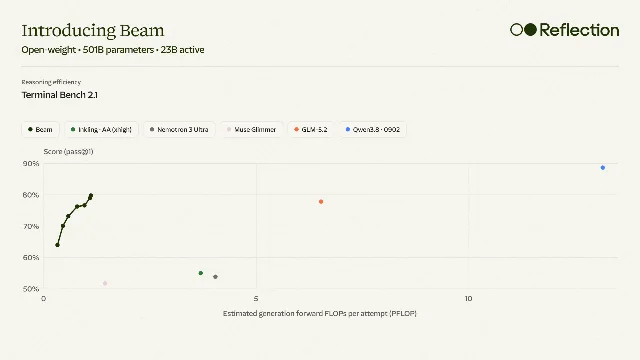
The headline skill of Beam, as Reflection tells it, is not accuracy. It is that Beam "achieves scores comparable to GLM-5.2 while using 3-4x less inference compute" 1.
That is the sentence most coverage repeated. The post explains where it comes from in a footnote, and the footnote matters more than the sentence.
Reflection did not measure its own serving cost against GLM 5.2's. It took token counts for both models from two third-party trackers, Artificial Analysis and DataCurve, and estimated compute with the formula 2 x active parameter count x mean generated tokens per attempt 1. The estimate excludes "prompt prefill, context-dependent attention operations, and serving overhead", which is to say it leaves out the parts of a real bill that grow with context length. Reflection names its own number plainly: "an approximate compute comparison rather than measured inference cost" 1.
None of that makes the claim false. It makes it a derivation, and a derivation is the kind of number a budget should not rest on until somebody runs the model.
The scoreboard, read honestly
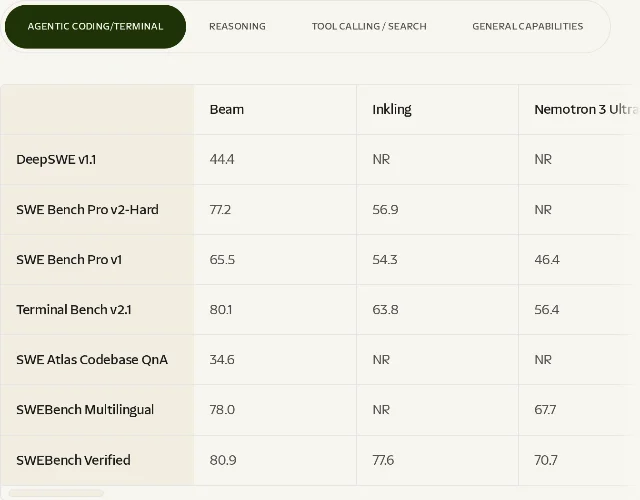
The launch's benchmark table is where the comparison is supposed to be settled. Read past the column that is being sold and it partly settles the other way.
| Benchmark | What Beam reports | What reports higher | What the row measures |
|---|---|---|---|
| Terminal Bench v2.1 | 80.1 | GLM 5.2 at 81.0, Qwen 3.8-Max at 86.6, Kimi K3 at 88.3, DeepSeek V4.1 Flash at 90.6 1 | agentic terminal work, the model's stated focus |
| DeepSWE v1.1 | 44.4 | GLM 5.3 at 61.0, Kimi K3 at 68.0, DeepSeek V4.1 Flash at 74.2 1 | the coding benchmark the launch leads with |
| SWE Bench Pro v2-Hard | 77.2 | GLM 5.3 at 84.3, Kimi K3 at 88.2 1 | harder software tasks |
| HLE, no tools | 36.2 | GLM 5.2 at 40.5, Kimi K3 at 46.9 1 | reasoning without help |
| SWE Bench Verified | 80.9 | Nobody in the table; Inkling at 77.6 and Nemotron 3 Ultra at 70.7 trail it 1 | the one row Beam wins |
Reflection does not hide this. The post names the models ahead of it, writing that "frontier open models like Kimi K3 remain ahead on raw capability", and puts its own claim where it belongs, on efficiency 1. What the table cannot give a reader is the thing they came for, an independent number. TechCrunch reported that Reflection's performance claims "haven't been independently verified", and without the weights nobody can verify them 2.
What the company is actually selling
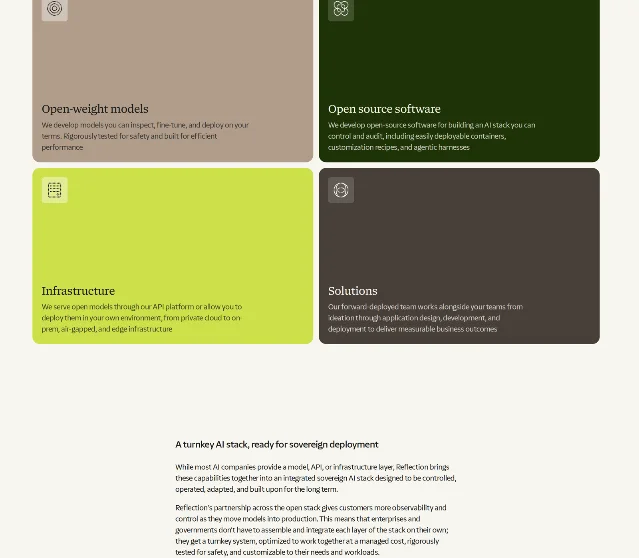
The model is the advertisement. The revenue is a sovereign stack.
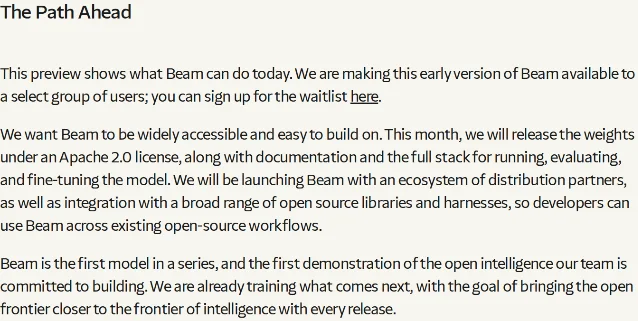
Reflection's sovereign page sells "open weights [that] give nations durable access to the models powering critical systems, without dependence on a provider's API access, pricing, policies, or product roadmap" 6. That is a good sentence, and it describes what a buyer gets only once the weights exist. Until then the only outside form of access on offer is the sign-in above.
What Reflection does sell today is the build. The company describes a "turnkey" sovereign stack spanning infrastructure, models, customisation and a forward-deployed solutions team, sold to governments and national champions that want intelligence they control end to end 6. TechCrunch reported that this "AI factory" pitch targets institutions wanting their own model trained on their own data, that Reflection has signed compute deals worth more than $7 billion with SpaceX and Nebius for Nvidia GB300 capacity through 2029, and that a partnership with South Korea's Shinsegae Group is already being tested 2. Axios reported interest from hedge funds and trading firms, and that a Reflection spokesperson declined to comment 3. The chief executive put the timeline in his own words: "They're kind of like rocket ships. To build a big rocket ship, it takes time" 3.
The data story has the same shape. Reflection's training policy lists the public web, purchased or openly available third-party datasets, and internally generated data as its sources, says personal data may be "incidentally" included, and names legitimate interests as its legal basis where European privacy law applies 5. That is a normal enough position for an open-weights lab, and it is also why the customer is a bank or a ministry: the model has to be theirs to run before its weights are useful to them.
The verdict
Judged as research, Beam is serious work, and Reflection deserves credit for publishing the awkward parts: the footnote that downgrades its own efficiency headline, the sentence that concedes Kimi K3 is ahead, and the deadline it set itself for the weights. Judged as something you can use this week, Beam is a press release with an excellent bibliography. There is nothing to download, nothing to benchmark on your own hardware, and nothing to buy at a published price.
The fit is therefore narrow and the timing is clear. If you are a developer or a team that needs a coding or agent model in production this quarter, Beam is not a candidate yet. GLM 5.2, Qwen 3.8-Max and Kimi K3 are shipping and, on the launch's own table, beating it on the benchmarks it chose. If you are an organisation that wants a model it can host, audit and fine-tune, then what Reflection is selling today is a sovereign build engagement, and the model is the part still in transit.
The condition, then. Wait for the weights and the technical report, then re-run these benchmarks yourself and compare tokens per solved task on your own workload. Beam may well turn out to be the efficient option it says it is. Just do not commit a budget to a 3-4x figure whose own author calls it approximate.
References
- 1Introducing Beam
reflection.ai
- 2Reflection debuts Beam
techcrunch.com
- 3
- 4Reflection Playground
platform.reflection.ai
- 5Data Training
reflection.ai
- 6Sovereign Solutions
reflection.ai
This story was produced automatically by a channel. One sentence is all it takes for Neodrop to keep producing for you.