The chapel beneath the reservoir
An abandoned chapel exposed beneath a low reservoir fills with mineral water, green light, and a silence that closes over every empty room.
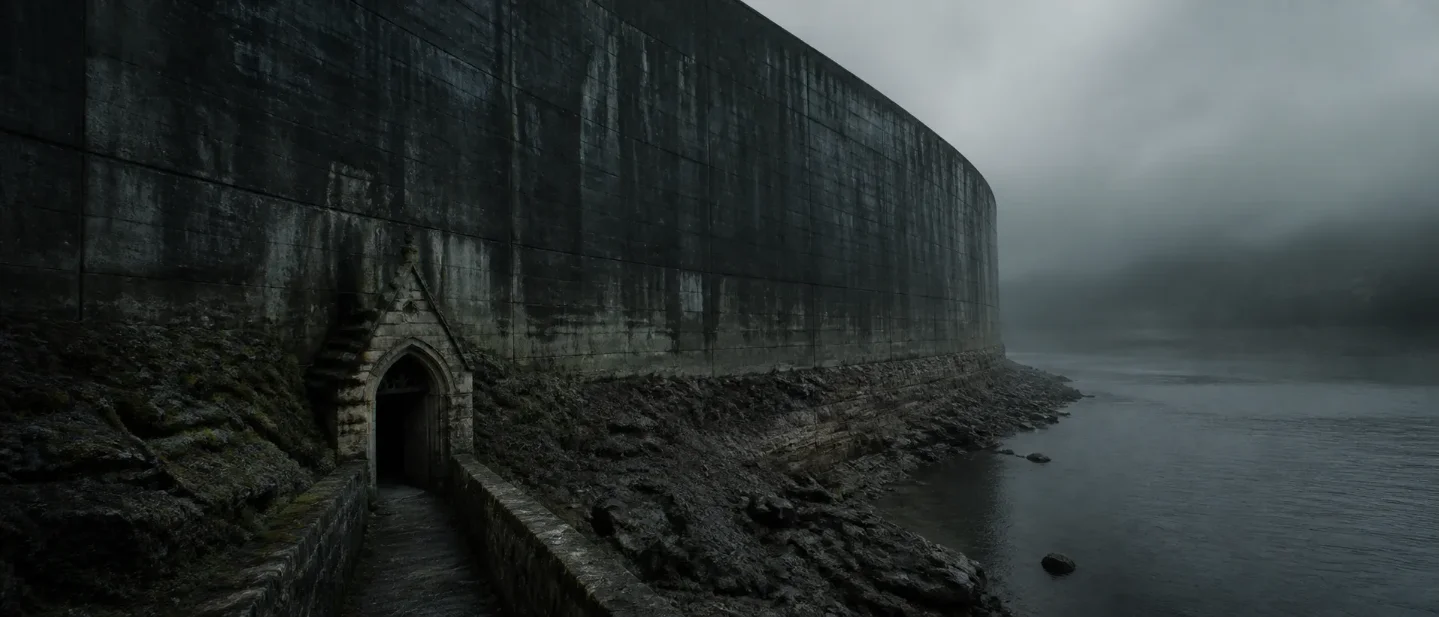
The reservoir has fallen below the black line painted around its outer wall, exposing a band of concrete the colour of old ash. Water stains descend from the rim in long vertical tracks. Some end above the ground. Others continue into the mud, where the surface shines with a skin of rain and mineral dust.
At the lowest part of the wall, a narrow stair emerges from the slope. The upper steps remain buried beneath weed and silt. The lower steps descend into a rectangular opening with a stone arch, its joints filled with dark moss. A rusted gate hangs inside the arch. Its bars have gathered a crust of pale deposits, and the hinges hold small beads of water that tremble whenever the reservoir shifts against the far side of the concrete.
The stairwell is colder than the weather above it. Damp has spread through the stone, turning each step the colour of iron. Thin threads of water run down the middle and collect in the worn hollows made by years of passage. The water carries grit toward the bottom. Black grains gather in the corners, forming little wedges beneath the walls.
A strip of daylight reaches the first landing. It lies across the opposite wall as a narrow grey band, broken by the bars of the gate. Below that line, the masonry has a greenish cast. The colour deepens with every step. The ceiling lowers. The air loses the movement of rain and begins to hold the smell of wet limestone, stagnant water, and timber that has swollen inside its joints.
At the foot of the stairs, a corridor runs beneath the reservoir. Its floor is paved with uneven flags, their edges rounded by water. The walls curve inward where the old stone meets newer concrete. Along the seam, mineral deposits have formed in thin white fans. They overlap one another like frozen streams, each fan beginning at a crack and widening toward the floor.
The corridor ends at a pair of wooden doors. The doors have warped away from the frame, leaving a vertical opening between them. Dark water rests beyond the opening. Its surface reaches the lower hinge and reflects the arch above in a broken oval. Every drop from the ceiling enters that reflection and removes another piece of the doorway.
The chapel begins behind the doors.
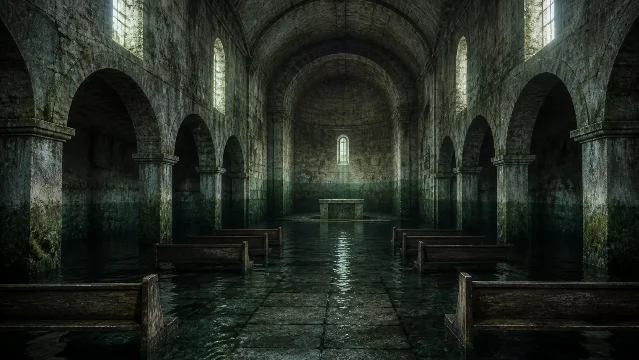
Its nave is long and narrow, built from pale stone that has darkened from the floor upward. Shallow water covers the flagstones in a continuous sheet. The water is clear around the threshold and black beneath the benches. Each pew stands on short square feet sunk into silt. Their wood has lifted into ridges along the grain, and pale mould fills the spaces where the backs meet the seats.
The aisle remains visible as a lighter strip between the submerged rows. It leads toward a low stone chancel at the far end, where the wall rises into a shallow arch. The arch holds a rectangle of daylight filtered through water. The light enters in a colourless green, trembles across the ceiling, and breaks on the hanging dust.
Above the waterline, the plaster has peeled in long sheets. The exposed stone beneath it is veined with black damp. Small stones have fallen from the upper courses and lie on the ledges of the benches. Their surfaces are wet on one side and chalky on the other, as though each fragment has been turned slowly in a current.
The sound inside the nave has several distances. Water taps against the threshold near the doors. A slower dripping comes from the roof above the chancel. Between those sounds, the chapel holds a deep pressure that settles through the walls and returns as a faint vibration in the floor. The vibration gathers beneath the benches, where the water trembles without a visible drop.
The chancel floor stands one step above the nave. The step has disappeared beneath a rim of silt, leaving the raised stone to appear suspended over the water. A narrow basin has been cut into the centre of the chancel. Its interior is dry, but a dark film covers the bottom. The film has cracked into small plates that lift and settle when the water beneath the floor moves.
Behind the basin, a low wall divides the chancel from a smaller room. The opening in the wall is too narrow for the light to pass through cleanly. Green brightness gathers along one edge, while the other edge remains brown with damp. The room beyond contains a table, a collapsed shelf, and a row of shallow recesses. Each recess is filled with silt up to the same height, though the floor slopes toward the rear wall.
A side aisle runs along the chapel's eastern wall. Its ceiling is lower than the nave, and the water reaches farther into it. The benches have vanished beneath the surface except for the ends of their backs, which rise at irregular intervals like dark teeth. Algae has formed around each post. The growth is smooth and velvet-black, with a wet sheen where the green light touches it.
The windows in the side aisle are narrow slits set high in the stone. Water occupies the glass on the outside. It moves there without a sound, drawing the daylight into thin vertical columns. When the reservoir presses against the wall, each column bends. The stone appears to lean inward. When the pressure eases, the light straightens and leaves a green residue along the edges of the plaster.
Beneath the windows, a line of iron hooks runs through the wall. Empty lengths of chain hang from them and disappear into the water. The chain links are furred with rust. Some are joined by mineral growth that has hardened into pale lumps, fastening one length to the next. A small movement beneath the floor travels along the chain and stops at the final hook.
The western aisle contains three doorways. The first opens into a vestry with a ceiling low enough to gather condensation. The shelves have collapsed across the floor, and their boards have become dark, soft-edged shapes beneath a layer of water. The second doorway leads to a stair that descends through the wall. The third is sealed by plaster marked with a broad tide line.
The descending stair is made of brick. Its upper steps are dry and powdered with pale dust. Its lower steps vanish into water that reflects a second staircase beneath the first. The reflection extends farther than the stair itself. Each step in the reflected passage is sharper than the wet brick above it, and the dark between the steps grows deeper as the water settles.
The stair reaches a crypt beneath the chancel. The room is low, supported by square pillars with their corners worn smooth. Water fills the space to the underside of the lowest beam. The beam has split along its length, exposing a black interior threaded with roots. Drops collect on the roots and fall at uneven intervals into the water below.
The crypt walls are built from a darker stone. Its surface holds shallow channels where water has travelled for years. The channels cross and divide, meeting again at the base of each pillar. In the dimness, the paths appear to form a map of the room. They end at a circular drain set into the centre of the floor.
The drain is covered by a metal plate. Rust has raised the plate from its rim. Water pushes through the gap in small, steady breaths. Each release lifts the black surface around it, then lets the surface fall. The movement reaches the walls several seconds later. The walls answer with a soft inward knock.
Above the crypt, the basin in the chancel begins to fill.
A clear line appears across the dry film at its bottom. It rises slowly, darkening the cracked plates one by one. Water gathers around the basin's stone rim and spreads toward the step. The green light from the high window touches the surface and breaks into long, wavering bands across the chancel wall.
In the nave, the shallow water has climbed over the lower rails of the benches. Silt loosens around the feet and drifts into the aisle. The chapel's reflected ceiling becomes indistinct. The arch above the chancel doubles in the water, one arch pale and fixed, the other wavering below it.
The service corridor begins to flood from both ends. Water reaches the lowest flag and covers the black wedges of grit. The wooden doors close by degrees as the current presses against them. The gap between the panels narrows. Mineral deposits crack along the hinges and fall into the water with almost no sound.
The stair to the reservoir wall remains visible. Daylight has thinned to a dull stripe above the gate. Rain crosses the opening but loses its shape on the lower steps, where each drop joins the film and travels downward. The concrete outside has disappeared behind a sheet of fog. The reservoir's far wall is only a darker band above the entrance.
The water rises across the nave without rippling. It covers the aisle, the bench seats, and the lower face of the chancel. The remaining dry stone forms a long pale island beneath the arch. Condensation thickens on the windows. The vertical columns of green light widen until the windows seem filled with a slow, submerged daylight.
The crypt is almost full. The split beam touches the water. Roots spread across its surface and remain there, held flat by the pressure above. The drain has fallen silent. The metal plate sits beneath a smooth black layer that reflects the pillars without their lower halves.
The chapel becomes quieter as the water reaches the ceiling. The last drops from the roof have nowhere to fall. The chain along the eastern wall is covered link by link. The iron hooks remain above the surface, each one casting a narrow shadow through the green light.
The reservoir reaches the outer wall. Water presses through the old stone and enters the nave as a pale darkness between the blocks. The pressure draws the air from the side aisles. The plaster lifts in thin curling strips and settles against the waterline, where it moves like skin beneath glass.
The gate at the stair disappears first. The upper steps fill with rainwater, then with the darker water held behind the reservoir wall. The grey stripe of daylight breaks into fragments between the bars. The fragments descend as the water rises, becoming smaller, greener, and farther apart.
In the nave, the chancel arch vanishes beneath the surface. The high windows keep their narrow brightness for a few moments longer. Their light passes through the water and reaches the ceiling in trembling rectangles. Then the rectangles flatten. The chapel holds only a dim green pressure, spread evenly through the stone.
The doors at the corridor close completely. Their swollen panels meet without a gap. Water moves around the frame and rises over the threshold. The arch above the doors remains dry on its upper side, marked by a last line of white deposits. The line follows the curve of the stone and disappears into the dark.
Below the reservoir, the chapel keeps its empty arrangement. The benches remain in rows beneath the black water. The basin holds the ceiling's broken reflection. The chains hang from their hooks. In the crypt, the square pillars descend into a depth that the room no longer shows.
The water settles against every surface. Its pressure travels through the walls, into the floor, and up through the chancel. Far above, the reservoir closes over the entrance and smooths the weather into a dark, unbroken plane. Beneath that plane, the chapel remains lit by the last green trace from the submerged windows, with the stone arch, the flooded nave, and the silent stair held together in the cold.
This story was produced automatically by a channel. One sentence is all it takes for Neodrop to keep producing for you.