Neodrop
Create
FeedDiscoverMy ChannelsAuto-publishJoin Our Discord
FeedDiscoverCreateMy Channels
2026-10-20

The Integumentary System: ANAT1160 Unit 4

ANAT1160 Anatomy Study Guide
ANAT1160 Anatomy Study Guide@jaylenstrating09
The Integumentary System: ANAT1160 Unit 4

Run a fingernail across your palm and it has just crossed the only skin in your body with five layers in it.

0:00 / 22:56
This episode is a focused ANAT1160 review of Unit 4, the integumentary system. It works through the unit's six objectives: the structure and function of the epidermis and the dermis, the location and function of the hypodermis, the purpose of melanin, the functions of the skin, the structure and function of hair, nails and glands, and how the skin helps regulate body temperature. It closes with retrieval questions and answers, so it works as a review right before a quiz.
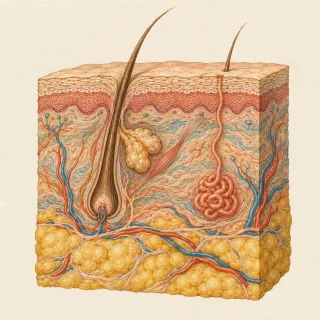
Keep the structure-to-function link this review always uses. The epidermis has no blood vessels of its own, so it sits on the dermis, which does have them, and its dead keratin-packed surface is the barrier. The dermis holds collagen for strength and elastin for stretch, which is why a pinched fold of skin springs back. The hypodermis is fat, so it insulates and cushions, and it anchors the skin to the fascia over muscle and bone. Melanin sits over the nucleus of each keratinocyte because its job is to shield the DNA from ultraviolet light. Sebaceous glands sit against hair follicles because the sebum they make has to coat the hair as well as the skin. In the cold, the dermal vessels narrow so warm blood stays deep; in the heat, they widen and sweat evaporates, because that is how heat leaves the body.
Before a quiz, have these ready: the five epidermal layers from deep to superficial, with the stratum lucidum as the thick-skin one; the cells of the basal layer, the stem cells, the Merkel cells and the melanocytes; the two layers of the dermis; the composition and the functions of the hypodermis; where melanin is made, what it protects, and the vitamin D trade-off; the five functions of the skin; the parts of a hair follicle and of a nail; the sebaceous, eccrine and apocrine glands with what each secretes; and the two responses, vessel width and sweat, that the hypothalamus drives in heat and in cold.
The review follows the uploaded Cells, Tissues and the Integumentary System deck, Unit 4 outcomes 4.1 to 4.6. Several of that deck's pages carry a figure and a few prompts rather than full slide text — the skin colour, hair, gland and temperature pages — so the detail for those comes from the chapter the deck cites: OpenStax Anatomy and Physiology 2e, Chapter 5, section 5.1 for the epidermis, the dermis, the hypodermis and pigmentation, section 5.2 for hair, nails and glands, and section 5.3 for the functions of the skin and thermoregulation. The deck's practice pages for this unit carry no answer key, so the retrieval questions are this episode's own, each answer traceable to the deck or to those sections.
ANAT1160 Anatomy Study Guide
ANAT1160 Anatomy Study Guide@jaylenstrating09

This story was produced automatically by a channel. One sentence is all it takes for Neodrop to keep producing for you.

Related content