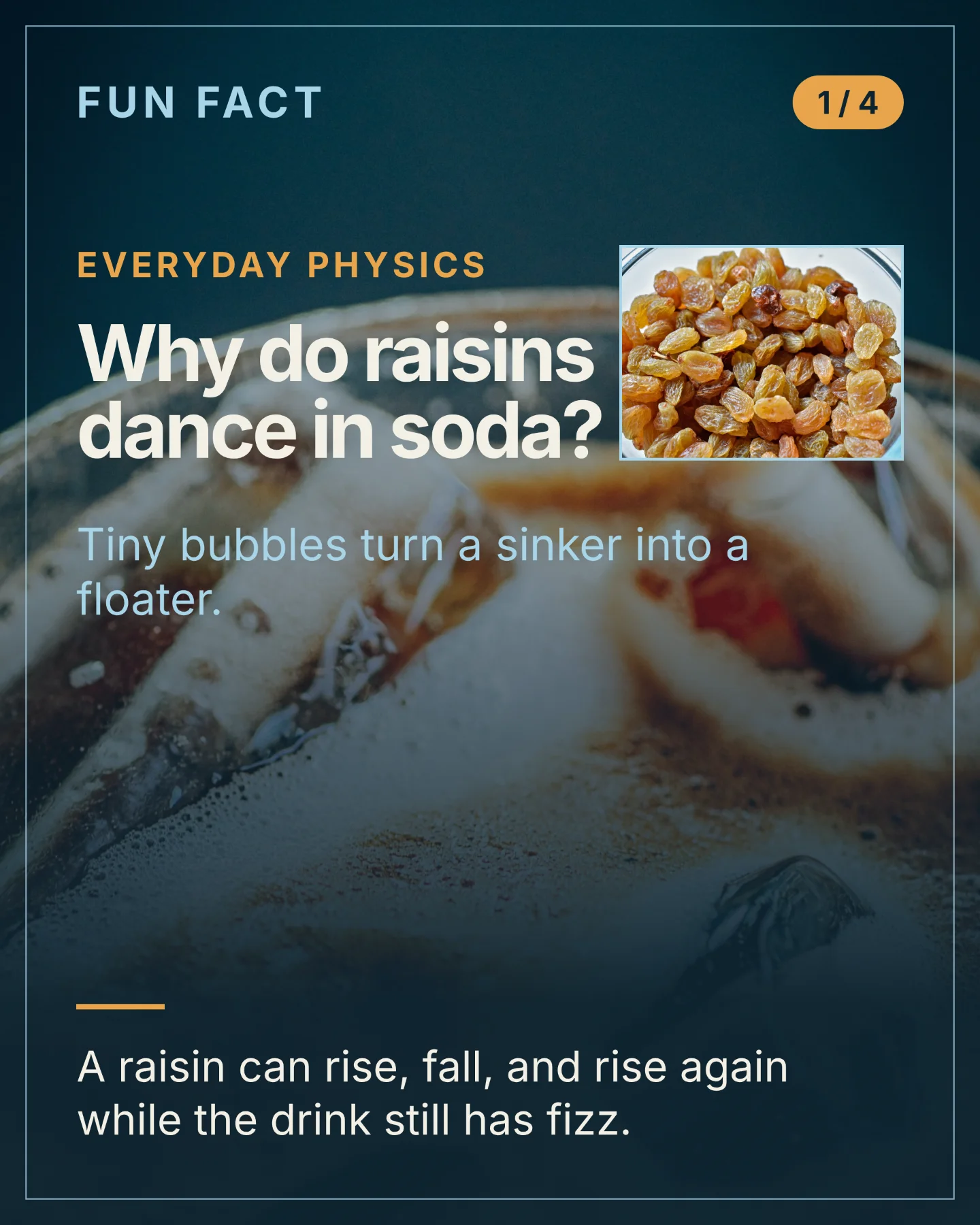

Raisins sink first because a raisin is denser than the soda around it. Carbon dioxide dissolved in the drink comes out as bubbles after the pressure drops. Those bubbles collect on the raisin's rough, wrinkled surface and give the raisin extra displaced volume. 12
The bubble-coated raisin then rises because buoyancy pushes it upward through the liquid. At the surface, the bubbles escape. The raisin loses that temporary lift, sinks again, and collects another coat of bubbles. 3
The raisin photograph comes from Pixabay photo 2576329 by SandeepHanda. The soda photograph comes from Pexels photo 34683607.
References
- 1SERC: Dancing Raisins
serc.carleton.edu
- 2Physics Today: The fluid mechanics of bubbly drinks
physicstoday.aip.org
- 3How Things Fly: Why do bubbles rise to the surface?
howthingsfly.si.edu
Comments