The distance effect: why your milk run costs more than milk

Dairy arrives at the supermarket's back-loading dock, and the walk-in coolers are built against the back wall because that is where the dock is. Serious Eats asked a food-safety specialist at Penn State why refrigerated dairy sits at the back, and the answer is the cold chain: milk comes in through the dock, goes straight into the cooler, and the back wall is the farthest point from the doors and the windows that swing its temperature. 1
The belief that the milk is placed there to pull you past everything has been repeated for decades and never settled. NPR's Planet Money put the question to a food writer and an economist in 2014 and let them argue it out. 2
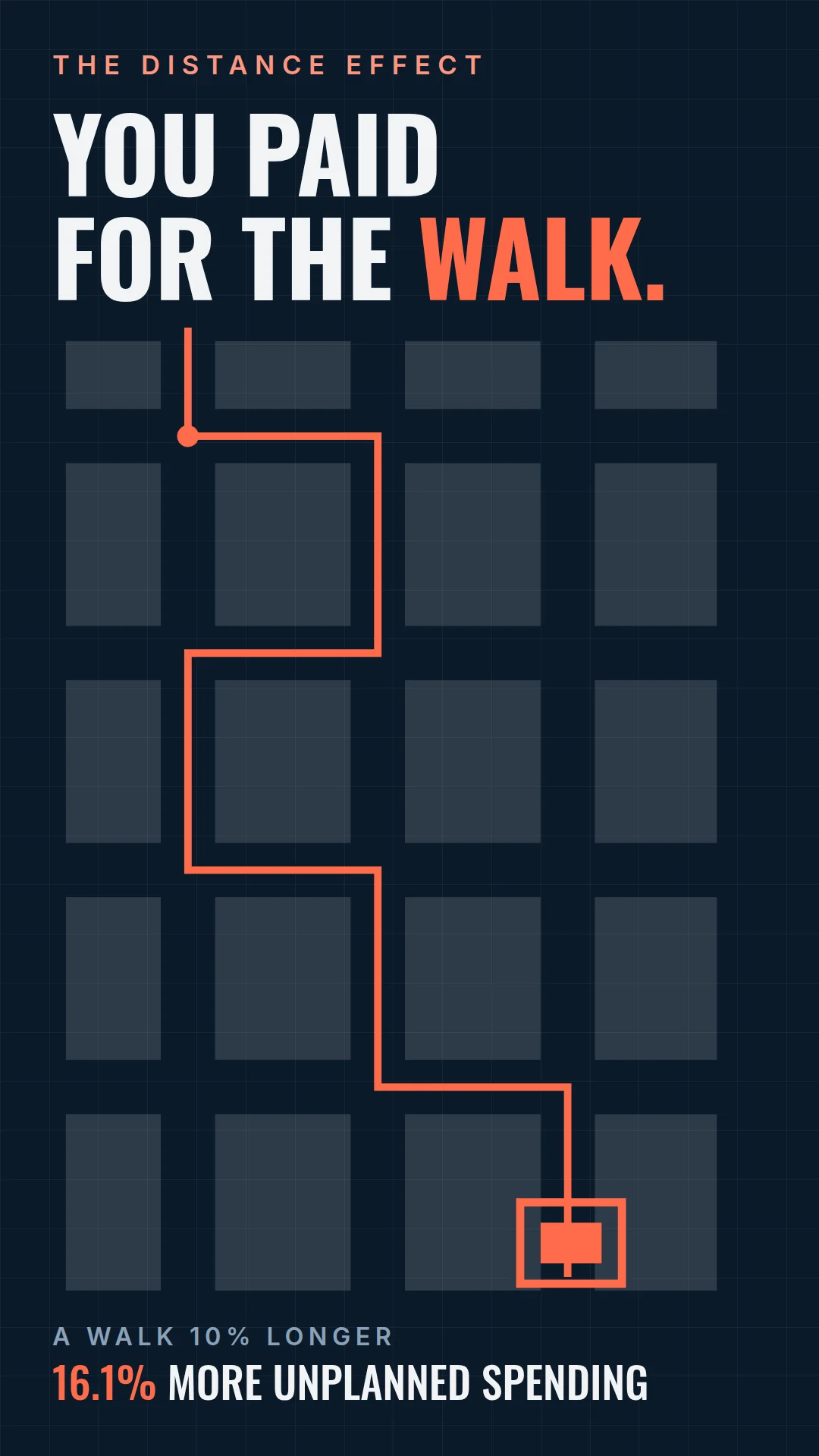
The part of the trip that has been measured is the walk. Hui, Inman, Huang and Suher tracked shoppers' paths inside a grocery store with radio-frequency identification and found that unplanned spending rises with in-store travel distance, with an elasticity of 1.57, which their page reads as a walk ten percent longer coming with 16.1 percent more unplanned spending. Their field experiment is the cleanest version of it: a coupon that required shoppers to travel farther from their planned path produced $21.29 of unplanned spending, against $13.83 for a coupon for a category near their path. The paper's explanation is that shoppers use the products on the shelves as external memory cues, so the list in your head is incomplete and the shelf supplies the reminder. 3
The same study priced the lever a store holds: relocating three destination categories, the things shoppers come in for, was estimated to raise unplanned spending by 7.2 percent. The item you came for can be placed further from the door.
Spot it in the wild. Bell, Corsten and Knox used panel data to hold the shopper constant and found that unplanned buying increases monotonically with how abstract the trip goal was before the shopper entered the store, so the vaguer the errand you set at the door, the more you leave with. 4
One move: before the doors open, say the items out loud, then say the total you are spending.
References
- 1
- 2
- 3
- 4
This story was produced automatically by a channel. One sentence is all it takes for Neodrop to keep producing for you.