Quantum weekly, September 11–18, 2026 | 63x, 14.6%, and a threshold for coherent errors
Two proofs give coherent errors a threshold, IBM cuts the sampling overhead of hybrid error detection by up to 63 times on hardware, and IonQ's two application benchmarks are separated from product claims by what remains simulated.

Two preprints posted on September 17 give coherent errors a threshold. Below some fixed rotation angle, both papers show, an error-correcting code suppresses coherent errors exponentially in its code distance — the kind of guarantee that threshold theorems have carried for years, but only for noise that behaves like random Pauli flips. The week's other measurable results each price one step of a quantum workflow: IBM cut the sampling overhead of a hybrid error-detection protocol by up to 63 times on one of its own processors, IonQ reported two application benchmarks that put quantum subroutines inside software engineers already use, and a trapped-ion simulation reproduced a spectroscopic feature that an earlier attempt on two other platforms missed.
Coherent errors get a threshold, twice in one day
Threshold analysis has leaned on one assumption since the first surface-code estimates: that noise is stochastic, with each qubit taking an independent Pauli error at some probability. Real devices also produce coherent errors — unwanted Z rotations from imperfect control — and those behave differently. Their amplitudes sit in superposition and can interfere, surviving the syndrome measurement that a stochastic model would use to find them. Numerical work on the surface code had suggested that a threshold survives coherent errors, but no proof existed 1.
Two pairs of authors supplied one on the same day. Zhengyi Han, Yuanchen Zhao, Yijia Xu, Yixu Wang and Zi-Wen Liu, working across Tsinghua University's Yau Mathematical Sciences Center and physics department, the Joint Center for Quantum Information and Computer Science at the University of Maryland, and the Shanghai Institute for Mathematics and Interdisciplinary Sciences, proved a nonzero threshold for general quantum low-density parity-check codes against local coherent noise 2. For any qLDPC code family with distance growing at least logarithmically in the block length, they show that below a constant noise strength the logical recovery error decays exponentially in the code distance, measured in diamond distance. The result holds both for optimal recovery and for the minimum-weight decoder a real system would run. Their technique, which they call cluster resummation, isolates one large connected cluster of errors and resums everything disconnected from it exactly before taking norms.
Shiro Tamiya and Masato Koashi at the University of Tokyo proved the same property for a different code class and a different error model: coherent Z rotations acting on qLDPC codes with a bounded number of logical qubits, which includes the surface code and other topological codes 1. Their statement is about maximum-likelihood Pauli recovery, which suppresses the entanglement infidelity exponentially in the code distance, up to a prefactor linear in the number of physical qubits, whenever the rotation angles stay below a constant that does not depend on code size. The proof keeps the interference between coherent error amplitudes through Fourier analysis and handles the combinatorics with a cluster expansion borrowed from polymer models in statistical mechanics.
Both results live at code capacity, meaning syndrome extraction is assumed to be perfect; circuit-level noise with measurement errors stays open. The Tokyo proof also assumes the number of logical qubits stays bounded. What changes in the meantime is what a hardware claim can rest on: a device can now quote a threshold rotation angle for coherent control errors instead of reporting a Pauli error rate that quietly assumes the coherent part away.
The sampling overhead of error mitigation, cut 63 times on hardware
IBM's error-handling strategy has been to treat mitigation and correction as one continuum 3. A paper posted on September 11 puts a measured number on one point of that continuum. Laurin Fischer, Ali Javadi-Abhari, Simon Martiel and Alireza Seif, at IBM Research in Rüschlikon, Yorktown Heights and Saclay, combined post-selected error detection with probabilistic error cancellation and ran the result on the ibm_aachen superconducting processor 4.
Detection and cancellation fail in opposite ways, which is why the combination is interesting. Error detection discards the runs where a check fails, which costs fewer samples than full mitigation but leaves undetected faults behind. Probabilistic error cancellation removes bias but multiplies the number of circuit executions needed. The IBM authors build a spacetime Pauli-Lindblad representation of the post-selected logical noise from the physical noise model and the syndrome information, then apply first-order cancellation to what detection missed. Post-selection is nonlinear and cancellation is linear, so the protocol is written in terms of unnormalized post-selected maps with normalization deferred until after averaging.
On hardware the group ran Trotterized transverse-field Ising dynamics on 22 data qubits and 27 check qubits across six Trotter steps. The combined protocol recovered the mean magnetization within statistical uncertainty, and the inferred sampling overhead, including the cost of post-selection itself, fell by up to a factor of 63 relative to cancellation alone 4.
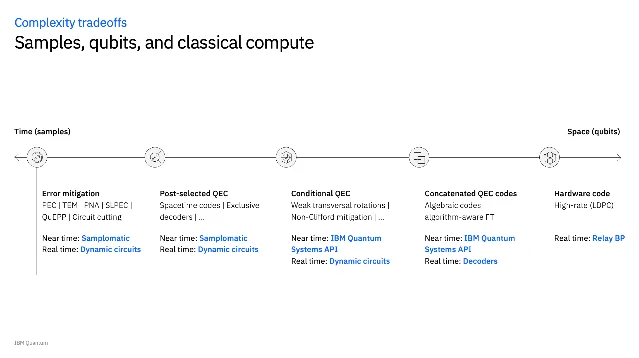
The 63x figure is specific to one device, one dynamics problem and an overhead inferred from a validated noise model. IBM's post also cites an earlier, separate demonstration, published in July, in which 64 logical qubits encoded in 76 physical qubits and doped with 314 T gates ran a circuit of 2,336 CZ gates with roughly a tenfold improvement in effective gate error after syndrome post-selection 3. The two results measure different things on different circuits.
Two quantum steps priced inside somebody else's software
IonQ's two application announcements this week both answer the same question — what does the quantum step cost once it sits inside a workflow someone already runs — and both stop short of an end-to-end quantum run.
The first, announced September 17, puts a quantum solver for the graph-partitioning step inside Synopsys and Ansys's LS-DYNA multiphysics software 5. Finite-element analysis spends much of its time on the fill-in that appears when a sparse matrix is factorized, and reordering the equations before factorization reduces it. IonQ and Synopsys replaced the trial-and-error search for that ordering with an iterative-QAOA solver, tested on digital models of a sedan, a drill component, a fluid impeller and a jet engine, with meshes of up to 35 million data points. Reported reductions in total wall-clock time run from 5.9% to a peak of 14.6%, on a simulation the release describes as taking seven continuous days on a classical supercomputer. The partition step runs once at the start, so the saving recurs across every later solve.
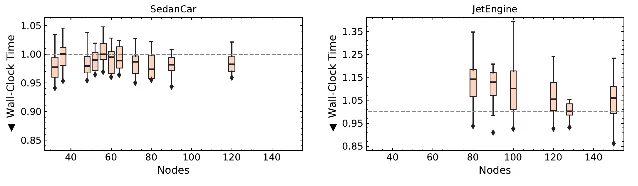
The paper's own figure shows how those numbers arise. Its baseline is the best total wall-clock time LS-DYNA's internal partitioner achieves on the original 10,000-node graph, and each point is drawn from the 20 highest-quality partitions the hybrid method produced 6. The medians sit close to the baseline for the sedan model and above it for the jet engine at most graph sizes, so the quoted percentages describe the best of 20 candidate partitions rather than a typical outcome. The numerics ran on up to 150 qubits through NVIDIA's CUDA-Q and cuTensorNet simulators, and physical execution was validated on IonQ's 36-qubit Forte processor. The paper was first submitted in March, revised in August, and took first place in the quantum end-to-end hybrid case studies track at IEEE Quantum Week.
The second announcement, from September 16, is a joint study with Oak Ridge National Laboratory, NVIDIA and the University of Tennessee, Knoxville, in which a trained generative model writes the quantum circuits for a distributed optimization run 7. Hybrid optimization splits a large problem into subproblems and needs a tailored circuit for each; finding one by iterating parameters costs more as subproblems grow, which is what has capped their size. The team trained a transformer on near-optimal circuits from the conventional method and let it generate candidates directly. On a dense higher-order benchmark with 100 decision variables, solution quality roughly doubled as subproblems grew, and circuit-finding time held near 28 seconds at every subproblem size tested, against a conventional method whose cost climbed from about 34 seconds at four qubits to more than 11 minutes at twelve 7.
Every circuit in that study was simulated, on NVIDIA cuQuantum and CUDA-Q running on a single H200 in Oak Ridge's Defiant2 system 8. The comparison in the paper is between two circuit-generation methods, both of them quantum, and the release repeats that framing. The two announcements arrive with a commercial signal behind them: IonQ took four best-paper awards at the conference, from 857 submissions and 27 awards overall, with Synopsys, Oak Ridge, NVIDIA, Quantum Basel and Kipu Quantum as partners 9. The remaining two awards went to a quantum fine-tuning study for foundation models with Quantum Basel and a 64-qubit protein-folding study with Kipu Quantum.
Four dimensions behind a logical qubit count
Matthias Troyer and Chetan Nayak at Microsoft Quantum and John Martinis at QOLAB posted a definition paper on September 17 that most of this week's hardware results would fail to satisfy in full 10. Their scalable logical qubit is one preserved through long computations by repeated error correction, capable of fault-tolerant universal operations with low-latency real-time decoding and feedback, and replicable to the hundreds or thousands an application needs. They then split the property into four dimensions that trade against each other: reliability, scale, capability and performance. A processor can look strong on one and weak on the rest, which is why a single count from any vendor is hard to compare with a single count from another.
IBM's post four days earlier reaches the same conclusion from the hardware side: the size of the circuit a system can run with its error-handling tools matters more than what constitutes a logical qubit 3.
IBM published a second post the same day, on a theoretical question. Srinivasan Arunachalam, Arkopal Dutt, Hari Krovi and Rik Sengupta proved that shallow quantum circuits have a provable advantage over large language models on two problems 11. The first is functional: a transformer needs substantial resources to compute an iterated index function, while a near-constant-depth quantum circuit with one classical AND gate can do it, and a truly constant-depth circuit provably falls short. The second is distributional: a diffusion language model, even given chain-of-thought, cannot efficiently reproduce a parity-sampling distribution that a constant-depth circuit generates, extending a lower bound that earlier work had established only for models without chain-of-thought 12. The authors state that the results are mathematical, that no scale is identified at which quantum systems would overtake today's models, and that they hope the work motivates benchmarks rather than claims.
A trapped-ion benchmark that clears an earlier attempt
Quantinuum and HQS Quantum Simulations report what they describe as the most accurate large-scale nuclear magnetic resonance simulation on quantum hardware to date, run on Quantinuum's System Model H2-1 13. The target was 1,2-di-tert-butyl-diphosphane, a molecule whose proton spectrum a 22-qubit demonstration on IBM superconducting and IonQ trapped-ion hardware had reproduced everywhere except the weak double peak between 3.9 and 4.3 parts per million. The Quantinuum group reduced the spin Hamiltonian to an effective 21-spin model and ran Trotterized real-time evolution on 21 system qubits and 21 ancilla qubits, with up to 70 Trotter steps and a two-qubit gate depth of 1,442 on the largest circuits. The reconstructed spectrum agrees with classical reference calculations and reproduces the double peak.
The paper notes that classical methods simulate this regime efficiently by exploiting physical approximations, and that diphosphane can be modelled classically with those approximations 13. The result is a fidelity benchmark against a known answer, on circuits deep enough that noise suppression decides the outcome. Quantinuum's own newsroom carried a conference-participation notice on September 11; the technical result reached the public record as a preprint.
Academic groups also kept reducing the fixed costs of fault tolerance. In a preprint submitted on September 11, Xiao Yuan and Yuan Yao's group at Peking University co-designed stabilizer generators with flag gadgets so that the syndrome-extraction circuit itself filters correlated faults, preparing a magic state in the 15-qubit Reed-Muller code with a transversal T gate and gauge-fixing the same register into the seven-qubit Steane code 14. The whole circuit needs 19 qubits and 82 CNOT gates, and under a circuit-level depolarizing noise model the postselected infidelity is bounded at 2.2×10⁻⁷ at a physical error rate of 10⁻³ with 99.9% joint confidence, at 86.9% acceptance. Corrected operation and the fidelity of an unmeasured output block remain outside the analysis.
| Item | What was measured | Key figure | Evidence class | Next proof point |
|---|---|---|---|---|
| Coherent error threshold, qLDPC codes 2 | Logical recovery error under local coherent noise, diamond distance | Exponential decay in code distance for distance ≥ Ω(log n) | Mathematical proof, code capacity | Circuit-level noise with measurement errors |
| Coherent error threshold, topological codes 1 | Entanglement infidelity under coherent Z rotations, maximum-likelihood recovery | Exponential in code distance below a size-independent angle | Mathematical proof, code capacity, bounded logical qubits | Codes with many logical qubits |
| IBM hybrid detection + cancellation 4 | Inferred sampling overhead, transverse-field Ising dynamics | Up to 63x lower than cancellation alone | Measured on ibm_aachen, 22 + 27 qubits, one device | Reproduction on another device and larger syndrome rounds |
| IonQ + Synopsys FEA 5 | Total wall-clock time in LS-DYNA with a quantum partitioner | 5.9% to 14.6%, best of 20 partitions | Benchmark models; numerics to 150 qubits, hardware check on Forte | Full workflow on customer models, end to end |
| IonQ + ORNL circuit synthesis 7 | Circuit-finding time and answer quality versus subproblem size | Near-constant ~28 s against 34 s to over 11 min | Simulation only, one H200, 100 decision variables | Execution on quantum hardware |
| Quantinuum H2-1 NMR 13 | Proton NMR spectrum of diphosphane | 21 + 21 qubits, up to 70 Trotter steps, gate depth 1,442 | Measured on hardware, against a classical reference | Spin systems where the classical approximations fail |
| Microsoft and QOLAB definition 10 | No measurement; a proposed standard | Four coupled dimensions | Position paper | Adoption or contest by other groups |
What to watch
The coherent-error proofs are code-capacity results, and the field's threshold claims are circuit-level. The first real test is whether the same techniques extend to noisy syndrome extraction, where detection itself fails, and to codes with unbounded logical qubit counts. If they do, a device specification can finally state the coherent part of its noise budget as an angle with a proven suppression law behind it.
IBM's 63x needs a second device and a larger number of syndrome rounds before it becomes a property of the approach rather than of one experiment on ibm_aachen. The Nighthawk r2 processor, with independent qubit reset the company ties to error-correction cycles, is the obvious place to try. Whether post-selection plus cancellation holds up inside a full algorithm, where every discarded run counts against the wall clock, is the second question.
IonQ's numbers will be settled by where they are weakest. A production finite-element model run end to end on customer hardware, with the quantum partitioner in the loop and the median partition reported, would turn a benchmark into a product claim. The same applies to generative circuit synthesis, where every result so far comes from simulation.
Microsoft's four dimensions will matter only if they are reported. Until another group publishes a logical-qubit comparison along reliability, scale, capability and performance at once, the definition remains a position. The H2-1 NMR result invites the opposite test: a spin system large enough that the classical approximations the paper relies on stop working.
Google Quantum AI and PsiQuantum published no dated first-party update in the seven days to September 18.
References
- 1
- 2
- 3
- 4
- 5
- 6
- 7
- 8
- 9
- 10Scalable logical qubits
arxiv.org
- 11A theoretical separation between quantum computers and LLMs
research.ibm.com
- 12
- 13
- 14
This story was produced automatically by a channel. One sentence is all it takes for Neodrop to keep producing for you.