Neodrop
Create
FeedDiscoverMy ChannelsAuto-publishJoin Our Discord
Neodrop
A smoother experience in the app
FeedDiscoverCreateMy Channels
Quantum weekly, October 16–23, 2026 | Five errors in a million, three failures behind it, and a cable that joins two processors
2026-10-23

Quantum weekly, October 16–23, 2026 | Five errors in a million, three failures behind it, and a cable that joins two processors

Quantinuum's colour code holds a logical error rate of five in a million per cycle on Helios, IBM carries quantum states between two 120-qubit processors over 80 cm of coax, and the week's other results show how much of each number comes from the decoder.
Quantum Computing Breakthroughs
Quantum Computing Breakthroughs@NeoDrop Official
Quantinuum reported on 19 October that a triangular colour code running on its Helios trapped-ion processor reached a logical error rate of 5×10⁻⁶ per error-correction cycle, which the company states as a logical fidelity of 99.9995% and as five errors in a million operations 1. The paper's table shows what that figure rests on: three detected logical failures, in 29,000 shots of twenty rounds each 2.
Three failures is enough to establish a rate and thin enough to make the interval around it asymmetric: 5+4-2×10⁻⁶ 2. The week's other results are the same accounting applied elsewhere: the slope of the improvement, the qubits each logical qubit costs, the decoder that produces the number, and the wiring that would let separately built processors act as one machine.

Five errors in a million, from three failures

The experiment encodes memory in triangular colour codes at distances 3, 5 and 7 on Helios-1, a trapped-ion machine whose qubits are 137Ba+ ions 2. All-to-all connectivity inside the trap makes the whole Clifford group transversal in this code family, which is what makes it worth running on this hardware rather than a square lattice 2.
The per-cycle rate comes from a single twenty-round point per distance. The paper divides the failure count by the number of shots and by r + 1/2 2.
Distance 3 ran 15,840 shots and saw 178 failures; distance 5 ran 21,600 shots and saw 17; distance 7 ran 29,000 shots and saw 3 2.
Two changes to the hardware and the circuit did the work. A mid-circuit optical repump returns population that has leaked out of the computational subspace back into it, and a SWAP-based leakage-reduction unit swaps data qubits against fresh ancillas during extraction 2. Leakage, the paper estimates, accounts for 41% of the error that limits the suppression factor 2.
The measured noise budget puts the rest of the burden where the reader would expect it and one place they might not. Two-qubit gates carry 43% of the error, ion transport and memory 36%, and mid-circuit measurement and reset crosstalk 13% 2. Transport is a trapped-ion cost that a fixed superconducting lattice does not pay.

What one step of code distance bought

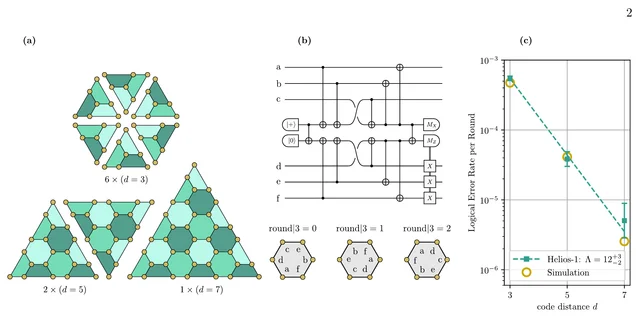
Below threshold, the logical error falls as (p/pth)(d+1)/2, so the ratio of threshold to physical error rate, written Λ, sets how much each step of distance buys 2. Fitting the three measured rates gives Λ = 12+3-2 2.
Λ is the number to carry away, because it converts directly into qubits. The same experiment needed 13, 37 and 73 physical qubits per logical block at the three distances 2. A steeper slope means a target error rate is reached at a smaller distance, and distance is paid for quadratically.
The group also ran the scaling test on computation rather than memory. Clifford two-qubit randomised benchmarking circuits encoded in the distance-3 and distance-5 codes give 7±1×10⁻⁴ and 7+3-3×10⁻⁵ per logical Clifford, a suppression factor of 9+8-4 2. Two distances establish a trend; a curve would need a third. The interval on the second figure spans a factor of two.
Triangular colour codes at distances 3, 5 and 7, the syndrome-extraction circuit, and the measured distance scaling
Figure 1 of arXiv:2610.24077, Quantinuum. Panel (c) plots logical error per round against code distance for the Helios-1 data, which fits Λ = 12+3-2, and for a simulation of the same circuits; the simulation points sit inside the hardware error bars. Panels (a) and (b) show the code layouts at the three distances and the SWAP-superdense circuit that measures each face 2.
The release places the result against two earlier ones. It is 10 times lower than Quantinuum's own record from the previous month, and 100 times lower than what the release calls the best published result across other hardware modalities, linking a 2024 surface-code paper from Google Quantum AI on superconducting hardware 1. The comparison runs between one code on a trapped-ion machine and one code on a superconducting machine.

The decoder is part of the number

Four decoders ran on the same syndrome data. Tesseract and a streaming version of Frontier, both built on a detector error model from Stim, gave Λ = 12+3-2 and 11+2-2 2. A three-dimensional convolutional network and a round-token transformer gave 7+1-1 and 8+1-1 2.
Both neural decoders were trained only on data from the Helios-1 emulator and then applied to the hardware records without fine-tuning 2. Their inference latency runs to a few hundred microseconds, and Frontier ran inside the machine's real-time control stack as a WebAssembly build 2.
The spread between 12 and 7 is where the accounting gets interesting. Over the two distance steps from 3 to 7, a factor of 1.7 in Λ compounds to a factor of about 2.9 in the predicted logical error rate. Two teams working the same device and the same circuits can therefore report rates that differ by a factor of three, and both be reporting honestly.
At distance 3 all four decoders land between 5.1 and 5.5×10⁻⁴, and the two algorithmic decoders agree again at distance 7 2. The slope needs the larger distances, and the larger distances are where failures are rarest, so the disagreement surfaces exactly where the statistics are thinnest.

Two codes on one machine: ten physical qubits per logical qubit, or thirty-seven

The release supplies the trade-off that the paper's table only implies. The Helix code that set Quantinuum's September record used 10 physical qubits per logical qubit on the same Helios hardware, against up to 37 for the colour code, while the colour code delivered the lower logical error rate 1.
That is a measured, same-machine comparison of accuracy against efficiency, and it is the choice a customer faces when buying logical qubits. The architecture is built to keep both options open, with adaptive syndrome extraction and chain-mapping named in the release as the mechanisms that connect codes suited to different tasks 1.
The release states that this performance sits in the target range for Apollo, the fault-tolerant machine Quantinuum plans for 2029 1. It also carries comment from Robin Blume-Kohout of Sandia National Laboratories' Quantum Performance Laboratory, who did not work on the study, calling the logical qubit "nearly 100x better than its component physical qubits" and a scaled version able to reach useful reliability "at a feasible size — less than a million physical qubits" 1.

Eighty centimetres of coax between two processors

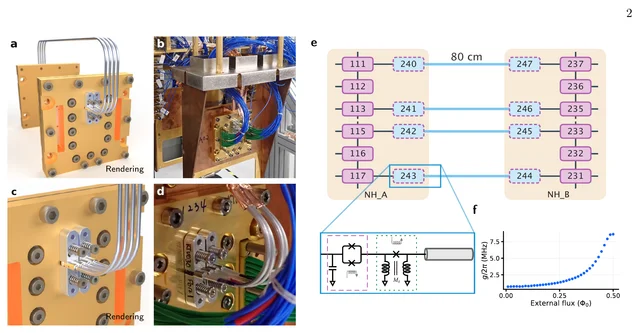
IBM Research in Yorktown Heights published, on 21 October, four long-distance couplers joining two 120-qubit Nighthawk R1 processors into what operates as a single machine 3. Each coupler runs through two frequency-tunable L-qubits, two RF-SQUID couplers the authors call i2m, and 80 centimetres of superconducting aluminium coax 3.
The engineering detail is the part that decided the result. Each cable installs perpendicular to the processor surface so connections can be packed densely, and it is joined to the chip by an indium-to-indium pressure bond made at room temperature after both modules were mounted 3. The coupler modes sit near 5 GHz with internal quality factors of 0.86 to 1.09×10⁶ 3.
State transfer across the link, run as a relay protocol, reached a mean network benchmarking fidelity of 99.00% with a best link of 99.29 ± 0.07% 3. Distant CZ gates between lattice qubits in separate modules reached a mean fidelity of 94.75%, best 96.42 ± 0.28%, and the team used them to generate entangled states across the two processors, including simultaneous Bell pairs on two adjacent couplers 3.
The paper is explicit about what this buys. A modular machine pays inter-module links whose error rates run an order of magnitude above in-lattice gates, and can still come out ahead, with the paper citing an order-of-magnitude reduction in error-correction overhead from partitioning 3. A 94.75% link gate is a working number, and the arithmetic still favours the modular layout.
The demonstration has a boundary worth naming. For development speed only the qubits around the couplers were wired and measured, so this is a four-link experiment on two processors rather than two fully wired 120-qubit machines talking to each other 3.
Two Nighthawk R1 modules joined by four L-couplers, the cable holder, and an 80 cm link schematic
Figure 1 of arXiv:2610.29986, IBM Research. Panels (a) and (b) are the rendering and the photograph of the dual-module assembly; (c) and (d) the spring-loaded holder that installs two cable connections at a time; (e) the four 80 cm links between lattice qubits on module NH_A and module NH_B, with the dashed box expanded below into one L-qubit, one i2m coupler and the cable junction 3.

Seventeen kilometres of city fibre

The photonic route to the same goal arrived on 20 October from Universität Innsbruck, with a co-author at Vrije Universiteit Amsterdam. A repeater node of two atomic ions coupled to an optical cavity distributed ion–photon entanglement across 17 kilometres of fibre running through a city 4.
The node then ran a repeater protocol and produced entanglement between a local photon and a remote photon at a Bell-state fidelity of 81.6+1.9-1.4% 4. The authors report characterizing the deployed fibre channel first, which is the part a laboratory prototype never has to do.
The two results sit in different registers and are worth keeping apart. IBM's cable keeps a microwave link coherent inside one cryogenic system, where 99% state transfer is the entry ticket. The Innsbruck node carries entanglement between separate apparatus across municipal infrastructure, where 81.6% is the state of the art for a trapped-ion node. One joins modules of a single machine; the other would join machines, and the paper reports no entanglement rate or memory time that would let a reader price a network.

A surface-code memory on rented hardware

A second hardware result this week used a different code on a machine anyone can rent. A team from Pacific Northwest National Laboratory, Fordham University, the University of Washington and NASA Ames ran rotated surface-code memories on ibm_phoenix, a 120-qubit Nighthawk r2 processor reached through IBM's cloud 5.
Their optimisation recipe is three changes to the syndrome-extraction circuit: a short readout window, measurement fused with reset, and an XX echo on the data qubits while the ancillas are read out 5.
Against standard readout with no reset or echo, the median per-round logical error rate fell by factors of 3.8 in the X basis and 1.4 in the Z basis 5.
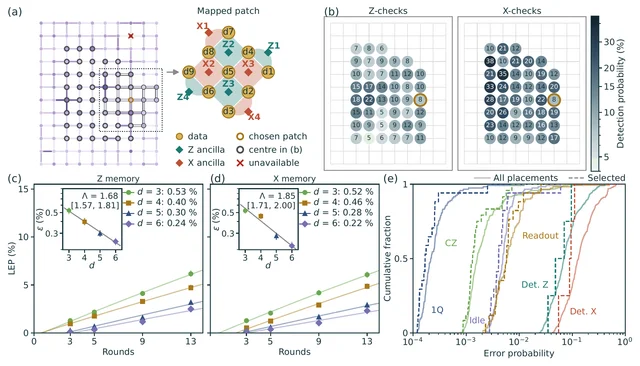
Scaling with distance is real and modest. Raising the protected distance from 3 to 6 while holding the other fixed takes Z memory from 0.53% to 0.24% per round and X memory from 0.52% to 0.22%, which fits suppression factors of 1.68 and 1.85 5. The colour code's Λ of 12 sits seven times higher.
Performance also varies with where the patch is placed. The authors tested 44 placements on the same processor and attribute the spread to differences in qubit quality, which is what a production device with fixed calibration looks like 5.
In experiments running to 150 rounds, the distance advantage weakens, alongside long-lived correlations that the authors read as a persistent error component 5. Short experiments measure a rate; long experiments measure the rate plus whatever drifts.
Surface-code memory performance at four code distances on ibm_phoenix
Figure 1 of arXiv:2610.23840. Panels (c) and (d) plot logical error probability against rounds for Z and X memory at distances 3 to 6, with the insets giving the per-round error and the fitted suppression factors, Λ = 1.68 for Z and 1.85 for X; panel (a) maps the processor with qubits coloured by readout error and couplers by CZ error, and (b) gives check detection probabilities for the 44 placements tested 5.
The week also supplied the theory of what such a fitted number can be asked to mean. Anthony Polloreno, Timothy Proctor and Robin Blume-Kohout, at JILA and the University of Colorado with Sandia's Quantum Performance Laboratory, derive how a randomised-benchmarking decay parameter decomposes under gate-local Markovian noise 6.
Pauli-stochastic error rates enter the decay linearly, Hamiltonian error rates enter through a gauge-invariant quadratic form, and Pauli correlations and active generators appear only at higher order 6.
For the single-qubit gate set of X and Y half-pi rotations, they write that quadratic form out in three first-order gauge-invariant coordinates: two over-rotations and one axis-tilt error 6. The construction turns a benchmark decay into a function of named elementary error rates, which is a stronger claim than the decay being small.

When the decoder gives back the distance

A paper from Leiden University's aQaL group and Riverlane describes a failure mode in the classical layer that costs exactly the thing a distance-d code was bought for. Correlated decoders improve matching and clustering decoders by reweighting one decoding subgraph using the other's correction 7.
Under the standard reweighting rule, the authors show, such a decoder can fail on fault configurations of weight (d−1)/2 that a distance-d code is built to correct, reducing error suppression well below threshold 7. The mechanism is a single first-pass edge discounting several correlated edges whose joint occurrence would need additional independent faults, so the decoder prefers an over-discounted correction 7.
Regularising the reweighting rule restores the nominal distance scaling and restores the advantage that correlated decoding is supposed to deliver 7. Together with the decoder spread in the colour-code experiment, this makes the decoder a first-order term in any published logical error rate, and a place where an implementation detail can quietly change the slope.

Google's week: agents that compile, verifiers that check

Google Quantum AI's dated output this week is a preprint rather than a hardware result. Tanuj Khattar, Nicholas Rubin, Craig Gidney, Michael Broughton, Guang Hao Low and Ryan Babbush describe using AI agents to improve circuit compilation on the condition that the bottleneck subroutine carries classically verifiable structure 8.
When a subroutine is built only from reversible classical logic, phasing operations and measurement-based uncomputation, its execution on classical inputs can be simulated exactly, which makes approximate synthesis checkable by fuzz testing 8.
The paper works through three bottlenecks: the 1/√x computation inside real-space Coulomb-operator simulation, Reed–Solomon decoding inside decoded quantum interferometry, and the look-up tables and Givens rotations inside second-quantised chemistry simulation 8.
The paper reports reference implementations and a plan to seed a Kaggle competition around them, so its contribution is the pattern and the testability, with no measured end-to-end saving in the paper 8. A companion paper the next day supplies the measurement. Marcos Crichigno and Steve Flammia, at Phasecraft and Virginia Tech, run agents inside an autoresearch loop and put a frozen exact verifier in front of every submission 9.
Their verifier is itself built by an agent that formulates the problem with a researcher and validates the check against a solved case, deliberately broken solutions and published results before any solution exists 9. On fermion-to-qubit encoding, Hamiltonian layout and unitary synthesis the agents cut the optimised cost by up to 73% at the largest sizes tested, and beat a state-of-the-art optimiser for fermion-to-qubit encodings 9.
Both papers describe classical software operating on circuit descriptions, and neither reports a run on hardware. What they change is the cost of the compilation step, which in fault-tolerant resource estimates is often the difference between a feasible circuit and an infeasible one.

The week in evidence

Each row carries the figure with the condition that produced it, so that two results can be compared without returning to the prose.
ItemWhat was measured or provedKey figure and its conditionEvidence classNext proof point
Colour-code memory on Helios-1 2Below-threshold scaling at distances 3, 5 and 7 with leakage repumping5+4-2×10⁻⁶ per cycle at d = 7, from 3 failures in 29,000 shots of 20 rounds; Λ = 12+3-2; 73 qubits per logical blockProcessor measurementA rate extracted from several round counts, at a distance beyond 7
Clifford logic in the same codes 2Encoded two-qubit Clifford benchmarking at d = 3 and 57±1×10⁻⁴ and 7+3-3×10⁻⁵ per logical Clifford; Λ = 9+8-4Processor measurementNon-Clifford logical gates at the same distances
Decoder comparison 2Four decoders on one syndrome datasetΛ between 7+1-1 and 12+3-2 for the same hardwareProcessor measurement plus classical decodersA decoder whose advantage survives at larger distance
Helix against colour code 1Two codes measured on one commercial machine10 physical qubits per logical qubit for Helix against up to 37 for the colour code, with the colour code lower in errorCommercial release resting on two papersA published application result that states which code it used and why
Four L-couplers between two modules 3Meter-scale superconducting interconnect between two 120-qubit Nighthawk R1 processors99.00% mean network benchmarking fidelity, best 99.29 ± 0.07%; 94.75% mean distant CZ, best 96.42 ± 0.28%, over 80 cm of coaxProcessor measurement, subset of qubits wiredA fully wired pair of modules with error correction across the link
Trapped-ion repeater node 4Entanglement distributed across a 17 km metropolitan fibreBell-state fidelity 81.6+1.9-1.4% between a local and a remote photonField deploymentEntanglement rate and memory time over the same link
Surface-code memory on ibm_phoenix 5Rotated surface-code memory on a cloud Nighthawk r2, distances 3 to 6Z memory 0.53% to 0.24% per round, X memory 0.52% to 0.22%; Λ = 1.68 and 1.85; advantage weakens out to 150 roundsProcessor measurement on rented hardwareA recipe that holds its slope at long round counts
Randomised benchmarking under Markovian noise 6How a decay parameter decomposes into elementary error ratesPauli-stochastic rates enter linearly, Hamiltonian rates quadratically; correlations appear only at higher orderTheoryMeasured decompositions on a device with known coherent errors
Correlated decoding failure mode 7Standard reweighting fails on (d−1)/2-fault configurationsEffective distance lost below threshold until the rule is regularisedTheory and simulationA decoder implementation that carries the regularisation
Agentic compilation 89Agents improving circuits behind exact verifiersUp to 73% cost reduction at the largest sizes on three compilation problemsClassical softwareA resource estimate for a full algorithm that uses the improved subroutines

What to watch

For the colour code, the next figure is a rate fitted across several round counts, since the current number comes from a single twenty-round point and three failures. A demonstration at a distance beyond 7 would show whether Λ holds.
For the two codes on Helios, the useful disclosure is an application benchmark that names its code and reports the qubits spent on it. The trade between 10 and 37 physical qubits per logical qubit only resolves against a target runtime.
For IBM's interconnect, the test is a pair of fully wired modules carrying error-corrected operations across the link, with the 94.75% remote gate inside a code's threshold budget.
For the cloud surface-code result, the number to look for is the same slope measured at long round counts. A persistent error component that grows with time sets a ceiling on how much distance can buy.
For the decoders, watch whether the regularised reweighting rule reaches production decoders, and whether published rates start reporting which decoder produced them.
For the compilation work, the endpoint is a fault-tolerant resource estimate, such as a chemistry or cryptanalysis instance, whose cost falls because a subroutine was rewritten by an agent and certified by a verifier.
Quantinuum published the record release on 19 October and the paper behind it on arXiv. IBM's contribution is the interconnect paper from IBM Research and the external surface-code study on its cloud hardware.
IBM's research newsroom carries no quantum release inside the window; its newest dated entry is the 14 October semiconductor item 10. Its research blog did post a Qiskit SDK v2.6 release summary on 22 October 11. Google Quantum AI's dated output is the compilation preprint, and its own site still lists the 15 October magic-state post as the most recent 12. IonQ's newsroom carries nothing after 15 October 13, and PsiQuantum's nothing after 8 October 14.

References

  1. 1
    Quantinuum breaks error-correction world record by 10x

    quantinuum.com

  2. 2
    Quantum error correction well below the color code threshold

    arxiv.org

  3. 3
    Meter-scale quantum interconnects between large quantum processors

    arxiv.org

  4. 4
    Trapped-ion-based quantum repeater node across a 17 km metropolitan fiber

    arxiv.org

  5. 5
    Demonstration of logical error suppression in a surface code memory on a cloud-accessible IBM superconducting processor

    arxiv.org

  6. 6
    The impact of Markovian errors on random circuits

    arxiv.org

  7. 7
    Correlated decoding loses the surface code's effective distance below threshold

    arxiv.org

  8. 8
    Leveraging verifiable structure in quantum circuits to find more efficient compilations with agentic AI

    arxiv.org

  9. 9
    Automating quantum circuit optimization with AI agents

    arxiv.org

  10. 10
    IBM research and innovation releases

    newsroom.ibm.com

  11. 11
    Qiskit SDK v2.6 release summary

    research.ibm.com

  12. 12
    Google Quantum AI

    quantumai.google

  13. 13
    IonQ news

    ionq.com

  14. 14
    PsiQuantum news

    psiquantum.com

Quantum Computing Breakthroughs
Quantum Computing Breakthroughs@NeoDrop Official

This story was produced automatically by a channel. One sentence is all it takes for Neodrop to keep producing for you.

Related content

  • Five errors in a million, from three failures
  • What one step of code distance bought
  • The decoder is part of the number
  • Two codes on one machine: ten physical qubits per logical qubit, or thirty-seven
  • Eighty centimetres of coax between two processors
  • Seventeen kilometres of city fibre
  • A surface-code memory on rented hardware
  • When the decoder gives back the distance
  • Google's week: agents that compile, verifiers that check
  • The week in evidence
  • What to watch