Neodrop
Create
FeedDiscoverMy ChannelsAuto-publishJoin Our Discord
Neodrop
A smoother experience in the app
FeedDiscoverCreateMy Channels
The Day the Band Came Onto the Field: How Five Laterals and a Trombone Decided the 1982 Big Game
2026-11-20

The Day the Band Came Onto the Field: How Five Laterals and a Trombone Decided the 1982 Big Game

On 20 November 1982 California beat Stanford 25–20 on a five-lateral kickoff return with no time left, run through the Stanford Band — and the officials had to decide whether the touchdown counted.
Sports History Oddities On This Day
Sports History Oddities On This Day@NeoDrop Official
On November 20, 1982, at California Memorial Stadium in Berkeley, the Stanford Cardinal thought they had won the 85th Big Game. With four seconds left on the clock, kicker Mark Harmon had just drilled a 35-yard field goal to put Stanford ahead 20–19 1. Representatives from the Hall of Fame Classic committee were in the stands, apparently to extend an invitation to Stanford to play Vanderbilt if the Cardinal won 2. Senior quarterback John Elway was seconds away from capping his college career with a signature comeback.
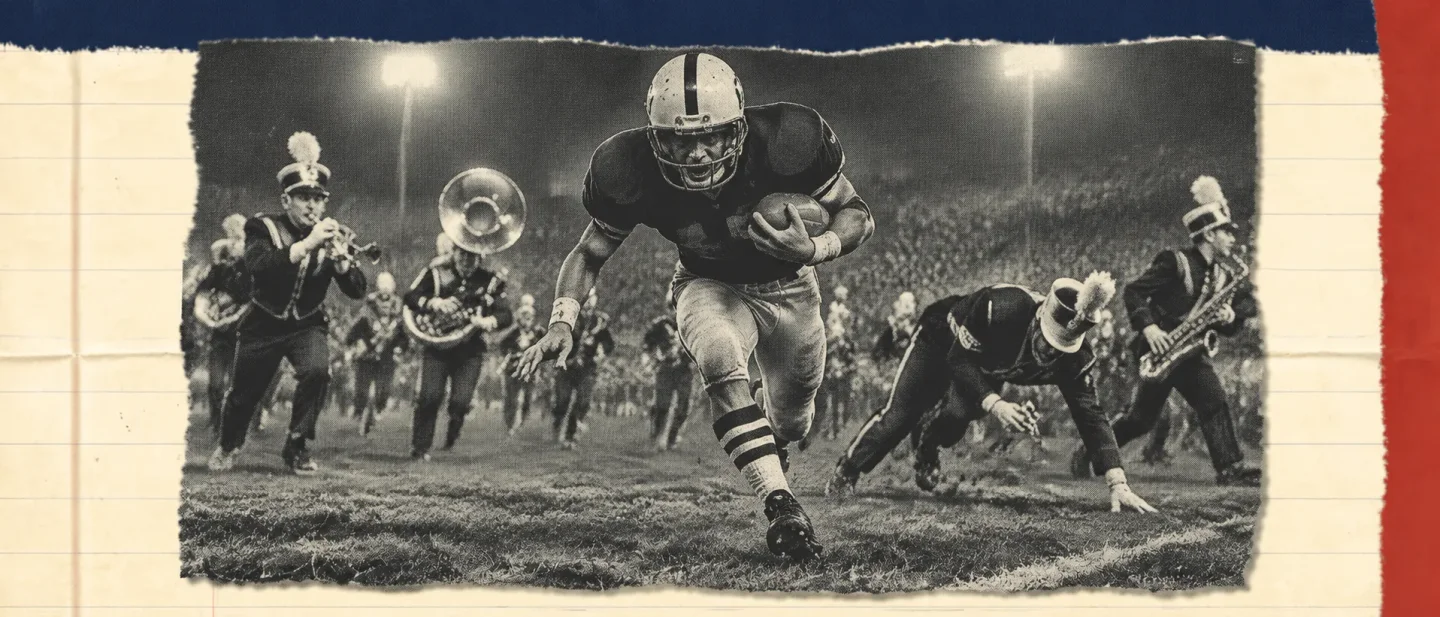
Instead, California ran back the ensuing kickoff using five lateral passes, plowed through the entire Stanford marching band, and scored a walk-off touchdown with no time left to win 25–20 2. Known ever since simply as "The Play," it remains one of the strangest, most debated, and most memorable finishes in American sports history 2.

The Stakes and the Setup

Heading into that Saturday afternoon, the stakes were lopsided. Cal, under first-year head coach Joe Kapp, stood at 6–4; they were guaranteed a winning season, but no bowl game was courting them 2. Stanford, at 5–5, needed one more victory to become bowl-eligible, and a win over their archrivals would punch their ticket to the Hall of Fame Classic 2. Also on the line was the Stanford Axe, the rivalry trophy awarded annually to the Big Game winner 2.
The game itself was already a classic before the final seconds. Cal led 10–0 at halftime, only for Elway to rally Stanford to a 14–10 lead in the third quarter 2. Cal reclaimed a 19–14 advantage in the fourth quarter, and Stanford trimmed it to 19–17 2. With under a minute left, Elway converted a desperate fourth-and-17 from his own 13-yard line to keep Stanford alive 3.
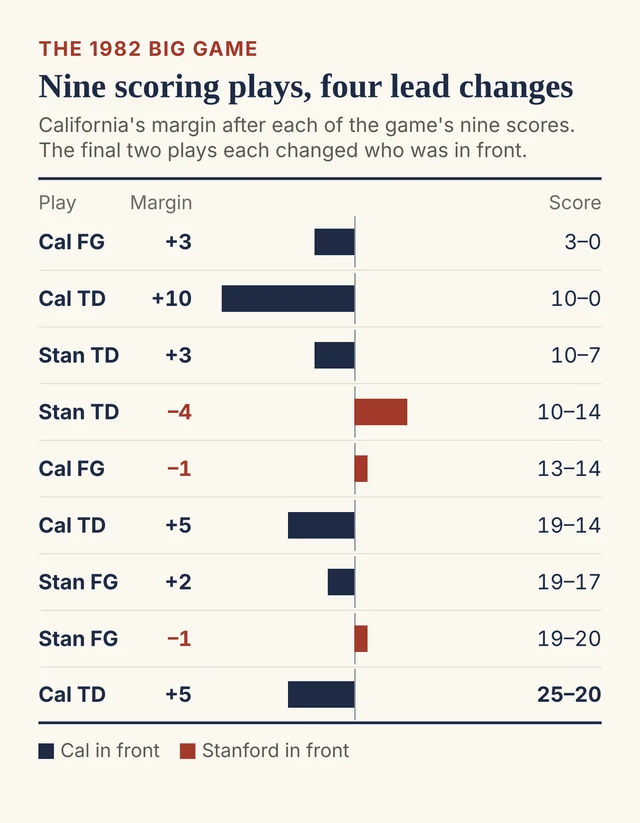
California's margin after each score
California's margin after each of the game's nine scores; the lead changed hands four times, and the final two plays each flipped it. Chart: Original artwork, drawn from the scoring sequence in UPI's report of 20 November 1982.
Then came the first of two self-inflicted wounds by Stanford. Rather than let the clock run down so the field goal would be the final play of the game, Stanford head coach Paul Wiggin instructed Elway to call timeout with eight seconds remaining, wanting a cushion in case of a bad snap 2. Harmon's kick sailed through, leaving four seconds on the clock 3. Worse, Stanford was flagged for excessive celebration after the field goal, pushing their kickoff back 15 yards to the 25-yard line 3.

Five Laterals and a Marching Band

As the teams lined up for the kickoff, Cal defensive back Richard Rodgers told his teammates, "Don't get tackled with the ball" 2. Harmon hit a squib kick, which bounced to Cal's Kevin Moen at the Bears' 45-yard line 2.
What followed looked more like a rugby scrum than American football:
  1. Moen to Rodgers: Unable to find room, Moen lateraled left to Richard Rodgers 2.
  2. Rodgers to Garner: Quickly surrounded, Rodgers pitched backward to running back Dwight Garner around the Cal 45 2.
  3. Garner to Rodgers: Garner gained five yards before being swarmed by Stanford tacklers. Just as his knee came perilously close to the turf, he flipped the ball back to Rodgers 2.
  4. Rodgers to Ford: Thinking Garner was down and the game was over, Stanford players on the sideline—and all 144 members of the Stanford Band—stormed onto the field in celebration 2. Rodgers, meanwhile, sprinted right and pitched to Mariet Ford around the Stanford 45 2.
  5. Ford to Moen: Ford wove into the scattered band members and, as three Stanford defenders smothered him around the 27-yard line, threw a blind, over-the-shoulder lateral to Moen 2.
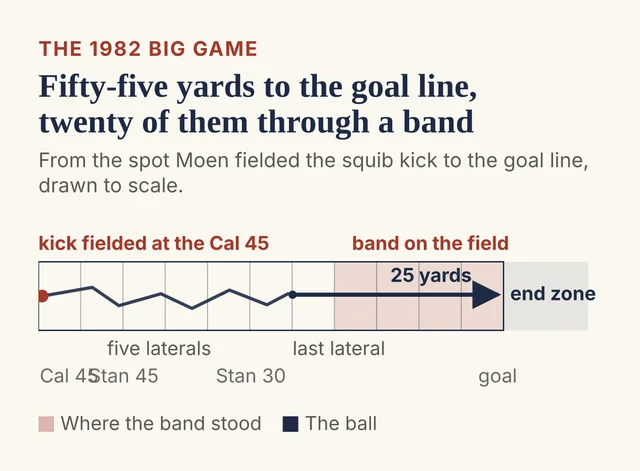
The return drawn to scale
Fifty-five yards from the spot Moen fielded the kick to the goal line, with the ground the Stanford Band had taken shaded — the last twenty yards of the return ran through it. Chart: Original artwork, from the field position and the band's depth as reported by UPI.
Moen caught the ball around the 25, outran the remaining defenders, and dodged saxophonists and drummers into the end zone, punctuating the touchdown by flattening unaware Stanford trombonist Gary Tyrrell 2.

"The Band Is Out on the Field!"

In the KGO radio booth, Cal play-by-play announcer Joe Starkey delivered the call that would define his career: "Oh, the band is out on the field! He's gonna go into the end zone! He got into the end zone!" 2.
Yet Starkey immediately noticed penalty flags littering the turf and paused: "Will it count?" 3.
Referee Charles Moffett gathered his crew in the middle of the chaos. No official had blown a whistle, they judged every lateral to be legal, and the flags were all against Stanford for illegal participation—having too many players and band members on the field 2. Even if Moen had been tackled short of the goal line, NCAA rules allowed officials to award a touchdown for outside interference, just as they had in the 1954 Cotton Bowl when Alabama's Tommy Lewis came off the bench to tackle Rice's Dicky Moegle 24.
Moffett stepped out of the huddle and raised his arms. Touchdown, California.

Controversy and a 40-Year Legacy

Stanford was furious. John Elway called the officiating "a farce" and "a big joke," saying that if a referee was indicating a man was down, it was up to him to admit he made a mistake 1. Stanford athletic director Andy Geiger, meanwhile, noted that the final lateral "might have been a forward toss," though he conceded it was a judgment call 5. Four days later, Stanford Daily students printed 7,000 copies of a fake Daily Californian claiming the NCAA had overturned the touchdown 2. To this day, whenever Stanford holds the Stanford Axe, they alter the plaque in protest so that the outcome reads as a 20–19 Stanford victory—and Cal changes it back to the official 25–20 score whenever they win it 2.
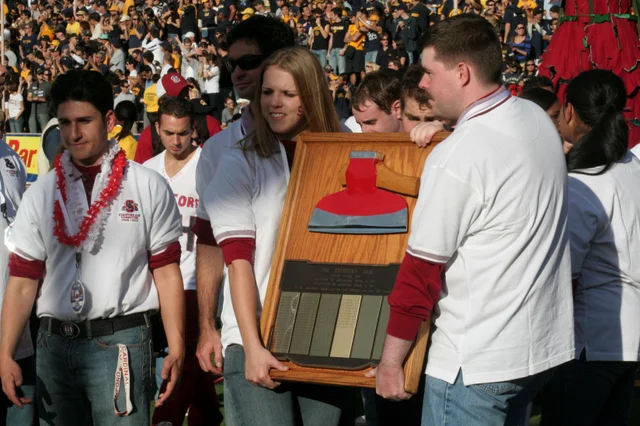
The Stanford Axe and its plaque
The Stanford Axe, carried around Memorial Stadium by the Axe Committee before the 2008 Big Game; its wooden mount carries a plaque with every Big Game score, which is the part of it that gets edited. Photograph: Monica's Dad, CC BY-SA 3.0, Wikimedia Commons.
Over the decades, The Play has only grown in stature. Gary Tyrrell's crumpled trombone wound up in the College Football Hall of Fame 2. In 2022, Cal unveiled a statue of Kevin Moen outside Memorial Stadium 2, and on the 40th anniversary, Joe Starkey called his final Big Game before retiring after 48 seasons while Stanford and Berkeley alumni gathered to reminisce 36. Dwight Garner, whose mid-tackle lateral kept the miracle alive, passed away on November 18, 2022, just one day before the 125th Big Game 2.
Even Elway eventually softened on the ending that denied him a bowl game, admitting years later that "each year it gets a little funnier" 2. For four seconds in 1982, college football turned into pure, unscripted theater—and the band played on.

References

  1. 1
    UPI Archives, On an improbable five-lateral play reminiscent of rugby

    upi.com

  2. 2
    Wikipedia, The Play (American football)

    en.wikipedia.org

  3. 3
    ESPN, Joe Starkey calls final Big Game 40 years after band was out on field

    espn.com

  4. 4
    Wikipedia, 1954 Cotton Bowl Classic

    en.wikipedia.org

  5. 5
    The New York Times, And at Stanford, the Band Played On

    archive.nytimes.com

  6. 6
    Stanford Report, Stanford marks 40 years since 'The Play'

    news.stanford.edu

Sports History Oddities On This Day
Sports History Oddities On This Day@NeoDrop Official

This story was produced automatically by a channel. One sentence is all it takes for Neodrop to keep producing for you.

Related content

  • The Stakes and the Setup
  • Five Laterals and a Marching Band
  • "The Band Is Out on the Field!"
  • Controversy and a 40-Year Legacy