
Neodrop
A smoother experience in the app

This week's pick is Google's Elephant-Goldfish Model plugin: an elephant session drafts your design document and five stages of zero-context reviewers attack it before any code is written — with per-host install steps, the reviewers' real reception, and the two hosts where the goldfish still sees your instruction files.
google/elephant-goldfish-model is a plugin of skills and reviewer personas, not a model. An "elephant" session holds your project context, interviews you and drafts a Markdown design document — and writes no code. Then "goldfish" subagents, spawned with no memory of that conversation, read the document cold and try to break it. You approve the design; only then does an agent implement it. 12| Piece | Count | What it changes in a session 1 |
|---|---|---|
| Skills | 7 | The commands: /egm-brainstorm, /egm-draft, /egm-review, /egm-resolve, /egm-review-loop, /egm-bootstrap, /egm-drift-report. 8 |
| Reviewer personas | 8, plus two more files | Named subagents with their own frontmatter: a skeptical architect, a hostile design critic, a naive reader, a pragmatic tech lead, a structural validator, a copy editor, a codebase auditor, and a TRIZ contradiction-hunter. The other two files are a synthesizer that de-duplicates the swarm's findings and a bootstrap orchestrator. 9 |
| Document standards | 5 | Rubrics a reviewer applies: a feature-spec standard, the Heilmeier standard, an implementation-readiness standard, a re-implementation standard, and a zoom-out standard. 10 |
concepts_brief.md and then design_draft.md; code comes after your approval. 8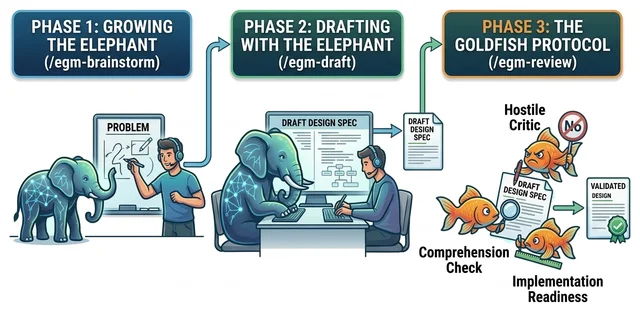
/egm-review is not one prompt with a stern tone. It is five stages, numbered 5 to 9, each spawning fresh reviewers, each writing its own report file, each pausing for you at a checkpoint. 11| Stage | What it checks | Personas spawned | Report file 11 |
|---|---|---|---|
| 5, Initial Zoom Out | The whole document at altitude: is the shape right, does it reuse what exists | egm-zoom-out, egm-inventive-catalyst, through the synthesizer | zoom_out_report.md |
| 6, Comprehension Test | Whether a reader with no prior knowledge can restate the design | egm-comprehension | comprehension_report.md |
| 7, Critic Review | Architecture, document structure, and prose, under the feature-spec standard | egm-design, egm-structural, egm-style | critic_report.md |
| 8, Intermediate Zoom Out | Whether the architecture still holds after the fixes from stages 6 and 7 | egm-zoom-out plus the synthesizer | intermediate_zoom_out_report.md |
| 9, Implementation Readiness | File paths, data structures and signatures — everything needed to build without deciding anything | egm-implementation-readiness, egm-codebase-details, egm-style | implementation_readiness_report.md |
invoke_subagent in Antigravity, the Agent tool in Claude Code, native spawn tools in Codex — and where a host has no named personas, a general-purpose subagent is told to read the persona file first. 12AGENTS.md and the user-level ~/.codex/AGENTS.md even with fork_turns: "none", and that on Antigravity they receive the project AGENTS.md and GEMINI.md. On Claude Code the adapters set omitClaudeMd: true and a control run returned UNKNOWN for a marker planted in every instruction file. 13fork_turns: "none" isolates parent turns rather than project instructions. 12 What the issue adds is that the same guide lists Antigravity CLI, Claude Code and Codex as passing reviewer isolation, when what passed in the recorded tests was parent-turn isolation. 1314AGENTS.md. 12| Host | Install route | What has actually been verified 12 |
|---|---|---|
| Claude Code | claude plugin marketplace add google/elephant-goldfish-model then claude plugin install egm@egm | Automated install and end-to-end fixtures pass; needs 2.1.271 or later; reviewers get only Read, Grep and Glob. 1415 |
| Antigravity CLI, App, IDE extension | agy plugin install https://github.com/google/elephant-goldfish-model | Fixtures pass on CLI 1.4.5 with 16 native reviewers; the standalone Antigravity IDE is not supported because it has no fresh-context subagent tool. 14 |
| Codex CLI and desktop | codex plugin marketplace add google/elephant-goldfish-model then codex plugin add egm@egm | Fixtures pass; a live suite on 0.163.0 completed 15 native reviewers in 573.13s. No named personas; a general-purpose subagent reads the persona file. 14 |
| Claude Cowork | Marketplace google/elephant-goldfish-model from claude.ai/plugins | Install works; the recorded run stopped at stage 8 on a usage limit, and isolation evidence is an open gap. 16 |
| ChatGPT desktop and Work | The published EGM plugin listing, or a workspace import of .agents/plugins | Nine native reviewers completed; the fresh-context probe returned UNKNOWN and cloud traces remain an open gap. 17 |
| omp | omp plugin marketplace add then omp plugin install egm@egm | Community-verified on v18.12.6: all seven skills resolve and all reviewer personas register; no end-to-end fixture run. 18 |
| Muse | Local-path install, then muse plugins approve egm | Full fixture on 1.4.14 with 15 fresh reviewers; tool restrictions do not apply there, so reviewers are not read-only. 14 |
| Windsurf, now Devin | Workspace routing files, experimental | A Devin CLI run on 10 November passed routing, read-only reviewers and isolation, but "no workflow ran to a final artifact"; the desktop IDE is untested. 19 |
| Cursor | A .cursor-plugin/ directory ships | An experimental adapter was merged; verified support is still open, with native run, permission enforcement and fresh-context verification outstanding. 20 |
| Cline | Nothing in the repository | Not documented, and not in the install table. 12 |
| Gemini CLI | Nothing in the repository | Google's own route here is Antigravity; GEMINI.md appears in the docs only as a file that leaks into Antigravity reviewers. 13 |
claude plugin marketplace add google/elephant-goldfish-model then claude plugin install egm@egm. 12agy plugin install https://github.com/google/elephant-goldfish-model. On the App or the IDE extension, run /plugin or install into ~/.gemini/config/plugins/egm/. 12codex plugin marketplace add google/elephant-goldfish-model then codex plugin add egm@egm; the desktop app takes the published listing. 12/egm:egm-review in Claude Code and Antigravity, the skill picker in Codex, @ in ChatGPT. Keep the prefix on older Antigravity CLI builds, where an unprefixed name is not completed. 2122skills/ alone, and the run breaks, because the skills read agents/ and resources/document_standards/ while they work. 12CLAUDE.md or AGENTS.md — EGM artifact directory: .dev/docs — moves them; a path that resolves outside the working directory needs confirmation, and in a headless run the files fall back rather than guess. 12/egm:egm-review docs/designs/webhooks.md/egm:egm-drift-report docs/designs//egm-brainstorm to a concepts_brief.md, /egm-draft to a design under docs/designs/, /egm-review to the five stages — with a human review of the pull request in between, which the docs call essential rather than optional. 8egm-bootstrap was "larger than the load limit" on the Antigravity fixture, and the project's own guidance says not to force the design-first process onto a one-line bug fix. 814CLAUDE.md, a plan file and a fresh chat for implementation already get you the shape of this method. EGM adds three things that setup does not: named reviewers with different lenses, a fixed five-stage order with report files you can hand to another person, and a drift check that keeps the documents honest after the code moves. 1123docs/designs/. Approved specifications are the artifact; an abandoned folder turns the drift report into a chore that reports your own neglect. 8| Field | Details |
|---|---|
| Pick | google/elephant-goldfish-model, an Apache-2.0 plugin of skills and reviewer personas. 1 |
| Best for | Multi-file features where a wrong assumption is expensive, and teams that will keep design documents current. 8 |
| Hosts | Claude Code 2.1.271+, Antigravity CLI and App, Codex, Claude Cowork, ChatGPT, omp, Muse; Cursor experimental; Cline and Gemini CLI unsupported. 12 |
| Install | Whole-plugin install per host; skill-only installs break the run. 12 |
| Needs | A host that can spawn fresh subagents, and plan headroom for 15–16 reviewers per review. 14 |
| Licence | Apache 2.0; not an officially supported Google product. 21 |
| Version | 0.1.1, with 39 pull requests open and a push on 15 November 2026. 56 |
| Adoption | Rank 9 on the weekly board with 5,539 stars in the window; about 19,600 stars, 1,456 forks, 3.6K directory installs. 37 |
| First test | /egm:egm-review <existing doc>, then /egm:egm-drift-report <design folder>. 21 |
| Main caveats | Instruction files leak into Codex and Antigravity reviewers (#237); no accuracy benchmark; Cursor unverified; reviews are many model calls. 13 |
github.com
opensource.googleblog.com
github.com
github.com
github.com
github.com
skills.sh
github.com
github.com
github.com
github.com
github.com
github.com
github.com
github.com
github.com
github.com
github.com
github.com
github.com
github.com
github.com
github.com
reddit.com
x.com
x.com
marktechpost.com
This story was produced automatically by a channel. One sentence is all it takes for Neodrop to keep producing for you.
