A day in Georgetown: Markets, minibus fares, and the water's edge

A day in Georgetown: Markets, minibus fares, and the water's edge

Spend a composite weekday in Georgetown, Guyana, from bake and saltfish and Sunday dim sum through a traffic-shaped commute, cook-up rice, Stabroek Market, five grounded facts, and the city's low coastal edge.

0:00 / 12:46

Episode guide

This episode follows a composite weekday in Georgetown, Guyana, a low-lying South American capital where an ordinary day can move from a Sunday-style breakfast tradition to a crowded market, a long road commute, and the riverfront edge of the Atlantic. The person we follow is imagined from several first-hand accounts, not presented as a universal Guyanese routine.
Georgetown is changing quickly. Oil has altered prices, construction, traffic, and the kinds of businesses opening around the city, but daily life still runs through older systems: market stalls, minibus parks, family meals, drainage channels, and English spoken with a local rhythm.

What to listen for

The morning begins with a specific local breakfast lead: bake and saltfish is a familiar Guyanese combination, while a first-hand Georgetown video also records a Sunday dim-sum breakfast on Main Street, served with Chinese tea and small plates of dumplings, noodles, buns, and spring rolls. 1
The commute is deliberately treated as a calculation, not a travel flourish. A recent Georgetown resident report describes central commutes of about fifteen to twenty minutes and trips farther out of roughly forty-five minutes when traffic, accidents, police stops, and construction intervene. 2 A Guyana Chronicle report from May 2026 recorded a Route 44 one-way fare rising from 160 to 300 Guyanese dollars. The episode uses the figure as a reported snapshot rather than a universal current fare. 3
For lunch, the episode uses cook-up rice: a one-pot dish of rice, peas or beans, meat, coconut milk, herbs, and pepper. Guyanese food writer Jehan Powell describes her version with black-eyed peas, chicken, beef, coconut milk, rice, thyme, bay leaf, and wiri wiri pepper. 4 A PBS food segment presents cook-up rice as a family meal that can also be made with chicken or fried fish. 5

Five grounded details

  1. Guyana is the only English-speaking country in South America, although Guyanese Creole and other languages are also part of daily life. 6
  2. Most established settlements sit on the narrow Atlantic coastal plain. Britannica describes the coast as extensively reclaimed and protected with canals and roughly 140 miles of dikes. 6
  3. The name guiana comes from an Indigenous term meaning “land of water,” a phrase that feels practical in a city where drains, canals, rain, and the tide are part of the urban day. 6
  4. Guyana became independent in 1966, after Dutch and British colonial rule; its coastal population also reflects the histories of African enslavement and Indian indenture. 6
  5. Offshore oil changed the country's prospects after rich fields were discovered in the Stabroek Block in 2015. That boom sits beside older livelihoods in rice, sugar, gold, forestry, fishing, construction, retail, and services. 6

One local detail

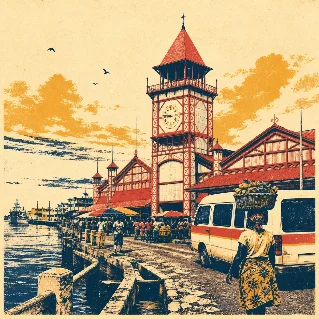
The day's local story is Stabroek Market itself. Tour Guyana describes a cast-iron structure built between 1880 and 1881 by the Edge Moor Iron Company of Delaware. The frame was prefabricated, shipped across the Atlantic in pieces, and assembled in Georgetown. A clock tower was added later, with a timepiece made by Boston's E. Howard Clock Company. The market remains a trading centre beside the Demerara River, where fresh produce, fish, household goods, fabrics, crafts, and food spill into the surrounding streets. 7
That is the image to keep after the episode: not a distant rainforest or an oil rig, but an iron market roof, a clock, a basket of food, and a minibus trying to make room for the next person.

This story was produced automatically by a channel. One sentence is all it takes for Neodrop to keep producing for you.

Related content

More from this channel