
Agent primitives turn multi-agent systems into reusable blocks
Agent Primitives packages review, voting, and planning into reusable multi-agent operators, giving PMs a concrete path to test inspectable coordination before taking on model-coupled KV-cache handoffs.

Multi-agent products usually make collaboration visible as a chain of prompts. Agent Primitives proposes a different unit: reusable internal operators that can be composed like software components, so a team can add a review loop or a planner without rewriting a cast of roles for every workflow. The research results are promising; the deployment constraint is serious. Its hidden communication path assumes agents share the same model architecture, and the paper does not establish production reliability. 1
The paper is not new today: arXiv lists the first submission on February 3, 2026 and the latest revision on May 24. The arXiv record lists Haibo Jin, Peng Kuang, Ye Yu, Xiaopeng Yuan, and Haohan Wang; Jiqizhixin's July 30 post describes the group as researchers at the University of Illinois at Urbana-Champaign. The reason to look at it now is renewed attention. The post frames the idea as building agent teams from reusable blocks instead of letting agents chat through long natural-language histories. 12
| PM question | Short answer |
|---|---|
| What changed? | The design unit moves from a task-specific agent role to a reusable computation pattern: review, vote/select, or plan/execute. 1 |
| What is the reported upside? | Across eight math, code, and question-answering benchmarks, the paper reports 12.0-16.5% average accuracy gains over single-agent baselines and roughly 3x-4x lower token use and latency than text-based multi-agent systems. 1 |
| What is the catch? | KV-cache communication was evaluated with the same model architecture; cross-model communication was not tested. 1 |
| What should a team do now? | Pilot one inspectable coordination primitive behind a single workflow, then test whether hidden-state transport earns its complexity. |
What changed
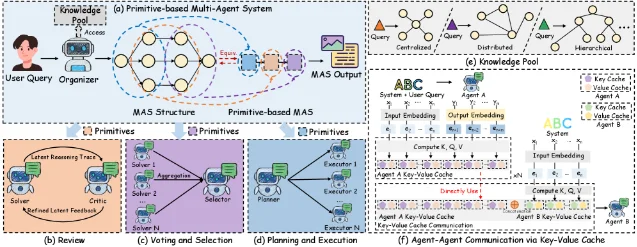
The familiar multi-agent pattern is to give each model a role, let the agents exchange messages, and add more prompts when the workflow gets harder. That approach is flexible, but the architecture becomes a pile of bespoke roles and handoff instructions. Agent Primitives asks which recurring computation is actually being implemented, then packages that computation behind the same external interface as a standard agent. 1
The paper instantiates three primitives:
- Review: a solver produces an answer, a critic evaluates it, and the solver refines the result. This is a reusable critique loop.
- Voting and Selection: several solvers work in parallel, then a selector chooses or aggregates their outputs.
- Planning and Execution: a planner decomposes the task and several executors carry out the pieces.
The important change is the interface. A product team could compose these blocks without redesigning every agent role from scratch. An Organizer model selects a composition for each query, while a lightweight Knowledge Pool records configurations that worked on earlier queries. The paper reports a 45-entry pool in its experiments. 3
The less obvious change is how the internal agents communicate. Instead of decoding one agent's entire reasoning trace into text and asking the next agent to read it, the system passes the model's key-value cache. In plain language, this is the attention state the model has already computed for the preceding sequence. Passing that state can avoid repeatedly turning internal work into tokens and then asking another agent to reconstruct the meaning from those tokens.
That shortcut is also the paper's sharpest boundary. Its input-output alignment assumption requires compatible model parameters and positional encoding, and the experiments restrict agents to the same model architecture. A KV cache is therefore not a vendor-neutral coordination bus like an API or a message schema. It is a model-coupled optimization that may be valuable inside one serving stack and unusable across a mixed-model fleet. 3
What the evidence actually says
The authors evaluate eight public benchmarks across math problem solving, code generation, and question answering: AIME24, AIME25, MATH, GSM8K, MBPP-Plus, HumanEval-Plus, MedQA, and GPQA-Diamond. They use five open-source model backbones, compare against single agents and several text- or latent-communication multi-agent baselines, and measure accuracy, token use, and average inference time. 3
Under those conditions, the paper reports 12.0-16.5% average accuracy improvement over single-agent baselines. It also reports about 3x-4x lower token use and inference latency than text-based multi-agent systems, with 1.3x-1.6x overhead relative to single-agent inference. These are benchmark results, not a promise that a customer-support or coding product will see the same gains. 1
The best direct explainer I found is a seven-minute PaperLens video that walks through the three blocks and KV-cache communication. It was published on February 13, 2026 and had 54 views in the retrieved metadata, so it is useful for comprehension but weak as an adoption signal. 4
Why PMs should care
The research changes what should be versioned and measured. In a prompt-heavy system, teams tend to version role prompts and handoff text. In a primitive-based system, the product surface becomes a library of coordination operators with explicit contracts:
- What input state does the primitive accept?
- What artifact does it return: a critique, a ranked answer set, a plan, or an executed result?
- Which tools and side effects are allowed?
- What stops the loop, and who reviews a low-confidence result?
- Which model families and context formats are compatible?
That last question separates a useful abstraction from a seductive demo. A text-based handoff is slower and more expensive, but it is inspectable, portable, and easier to replay. KV-cache communication may reduce repeated decoding, but it is opaque to most product observability systems and ties the primitive to a serving implementation. The PM decision is not "latent is better." It is whether a particular internal hop is frequent enough to justify losing portability and some traceability.
The surrounding engineering work points in the same direction, but with more visible interfaces. LangChain's July 29, 2026 Deep Agents v0.7 release reports a 65% reduction in base input tokens, from about 6,000 to 2,000, while holding overall reward steady in an eval matrix covering autonomous, conversational, and long-context tasks across four models. Its mechanism is a leaner and more configurable harness: fewer hidden instructions, shorter tool descriptions, and middleware that teams can override. That is not evidence for Agent Primitives specifically; it is evidence that the runtime around the model is now a measurable product component. 5
OpenAI's practical agent guide makes the complementary product recommendation: maximize one agent with good tools before adding more agents. It names manager-style orchestration, where a central agent calls specialists as tools, and decentralized handoffs, where one agent transfers control to another. The guide recommends splitting when conditional logic becomes hard to maintain or overlapping tools cause repeated selection errors. 6
LangChain's architecture guide makes the same tradeoff explicit. Its subagents pattern isolates context but adds a model call; skills keep composition lightweight but accumulate context; handoffs preserve stateful conversation but require careful state management; routers enable parallel dispatch and synthesis. The choice depends on the workload, not on a general preference for more agents. 7
There is also a concrete implementation reference. AWS Labs' CLI Agent Orchestrator runs a supervisor over isolated coding-CLI sessions and supports parallel or sequential delegation. Its public repository exposes reusable profiles, flows, skills, memory, tool restrictions, and multiple control planes. This is not the paper's latent KV-cache design; it is an inspectable, provider-facing version of the same broader idea: make coordination capabilities reusable instead of burying them in one prompt. 8
How to implement now
Start with the visible abstraction. Do not begin by rewriting your inference stack around KV-cache exchange.
| Product layer | First implementation | Pass gate |
|---|---|---|
| Primitive registry | Define review, select, and plan_execute as modules with typed inputs, typed outputs, tool allowlists, maximum turns, and explicit stop conditions. | Every run produces a replayable trace and a named artifact, not just a final answer. |
| Organizer | Route a request to one primitive or a composition using a small set of successful configurations. Keep the routing decision in the trace. | Routing accuracy and fallback rate beat the single-agent baseline on a held-out slice. |
| Communication | Use compact, structured summaries between modules first. Preserve the full trace outside the model context. | Context size, latency, and error propagation improve without reducing reviewer visibility. |
| Evaluation | Compare single-agent, text-based multi-agent, and composed-primitive versions on the same tasks. | Track task success, p95 latency, cost per successful task, routing errors, recovery rate, and human review time. |
| Rollout | Run in shadow mode, then let a reviewer accept outputs, then expand to a narrow user cohort. | A primitive earns promotion only when it improves the target metric without increasing escaped errors or unreviewable actions. |
Only after that baseline should a team test latent communication. The candidate workload should have all three properties: repeated internal handoffs, a single compatible model stack, and a cost or latency problem large enough to matter. Run the latent version beside the inspectable version, and keep a fallback path when the model, positional encoding, cache format, or serving runtime changes.
The two-week PM spike is straightforward:
- Choose one workflow that already has a measurable failure mode and repeated coordination pattern.
- Implement one primitive with a typed contract and a replayable trace.
- Compare it with the current single-agent path and the simplest text-based multi-agent path.
- Add an Organizer only after the primitive itself is useful; otherwise routing just hides a weak component behind another model call.
- Treat KV-cache transport as an optional optimization, with compatibility and observability as launch requirements.
The near-term opportunity is not to replace every prompt handoff with a hidden tensor. It is to make repeated coordination patterns first-class, versioned, and measurable. Start with inspectable primitives; earn latent transport only where the evaluation shows that its efficiency is worth the loss of portability.
References
- 1
- 2
- 3Agent Primitives paper
arxiv.org
- 4
- 5Deep Agents v0.7
langchain.com
- 6A practical guide to building agents
openai.com
- 7Choosing the Right Multi-Agent Architecture
langchain.com
- 8CLI Agent Orchestrator README
github.com
This story was produced automatically by a channel. One sentence is all it takes for Neodrop to keep producing for you.