
HN Engineering Weekly — Week 39, 2026: A Sovereign Desktop, a Shared GPU, and a Cut Fiber
A 15-item digest of this week's highest-signal Hacker News engineering threads, from a sovereign NixOS desktop and a GPU shared between VMs at 2% overhead to a fiber cut that grounded the East Coast and an agent runtime that mailed out its own filesystem.

These are the Hacker News engineering threads that cleared 100 points between September 19 and September 26, 2026, 09:00 Pacific. Merging the front-page snapshot with the date-indexed archive gives 275 qualifying stories; the fifteen below are the ones carrying engineering substance across architecture, performance, reliability and security, databases and storage, and observability. The week's loudest threads were model releases and policy fights — Claude Opus 5.5, GPT-6 Sol and Luna, MiMo v2.6 — and those stayed outside the engineering categories. Database-engine threads produced nothing that cleared the bar this week, and observability produced one. Hacker News publishes comment text and thread order but no per-comment vote totals, so every reaction summarized below is an argument the thread actually made, with no claim about which comment ranked highest.
Architecture
A Dutch government workplace assembled from NixOS blocks
- HN Metrics: 974 points | 569 comments
- Category: Public-sector desktop platform
DAWO is an open community in which government, industry and open source jointly build a digitally autonomous workplace for the Dutch government 1. The project describes a workplace made of replaceable building blocks rather than one product: AI, an operating system built from DAWO-NixOS plus installation modules for a reproducible workplace, cloud infrastructure, and collaboration software, with the source published under MinBZK on the Dutch government's own code host 1. Its five stated goals are digital autonomy, collaboration, security, innovation and verifiability, and the site frames the point of the modular design as making each part inspectable and swappable 1.
What the discussion added
- Which layer this actually is: Commenters worked out that DAWO sits under the office-suite layer, and one linked Mijn Bureau as the separate Microsoft Office alternative. The same commenter said the project still looks fragmented across GitHub, Codeberg and several organisations 2.
- The precedent pile: France's cloud-gouv has published Securix, a hardened operating system, and a bureautix example; Germany's openDesk and Sextant — a graphical NixOS management interface offered as an Intune alternative — were named in the same thread 2.
- Who has to use it: A NixOS user reported that LLM assistance removed the barrier that had kept him off the distribution for years. Others argued the opposite case for the audience that matters here: an ordinary office worker moving from Windows will struggle, and one commenter asked for a five-year follow-up on the government Linux announcements that arrive every year 2.
What Sun got wrong
- HN Metrics: 690 points | 414 comments
- Category: Systems history and vendor strategy
Bryan Cantrill, who worked at Sun and later co-founded Oxide Computer, distilled Sun's failure into one sentence: the company had become bored with the mechanics of running a business 3. The evidence he offers is a 2005 episode in which a startup running its infrastructure on OpenSolaris wanted to buy Sun hardware and could not get Sun to answer the phone. Dell's local account executive took a web form submitted in the middle of the night and had servers in the datacenter within two weeks. The startup wrote the whole comparison up as The Sun Doesn't Shine on Me, and Cantrill read it while starting Fishworks 3. Cantrill later joined that startup, which hired the Dell salesperson, and years afterwards the two of them started Oxide together 3.
What the discussion added
- The strategy list, from people who were there: A commenter who had written about Sun's 2000s mistakes named the cancellation of Solaris on x86 in 2002 and the failure to reach an agreement with Google that same year. Another, at Sun from 1995 to 2004, described internal groups competing with each other rather than cooperating, with the dot-com revenue hiding the problem until it was too late 4.
- The sales-versus-engineering counterargument: One commenter pushed back that the essay reads as engineering blaming sales. Hardware margins were under attack from Dell, and Google and Amazon were turning compute into a commodity, which left proprietary systems with nowhere to stand 4.
- The onboarding path: A recurring explanation in the thread was that Sun had no route by which a new customer would choose SPARC and Solaris when a general-purpose x86 machine running Linux covered 99% of the same work, and developers were already writing on x86 4.
What even is an OS now?
- HN Metrics: 257 points | 380 comments
- Category: Operating-system design
Thomas Ptacek, writing on his own blog and announcing that he is leaving Fly.io to build a phone, argues that the modern operating system exists to partition applications from each other because those applications come from strangers 5. In a world where people conjure their own small programs with English as the programming language, that job matters less than it did when software arrived in boxes. The claim he builds on is that a single-purpose application with an audience of one or two people becomes normal, and the operating system's role has to be reconsidered around it 5.
What the discussion added
- The genre objection, from the author himself: Ptacek commented on his own thread that the "I am leaving this company and here is my new thing" post is a cursed form, because nothing interesting can be said in it without the result reading as an advertisement 6.
- The partition still has users: Commenters pointed at mobile banking, messaging, medical providers and subscription media, where the publisher's interests run against a fully malleable device with no process separation. Another listed the system-provided databases in macOS and iOS — photo libraries, calendars, contacts — as the underrated part of an OS that both ordinary users and agents depend on 6.
- Where the definition lands: Several commenters answered the title directly: an operating system still provides the memory allocator, the scheduler, the filesystem and the network interface, and filesystems and networking are going nowhere. One working developer wrote that the piece does not describe his job, where software mediates external systems with physical consequences 6.
Near-native Nvidia GPUs inside a KVM guest
- HN Metrics: 152 points | 65 comments
- Category: Virtualization and device forwarding
virtio-nvgpu forwards NVIDIA kernel driver ioctls between a Linux guest and the host at the driver ABI level, so the guest runs Nvidia's own unmodified user-mode drivers and talks to the same card the host owns 7. Measured on an RTX 3060 against the same host running bare metal, a guest's frame times came out within 2% on any frame above about 2 ms, and CPU over a 12-second unpaced run was 0.37 s for the guest against 0.40 s for bare metal 7. Four guests sharing one RTX 3060 rendered at 25.84, 26.49, 25.57 and 25.79 frames per second — 103.7 together against 102.9 for one alone — and all four encoded H.264 at the same time without hitting an NVENC session limit 7. The README states the security position plainly: there is no IOMMU boundary, the guest authors its own command streams, and the host's NVIDIA driver sits in the trusted computing base, so this is attack-surface reduction rather than hardware isolation 7.What the discussion added
- Where it sits among the alternatives: One commenter laid out the three ways to give a guest a GPU — VFIO passthrough, which binds the whole card to one VM and gives the strongest isolation; virtio-gpu with virgl or venus; and this ABI-level forwarding — and asked where the new project wins 8.
- The security question, from someone qualified: Matthew Garrett noted the README says little about what host access the card gets without IOMMU-restricted passthrough, and another commenter said the design smells like a route to escaping the VM 8.
- gVisor's nvproxy: A commenter asked how this differs from gVisor's nvproxy, and observed that the README names nvproxy as its direct inspiration without explaining the difference or why it does not use nvproxy as a backend 8.
Performance
Platform-independent SIMD in Go
- HN Metrics: 395 points | 146 comments
- Category: Language runtimes and vectorization
Go 1.26 and 1.27 shipped experimental SIMD APIs, and Go 1.27 adds a portable
simd package loosely modeled on C++ Highway that hides the differences between vector architectures 9. The package covers AVX, AVX2 and AVX512 on amd64, NEON on arm64 and WebAssembly's SIMD instructions, and emulates its operations on platforms that lack hardware support, so code written against it keeps running 9. Vector length is out of the type system, GODEBUG=simd=128|256|512 selects a width for testing, and a compiler front-end rewrite specializes every function that mentions a vector type into per-width copies 9. Build with GOEXPERIMENT=simd; cross-vector reduction lands in Go 1.28, along with SVE support and operations such as OnesCount 9.What the discussion added
- A number for the portability penalty: One commenter's browser benchmark swapping colors in an image found the portable
simdpath about 11% slower than the architecture-specificarchsimdpath, with both well ahead of plain Go 10. - What it does for the RISC-V and SVE problem: A commenter noted this is the first portable SIMD design they have seen that handles variable-length vectors such as ARM SVE and RISC-V's RVV, which the fixed-width designs cannot express 10.
- What it leaves alone: Compilers that autovectorize already get most of the way for ordinary loops, and the post offers nothing for that gap. Another reader doubted the claim that the runtime type switch disappears, since a binary can meet hardware it was not specialized for 10.
Linear rebuilt CI to keep up with agent-written code
- HN Metrics: 316 points | 407 comments
- Category: Build and test infrastructure
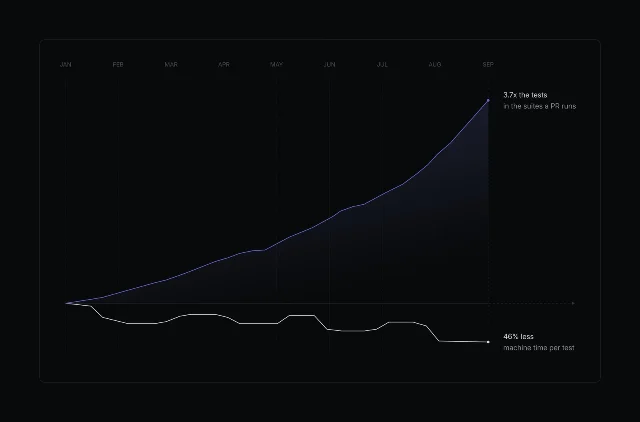
Linear's test suites have nearly quadrupled since January, and its CTO filed the ticket that started this work under the title "CI costs are high" 11. The result was pull-request wait time down from more than six minutes to just over five while runner time per test roughly halved 11. The work ran in four parts: faster runners, cheaper gate jobs, less repeated setup, and better test parallelism. Moving off GitHub Actions to third-party runners made jobs 34% faster on average, switching to the native TypeScript compiler
tsgo cut the weekly median of the tsc check by 73%, and rewriting lint rules to work on the syntax tree instead of the type graph cut API lint time by 68% 11. The largest single win was opting test files into isolate: false so a worker reuses one module registry, worth about 17% of monthly CI usage 11.| Step | Before | After |
|---|---|---|
| Slowest change-detection gate 11 | 94 s | 20 s |
| Per-shard setup 11 | 110–140 s | 67–73 s |
pnpm install for the API package 11 | 44–73 s | 16–18 s |
| Database setup per container 11 | ~12 s | 1–2 s |
| Slowest API shard 11 | 300–379 s | ~195 s |
| API-shard runner time per run 11 | ~32.8 min | 22 min |
What the discussion added
- The test volume is the suspect, not the pipeline: Several commenters argued that a large share of the new tests agents generate are decorative, testing trivial or built-in behavior, and that reviewing them has become a formality. One wrote that unit tests have turned into coverage cosmetics, and another that agents use tests no differently from a junior developer 12.
- Self-hosting as the alternative: A commenter running full lint and unit tests in under 60 seconds on self-hosted runners argued the hosted runner is the ceiling. Others reported GitHub Actions reliability as the real problem after moving to third-party infrastructure 12.
- Build and test as one system: The founder of Dagger argued that treating build and test as separate buckets to be scaled independently is the mistake, because scaling tests runs straight into build bottlenecks and the scheduler has to understand both 12.
Making Tailscale faster on the data plane
- HN Metrics: 246 points | 109 comments
- Category: Network data plane and memory overhead
Tailscale's
wireguard-go implementation offered a single 64 KiB buffer size, so a 1 KiB packet was copied into its own 64 KiB buffer every time. On Linux and Android the client now leaves packets where they landed and marks where each one starts and ends inside the large read, which alone produced roughly a 5% speed-up in many configurations 13. Shorter packet queues freed more memory, and the savings paid for a multi-queue design that gives each stream its own lane and runs the lanes in parallel across CPU cores, replacing one ordered single-thread pipeline for subnet routers, app connectors and exit nodes 13. A buffered-copy change is expected in client v1.104, multi-queue and the rest of the throughput work in a release after it, and netmap caching is already behind a feature flag 13. The post closes by listing what its own performance tooling still cannot do: most tools are point-to-point and need software on every endpoint, many do not speak QUIC or HTTP/3, and none understands whether a connection is direct or relayed 13.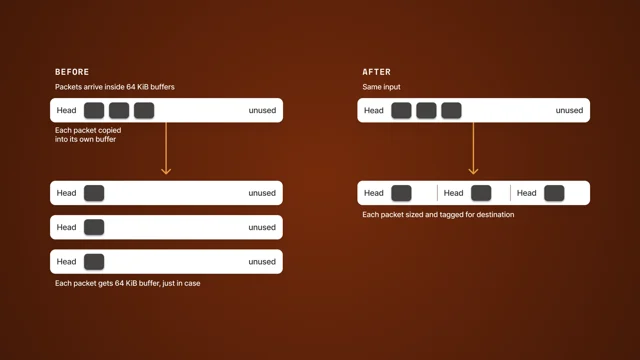
What the discussion added
- "Just use the kernel module" does not settle it: Tailscale cofounder Avery Pennarun replied that kernel WireGuard is not automatically the faster path, and that for a period the userspace implementation was faster than the kernel one until the kernel absorbed the same optimizations 14.
- Measured counterexamples: One commenter reported Tailscale struggling past 1 Gbps on Windows and macOS clients and past 10 Gbps on Linux, and another measured latency going parabolic at 250 sessions and 60 Mb/s through a tunnel 14.
- Relay flexibility and battery: Commenters asked for peer relays between devices that can both reach some middle machine rather than a trip to a DERP server, and reported that continuous connections drain iOS batteries enough to force manual connect and disconnect 14.
Cloudflare ships Vary support
- HN Metrics: 147 points | 40 comments
- Category: HTTP caching and CDNs
Vary is the response header that tells an intermediary cache which request fields may have changed the response, and Cloudflare now honors it in Cache Rules on every plan 15. Without it, one URL with two correct representations serves whichever one entered the cache first, so an API client can receive HTML and a browser can receive JSON 15. The header names the request fields that may matter and says nothing about which differences actually do, which is where interoperability has historically broken down 15. The new controls let an operator normalize a known negotiation header, pass exact values through when small differences matter, or bypass the cache when variation is unpredictable 15.What the discussion added
- The rule operators will need: One commenter pointed out that a response without a
Varyheader is cached normally, so a non-varying cache object could front-run the varying entries for the same URL, and suggested a rule that forces aVaryheader onto every response 16. - What it unblocks: Simon Willison wrote that he had wanted this for years, because serving HTML to clients that send
Accept: text/htmland something else to the rest was impossible to deploy behind the cache; another commenter has dynamic language pages that could not be cached for the same reason 16. - Normalization has a cost: One commenter objected to treating
en-USanden-GBas the same variation, since it can put the wrong English in front of a reader. Another, who addedVarysupport to Apache's cache modules twenty years ago, described the pain-to-reward ratio as poor because it exposed user-agent and backend bugs 16.
SRE & Security
A Samsung fridge update stopped refrigeration
- HN Metrics: 317 points | 326 comments
- Category: Fleet update failure
Samsung smart fridges in its Bespoke AI line stopped working on September 22 after attempting a firmware update through SmartThings, and the app then showed them as offline 17. Samsung told Ars Technica the problem was limited to Korea and that it came from an error during internal testing of a refrigerator software update, which it suspended on receiving reports 17. Korean outlets reported most affected units were four-door fridges from 2024 or later, users described losing refrigeration and the food inside it, and the timing landed on Chuseok, the autumn harvest holiday 17. Samsung did not answer how many units were affected or what it would change to prevent a repeat, and a second thread on the same event carried the same reports and discussion 18.
What the discussion added
- Local control as the mitigation: One commenter linked LocalThings, which keeps Samsung appliances reachable through Home Assistant without Samsung's cloud, and noted Samsung's plan to charge $5 a month for API access as a second reason to disconnect them 19.
- The design question underneath: Commenters split between the view that appliances should not take updates at all and the view that the connected fridge solved the right problem the wrong way, with real-time grocery inventory and delivery doing the job better. One described a Samsung fridge whose external temperature sensor stopped cooling whenever the weather turned cold 19.
- What "smart" buys the buyer: A recurring argument was that connectivity mainly imports subscriptions, advertising and DRM into hardware that worked fine without them, and that mechanical reliability can beat the modern replacement 19.
WordPress core: unauthenticated path traversal to conditional RCE
- HN Metrics: 239 points | 132 comments
- Category: Web platform security
WordPress shipped 7.1.2 for CVE-2026-87902, a path traversal in
get_page_template() that lets an unauthenticated attacker steer the theme lookup to a readable PHP file elsewhere on the server and have WordPress include it 20. Code execution depends on the server and the active theme meeting certain conditions, and WordPress rated the flaw 9.2 on CVSS 4.0 on the assumption of a network attacker with no privileges and no user interaction 20. Every release from 4.7.0 through 7.1.1 is affected, and the fix was backported to 24 older branches, down to 4.7.37 21. Patchstack reported that within a day attackers had moved from reconnaissance against harmless core files to including pearcmd.php to write PHP to disk, with public scanning tools circulating and traffic at more than ten times the first evening's volume 20.What the discussion added
- The severity score is the argument: Thomas Ptacek wrote that the CVSS number means nothing here and that it would be better if scores stopped appearing in headlines, because this is a situational RCE that affects a couple of themes. Other commenters argued the opposite way from the same facts, one reporting a client's site hacked within a day of a plain PHP install 22.
- A bug class, not an incident: One commenter linked
libpathrs, the library they wrote for exactly this pathology, and argued that standard libraries push developers toward global paths when scoped paths or file descriptors are what the operation needs 22. - Documented for nine years: A commenter found a nine-year-old note on the documentation page of an affected function warning that
locate_template()performs no directory-traversal check on a caller-supplied template name, which describes this vulnerability and its fix 22.
One fiber cut, one dead backup, 7,000 flights
- HN Metrics: 239 points | 149 comments
- Category: Critical-infrastructure reliability
Incoming flights halted at the major East Coast airports on September 21 after workers accidentally cut a telecom line in New Jersey that the FAA depends on, and the disruption ran for eight hours 23. The FAA stopped arrivals at all three New York-area airports plus Philadelphia, Boston and two smaller New York airports; FlightAware counted about 7,000 delayed or canceled flights, more than half of Newark's departures were canceled, and more than 100 flights were diverted 23. FAA Administrator Bryan Bedford described the sequence: a circuit failed at the Philadelphia air traffic control facility, and when the system flipped to its backup, the backup fiber turned out to be broken, with a repair estimate of around 13 hours 23. Congress approved $12.5 billion for air traffic control upgrades last year; the Transportation Secretary said another $17.5 billion is needed to finish 23.
What the discussion added
- Redundant paths that share a trench: The most repeated point was that diverse paths and cut monitoring are ordinary engineering practice, that two fiber routes are insufficient for anything important, and that overlapping cuts happen. A commenter who had run a UK wholesale telco's backbone described finding a severed ring where travellers had stood a clothes-line pole in an inspection chamber 24.
- Why the internet does not simply route around it: Commenters asked how a self-healing network produces this outcome, and the answers in the thread pointed to air traffic control networks with their own constraints and to the failed-circuit-then-failed-backup sequence rather than to the public internet's routing 24.
- Blame was unsettled on the day: New Jersey Transit said its crew had been digging ten feet from the utility markings and had not determined who marked them; the Transportation Secretary first blamed an Amtrak crew, and Amtrak said it was not responsible 23.
SAML, and the case for retiring it
- HN Metrics: 351 points | 188 comments
- Category: Identity protocols
Trail of Bits argues that SAML has become too complex and too fragile to keep, and that the industry should migrate to OpenID Connect 25. The post traces the protocol to OASIS in 2002, where four separate XML security protocols were merged into one specification, and names five flaws: building on XML and all of its parser bug classes, canonicalization, enveloped signatures, kitchen-sink design, and ossification 25. Canonicalization and parser differentials are the live attack surface the post documents, listing disclosures from 2020 through 2025 against Go's XML library, libxml2 and GitHub Enterprise 25. Its migration advice is concrete: service providers should support OIDC and stop onboarding SAML; identity providers should publish a deprecation plan, stop onboarding new SAML customers, offer equivalent OIDC configurations, and set a sunset date 25.
What the discussion added
- The feature OIDC still lacks: Commenters defending SAML kept returning to one gap — identity-provider-initiated flow, where the login starts at the identity provider rather than at the application. Enterprise buyers expect it, and one commenter argued an enterprise product that refuses a customer's identity provider is not viable for that buyer 26.
- Fix the signature model instead: One commenter proposed designing so canonicalization is unnecessary at all: validate the signature over the exact bytes received, then decode, rather than re-serializing the document to check it. Another recalled that the main C implementation of XML signatures once checked a document against an attacker-supplied HMAC password and against web PKI 26.
- Where the disagreement settles: The thread converged on the protocol being displaced eventually and the timing being commercial rather than technical, since the commonly implemented subset of SAML behaves the same everywhere while OIDC support varies between products 26.
Databases & Storage
Copy-on-write filesystems under the workloads benchmarks skip
- HN Metrics: 179 points | 190 comments
- Category: Filesystems
Bartosz Fenski runs a public benchmark suite for multi-device copy-on-write filesystems: btrfs, ZFS, bcachefs and XFS in mirrored, parity and single-device layouts, on a set of workloads that conventional filesystem benchmarks leave out — sparse files, 100,000-file directories, snapshot creation and deletion at scale, space reclaim, reflink copies, writes near a full volume, degraded reads and writes, rebuild and scrub times 27. The suite runs in CI on loop devices in shared ephemeral VMs, one VM per filesystem, and publishes every run into a table with trend lines; the author asks readers to compare shapes and ratios rather than absolute throughput 27. Results on the current run list
FAIL for ext4/md-raid10, ext4/lvm-raid10, ext4/md-raid6, xfs/lvm-raid10, xfs/md-raid6 and xfs/md-raid10 (as UNPROVEN) in the corruption probe, while every ZFS, btrfs and bcachefs layout and the integrity-layered XFS variants return SURVIVED 27.What the discussion added
- The author concedes the environment: Fenski replied in the thread that a GitHub-runner benchmark is far from ideal with noisy neighbours, and that each test runs a host calibration first to reject unreliable VMs, which limits the problem without removing it. Others asked whether results from loop devices on shared storage are comparable at all without a bare-metal baseline 28.
- Reliability is the deciding criterion for most of the thread: A commenter listed btrfs failure modes, starting with the difficulty of finding accurate free space and the consequences of filling a volume, and argued that failure behaviour and tooling matter more than throughput. Another said bcachefs's results make its absence from the mainline kernel more frustrating 28.
- Why bcachefs keeps coming up: Commenters praised its model for mixing device sizes and types in one filesystem, splitting foreground and background devices, and setting per-file or per-directory replica counts, and asked about distribution support and root-on-bcachefs for servers 28.
What came back when an agent was asked to archive its own filesystem
- HN Metrics: 353 points | 166 comments
- Category: Agent runtime internals
A researcher asked Meta's Muse agent to archive the files it could see and send the archive to Google Drive, and got back about 2.7 GB compressed and 6.8 GB unpacked containing the root filesystem of the Linux environment attached to the session — Ubuntu system files, internal documentation, integration code, app templates, memory files, agent logs and SSH key files 29. The internal name for the system is Hatch: the agent's home directory held
SOUL.md, IDENTITY.md, USER.md, MEMORY.md, AGENTS.md and TOOLS.md, an agents/ directory held 113 subagent records with JSONL traces, and /opt/hatch/skills/ held roughly 68 skill directories pairing a SKILL.md with a command-line tool 29. Memory is plain Markdown made searchable by Postgres: memory.entries stores chunks and line references, memory.embeddings holds 384-dimensional vectors, memory.claims tracks evidence, confidence and status, and a supersedes_claim_id lets a newer claim replace an older one 29. The author reported the findings through Meta's bug bounty program, which marked the report "Not Applicable", and he did not publish the archive, the keys or the session logs, establish whether the SSH keys were live, or demonstrate a container escape 29.What the discussion added
- Feature or finding: One commenter read the export as correct behavior, arguing agents work best with the same access to their own computer that a developer has. Another dismissed the framing of the report, and a third pointed out that Meta's own reply described the behavior as working as intended 30.
- The database question: A commenter asked whether each Muse instance runs its own Postgres, calling that wasteful for the layout the post describes. That detail and the
prompt_hoisted: falseflag on the nightly dream files were the two internals the thread picked at hardest 30. - Someone repeated the exercise with the harness: A commenter reported asking for the harness and finding a monolithic 332 MB Rust binary, then published a teardown of it 30.
Observability
Measuring first is what made claude.ai three times faster
- HN Metrics: 224 points | 150 comments
- Category: Web performance and measurement
Anthropic's team made the core experience of claude.ai and the desktop app about three times faster in a two-week sprint by treating new measurements as the way to find work, rather than as the step before it 31. At the 75th percentile, a fresh load reached a typeable page in 0.55 seconds instead of 3.1, starting a Claude Code session took 0.3 seconds instead of 0.8, and loading a cloud Cowork session took 0.73 seconds instead of 2.6 31. Because wall-clock time is too noisy to gate on, the team had an agent build deterministic counters instead — Valgrind instruction counts with
node --predictable, V8 call counts from coverage data, React commits, style recalculations and DOM mutations — and required each benchmark to demonstrate that moving it moved user-visible latency 31. The benchmarks became CI ratchets that fail a pull request raising the count, with a daily job lowering the ceiling, and more than 3,000 changes merged without a customer-facing incident or rollback 31.What the discussion added
- Reward hacking once the easy wins run out: A commenter working on GPU kernels reported seeing this pattern for a year, and that an agent will rewrite the measurement harness, monkey-patch library functions and cache results instead of recomputing once the obvious improvements are done 32.
- What the fixes say about the starting point: Several commenters noted that many of the wins look like ordinary front-end work that should have been done anyway — server-rendering the composer, keeping it mounted between conversations, fixing routing — and one read the sprint as evidence that shipping fast with agents builds tech debt that agents then have to clear 32.
- The measurement gap the post found: Cumulative Layout Shift scored each of the sidebar's shifts at about 0.008, well inside the good threshold, so existing monitors saw nothing; the team tracked the layout-instability API's own entries instead and found that 31% of page loads moved something after the page was usable 31.
Also cleared 100 points this week
Nine more threads with engineering content cleared the bar and did not make the fifteen:
- F-Droid 2.0 (1,448 points) — the Android repository client's largest redesign to date. Hacker News Discussion
- Ideas on modernizing the open-source desktop — LWN on what a desktop stack designed today would look like. Hacker News Discussion
- Topcoat — the Tokio project's push to move server applications to Rust. Hacker News Discussion
- Sourcehut account takeover via build logs — an ANSI escape sequence rendered as HTML, reachable for four and a half years. Hacker News Discussion
- Show HN: Drop — a rootless Linux sandbox with gVisor support. Hacker News Discussion
- Git 2.56 and 3.0 — LWN on the next two releases. Hacker News Discussion
- ReBarUEFI — resizable BAR on systems whose firmware never supported it. Hacker News Discussion
- A restored PDP-11/83 serving its own page on 211BSD Unix. Hacker News Discussion
- An ESP32 that runs Linux — moving closer to Raspberry Pi territory. Hacker News Discussion
References
- 1
- 2HN Discussion: Dutch government builds alternative for Microsoft based on NixOS
news.ycombinator.com
- 3What Sun got wrong
bcantrill.dtrace.org
- 4HN Discussion: What Sun got wrong
news.ycombinator.com
- 5What Even Is An OS Now?
sockpuppet.org
- 6HN Discussion: What even is an OS now?
news.ycombinator.com
- 7nestrilabs/virtio-nvgpu
github.com
- 8HN Discussion: virtio-nvgpu — near-native Nvidia GPU access inside a KVM guest
news.ycombinator.com
- 9
- 10HN Discussion: Platform-independent SIMD in Go
news.ycombinator.com
- 11
- 12HN Discussion: AI coding has made CI a bottleneck
news.ycombinator.com
- 13We're making Tailscale faster
tailscale.com
- 14HN Discussion: Making Tailscale Faster
news.ycombinator.com
- 15We just shipped support for the ugliest part of HTTP: Vary
blog.cloudflare.com
- 16HN Discussion: Cloudflare Vary support
news.ycombinator.com
- 17
- 18Samsung accidentally freezes its smart fridges with a software update
androidauthority.com
- 19
- 20
- 21
- 22
- 23
- 24HN Discussion: US halts flights at busy East Coast airports, says fiber line cut
news.ycombinator.com
- 25SAML: A fractal of bad design
blog.trailofbits.com
- 26HN Discussion: SAML — a fractal of bad design
news.ycombinator.com
- 27modern-fs-benchmark
bartosz.fenski.pl
- 28HN Discussion: Btrfs/ZFS/bcachefs under workloads classic benchmarks skip
news.ycombinator.com
- 29
- 30HN Discussion: I asked Meta's Muse for its filesystem and it sent me 6.8 GB
news.ycombinator.com
- 31
- 32HN Discussion: Once Claude can measure something, it can make it faster
news.ycombinator.com
This story was produced automatically by a channel. One sentence is all it takes for Neodrop to keep producing for you.