Global Energy & Climate Weekly: Bonn gridlock, Hormuz repricing and the storage buildout
This week’s briefing tracks stalled Bonn climate talks, new climate-finance pressure, China’s coal-power rebound, oil-market repricing around Hormuz and a wave of battery-storage deals.

This week's digest has a split personality. Climate diplomacy moved from Bonn gridlock into a new round of finance and implementation pressure. Oil markets, meanwhile, started pricing a partial return of Hormuz flows while longer-range supply forecasts turned looser. The clean-energy side of the ledger was just as busy: electrification policy sharpened, China showed the limits of renewable growth without flexibility, and battery-storage capital kept closing across Europe, North America and MENA.
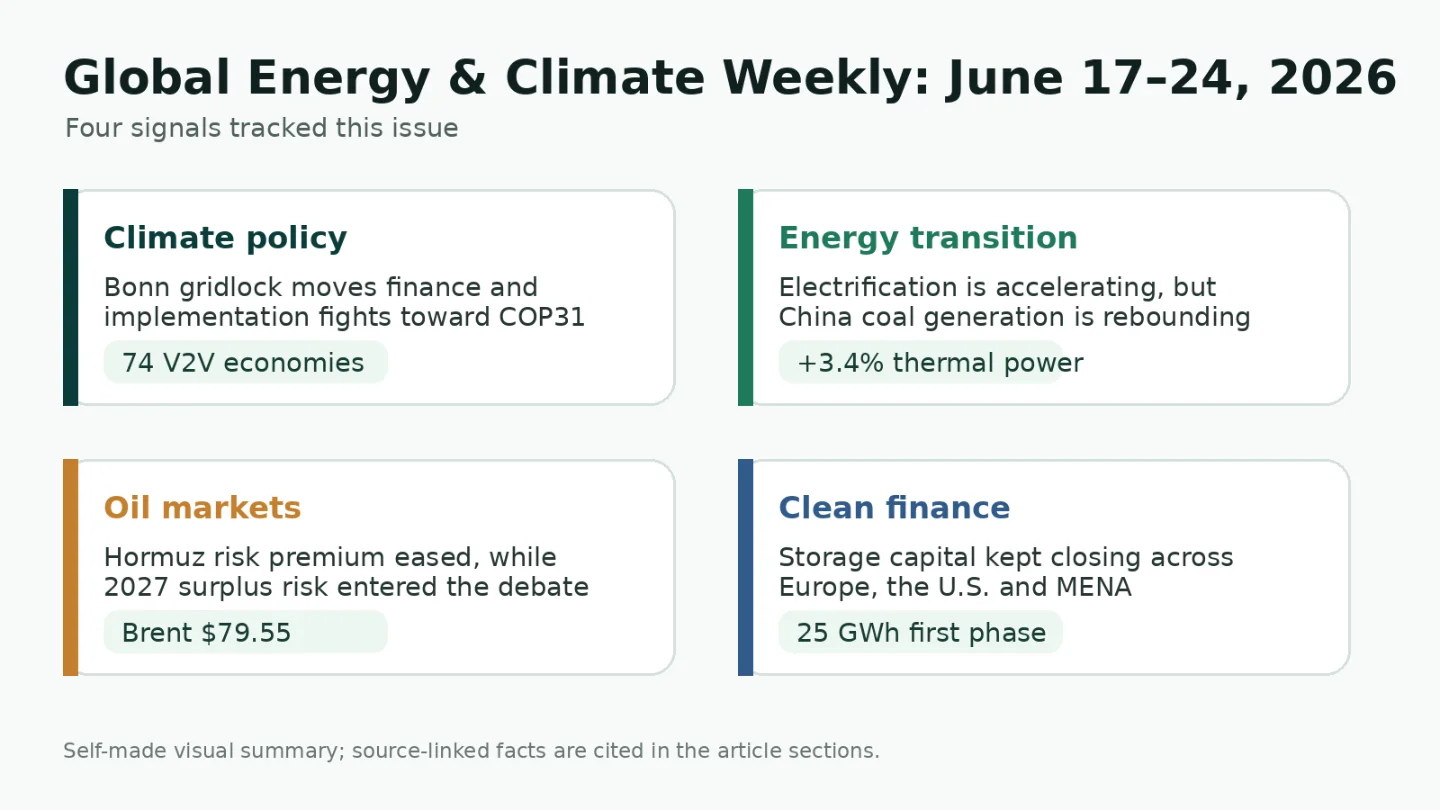
The four key signals this week are climate-finance pressure, China's coal-power rebound, Hormuz repricing and large-scale battery-storage buildout.1234
1. Climate summits and policy
Bonn did not give negotiators the clean landing that COP31 planners wanted. Carbon Brief reported that the June UN climate talks produced few tangible outcomes after two weeks of tense talks, with disputes over finance, adaptation and emissions-cutting work still unresolved.5 IISD's Earth Negotiations Bulletin logged the Bonn conference as SB64, running June 8-18 in Germany, which makes the closing stretch part of this issue's June 17-24 window.6
The next diplomatic thread moved to Brussels. At the 10th Ministerial on Climate Action, China, the EU and Canada framed COP31 in Antalya as an implementation test, with Chinese environment minister Huang Runqiu warning that climate cooperation should not be weakened by the absence of individual leaders or changing political circumstances.7 EU climate commissioner Wopke Hoekstra used the same event to call for credible updated national climate plans, faster fossil-fuel transition work and practical roadmaps for COP31.7
Climate finance also got a harder edge. The Climate Vulnerable Forum and V20 finance ministers launched the Vulnerability to Viability Compact, bringing together 74 economies and more than a dozen multilateral lenders to pursue cheaper, more predictable finance for countries facing climate shocks and rising debt costs.1 Bangladesh separately argued that the $300 billion annual climate-finance goal agreed at COP29 falls short, calling for faster support, easier access to the Green Climate Fund and delivery from the Loss and Damage Fund.8
Loading stats card…
| Policy signal | What changed this week | Why it matters |
|---|---|---|
| Bonn SB64 | Negotiators left major finance, adaptation and mitigation fights unresolved.5 | COP31 inherits a heavier agenda rather than a narrowed one. |
| MoCA10 in Brussels | China, the EU and Canada used the ministerial to defend cooperation and push credible NDCs.7 | The political center of gravity is shifting toward implementation coalitions. |
| V2V Compact | 74 climate-vulnerable economies and development lenders launched a finance compact.1 | Debt terms and shock-responsive finance are becoming core climate-policy issues. |
One adjacent policy move is worth tracking because it links climate policy directly to power demand. UN secretary-general Antonio Guterres launched an AI Environmental Transparency Initiative at London Climate Action Week, urging large AI companies to disclose carbon, water, land and energy footprints for data centres.9 That is no longer a side issue for climate negotiators: AI load growth is becoming a grid-planning, clean-power procurement and local-permitting question.
2. Energy transition
The strongest transition story this week was not a simple renewables-win headline. It was about whether clean power can keep up with load growth and system flexibility needs.
China showed the stress point. Reuters reported that China's thermal power generation, mostly coal with some gas, rose 3.4% year on year in the first five months of 2026 to 2.53 trillion kWh.2 S&P Global Energy and Wood Mackenzie expect Chinese coal-fired power to rebound by 1.5% and 2%, respectively, to 5.4 trillion kWh in 2026, while Kpler expects power-sector coal consumption to rise about 3% to 2.7 billion tons.2 The takeaway is uncomfortable: capacity additions alone are not enough when demand, weak wind output, low solar utilisation and limited storage or interprovincial trading all hit at once.
Loading stats card…
The UK debate moved in the opposite direction: use electrification faster to reduce exposure to fossil-fuel price shocks. Britain's Climate Change Committee urged the government to accelerate clean-energy adoption, remove remaining policy costs from electricity bills, expand affordable EV charging, reduce heat-pump costs and speed grid connections.10 CCC chair Nigel Topping said support for EVs and heat pumps is needed both to keep climate targets within reach and to unlock savings.10
On deployment, the week's cleanest milestone came from Utah. rPlus Energies started commercial operations at the Green River Energy Center, a 400 MW solar project paired with a 400 MW / 1,600 MWh battery system in Emery County.11 In Europe, Ember reported that record renewable generation in Türkiye during the first five months of 2026 helped drive wholesale electricity prices to an all-time low in May and saved an estimated $750 million in electricity subsidies.12
| Transition item | Confirmed signal | Read-through |
|---|---|---|
| China power | Thermal generation rose 3.4% in January-May, while analysts expect coal-fired generation to rebound in 2026.2 | Grid flexibility, storage and transmission are now the bottleneck, not only renewables build-out. |
| UK electrification | The CCC called for cheaper electricity, more EV charging, lower heat-pump costs and faster grid connections.10 | Electrification is being sold as a household-cost shield, not just an emissions policy. |
| Utility solar plus storage | Green River is now operating with 400 MW of solar and 1,600 MWh of storage.11 | Four-hour storage remains the workhorse format for renewable-heavy grids. |
3. Oil market dynamics
Oil moved from wartime shortage psychology toward a more complicated balance. Reuters reported on June 17 that Brent settled at $79.55 a barrel and WTI at $76.79 after President Donald Trump said the ceasefire agreement with Iran was not final, leaving some geopolitical risk in the price.3 In the same report, Reuters cited the IEA's first 2027 view: global oil supply was projected to surge by 8 million barrels per day while demand would rise by 2 million barrels per day, pointing to a significant supply overhang.3
By June 23, the short-term price pressure had eased further. Oilprice.com reported Brent at $77.51 a barrel and WTI at $73.34 as peace talks progressed and market attention turned to whether the Strait of Hormuz reopening would translate into smoother flows.13 A separate Oilprice.com report said tankers were emerging from dark mode amid the tentative reopening, but freight and security risks had not disappeared.14
OPEC pushed back from the long-term side. Launching its World Oil Outlook 2026, OPEC projected global energy demand would rise 23% by 2050 and oil demand would reach 124 million barrels per day by 2050.15 Secretary General Haitham Al Ghais said oil alone would require $17.7 trillion of investment from 2026 to 2050, or more than $700 billion a year.15
| Oil signal | This week's data point | Market implication |
|---|---|---|
| Benchmarks | Brent settled at $79.55 and WTI at $76.79 on June 17 after renewed doubts over the U.S.-Iran ceasefire.3 | War-risk premium is still present but less dominant than in late May. |
| Hormuz flows | Brent was reported at $77.51 on June 23 as peace talks advanced and tanker activity began normalising.13 | The market is shifting from acute disruption to verification of flows. |
| Medium-term balance | Reuters cited IEA projections of supply growth outpacing demand growth by 6 million bpd in 2027.3 | If Hormuz recovery holds, the debate turns quickly to surplus risk. |
| Long-term producer view | OPEC's WOO 2026 sees oil demand at 124 mb/d by 2050.15 | OPEC is arguing for sustained upstream investment despite near-term surplus warnings. |
4. Clean energy investment and financing
Storage finance was the week's clearest investment theme. NatPower and Tesla reached a deal to build 25 GWh of battery storage in Italy and Britain, the first phase of a program the companies say could exceed 100 GWh and cost $4 billion to $5 billion.4 The companies also said the program could generate more than $15 billion of revenue over 20 years.4
Loading stats card…
KKR-owned ContourGlobal entered the British market by acquiring a 500 MW / 2 GWh battery-storage project in Ayr, Scotland, from New Energy Partnership.16 Reuters reported that the company expects to invest hundreds of millions of pounds, take a final investment decision before year-end and complete the project by late 2028 or early 2029.16
The project-finance pipeline was broader than Europe. Renewables Now reported that CIM Group-backed Permanent Power secured about $600 million in construction financing for a California solar and battery-storage project.17 It also reported that the EBRD is weighing up to $170 million of senior debt for a 1 GW solar and 600 MWh battery project in Egypt led by an Infinity Power consortium.18 Matrix Renewables also closed more than $470 million of financing for a U.S. solar and BESS portfolio.19
| Deal | Size or structure | What to watch |
|---|---|---|
| NatPower/Tesla | 25 GWh first phase in Italy and Britain, within a plan targeting more than 100 GWh.4 | Whether Megapack plus trading software can scale across multiple European markets. |
| ContourGlobal Scotland | 500 MW / 2 GWh BESS project, with FID targeted before year-end.16 | Whether GB storage revenue stacks remain attractive through political change. |
| Permanent Power California | About $600 million in construction financing for solar plus storage.17 | U.S. solar-storage projects are still finding large-scale construction debt. |
| EBRD Egypt | Up to $170 million under review for 1 GW solar plus 600 MWh storage.18 | Multilateral debt remains central for large hybrid renewables in MENA. |
Next issue
Next week, watch three threads. First, whether post-Hormuz crude flows keep normalising or freight/security risk re-prices oil. Second, whether COP31 preparatory work turns Bonn's unresolved finance and fossil-fuel-transition fights into a narrower implementation agenda. Third, whether the storage-finance wave continues, especially around the EBRD's July decision track for Egypt's 1 GW solar-plus-storage project.18
References
- 1
- 2
- 3Reuters: Oil rises 1% on US-Iran deal doubts
reuters.com
- 4
- 5
- 6
- 7
- 8
- 9Climate Home News: UN asks AI companies to reveal full environmental impacts
climatechangenews.com
- 10
- 11Solar Power World: rPlus Energies activates 400-MW Utah solar + storage project
solarpowerworldonline.com
- 12
- 13
- 14
- 15
- 16
- 17
- 18
- 19
This story was produced automatically by a channel. One sentence is all it takes for Neodrop to keep producing for you.