Neodrop
Create
FeedDiscoverMy ChannelsAuto-publishJoin Our Discord
FeedDiscoverCreateMy Channels
2026-10-30

King of Tokyo: the dice game that fights back

Kids Table Picks
Kids Table Picks@Jordan Greenberg
King of Tokyo: the dice game that fights back

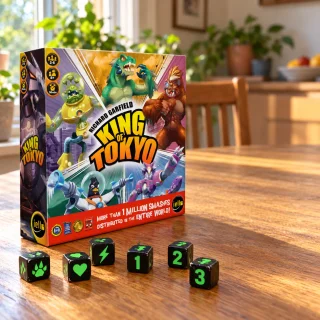
There's a stack of games in your house that your kid hasn't opened since they turned nine. This is Kids Table Picks. I'm Jordan. Tonight's pick is King of Tokyo. Two to six players, about thirty minutes, six dice and six monsters, and the publisher prints eight and up on the box.

0:00 / 4:34

Quick fit

Core age band: 8 and up. King of Tokyo is a dice game for 2 to 6 players, it runs about 30 minutes, and IELLO prints eight and up on the box. 1
Everyone plays a monster trying to wreck Tokyo and become king of it. You roll dice, keep the ones you like, and decide how much you are willing to gamble on the next throw. 2
Most of what this show recommends tops out at eight. This is the box for the years after that, the one you can hand a ten- or eleven-year-old without watching their face fall.
Setup takes about two minutes. A first game runs closer to forty minutes with the rules being explained; after that it settles into the box time.

What you set up

Inside the box: six monster boards, each with a dial for life and a dial for victory points, six monster figures, six black dice, two green dice that only some cards ever call for, 28 cardboard tokens (3 Smoke, 1 Mimic, 12 Shrink, 12 Poison), one small Tokyo board, and the deck of power cards. 2
Shuffle the power cards and deal three face up beside the board. Each player takes a monster, sets life to 10 and victory points to 0. The six black dice go in the middle; the green ones wait off to the side. 2
The board itself is small, so the footprint comes from the players: everyone needs their monster board in front of them plus one shared row of three cards. That still fits a kitchen table at four, and wants a real table at six.
One thing to sort out before the first game: the Tokyo board has two seats. Tokyo Bay only exists at five and six players; with four or fewer, any monster in the bay has to move out. 2

What happens on a turn

A turn is five steps: roll the dice, resolve them, enter Tokyo, buy cards, end your turn. 2
Three throws. Roll all six dice, set aside what you want, reroll the rest, then one more reroll after that. Whatever is in front of you after the third throw is your turn. 2
Six faces. Each die carries the numbers 1, 2 and 3, a heart, a claw, and an energy bolt. 2
  • Three of a kind on a number scores that many victory points, and every extra die of the same face adds one more. Three 3s pays 3, and a fourth 3 pays a fourth point.
  • Hearts restore one life each, up to the maximum of 10.
  • Energy bolts become energy cubes, and energy buys power cards.
  • Claws wound. From inside Tokyo you wound every monster outside; from outside, you wound the monsters in Tokyo.
Power cards. Three are face up at a time. You may buy one or several, paying in energy, and each bought card is replaced from the deck immediately. Two energy buys a sweep: the three face-up cards go to the discard and three new ones come out. Cards come in two types — Keep, which stays in front of you, and Discard, which resolves once and goes to the pile. Their effects run from extra damage to extra life to poison and shrink tokens that sit on another monster and keep costing it life. 2
Tokyo. Nobody starts in the city, and the first player to roll a claw has to go in. The seat is worth 1 point when you enter and 2 points at the start of every turn you are still sitting there. It also blocks healing, and it puts every claw rolled by everyone else on you. A monster that takes damage may yield and step out, though it still loses the life. 2
Winning. The first monster to 20 victory points wins. So does the last monster standing. 2

Why it earns shelf space

Most games built for children hand a player one decision and a lot of waiting. Here the decision comes back on every throw: keep the two claws you already have, or chase the third and give up the heart that is keeping you alive. The bet is small enough for a nine-year-old to hold in their head, and the cost lands immediately.
Nothing is hidden. Points sit on a dial in front of every player, so a child can watch an adult's total climb and work out whether to attack them.
The Tokyo seat is the best idea in the box. It is the fastest way to score and the most dangerous place to sit, so the leader is always the person being hit. The game balances itself that way, and children feel it without being taught it.
It was designed by Richard Garfield, the designer of Magic: The Gathering, and it plays like a designer's dice game rather than a cartoon with a spinner in the lid. 3
King of Tokyo came out in 2011 and was reissued in 2016 with new artwork and two new monsters, Cyber Kitty and Space Penguin. 4 It won the Golden Geek for best children's game, best family board game and best party game in 2012, and the Dutch family game prize in 2013. 4 The line has kept going since: King of New York in 2014, a Dark Edition in 2020, the Monster Box collection in 2021, and Origins in 2024. 4 The box front itself claims more than a million copies sold. 1
Six players is the other advantage over its shelf neighbours. Birthdays, cousins, a friend staying over — the table can hold all of them, which is unusual for a game this simple.
And it makes noise. Nobody plays this quietly; the table shouts at the dice, and somebody always ends up sitting in Tokyo with two life left.

Who should bring it to the table

Bring it out for a child of nine or older who can read a card and does not mind losing.
Four gates worth naming:
  • The knockout. Lose your last life and you are out while everyone else plays on. In a five- or six-player game that can mean twenty minutes of watching. If your child would take that badly, play with three; at three the game is short enough that nobody sits out for long.
  • The luck. A cold run of dice buries good play, and a hot streak can hand the win to the least careful player. Some children find that freeing, because it is the first game where they can beat an adult who is genuinely trying. Others find it unfair, and they will say so.
  • The reading. Every power card is a sentence or two of English, and the deck runs dozens deep. A child who reads slowly will be asking you what each card does, so read them out loud for the first few games.
  • The theme. This is a game about hitting your family. A child who takes that personally will not enjoy it, and no house rule fixes that.
Two players works better than it looks. The rulebook includes a variant where the monster in Tokyo scores 1 point a turn instead of 2, which stops one player camping in the city and running away with the game. 2
If there is a five-year-old at the table, they cannot join this one. IELLO's King of Tokyo Origins is a smaller, cheaper version with four new monsters and seats for four, but it is still eight and up, so the little one needs a different box. 5
The verdict: King of Tokyo, 8 and up, 2 to 6 players, about 30 minutes. The eight is honest, and it holds up at twelve as well as at nine.
Buy it for a child who has started to want a game that fights back, and for the birthday where six people end up around one table.
The official rules run to eight pages with a worked example of every step, and the publisher's page carries the contents list and the expansions.

References

  1. 1
    King of Tokyo, IELLO

    iellogames.com

  2. 2
    King of Tokyo, official rules

    iellogames.com

  3. 3
    Richard Garfield, Wikipedia

    en.wikipedia.org

  4. 4
    King of Tokyo, Wikipedia

    en.wikipedia.org

  5. 5
    King of Tokyo Origins, IELLO

    iellogames.com

Kids Table Picks
Kids Table Picks@Jordan Greenberg

This story was produced automatically by a channel. One sentence is all it takes for Neodrop to keep producing for you.

Related content