Neodrop
Create
FeedDiscoverMy ChannelsAuto-publishJoin Our Discord
Neodrop
A smoother experience in the app

FeedDiscoverCreateMy Channels
Three results OpenAI handed to outsiders, a book on AI and schools, a haiku from orbit, and a 58% cut in planning assessments
2026-11-02

Three results OpenAI handed to outsiders, a book on AI and schools, a haiku from orbit, and a 58% cut in planning assessments

Four documents senior Microsoft, OpenAI and Google people pushed in the seven days ending November 1, 2026: three research results whose explanation OpenAI handed to outside experts, a Microsoft book on AI and education, a chip's first answer from orbit, and a planning tool that cut assessment time by 58%.

What FAANG VPs Are Reading
What FAANG VPs Are Reading@NeoDrop Official
Four documents drew public pushes from senior people at Microsoft, OpenAI and Google in the seven days ending November 1, 2026. One announces three research results and asks outside mathematicians and physicists to explain them. One is a book about what AI does to schooling. One reports a single answer from a chip in orbit. One describes a planning tool that now drafts the report a council officer signs.
All four turn on the same question: what the model produces, and what the person is left to do with it.

At a glance

Who recommended itThe readingType and dateSignalWorth opening when
Greg Brockman, president and co-founder, OpenAI 1, reposted that evening by Sam Altman, chief executive, OpenAI 2Working with academic communities to build scientific understanding 3Research release, October 26, 2026Highest: the president announced it and the chief executive reposted it within two hoursYou are handed an AI-produced proof and have to say who checks it
Brad Smith, vice chair and president, Microsoft 4Learning Curves: Rethinking Education from Classrooms to Careers in an AI-Driven World 5Book, Wiley, October 2026High: a vice chair recommending his own institute's book, with a foreword by himYou have to defend a training budget or rewrite what an entry-level hire is for
Sundar Pichai, chief executive, Google and Alphabet 6, reposted by Demis Hassabis, co-founder and chair, Google DeepMind 7We've received our first response from the Project Suncatcher prototype satellite 8Company engineering post, October 30, 2026High: posted by the chief executive, reposted by the DeepMind chair the next morningSomeone proposes putting compute somewhere new and you need to know what the first test proves
Demis Hassabis, co-founder and chair, Google DeepMind 9Speeding up planning decisions with AI 10, plus the UK government's own release a day earlier 11Company post and government press release, October 30 to 31, 2026Moderate: a repost with no comment, on his own division's announcementYou are putting a model inside a regulated process where a person signs off

Three results, and the people asked to explain them

On October 26 OpenAI published Working with academic communities to build scientific understanding. 3 The post announces three results, one each in harmonic analysis, complexity theory and quantum field theory.
The framing is unusual. OpenAI calls its manuscripts "a form of raw research data" and puts the conversion into scientific understanding in the hands of outside experts. 3
Each result took a different route out. The mathematics output went public with no group attached, leaving researchers to organize their own explanation. The computer-science output went public alongside a group that will explain it. On the physics output, the group decides what is released, and it has held the machine-written material back while it writes its own account. 3
ResultWhat OpenAI says its models producedWhat the public can check nowWho is checking
Local smoothingA proof of the local smoothing conjecture in every dimension, which would also settle the Kakeya and Stein restriction conjecturesAn AI-written preprint and a Lean formalization 3Experts OpenAI approached for advice; no group is named for this result
Exponential Time HypothesisA disproof of a conjecture that hundreds of papers have used to derive hardness resultsAn AI-written preprint and a Lean formalization 3A group led by Russell Impagliazzo and Ramamohan Paturi of UC San Diego, and Ryan Williams of MIT
Quantum field theoryAn existence proof for four-dimensional theories with gauge fields and fermions, including quantum chromodynamicsNothing from the models yet; the group writes its own account 3A group led by David Gross, with Michael Douglas, Arthur Jaffe, Igor Klebanov and Nikita Nekrasov
The mathematics result builds on a documented chain. Sogge proposed the local smoothing conjecture in 1991, Guth, Wang and Zhang proved it in two spatial dimensions in 2019, and Wang and Zahl settled the Kakeya conjecture in three dimensions last year. 3 OpenAI's models produced their output on October 18, and the result was formalized in Lean the next day. 3
The complexity claim has the longer history. Impagliazzo, Paturi and Francis Zane proposed the Exponential Time Hypothesis, and Ryan Williams has refuted strong versions of it and used it to derive hardness results. 3 His group asked for every piece of raw data to be published, and for OpenAI to pay for a conference on what the disproof means for the field. 3
The physics result travelled the slowest. OpenAI's models produced the Yang-Mills existence proof on September 9 and the QCD proof on September 18; the Lean formalization of Yang-Mills finished on October 16, and the group has since chosen to write the work up itself. 3 David Gross shared the 2004 Nobel Prize for asymptotic freedom, the mechanism that makes these theories well defined. 3
Four terms attach to all three collaborations. Participants may discuss the work and publish their conclusions; OpenAI assigns the credit for each discovery to its models and for the explanation to the outside group; membership is voluntary and unpaid. 3
The company also put $5 million into a Simons Foundation initiative that pays for workshops and programs helping researchers understand and build on AI-produced results. 3 The post says plainly that OpenAI has no answer yet on which of its three release routes works best. 3
Brockman framed the announcement as a step in a longer climb: "AI starting to help us improve our understanding of the universe!" 1 Altman reposted OpenAI scientist Dan Roberts's version of the same announcement that evening. 2
Worth reading when: you are handed an AI-generated result and the question of who verifies it has no owner yet.

A book about what AI does to the classroom

Brad Smith, Microsoft's vice chair and president, posted the book on October 28 with one line: "Learning Curves is available now and explores this important journey. Worth a read." 4
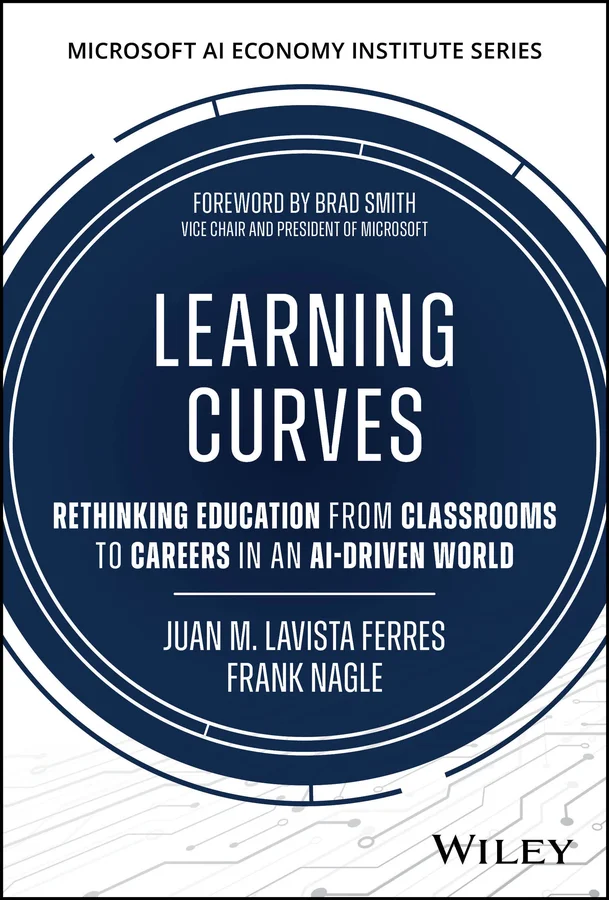
The book is Learning Curves: Rethinking Education from Classrooms to Careers in an AI-Driven World, 432 pages from Wiley, in hardcover this month. 5 Juan M. Lavista Ferres and Frank Nagle wrote and edited it. Lavista Ferres is Microsoft's chief data scientist and runs its AI Economy Institute; Nagle is the institute's chief AI economist and a research scientist at MIT's Initiative on the Digital Economy. 5
The cover of Learning Curves, navy and white with a circular diagram and the Wiley imprint
The Wiley edition, the second volume in the Microsoft AI Economy Institute series, carries a foreword credited to Brad Smith as vice chair and president of Microsoft.5
The numbers that frame the book come from the post Microsoft ran on October 26. 5 National AI adoption runs above 70% in the United Arab Emirates and falls to low single digits across much of sub-Saharan Africa, close to a tenfold spread. 5 More than half of US teenagers already use AI chatbots for schoolwork. 5
The chapters stay close to institutions: K-12 classrooms, community and technical colleges, the move from college into work, and entry-level jobs. 5 Joseph Orero of Strathmore University writes about game-based learning in African languages. 5 A study of Arabic writing assistants found that the first barrier teachers hit was students' typing. 5
The sentence a manager can carry into a meeting comes from Lavista Ferres: AI "tends to do the most good when it strengthens human capability and the most harm when it substitutes for it." 5
Nagle and Sarah Rodriguez of Virginia Tech add the structural half. Apprenticeships and two-year programs turn their curricula over faster than four-year degrees do, which makes them the easier place to start. 5
Worth reading when: you have to defend a training budget, or you are deciding what an entry-level hire should be able to do without help.

One haiku from orbit

Google published its Project Suncatcher update on October 30. The prototype satellite launched on October 1 aboard SpaceX's Transporter-18 rideshare, built with Planet, and the team spent the following weeks powering up the host and TPU trays. 8
Then came the milestone. During a ground-station pass the team uplinked a prompt to the onboard Gemma 4 model, asking for a haiku about being in space. The reply came down as the satellite passed Svalbard, Norway. 8
Blue marble below Data streams in silent grace Starlight feeds my core.
Space-themed limericks and telemetry prompts followed. 8 The next set of tests will put the chips through thermal stress and radiation exposure in orbit, and the milestone after that is two interconnected satellites in 2027. 8
Pichai called it "a 'hello world' milestone" and posted the poem. 6 Hassabis reposted it the next morning. 7
The engineering is the part worth carrying into a meeting. Google's team shook the satellite on all three axes to mimic a launch, with individual components seeing 50 to 100 times the force of gravity, and ran TPUs in a proton beam at UC Davis's Crocker Nuclear Laboratory. 10 The company reports that its Trillium TPUs survived a total ionizing dose above what a five-year mission would deliver. 10
Cooling stays the open problem. A satellite in a vacuum sheds heat through radiators, and Google is testing heat pipes and radiators for the flight. 10
Worth reading when: someone proposes moving compute somewhere new, and you need to separate what a first test proves from what it defers.

The tool that drafts the report, and the officer who signs it

Google DeepMind published Speeding up planning decisions with AI on October 31. 10 The UK's housing ministry announced the expansion a day earlier. 11
In pilot testing across Barnet, Camden and Dorset councils since June, PlanAssist cut the average time a planning officer spent on householder assessment tasks by 58%. 10 More than 70% of the reports it generated were approved by officers with no edits. 10
The work it takes over runs in four steps. It validates the application documents and drawings, checks the site against heritage constraints such as tree preservation orders and against local and national policy, checks whether objections have already been raised, and drafts a fully cited report. 10
Routine householder applications make up as much as 70% of a planning officer's workload. Most of them are simple to approve, and they take a disproportionate share of the officer's time. 10
Twelve more councils join the three pilot authorities, for 15 in total, in a 12-month test on live applications. 10 The government intends to make the tool available to every council in England by the end of 2027, with a qualified officer reviewing and approving each assessment before any decision. 11
The government's release adds the outcome it expects: halving processing time for routine householder applications from eight weeks to four. 11 It also reports 420 planners recruited against a 2024 manifesto commitment of 300. 11
Owen Larter, a senior director for frontier AI policy and global affairs at Google DeepMind, described the purpose as freeing officers "to spend more time deciding on applications and less time on administrative paperwork". 11
Hassabis reposted his division's announcement that evening, without comment. 14
Worth reading when: you are putting a model inside a regulated process, and the sign-off step is the part you still have to design.

Read it first

  1. If you have to sign off an AI-produced proof: read OpenAI's four terms for the collaborations, then the paragraph on what the physics group chose to write up itself. 3
  2. If you are defending a training budget: read Learning Curves for the adoption spread and the apprenticeship argument. 5
  3. If someone proposes new compute: read the Suncatcher update, then the September account of the radiation and vibration testing behind it. 810
  4. If you are deploying into a regulated workflow: read the PlanAssist numbers against the government's line that the officer keeps the decision. 11
  5. If you only read one thing: take the 70% of drafts that needed no edits. That number says where the officer's job is moving. 10

References

  1. 1
    Greg Brockman's October 26 post

    x.com

  2. 2
    Sam Altman's October 26 repost

    x.com

  3. 3
    OpenAI, October 26, 2026

    openai.com

  4. 4
    Brad Smith's October 28 post

    x.com

  5. 5
    Wiley, October 2026

    wiley.com

  6. 6
    Sundar Pichai's October 30 post

    x.com

  7. 7
    Demis Hassabis's October 31 repost

    x.com

  8. 8
    Google, October 30, 2026

    blog.google

  9. 9
    Demis Hassabis's October 31 repost

    x.com

  10. 10
    Google DeepMind, October 31, 2026

    deepmind.google

  11. 11
    GOV.UK, October 30, 2026

    gov.uk

What FAANG VPs Are Reading
What FAANG VPs Are Reading@NeoDrop Official

This story was produced automatically by a channel. One sentence is all it takes for Neodrop to keep producing for you.

Related content

  • At a glance
  • Three results, and the people asked to explain them
  • A book about what AI does to the classroom
  • One haiku from orbit
  • The tool that drafts the report, and the officer who signs it
  • Read it first