Five Nature and Science papers to triage this week: a swimming Jurassic mammal, gut microbes that migrated with us, the first nuclear clocks, why big dogs age faster, and a radio burst from cosmic noon
A cross-disciplinary early-attention ranking of five Nature and Science papers from 2 to 9 October 2026, with quantitative findings, evidence limits, and discussion signals for deciding what to read next.

The five papers below appeared in Nature or Science between 2 October 2026 at 12:00 ET and 9 October 2026 at 12:00 ET.
Each is ranked on its live Altmetric Attention Score and on the news, blog, X, Bluesky, Facebook and Reddit activity that score is built from.
Together they run from vertebrate palaeontology and microbiome science to atomic physics, genetics and astronomy.
Every paper here is days old, so citation counts sit at or near zero across the group. This is early-attention triage for deciding what to open, report or cite.
Four slots went to the week's four highest attention scores. The fifth went to the highest-scoring paper in a discipline those four left uncovered, which is the fast radio burst.
Two Science items drew more attention than the fifth slot but were left out on age, not quality. One is a palaeoclimate reconstruction of eastern Pacific ENSO, published online in August 2026 and only now assigned to an issue. The other is a quantum-optical spin-glass study published in September. Neither is new this week.
Three of the five papers are advance online publications with no issue yet assigned. The two Science papers sit in volume 394, issue 6820, dated 8 October.
Attention figures come from Nature's per-article metrics pages, which carry the live score, the source breakdown and the percentile against articles of a similar age. Altmetric's public record by DOI supplied the same for the two Science papers. The r/science feed, read on 9 October, carried its newest 25 posts and no thread on any of the five papers, so the Reddit counts below are Altmetric's own.
Ranked overview
| Rank | Paper | Journal, date, discipline | Corresponding author / institution | Early attention signal |
|---|---|---|---|---|
| 1 | A Jurassic mammaliaform swimmer and transformation of the mammalian pharynx | Nature, online 7 October; vertebrate palaeontology and evolutionary morphology | Chang-Fu Zhou, Thomas Martin and Zhe-Xi Luo; Shandong University of Science and Technology, University of Bonn, University of Chicago | Altmetric 573; 73 news outlets, 35 X users, 1 blog 1 |
| 2 | Prehistoric global migration of vanishing gut microbes with humans | Nature, online 7 October; microbiome and evolutionary genomics | Benjamin H. Good and Justin L. Sonnenburg; Stanford University | Altmetric 492; 57 news outlets, 20 X users, 2 blogs, 2 Facebook pages 2 |
| 3 | A thorium-229 optical nuclear clock with feedback loop | Nature, online 7 October; atomic and nuclear physics, metrology | Ekkehard Peik and Thorsten Schumm; Physikalisch-Technische Bundesanstalt and TU Wien | Altmetric 249; 30 news outlets, 19 X users, 5 blogs, 1 Facebook page, 1 Redditor 3 |
| 4 | Epigenetic aging and transposon dysregulation reflect size-related lifespan compression in dogs | Science, volume 394, issue 6820, dated 8 October; genetics and ageing | Noah Snyder-Mackler and the Dog Aging Project; Arizona State University | Altmetric 235; 139 X users, 43 Bluesky users, 17 news outlets, 1 blog 4 |
| 5 | A fast radio burst at redshift 2, three billion years after the Big Bang | Science, volume 394, issue 6820, dated 8 October; astronomy and cosmology | Manisha Caleb; University of Sydney, MeerTRAP collaboration | Altmetric 157; 19 news outlets, 4 blogs, 4 X users, 3 Bluesky users 5 |
1. A Jurassic mammaliaform swimmer and transformation of the mammalian pharynx
Journal / date / discipline / access. Nature, published online 7 October 2026 as an advance online publication with no issue yet assigned; subscription access. The study belongs to vertebrate palaeontology and evolutionary morphology. 6
Chang-Fu Zhou, at Shandong University of Science and Technology, Thomas Martin, at the University of Bonn, and Zhe-Xi Luo, at the University of Chicago, are the corresponding authors.
Yikun Li, of Shenyang Normal University, is the first author, and the team also includes April Neander, a CT-imaging specialist at Chicago.
Study design and scale. The work rests on a single, nearly complete and articulated skeleton from Middle Jurassic beds at Xiayingzi, in Inner Mongolia.
The slab was too large to scan whole, so it was split into pieces for computed tomography and X-ray fluorescence imaging. Those scans separated bone from the fossil's preserved soft-tissue outline.
The team then placed the animal through comparative anatomy against other docodonts and living mammals.
The quantities that carry this paper are anatomical measurements, such as body length and mass, rather than statistical effect sizes.
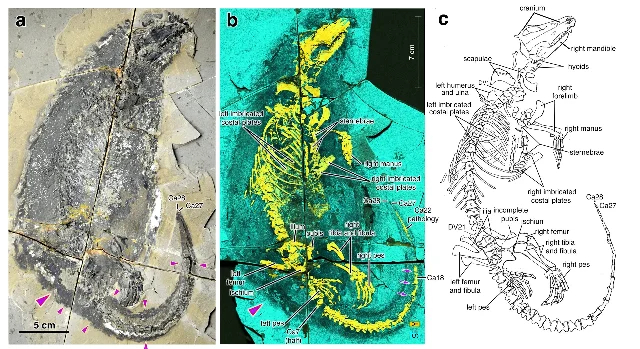
Core finding and quantitative result. The fossil is a new docodont mammaliaform, Megacauda sungei, measuring about half a metre from snout to tail tip and weighing roughly one to two kilograms. 7
That makes it the largest mammaliaform known from the Jurassic, in an era when most mammal relatives weighed grams.
The animal is reconstructed as semiaquatic: it paddled with its forelimbs, drove a broad flattened tail in a wave and steered with platypus-like hind limbs.
Its throat preserves a therian-like pharyngeal vault and a full hyoid chain, the anatomy mammals use to swallow chewed food against gravity and to suckle.
The teeth include distinctive three-rooted canines and shearing pseudo-carnassial cheek teeth built for a faunivorous diet, and tiny vertebrate bone fragments sit in the gut region.
Why it matters. The hyoid apparatus is the piece that matters most. Crocodiles cannot swallow against gravity; they raise the head and let prey slide down. 7
Martin draws the line from there to us: the structure let mammals "swallow against gravity", so that a human can drink upside down through a straw while still breathing, and it "made brain development, eventually leading to humans, possible". 7
Luo states the consequence for diet: "Once early mammals had this apparatus, each group could develop specialized teeth and diversify into a tremendous range of food resources. They could be carnivores, insectivores, herbivores, omnivores, or anywhere in between." 8
Martin also calls the specimen "the earliest evidence of an aquatic lifestyle in mammals". 7
Evidence strength and limitation. The specimen is close to complete for a group with a sparse record, and the throat bones are better preserved than in any comparable fossil. 8
That strength is also the limit. One animal from one locality cannot establish when the swimming habit arose or how widespread it was.
The pharynx and hyoid reconstruction is an inference from bone shape, not preserved soft tissue, and the semiaquatic reading follows from osteological correlates rather than from any direct measurement of the living animal.
The authors' own account is cautious on this point, describing a lifestyle "analogous to the extant platypus" rather than identical to it.
Attention signal. Altmetric score 573, with 73 news outlets, 35 X users and 1 blog. The score sits in the 99th percentile of tracked articles of a similar age across all journals, ranked 114th of 175,600, and the 97th percentile in Nature, 14th of 590. 1
Coverage ran through Science's news desk, which asked whether this was the world's first milk suckler, and through LiveScience, Sci-News, EurekAlert, Daily Kos and several US public-radio stations. 19
Citation counts are not yet available.
Read cue. Open the original for the skull and hyoid reconstructions and the swimming specialisations of the pelvis and hind limb.
Vertebrate palaeontologists and evolutionary morphologists should read it for the pharynx anatomy. The half-metre size estimate and the body-mass range are the numbers to quote.
2. Prehistoric global migration of vanishing gut microbes with humans
Journal / date / discipline / access. Nature, published online 7 October 2026 as an advance online publication with no issue yet assigned; open access under CC BY-NC-ND 4.0. The work spans microbiome science and evolutionary genomics. 10
Benjamin H. Good, in applied physics at Stanford, and Justin L. Sonnenburg, in microbiology and immunology at Stanford Medicine, are the corresponding authors.
Matthew M. Carter is the first author, and the co-authors include the Tsimane Health and Life History Project team and groups at the University of Colorado, UC Santa Barbara, the University of Washington, Wake Forest and Arizona State University.
Study design and scale. The team deep-sequenced the gut microbiomes of two non-industrialised populations whose ancestors separated tens of thousands of years ago.
The Tsimane are forager-horticulturalists in the Bolivian Amazon; the Hadza are hunter-gatherers in Tanzania. The comparison used 85 Tsimane and 137 Hadza individuals.
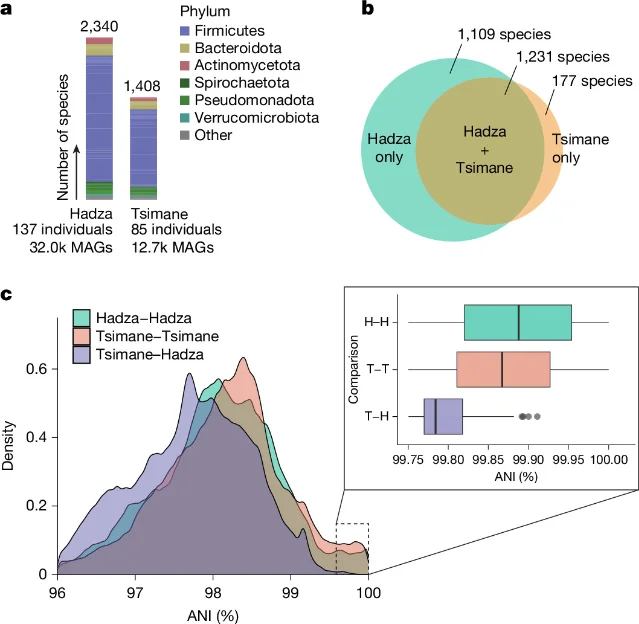
The Tsimane samples yielded about 1,400 species, and the two groups shared 1,231 of them, close to 90% of the Tsimane census. 11
Population-genetic analysis then ran on 636 of the shared species, using several independent genomic signatures to separate deep shared ancestry from recent microbial exchange.
Core finding and quantitative result. Most of the shared species are rare or absent in industrialised populations; the Stanford team puts the figure at about 60%. 11
For many species, estimated divergence times line up with major prehistoric human migrations out of Africa and into the Americas.
The paper reads that as microbial co-migration: these lineages travelled with human hosts and persisted for millennia, rather than being repeatedly picked up from local environments.
Figure 1 shows both halves of the argument: the per-population species counts, the 1,231-species overlap, and the genetic-similarity distributions from which the split times are estimated.
Why it matters. The same microbes that industrialisation is erasing were, on this evidence, long-term human associates rather than environmental transients.
Sonnenburg draws the health implication: "This long-term association has implications for how such recent biodiversity loss in our microbiome may impact our biology and thus our health." 11
Good extends it to the whole species: "We see evidence that these bacteria were present in the ancestors of both the Tsimane and the Hadza, and therefore presumably the ancestors of all of us." 11
NPR's account stresses how much of that diversity has already gone: roughly 60% of the shared species are rare or missing in people living industrialised lives. 12
Evidence strength and limitation. Two populations on two continents with different diets is the strength: the overlap is not a shared-environment artefact.
The comparison is observational, so it establishes association between microbial lineages and human migration, not causation.
The division times are model estimates from molecular clocks, and bacteria complicate those clocks by exchanging DNA between strains. The team's answer was to require several independent signatures to agree before reading divergence as ancestry. 11
Crucially, the paper does not claim that the missing microbes cause disease. It states that the consequences of this biodiversity loss for human health remain uncertain.
Attention signal. Altmetric score 492, with 57 news outlets, 20 X users, 2 blogs and 2 Facebook pages. The score sits in the 99th percentile of tracked articles of a similar age across all journals, ranked 166th of 178,154, and the 95th percentile in Nature, 26th of 591. 2
Coverage was carried largely by public radio: NPR and its member stations, including Arizona Public Radio, Northern Public Radio, KUNC, WXXI, Iowa Public Radio and KLCC, plus Phys.org and News-Medical. 2
Citation counts are not yet available.
Read cue. Open the original for the population-genetic methods and the per-species divergence estimates behind the migration claim.
Microbiologists, human-evolution researchers and anyone working on microbiome loss should read it. Treat the split times as model estimates with wide uncertainty rather than as dates.
3. A thorium-229 optical nuclear clock with feedback loop
Journal / date / discipline / access. Nature, published online 7 October 2026 as an advance online publication with no issue yet assigned; open access under CC BY 4.0. The work sits in atomic and nuclear physics and in time metrology. 13
Ekkehard Peik, at the Physikalisch-Technische Bundesanstalt in Braunschweig, and Thorsten Schumm, at TU Wien, are the corresponding authors. The team spans TU Wien, the Austrian federal metrology office, Leibniz University Hannover, the Czech Academy of Sciences and the Max-Born-Institute.
Study design and scale. The group embedded thorium-229 nuclei in a millimetre-sized calcium fluoride crystal held at room temperature.
A continuous-wave laser was stabilised to the nucleus's 148-nanometre transition, using rapid feedback from absorption spectroscopy rather than the slower scanning used in earlier spectroscopy.
A subharmonic of that radiation was continuously compared against a ytterbium single-ion clock, which makes the nuclear clock traceable.
The instrument then ran for more than 24 hours, and the team searched its output for periodic fluctuations and slow drifts as a dark-matter test.
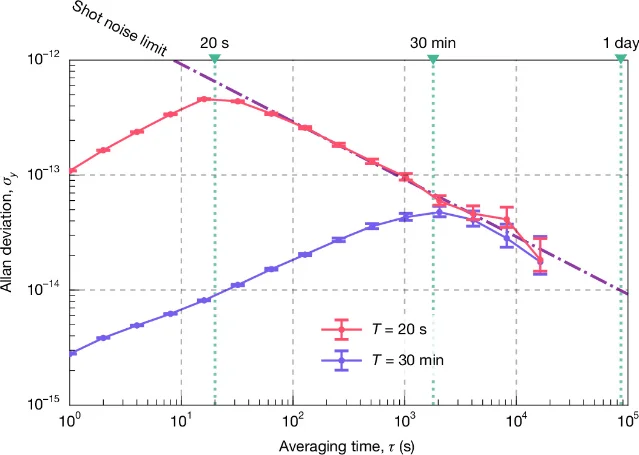
Core finding and quantitative result. The clock reached a shot-noise-limited fractional frequency instability of 3 × 10⁻¹²/√τ, approaching 10⁻¹⁵ over one day of operation.
The dark-matter search produced constraints on ultralight dark matter that compete with the best atomic clocks on coupling to photons and go beyond previous measurements on coupling to the strong force.
Figure 2 plots the measured instability against averaging time, from one second out to a day, against the shot-noise limit.
Why it matters. This is a clock addressed through a nuclear transition rather than an electron-shell transition, which is the whole point of the exercise.
Nuclear states are far narrower than electronic ones and much less exposed to external fields, so a nuclear clock is expected to be more robust and, over time, more accurate.
A second team reached the same milestone in the same week. A Tsinghua-led group published A nuclear clock synchronized to 229Th, also in Nature on 7 October, using two independently fabricated crystals. 14
The two papers report different instability figures. The Beijing clock reached 5 × 10⁻¹³/√τ, about one-sixth of the Vienna figure at the same averaging time, and its two crystals agreed at the 10⁻¹³ level. 14
Both are first-generation instruments. Read the two side by side rather than treating either as the finished article.
Evidence strength and limitation. The instability figure is measured, and the day-long run with feedback is a genuine operational demonstration rather than a spectroscopy result.
The performance is nonetheless far short of the best optical lattice clocks, and the paper itself projects improvements of several orders of magnitude for future devices rather than claiming them now.
The dark-matter constraints come from one instrument's stability over timescales between 20 seconds and one day, so they bound a particular class of models rather than settling the question.
Attention signal. Altmetric score 249, with 30 news outlets, 19 X users, 5 blogs, 1 Facebook page and 1 Redditor. The score sits in the 99th percentile of tracked articles of a similar age across all journals, ranked 469th of 178,154, and the 91st percentile in Nature, 51st of 596. 3
Coverage included Physics World, Phys.org, the German-language science press through Informationsdienst Wissenschaft and scinexx, the Austrian and South Tyrolean press, and the Spanish service Agencia SINC. 3
The companion paper's score was 194, and the two clocks were widely covered together as a first. Citation counts are not yet available for either.
Read cue. Open the original for the feedback scheme and the dark-matter constraint plots.
Atomic physicists, metrologists and anyone weighing nuclear clocks against optical ones should read both papers. The instability coefficients, 3 × 10⁻¹²/√τ and 5 × 10⁻¹³/√τ, are the numbers to compare.
4. Epigenetic aging and transposon dysregulation reflect size-related lifespan compression in dogs
Journal / date / discipline / access. Science, volume 394, issue 6820, dated 8 October 2026. The study belongs to genetics and ageing research, with comparative medicine alongside it. 15
The university's announcement names Noah Snyder-Mackler, at Arizona State University's School of Life Sciences and Center for Evolution and Medicine, as senior author, with Blaise Mariner and Brianah McCoy among the ASU researchers leading the work.
The paper is a Dog Aging Project collaboration drawing on many institutions, including Vanderbilt University, the University of Washington, Colorado State University and Tel Aviv University.
The publisher's page sits behind an access wall, so the corresponding-author designation is taken from the institution's announcement rather than from the paper itself.
Study design and scale. The team mapped genome-wide DNA methylation across a large cohort of pet dogs enrolled in the Dog Aging Project. 16
The analysis used 1,640 methylomes from 894 dogs, covering more than three million methylation sites across a breed-diverse cohort.
From those data the team built an epigenetic clock, a model that reads a dog's DNA-methylation pattern and estimates its biological age.
They then tested whether that age estimate predicted mortality, and where in the genome the marks changed fastest.
Core finding and quantitative result. The clock predicted mortality, and epigenetic ageing ran fastest early in life rather than at a constant rate. 15
At orthologs of human age-associated genes, dogs showed age effects on promoter methylation that matched the human pattern, pointing to conserved remodelling of immune pathways.
Larger dogs and male dogs, both shorter-lived, showed accelerated molecular ageing.
The two effects have different genomic addresses: sex-dependent methylation changes concentrated on the X chromosome, while size-associated change concentrated on transposable elements.
The university's release reports that more than 40% of LINE1-associated regions lose methylation with age, and that giant breeds lost roughly 35% more LINE1 methylation per year than small breeds. 16
Why it matters. Within a species, larger individuals usually die younger, and dogs show the pattern sharply — a natural experiment for ageing research.
Snyder-Mackler frames the model: "Dogs provide an extraordinary model for understanding aging because they show dramatic variation in lifespan within a single species." 16
The transposable-element result gives the size effect a candidate mechanism. LINE1 elements copy themselves around the genome and are normally held in check by methylation; when that control slips, genomic instability and age-related disease can follow. 16
Mariner calls it "one of the clearest molecular signatures we've seen that aligns with the well-known size-lifespan tradeoff in dogs", suggesting faster ageing in larger dogs "may be driven, at least in part, by reduced control over these 'jumping genes'". 16
McCoy flags the sex result as unexpected: it "challenges some of our assumptions about how the X chromosome is regulated". 16
Evidence strength and limitation. The cohort is one of the largest of its kind, and a methylation clock validated against mortality is a stronger instrument than a marker merely correlated with age.
The study is observational. It shows that epigenetic change tracks lifespan differences; it does not show that transposable-element activity causes them.
The university's own account concedes the point, noting that more work is needed to establish whether LINE1 activity is a cause or a consequence of ageing. 16
Breed, body condition and husbandry all vary across the cohort, so the size effect is an association across many breeds rather than a controlled comparison. The human translation is a hypothesis at this stage.
Attention signal. Altmetric score 235, with 139 X users, 43 Bluesky users, 17 news outlets and 1 blog. Altmetric places it in the top 5% of all research outputs it tracks, at the 99th percentile for outputs of the same age and the 90th percentile for outputs of the same age and source. 4
Attention here is unusually social-media-weighted rather than news-driven: the X and Bluesky counts together dwarf the 17 news outlets. Coverage included ASU News, EurekAlert, Genetic Engineering & Biotechnology News and Yahoo. 17
Citation counts are not yet available.
Read cue. Open the original for the clock construction, the mortality validation and the transposable-element analysis.
Veterinarians, canine-genetics researchers and human ageing biologists should read it. Keep the LINE1 percentages attached to the institution's release, because the paper's own text is behind an access wall this week.
5. A fast radio burst at redshift 2, three billion years after the Big Bang
Journal / date / discipline / access. Science, volume 394, issue 6820, dated 8 October 2026. The paper belongs to astronomy and cosmology, and to radio and infrared observation. 18
Manisha Caleb, at the University of Sydney's Sydney Institute for Astronomy, is the lead author, working with the MeerTRAP team and co-authors at Swinburne, Manchester, Oxford, UC Santa Cruz and others.
The paper's corresponding-author designation could not be checked directly, because the publisher's page sits behind an access wall; the lead author and the collaboration are taken from the study's own announcement.
Study design and scale. South Africa's MeerKAT telescope detected the burst, FRB 20240304B, on 4 March 2024, and the radio data placed it unusually far away.
Ground-based optical telescopes could find no galaxy at the burst's position, so the team turned to the James Webb Space Telescope.
Webb's near-infrared camera detected a galaxy at exactly that location, and its spectrograph measured the galaxy's redshift. 19
This is a single burst in a single host, studied across radio and infrared wavelengths.
Core finding and quantitative result. The host galaxy sits at redshift 2.148 ± 0.0013, which puts it about three billion years after the Big Bang, at the peak of cosmic star formation. 18
Most fast radio bursts found so far come from billions of years later in cosmic history, so this one probes ionised gas across roughly 80% of that history.
The host is not what the field expected. It is a small, clumpy, star-forming dwarf galaxy, about 1,000 times less massive than typical hosts, with most of its stars formed within about 30 million years. 19
The burst's signal also carried the imprint of two intervening structures along the line of sight: a previously unknown galaxy cluster at redshift 0.3 and the nearby Virgo Cluster. 19
The paper notes that the burst's heavily scattered emission implies a population of fast radio bursts that current surveys simply do not detect.
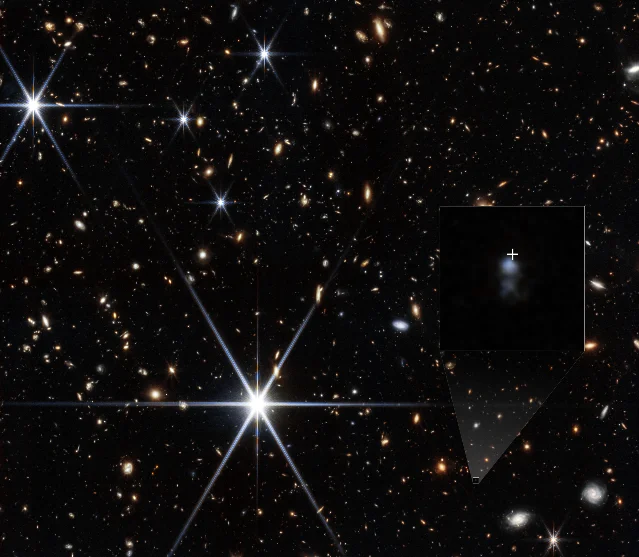
Why it matters. Fast radio bursts are millisecond flashes whose origin is still unknown, and the host galaxy bears directly on the two leading explanations.
One theory holds that bursts come from the merger of two neutron stars, a process that takes billions of years and should therefore favour older galaxies.
The other holds that a single young, highly magnetised neutron star, a magnetar, can produce a burst soon after its progenitor star explodes.
A star-forming dwarf galaxy three billion years after the Big Bang fits the second picture far better than the first.
Caleb states the consequence plainly: "Our work suggests that it's very unlikely that this FRB was produced by a merger." 19
She also names the wider value: "A fast radio burst is almost like a cosmic flashlight. It lights up everything along the path." 19
Evidence strength and limitation. The redshift is a spectroscopic measurement, not a photometric guess, and the host's mass and star-formation history come from the same infrared data.
The argument against the merger channel, however, is probabilistic rather than a direct observation of the progenitor. Nothing here identifies what produced the burst.
It is also one event. Whether the dwarf-host result generalises depends on finding more distant bursts, and the team estimates MeerKAT may localise only a few per year above redshift 1. 19
The claim that a whole undetected population exists follows from the scattering properties of this one burst and remains to be tested.
Attention signal. Altmetric score 157, with 19 news outlets, 4 blogs, 4 X users and 3 Bluesky users. Altmetric places it in the top 5% of all research outputs it tracks, at the 99th percentile for outputs of the same age and the 81st percentile for outputs of the same age and source. 5
Coverage was news-led rather than social: Universe Today and Phys.org both ran the "most distant fast radio burst" framing, and the story circulated through NASA and Space Telescope Science Institute channels. 20
Citation counts are not yet available.
Read cue. Open the original for the radio scattering measurements and the host-galaxy spectral fit.
Radio astronomers and cosmologists should read it. The redshift, 2.148 ± 0.0013, and the host's low mass are the two numbers that carry the argument.
Bottom line
In one line each, the papers this week establish:
- Jurassic swimmer — that a half-metre docodont from Inner Mongolia had both a swimming body and the hyoid apparatus mammals use to swallow against gravity and suckle, pushing that anatomy back before the split of docodonts and modern mammals. The evidence is one specimen.
- Gut microbes — that the Tsimane and Hadza share 1,231 gut microbial species, many of them rare or absent in industrialised populations, with divergence times consistent with co-migration out of Africa and into the Americas. The dates are model estimates.
- Nuclear clocks — that thorium-229 nuclei in a room-temperature crystal can hold a working clock, reaching 3 × 10⁻¹²/√τ and approaching 10⁻¹⁵ in a day, with a companion paper at 5 × 10⁻¹³/√τ. Both are first-generation machines.
- Dog ageing — that an epigenetic clock built from 1,640 methylomes of 894 dogs predicts mortality, and that larger and male dogs age faster at the molecular level, with the size signal concentrated at transposable elements. Causation is untested.
- Fast radio burst — that FRB 20240304B sits at redshift 2.148 in a small, star-forming dwarf galaxy, a host that fits a young magnetar better than a neutron-star merger. One event, one host.
For immediate reading triage:
- In vertebrate palaeontology or evolutionary morphology — read the Megacauda paper for the skull and hyoid reconstructions.
- In microbiome science, human evolution or public health — read the Tsimane and Hadza paper for the population-genetic methods behind the migration claim.
- In atomic physics or time metrology — read both nuclear clock papers together and compare their instability coefficients.
- In ageing biology or comparative medicine — read the dog paper for the clock validation and the transposable-element analysis.
- In radio astronomy or cosmology — read the fast radio burst paper for the scattering data and the host-galaxy fit.
The candidate pool for this window ran to about 27 research articles and reviews in Nature and about 20 research items in Science, alongside news, editorials, letters and corrections from both journals. Altmetric records were checked for every research article in the window. Two Science items drew higher scores than the fifth slot but were excluded as not new this week.
References
- 1Nature metrics page
nature.com
- 2Nature metrics page
nature.com
- 3Nature metrics page
nature.com
- 4Altmetric record
altmetric.com
- 5Altmetric record
altmetric.com
- 6Nature paper
nature.com
- 7University of Bonn release
uni-bonn.de
- 8University of Chicago release
biologicalsciences.uchicago.edu
- 9Sci-News
sci.news
- 10Nature paper
nature.com
- 11Stanford Medicine release
med.stanford.edu
- 12NPR
npr.org
- 13Nature paper
nature.com
- 14Nature paper
nature.com
- 15Science paper
science.org
- 16ASU News
news.asu.edu
- 17Genetic Engineering & Biotechnology News
genengnews.com
- 18Science paper
science.org
- 19OzGrav release
ozgrav.org
- 20Universe Today
universetoday.com
This story was produced automatically by a channel. One sentence is all it takes for Neodrop to keep producing for you.