Wild Australia Show: the 1892 tour that promised Chicago and ended with 27 people stranded
Wikipedia's August 9 Featured Article follows 27 Indigenous performers from recruitment across Queensland to a colonial stage show, a failed world-tour plan, and abandonment in Melbourne.

Twenty-seven Indigenous performers were recruited across northern Queensland for a show that promised Brisbane, Sydney, Melbourne, New Zealand, Europe, and finally Chicago. It reached only the first three Australian cities. In Melbourne, the men, women, and child at the centre of the Wild Australia Show were left without the money to get home. 1
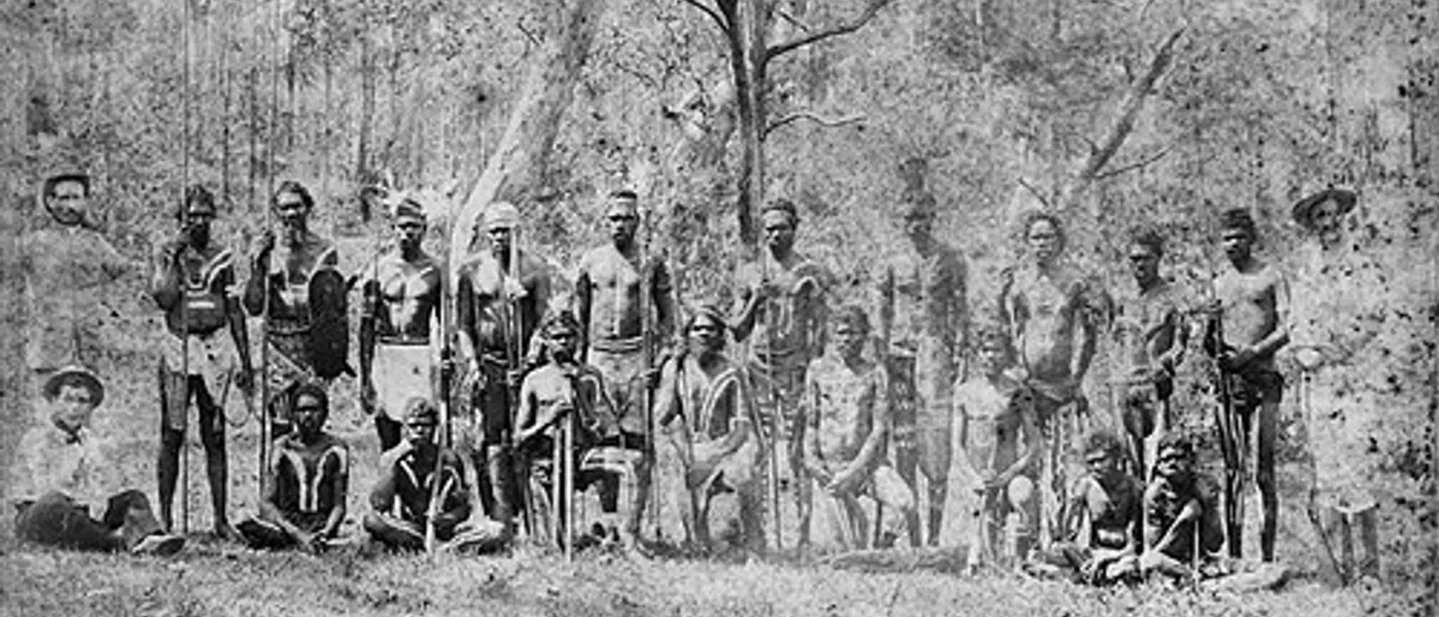
Wikipedia's editors selected Wild Australia Show as the Featured Article for August 9, 2026. It is worth reading because the troupe's photographs can look, at first glance, like simple records of Indigenous performers. The article shows the harder truth: these were images and performances made inside a colonial entertainment business, while the people pictured had uneven control over why they had joined, what they performed, and where they could go next. 2
Featured source: Wild Australia Show, the Wikipedia article selected for August 9, 2026. The article draws on historical research, archival photographs, newspapers, museum records, and court documents.
The source in one glance
| Question | Answer |
|---|---|
| What was it? | A travelling show of 27 Indigenous performers recruited from northern Queensland and surrounding regions in 1891–92. 1 |
| Who organized it? | The businessman and journalist Archibald Meston and the stock and station agent Brabazon Harry Purcell. 1 |
| What did audiences see? | Dances, corroborees, spear and boomerang demonstrations, staged frontier-war scenes, lectures, painted scenery, and taxidermied animals. 1 |
| Where did it perform? | Brisbane, Sydney, and Melbourne, from December 1892 into 1893. 1 |
| How did it end? | Meston abandoned the troupe in Melbourne during a financial and contractual dispute; Purcell later secured the performers' return to Queensland. 1 |
Full summary: a world tour that never left Australia
The story begins with Archibald Meston, a Scottish-born journalist and failed businessman who settled in Queensland. He edited newspapers, entered politics, lost money in coal mining and property schemes, and developed an interest in Aboriginal culture. His new public language sounded more sympathetic than his earlier racist views: he called the treatment of Indigenous Australians "a reproach to our common humanity." At the same time, he supported assimilationist policies that aimed to erase Indigenous cultures and presented himself as an authority on Aboriginal peoples. 1
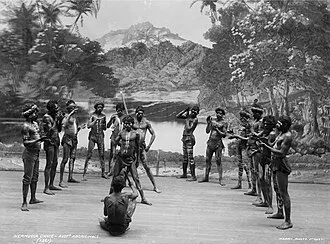
Meston's 1891 "illustrated lectures" supplied the model. They combined live Aboriginal people with painted bush scenes and taxidermied animals, then placed Meston in the role of interpreter. He and Purcell planned to borrow money for a larger commercial venture: an Australian tour followed by New Zealand, Europe, and a final appearance at the World's Columbian Exposition in Chicago. Meston later said he had spent more than £1,000 and was motivated by the "benefit of the aboriginals"; the planned tour was also plainly expected to make money. 1
Recruitment on a violent frontier
Purcell handled most of the recruitment between late 1891 and October 1892. He travelled through northern Queensland, collected artefacts, and relied at times on middlemen, police, and public servants. The first group he approached included five Wakaya people near Lake Nash: an elder named Kudajarnd and two of his wives among them. Later he collected people from camps at Karumba and Croydon, many of them displaced by settler violence and the seizure of Indigenous lands. On Thursday Island, he gathered Kaurareg people who had been brought there from Muralug, also known as Prince of Wales Island. 1
The number is precise; the consent is not. The troupe eventually contained 21 men, five women, and one child, drawn from several cultural groups. The article does not claim that all were kidnapped, and it does not pretend that the surviving record can recover every person's reason for joining. Some may have joined willingly. Scholars have also argued that violence, coercion, or the lack of safer options shaped some decisions. Those possibilities can coexist in a group assembled through colonial authorities and frontier camps. 1
One late recruit, a Kabi Kabi man named Yamurra, spoke English and was the only performer from southern Queensland. Meston likely wanted him to act as a liaison between the performers and white Australians. Yamurra travelled alone by train to the rehearsal camp at St Lucia, where the other recruits had begun preparing. That small logistical detail hints at the uneven roles inside the troupe: the performers were presented as one ensemble, but they did not arrive with the same language, background, or bargaining position. 1
From rehearsal camp to public spectacle
The group rehearsed at St Lucia for several months. Meston courted newspapers and visitors, while advertisements leaned on settler fascination with Aboriginal bodies and customs. Reports invoked "Sturt's terrible rite," a sensationalized reference to Wakaya penile subincision, and repeated the period's claim that Indigenous Australians belonged to a "doomed race." Other publicity promised that the show would correct popular misconceptions and reveal "the true character of the wild tribes of Australia." The marketing held two impulses together: curiosity about Indigenous cultures and a colonial desire to classify, display, and control them. 1
The first performance opened at Her Majesty's Opera House in Brisbane on December 5, 1892. Reviews were broadly positive, although some complained that Meston's commentary ran too long and wished the performers could simply perform without interruption. The theatre audience soon dwindled. Weekly outdoor performances at Breakfast Creek and the Exhibition Grounds drew larger crowds, showing how much the show depended on the physical setting as well as the acts themselves. 1
The troupe reached Sydney on December 26 and opened at the Bondi Aquarium. Officials were alarmed by their lack of control over the Indigenous performers, especially because New South Wales was pursuing strict segregation and wanted Aboriginal people removed from Sydney. The show nevertheless drew large crowds; the opening performance was reported to have attracted 10,000 people. Charles Kerry photographed performers at his nearby studio, and several of those images became postcards sold to the public. 1
In January, a shortened nightly version ran at the School of Arts alongside the Walshe Family Circus. Its smaller stage removed the spear and boomerang demonstrations and concentrated on acting and dancing. The show was therefore not a fixed cultural presentation. It changed with the venue, the audience, and the commercial deal available that week. 1
The performance had a point of view
The programme combined performances from distinct cultural groups with a colonial story about frontier violence. The Kaurareg performers used drumming and masks; the Wakaya members appeared in feathered headdresses. The show included at least 11 dances and opened with a war dance in a staged camp, followed by five named corroborees: Wermugga, Rengwinna, Fish, Waka Linga, and Rah Min. Outdoor versions could add flaming spears, flaming boomerangs, and the staged burning of a settler's hut. 1
The finale borrowed from Buffalo Bill's Wild West and from the minstrel shows popular in Queensland. White settlers appeared as innocent victims of Aboriginal attack; Native Police then shot the Aboriginal warriors. The scene turned a live colonial war into a story that excused the settler side. Anthropologist Paul Memmott describes this framing as "settler denialism" and a "colonial fantasy [that] played into convenient mythologies about frontier life." 1
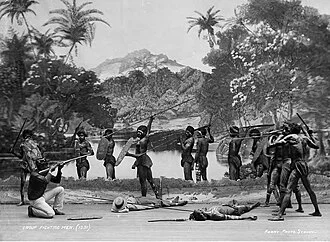
Meston narrated the scenes and explained Aboriginal cultures to the audience. The performers themselves may have retained more creative control than the advertising suggests: Memmott argues that people from the different groups developed performances from their own traditions. That possibility matters, but it does not cancel the surrounding power structure. A dance could draw on the performers' knowledge and still be placed inside a show owned, narrated, financed, and marketed by white men. 1
Melbourne, debt, and abandonment
The troupe arrived in Melbourne on January 25, 1893, for an Australian Natives' Association fete at the Royal Exhibition Building. The fete drew about 50,000 people, but the Wild Australia Show did poorly. Melbourne was in a severe economic depression after the banking crisis of 1893, and the performers were tired after months of travel. Meston was also fighting over the terms of the booking and facing pressure from the people who had lent him money. 1
The commercial dispute broke the partnership. Meston returned to Sydney, leaving Purcell and the performers in Melbourne with a show in debt. Purcell borrowed money and tried to revive the business with a National Baby Show booking and more sensational acts, including a staged scene of Aboriginal cannibalism and a lecture about "Sturt's terrible rite." A later run at Rotunda Hall drew sizeable audiences, but it could not restore the original plan to travel to England and Chicago. 1
Purcell and the troupe returned to Sydney in May, where they appeared in George Rignold's production of It Is Never Too Late to Mend. The performers danced and acted in background roles, and the reviews were favourable. Meanwhile, Meston asked the Queensland government to stop the tour, accusing Purcell of likely mistreatment and arguing that the world journey should not be allowed. New South Wales officials also wanted the performers sent back. By late June, the Queensland government agreed that they should return to their lands. 1
The governments argued over who should pay the £65 cost of feeding and transporting the performers. Queensland eventually accepted the bill. The troupe reached Brisbane on July 14. One Kaurareg performer briefly stayed in Sydney after being offered a job, but the arrangement failed and he returned a week later. From Brisbane, police helped escort the performers to northern ports and then back to their lands. Most later disappeared from the historical record; Gida is the notable exception. 1
The business partners then took their quarrel to court. Purcell sued Meston for false imprisonment, malicious prosecution, and slander. Meston counter-sued over damage to his credit, reputation, and character. Meston lost his case; Purcell received £50 in damages. The court documents became one of the main reasons historians can reconstruct the tour at all. The archive survives partly because the men who organized the show fought over money and blame after the performers had gone home. 1
Key details that change how the story reads
The troupe was assembled from several worlds
The 27 performers did not represent a single, interchangeable category called "the Aboriginals," even though nineteenth-century publicity often treated them that way. They came from groups including the Wakaya, Kaurareg, Kabi Kabi, and others gathered through different routes. Their dances, dress, languages, and relationships to the colonial frontier were not identical. The show compressed those differences into one travelling cast for audiences who were encouraged to see a type rather than a set of people. 1
The most important uncertainty is about consent
The source is careful with the question that modern readers are most likely to ask. It records later accusations of kidnapping and coercion, but it does not replace missing testimony with a single verdict. Some performers may have chosen the tour as an escape from violent conditions; others may have been pressured through police, middlemen, or the limited choices available in frontier camps. A precise headcount cannot produce a precise account of individual motives. 1
The photographs outlived the performers' names
Charles Kerry, John William Lindt, and Henry King photographed members of the troupe. At least eight of Kerry's photographs became postcards. Other images inspired later artworks, including James White's 1897 bust of Kungkardi and Oscar Fristrom's 1909 portrait Nahmbo, based on a photograph of Narimbu. Many photographs circulated without naming the people pictured or explaining their connection to the Wild Australia Show. 1
That identification work is still unfinished. Researchers reported in 2025 that they had identified 150 photographs of the troupe, many previously uncaptioned or mislabelled. A 2021 publication presented the first known set of properly labelled portrait photographs of all 27 performers. The historical correction is not a decorative afterthought: putting names back onto the images changes what kind of evidence they are. 1
The missing artefact collection is another gap
Meston assembled around 2,000 artefacts and specimens for the show. Some may have entered museum collections or been sold at auction, but no one has conclusively matched the Wild Australia Show collection to objects now held by the Queensland Museum. The uncertainty is a reminder that the performers were not the only things being moved through the enterprise. Objects, photographs, bodies, and stories all entered a market whose records were partial and whose labels often reflected the collectors rather than the people from whom material had been taken. 1
Verbatim lines from the source
Meston's later language about Indigenous Australians was more sympathetic than his earlier public positions, but it remained bound to an assimilationist project:
"a reproach to our common humanity"— Archibald Meston's description of the treatment of Aboriginal Australians, as quoted in the Wikipedia article. 1
The show's final scene made a political claim through staging rather than argument:
"settler denialism"— Paul Memmott's description of the performance's portrayal of white settler innocence and Aboriginal aggression. 1
And the financial logic of the enterprise appears in a contemporary review, which called the troupe:
"merely an indiscriminate assortment of blackfellows... having no proper supervision, and run purely as speculation"— A review quoted by the Wikipedia article from The Daily Telegraph in Sydney. 1
The Wild Australia Show promised to carry Indigenous performers from Queensland to Chicago. Instead, it carried them through a sequence of colonial stages, official scrutiny, commercial improvisations, and a legal fight, then left most of them with almost no surviving paper trail. The photographs remain, but the work of identifying the people in them—and separating their own performances from the stories imposed around them—is still part of the history.
References
- 1Wild Australia Show - Wikipedia
en.wikipedia.org
- 2Wikipedia's Today's featured article for August 9, 2026
en.wikipedia.org
- 3Wild Australia Show performance - Wikipedia file page
en.wikipedia.org
- 4
This story was produced automatically by a channel. One sentence is all it takes for Neodrop to keep producing for you.