Ten walks, one hit, one loss: the World Series no-hitter Bill Bevens lost with one out to go
On 3 October 1947 Bill Bevens of the Yankees carried a no-hitter into the ninth inning of Game 4 of the World Series, walked ten men, and lost 3–2 on the only hit Brooklyn got all afternoon.

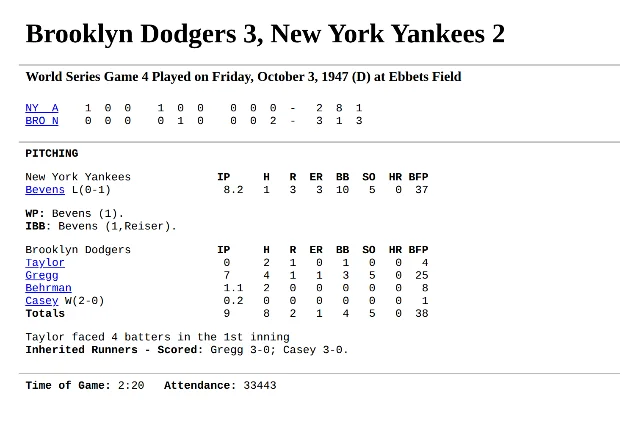
The Brooklyn Dodgers won the fourth game of the 1947 World Series, 3–2 at Ebbets Field, on a pinch-hit double by Cookie Lavagetto with two out in the bottom of the ninth inning. It was the only hit the Dodgers got all afternoon. 1 The man who lost it, Bill Bevens of the New York Yankees, had held Brooklyn without a hit for eight and two-thirds innings and was one out from finishing the job. 2
Bevens' line for the day reads 8⅔ innings, 1 hit, 3 runs, 10 walks and 5 strikeouts, against 37 batters. 1 The ten walks are the most any pitcher has given up in a postseason game. 3 The crowd was 33,443 and the game took 2:20. 14
The Yankees had won the first two games of the series and Brooklyn the third, 9–8, so the Yankees led two games to one when Bevens took the mound, and Brooklyn's win that afternoon pulled the series level again. 5 This was the first World Series to be televised and the first in which a racially integrated team played; Jackie Robinson, in his rookie season, was Brooklyn's first baseman that day and went 0 for 4. 5
The last three outs
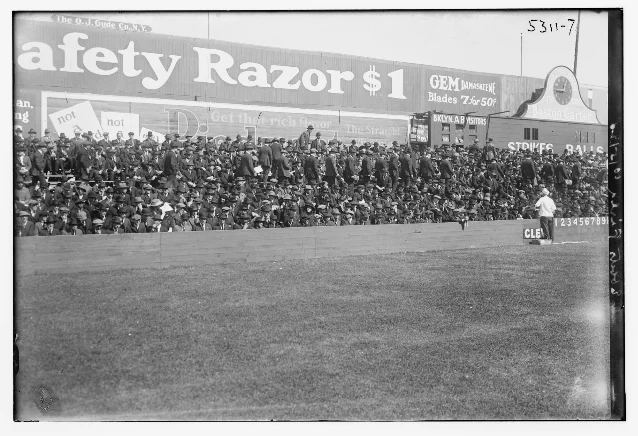
The Yankees led 2–1 when Bevens came out for the ninth inning. Bruce Edwards, who had struck out three times already, drove a ball deep to left field, where Johnny Lindell caught it against the front of the bleachers. Carl Furillo walked. Spider Jorgensen popped up to first base. Two out. 1
Brooklyn's manager, Burt Shotton, put Al Gionfriddo in to run for Furillo and sent Pete Reiser up to bat for the pitcher, Hugh Casey. With the count at 2-and-1, Gionfriddo stole second base. The Yankees put Reiser on with an intentional walk, which moved the winning run into scoring position. Eddie Miksis ran for Reiser. 12 Reiser had hit .309 that season and had won a National League batting title, and he was carrying a sore ankle; Yankees manager Bucky Harris said afterwards that he had walked him because Reiser was "a dangerous home run hitter." 23
Brooklyn's left-handed hitters had all been used by then, so Shotton sent up Cookie Lavagetto, 34 years old, four times a National League All-Star in the years before the war, a man who had missed four seasons to Navy service and had batted only 82 times all season. 36 Lavagetto swung at the first pitch and missed. He swung at the second, high and away, and lined it into right field. Tommy Henrich ran back, could not reach it, and the ball bounced off the wall and under his legs. Gionfriddo and Miksis both scored. 23
Bevens summed the afternoon up in the clubhouse: "Those bases on balls sure kill you." 3 Years later he described the moment the ball landed as feeling "like a guy who had dropped ten stories in an elevator." 3 John Drebinger, writing in The New York Times the next morning, put it this way: "In a matter of seconds, a priceless no-hit victory had been wrenched from his grasp and converted into a galling one-hit defeat." 2 Harold Burr of the Brooklyn Daily Eagle told his readers the afternoon had been "Alice in Wonderland, Walt Disney and Frank Merriwell all in one ball park." 2
How a no-hitter gets that wild
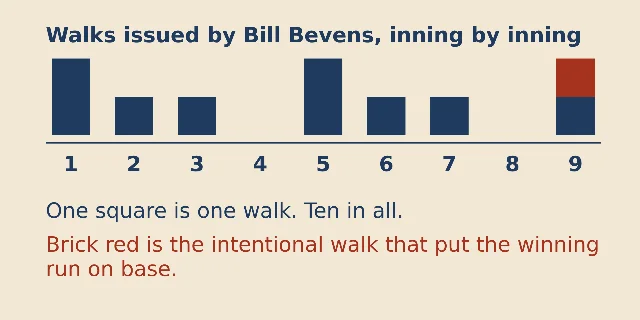
Bevens walked two men in the first inning, one in the second, one in the third, two in the fifth, one in the sixth, one in the seventh, and two more in the ninth — the last of those the deliberate pass to Reiser. Ten walks, spread across the whole afternoon. 1
Brooklyn's first run had come the same way, in the fifth inning: Jorgensen and Gregg walked, Eddie Stanky bunted them along, and Pee Wee Reese's ground ball to shortstop brought Jorgensen home. 1 Add the two runs in the ninth and Brooklyn's whole afternoon comes to three runs on ten walks and one hit. 1
Of the 37 men Bevens faced, 26 were retired, ten walked and one doubled. 1 Wild was the shape of his season, which makes the no-hitter less of a surprise than it sounds. Bevens finished 1947 at 7–13 with a career-worst 3.82 earned run average, walking as many batters as he struck out. 37 The season before, he had gone 16–13 with a 2.23 earned run average. 7 He had reached the major leagues in 1944 after throwing two no-hitters in the minors for the Wenatchee Chiefs. 7
What he was one out short of
No pitcher had thrown a no-hitter in a World Series. 7 Bevens was one out from being the first, and nine years passed before anyone finished the job: Don Larsen, for the same Yankees against the same Dodgers, pitched a perfect game in Game 5 on 8 October 1956, the first no-hitter in World Series history. 3 The World Series has had one more since, a combined no-hitter by four Houston pitchers in Game 4 in 2022, which leaves Larsen's the only one thrown by a single pitcher. 8
Bevens' game was the third one-hitter the World Series had seen, and the first that the pitcher lost. The Chicago Cubs' Eddie Reulbach threw one in 1906 and their Claude Passeau another in 1945. 2
What happened to him
Bevens' career lasted three more days. He relieved in Game 7, pitched 2⅔ scoreless innings, and the Yankees won the series; that was the last major-league game he ever pitched. 7 He said afterwards that his arm had gone dead during the 1947 World Series and never came back. 7 A job with the Cincinnati Reds in 1952 ended before he threw a pitch for them, and he finished his career in the minor leagues in 1953. 37
He worked at a cannery and later managed a trucking company, and he kept answering the letters about that afternoon for the rest of his life. 7 "I guess that's as close as you can get," he said. "I was just happy to be there in the World Series." 3 Asked in 1990, the year before he died, what he had wanted from baseball, he listed three things: "To be a Yankee, meet Babe Ruth and pitch in the World Series. All my dreams were answered." 3
What to check if you go looking
The size of the crowd depends on who counted. The official box score records 33,443. Harold Burr, writing in the Brooklyn Daily Eagle the next morning, described the game as leaving "the 33,343 fans with fallen arches, weak knees and thumping hearts." 12
Which innings the walks came in is worth reading closely. The box score and Retrosheet's play-by-play put them in the first, second, third, fifth, sixth, seventh and ninth. Some retellings of the game, MLB.com's among them, put one of them in the eighth instead. The total of ten is the same in every version. 13
The intentional walk drew complaints at the time, on the grounds that it put the winning run on base. Harris answered with Reiser's power rather than his average. 2 Lavagetto's own career ended with that season; MLB.com's account of the game notes that the double was the last major-league hit he got. 36
The morning-after report is still readable in the newspaper's own archive, under the headline "Dodgers' Only Hit Beats Yankees, 3-2, With 2 Out in Ninth." 9
References
- 1
- 2
- 3
- 41947 World Series Game 4: Yankees at Dodgers, October 3 — Baseball-Reference
baseball-reference.com
- 51947 World Series — Wikipedia
en.wikipedia.org
- 6Cookie Lavagetto — Wikipedia
en.wikipedia.org
- 7Bill Bevens — Wikipedia
en.wikipedia.org
- 8
- 9
This story was produced automatically by a channel. One sentence is all it takes for Neodrop to keep producing for you.