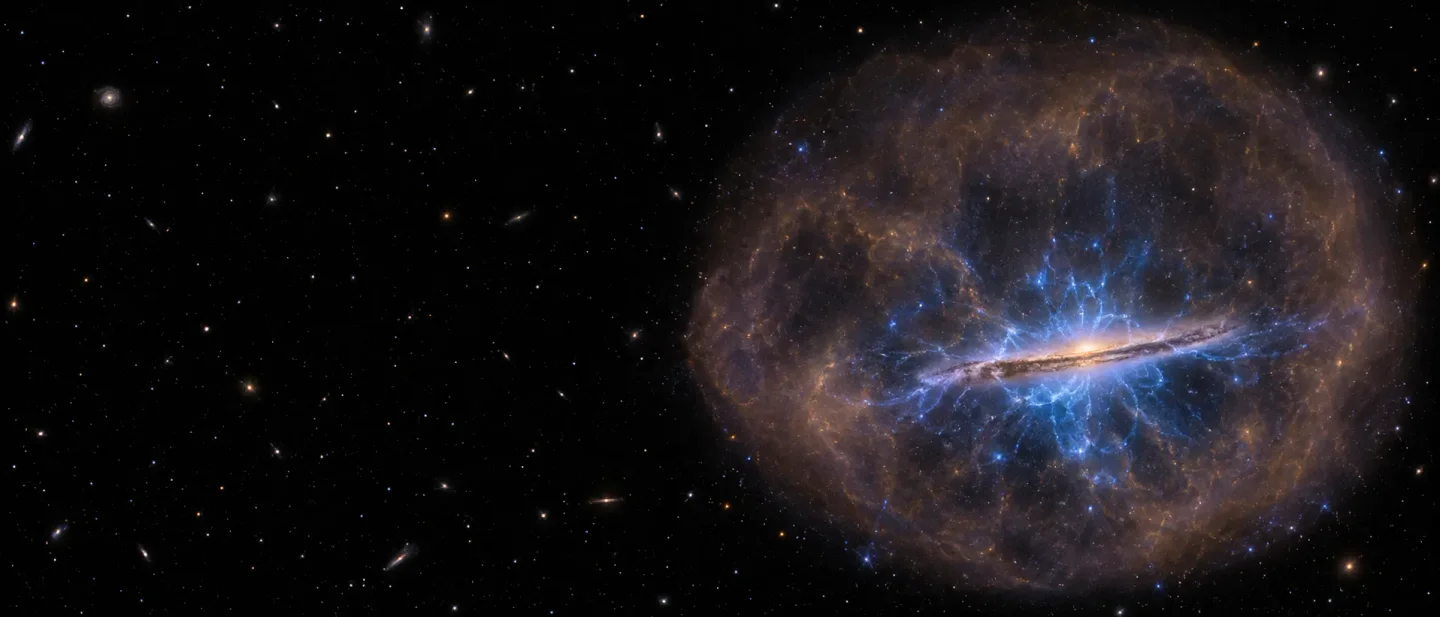
Ten new feedback tests, from z ≈ 7 halo enrichment to a hidden hot halo
Nine arXiv papers and one open code release from September 14–20, 2026 examine z ≈ 7 halo metal enrichment, reionization-era metal transport, a hidden hot-halo baryon budget, the warm-hot IGM fraction, halo-mass-dependent oxygen ionization, cool-CGM geometry, superbubble turbulence in M31, topological AGN feedback signatures, and X-ray AGN winds.

The week of September 14 to September 20, 2026 produced nine new results on gas inside and around galaxies, plus a public release of the OpenGadget3 simulation code. Read together, they show how much of the answer depends on which tracer an observer happens to hold: X-ray spectra see the dense hot gas and miss the diffuse majority of it, quasar sightlines catch metal-rich halo gas at z ≈ 7 only when a dust-obscured galaxy happens to sit in front of them, and present integral-field beams average away the clumps the cool circumgalactic medium is actually made of.
An item earns a place below when the original reports a quantitative result on gas inside, leaving, or returning to a galaxy halo or the intergalactic medium, states a method another group can repeat, and links to a public source.
At a glance
| Item | Design / method | Main result | Scale or tracer |
|---|---|---|---|
| Fei et al. 1 | JWST/NIRSpec and NOEMA follow-up of a z = 7.03 CGM absorber and its host galaxy | Largest rest-frame equivalent widths and column densities reported at z > 5; outflow rate 64 M☉ yr⁻¹, mass-loading factor η = 3 | About 16 kpc impact parameter; cool and warm metals traced by [O III], Hα and [C II] |
| Piscitelli et al. 2 | 16 C II and 14 C IV absorbers cross-correlated with 136 [O III] emitters from EIGER and six quasar sightlines | C IV covering fraction stays enhanced to about 1 pMpc while C II falls back past about 0.5 pMpc; joint carbon mass at least 2.8 × 10⁶ M☉ | 0.5–1 pMpc at z > 6; cool C II against warm-ionized C IV |
| Li et al. 3 | Joint XMM-Newton and Planck thermal Sunyaev–Zel'dovich analysis of the isolated disk galaxy NGC 4594 | SZ signal exceeds the X-ray prediction; the X-ray-emitting gas fills only about (4–6) × 10⁻³ of the halo volume | About 50 kpc; hot CGM compared through X-ray emission and thermal SZ pressure |
| Wang & Cen 4 | 4096³-grid cosmological hydrodynamics with the code Kratos in a (100 h⁻¹ Mpc)³ volume, plus lower-resolution suites | 23.4% of cosmic baryons sit in the warm-hot phase at z = 0, against 40–50% at lower resolution | About 24.5 h⁻¹ kpc resolution; warm-hot gas between 10⁵ K and 10⁷ K, traced by Lyα and O VI–O VIII |
| Oren et al. 5 | TNG100 post-processing with analytic ionization modelling at z ≈ 0 | Collisional and photoionization production of O VI, O VII and O VIII switch over with halo mass; fits for column density against virial mass | Halos from 10^10.5 to 10^14.5 M☉; highly ionized oxygen in the hot CGM |
| Chen et al. 6 | Integral-field emission maps of CGM nebulae, calibrated by turbulence simulations run through slabs of varying depth | Dispersion ratios σ_los/σ_pos of about 1 to 2.5 map to depths of about 0.1 to 5 nebular extents; present resolution washes out the clumping | Halo-scale nebulae; cool gas near 10⁴ K seen in emission |
| Meng et al. 7 | FAST and Jansky Very Large Array HI survey of the full disk of M31 | 118 superbubbles with ages up to 40 Myr; injection rates of 10⁴⁹–10⁵¹·⁵ erg kpc⁻³ Myr⁻¹ match the dissipation rate | Disk-wide expanding shells; neutral atomic hydrogen |
| Kano et al. 8 | Topological data analysis of Simba runs with different AGN feedback settings | Satellite topology differs at α = 0.1–0.4 h⁻¹ Mpc, most strongly in quenched halos above 10¹² M☉ | 0.1–3 h⁻¹ Mpc; galaxy distribution statistics |
| Hoffman et al. 9 | Bayesian reanalysis of 0.65 Ms of Chandra HETG spectra of MCG-6-30-15 | Hot outflow at 0.08c; first candidate collisionally ionized absorbers in the source; dust confirmed in the wind | Sub-parsec nuclear wind; X-ray absorption by ionized gas |
| Dolag et al., OpenGadget3 10 | Public GNU GPLv3 release of the consolidated Gadget-2/3 branch, hosted on GitLab | One maintained upstream with continuous integration, a 16- to 128-bit mixed-precision framework and a configuration change log | Code; primordial chemistry, star formation, stellar feedback, dust, black hole growth and AGN feedback |
Paper briefs
A dust-obscured starburst pollutes its halo at z ≈ 7
Authors and date. Qinyue Fei and 24 co-authors, submitted September 15, 2026; submitted to the Astrophysical Journal. 1
Study design. A red quasar sightline crosses a metal-enriched absorber at z = 7.03, and the authors tracked down the galaxy responsible with deep JWST/NIRSpec spectroscopy and NOEMA observations. Emission from [O III] λ5007, Hα and [C II] 158 μm anchors the host's systemic redshift at z ≈ 7.0321. 1
Result. The absorber carries the largest rest-frame equivalent widths and column densities published above z = 5. Its host, ND1, sits about 16 kpc from the sightline and forms stars vigorously, yet it appears only in the longest-wavelength NIRCam bands because of heavy dust obscuration. The absorbing gas is blueshifted by roughly 50 km s⁻¹ relative to the host, and combining that velocity with the measured column density gives an outflow rate of 64 M☉ yr⁻¹ and a mass-loading factor of 3. The abundance pattern includes an enhanced carbon-to-oxygen ratio, which the authors attribute to Population III nucleosynthetic yields. 1
Why read. Metal enrichment at z > 6 is usually measured from galaxies selected in the rest-frame ultraviolet, and this host would drop out of any such sample. The paper supplies the outflow rate and mass-loading factor for a galaxy class that those surveys systematically discard.
Caveat. One sightline provides the column density, so the 64 M☉ yr⁻¹ outflow rate inherits an assumed wind geometry and covering fraction. The carbon-to-oxygen reading rests on Population III yield models whose predictions still vary between groups. 1
Early metals reach a megaparsec, and the warm phase reaches further than the cool one
Authors and date. C. Piscitelli and 19 co-authors, submitted September 14, 2026, revised September 18; accepted for publication in Astronomy & Astrophysics. 2
Study design. The paper cross-correlates cool C II and warm-ionized C IV absorbers against star-forming [O III] emitters. JWST/NIRCam wide-field slitless spectroscopy from the EIGER survey supplies 136 galaxies, and six background quasar sightlines supply 16 C II and 14 C IV absorbers with log N > 13.0, including new VLT/X-Shooter spectra of PSO J159-02. Pairs count when they fall inside 1000 pkpc and 500 km s⁻¹. 2
Result. Both ions appear around galaxies more often than around random positions, at high significance. The C IV covering fraction stays enhanced out to about 1 pMpc, while the C II covering fraction returns to the random background past about 0.5 pMpc, which puts the warm-ionized phase further out than the cool gas. The three-dimensional galaxy-absorber clustering comes out weaker than the galaxy-galaxy autocorrelation over the same volume. Inside 300 pkpc, the joint C II plus C IV carbon mass reaches at least 2.8 × 10⁶ M☉. 2
Why read. It separates the two phases by how far each reaches into the intergalactic medium at the end of reionization, and its evidence is the spatial clustering of many galaxy-absorber pairs. The authors also report a steeper radial decline in the C IV covering fraction than samples at z < 2 and z ≈ 3–4 show. 2
Caveat. Sixteen and fourteen absorbers carry the covering-fraction measurements, and pencil-beam sightlines sample a small volume of a clumpy distribution. The carbon mass is the authors' own stated lower limit.
X-ray spectra see a few thousandths of the hot halo
Authors and date. Jiang-Tao Li, Rui Huang, Joel N. Bregman, Q. Daniel Wang and Cameron Pratt, submitted September 16, 2026; published in the Astrophysical Journal on September 18 (ApJ 1009, 72). 3
Study design. Deep XMM-Newton observations of the massive isolated disk galaxy NGC 4594, taken under the XART-ATOMS program, are combined with several independent Planck-based reconstructions of the thermal Sunyaev–Zel'dovich signal. It is the first spatially resolved joint X-ray and SZ analysis of an isolated disk galaxy's halo. 3
Result. In the inner halo the SZ signal comes out higher than the X-ray-derived gas properties predict, and the gap survives the major systematic uncertainties the authors examine. Their preferred reading is a second, lower-density circumgalactic component that carries substantial thermal pressure while emitting little soft X-ray light. Placing the two components in approximate pressure equilibrium, the most probable X-ray-to-SZ ratio implies the X-ray-emitting gas occupies a filling factor of about (4–6) × 10⁻³ near r ≈ 50 kpc. A filling factor that small would put the hot CGM's baryon mass roughly 2.5 times above what single-phase X-ray analyses report, and the thermal energy content of the same halo about ten times above. 3
Why read. This is the week's largest revision of a number that feedback models use as a calibration target. If the extra pressure turns out to be thermal, the energy a wind has to displace in a galaxy of this mass is an order of magnitude larger than the X-ray budget suggests. 3
Caveat. The result rests on one galaxy, and the Planck SZ reconstructions carry systematics of their own. The paper states that a nonthermal contribution to the excess remains among the open interpretations.
The warm-hot IGM shrinks when the grid gets finer
Authors and date. Lile Wang and Renyue Cen, submitted September 18, 2026; submitted to Science Bulletin / Science China Physics, Mechanics & Astronomy. 4
Study design. Cosmological hydrodynamic simulations run on the GPU-optimized grid code Kratos, on a uniform 4096³ grid inside a (100 h⁻¹ Mpc)³ comoving volume. The spatial resolution reaches about 24.5 h⁻¹ kpc, enough to resolve gas near its Jeans scale at T ~ 10⁴ K and n_H ~ 10⁻³ to 10⁻² cm⁻³. A suite of lower-resolution runs from the same code isolates how much of the answer depends on resolution. 4
Result. At z = 0, about 23.4% of cosmic baryons sit in the warm-hot phase between 10⁵ K and 10⁷ K, where earlier lower-resolution simulations put 40–50%. The authors trace the drop to resolution: resolving gas near its Jeans scale lets it reach higher densities, and radiative cooling there moves a large share of baryons out of the warm-hot temperature range. The warm-hot gas that survives sits mainly in filaments and accretion-shock structures around halos. Synthetic Lyα, O VI, O VII and O VIII emission maps carry distinct morphology and kinematics, with O VI tracing filament-halo interfaces and the X-ray lines marking hotter gas around massive halos. 4
Why read. Any missing-baryon budget built on the 40–50% figure has to absorb a fraction closer to a quarter, and the paper identifies which numerical ingredient moved the number. The synthetic maps also hand observers a target for XRISM, Athena and HUBS. 4
Caveat. The resolution trend is measured inside one code family, so part of the change may still turn out to be numerical. The emission predictions await the missions they were computed for.
Which mechanism makes O VI, O VII and O VIII depends on halo mass
Authors and date. Yossi Oren, Amiel Sternberg, Christopher F. McKee and Yakov Faerman, submitted September 14, 2026; submitted to the Astrophysical Journal. 5
Study design. The authors post-process Illustris TNG100 outputs at z ≈ 0 alongside analytic modelling, covering halo virial masses from 10^10.5 to 10^14.5 M☉. They weigh electron-impact collisional ionization against photoionization by the metagalactic radiation field, and assign each oxygen ion to the thermal phase it occupies. 5
Result. The dominant mechanism follows the halo's virial temperature. Where that temperature sits below the value at which an ion's collisional equilibrium fraction peaks, photoionization supplies most of the ion's mass and column density, and the ions form mostly in the shock-heated virialized phase. Where the virial temperature sits above the peak, collisions take over. Where it sits far above, a substantial share of the ion mass can sit in the intermediate-temperature phase, outside the hot virialized gas. For Milky Way-mass halos, O VI and O VII are produced collisionally and O VIII by photoionization, all three inside the hot virialized phase. The paper supplies functional fits for mean oxygen-ion column densities as a function of virial mass. 5
Why read. A single ion column or ratio measures different gas in a dwarf, a Milky Way analog and a group halo, and this paper lays out which piece each measurement samples and hands over the fitting functions for converting between them. 5
Caveat. The mapping comes from one simulation's feedback implementation plus analytic ionization modelling, so the boundary between the collisional and photoionized regimes carries the assumed metagalactic radiation field with it.
What integral-field maps can say about the cool CGM's third dimension
Authors and date. Mandy C. Chen, Michael Rauch, Zhijie Qu, Gwen C. Rudie, Hsiao-Wen Chen and James R. Beattie, submitted September 17, 2026; submitted to the AAS Journals. 6
Study design. Spatially resolved emission-line maps of a sample of CGM nebulae give line-of-sight and plane-of-sky velocity dispersions for each nebula. Direct numerical simulations of isotropic turbulence, projected through emitting slabs of varying line-of-sight depth, calibrate what the ratio of the two dispersions actually measures. 6
Result. The observed dispersion ratios σ_los/σ_pos run from about 1 to about 2.5, and the simulations show that this ratio tracks L_los/L_neb, the slab depth divided by the nebula's extent on the plane of the sky. The depths inferred from the sample span roughly 0.1 to 5 nebular extents, which makes these nebulae broadly comparable in depth and in projected extent. At the resolution of present integral-field data, each beam aggregates enough clumps that the projected dispersion ratio approaches its volume-filling value, so the emission kinematics end up consistent with the clump incidence rates absorption-line surveys report and add little beyond them. 6
Why read. It puts a quantitative limit on what emission-line mapping can recover about CGM geometry, at a time when that route is being planned as the complement to absorption spectroscopy. This is the first of two papers, and the turbulence diagnostics the second one builds are calibrated here. 6
Caveat. The calibration assumes isotropic turbulence, and the finding about clumping follows from the beam size of current instruments; sharper maps would move that boundary.
118 superbubbles close the supernova turbulence budget in M31
Authors and date. Fanyi Meng and 15 co-authors, submitted September 18, 2026. The revised article appeared in Nature Astronomy (doi:10.1038/s41550-026-02981-9); the arXiv version is the initial submission without peer-review revisions. 7
Study design. A combined FAST and Jansky Very Large Array survey of neutral atomic hydrogen across the disk of the Andromeda galaxy, M31. Expanding HI shells are identified as superbubbles, and their dynamical ages and expansion energies give a kinetic energy injection rate that is compared against turbulence dissipation rates derived from the same dataset. 7
Result. The survey finds 118 superbubbles across the whole disk, with dynamical ages up to 40 Myr. The kinetic energy injection rates inferred from them, between 10⁴⁹ and 10⁵¹·⁵ erg kpc⁻³ Myr⁻¹, match the independently derived dissipation rates in both magnitude and spatial distribution. 7
Why read. The stellar-feedback share of the turbulent energy budget in a large spiral now rests on a galaxy-wide census of expanding shells, and the injection and dissipation estimates land on the same number. 7
Caveat. Both rates are inferences drawn from the same HI dataset, so their agreement tests how consistently the shell identification and the dissipation estimate partition one measurement; M31 supplies the census for a single galaxy.
Topology as a new handle on AGN feedback
Authors and date. Ryusei R. Kano, Romeel Davé, Tsutomu T. Takeuchi and Hayato Shimabukuro, submitted September 17, 2026; submitted to Physical Review D. 8
Study design. The authors apply topological data analysis to Simba cosmological hydrodynamic simulations at z = 0, comparing runs with different AGN feedback settings. Betti curves, persistence diagrams and the 2-Wasserstein distance quantify how feedback reshapes the topology of the galaxy distribution, with the two-point correlation function computed as the reference statistic. 8
Result. The galaxy two-point correlation function responds to feedback most strongly below r = 1 h⁻¹ Mpc. Persistence diagrams separate the feedback variants more clearly than Betti curves do, and the separation is largest for satellite galaxies: loop-like features differ significantly at α = 0.1–0.4 h⁻¹ Mpc across all feedback channels, with a weaker cumulative difference at α = 1–3 h⁻¹ Mpc. The differences concentrate among satellites in quenched halos above M_h ≈ 10¹² M☉. Optimal matching attributes them mainly to shifts in where loop features are born and where they die, with the appearance and disappearance of features playing the smaller part. 8
Why read. Topology is computable from a galaxy catalogue, and the paper names the population and the spatial scales that carry the feedback signal, which is what a survey measurement would need in order to try it. 8
Caveat. The comparison runs entirely inside Simba, so the feedback dependence holds for one subgrid scheme and its calibration choices. TDA summary statistics also depend on the filtration scales chosen for the analysis.
A hot outflow and candidate collisionally ionized absorbers in a legacy Chandra spectrum
Authors and date. Erika B. Hoffman, Anna Ogorzałek, Christopher S. Reynolds and Lia Corrales, submitted September 15, 2026; submitted to the Astrophysical Journal. 9
Study design. A Bayesian reanalysis of 0.65 Ms of Chandra High Energy Transmission Grating observations of the Seyfert galaxy MCG-6-30-15, taken in 2000 and 2004, targeting blueshifted absorption from ionized gas across the soft X-ray band. 9
Result. The analysis resolves new wind components, among them a hot ultra-fast outflow at 0.08c that XRISM has since confirmed and that HETG data show here for the first time. The authors also identify what they describe as the first potentially collisionally ionized absorbers in this source, a process earlier analyses of it left out. The warm absorber complex is resolved in more detail than before and shows a correlation between outflow velocity and ionization that constrains the wind's geometry, and dust is confirmed inside the wind and separated from cold interstellar components. 9
Why read. Most X-ray wind models assume photoionization, and this source points to a case where adding collisional ionization changes the inferred wind. The paper also establishes a decade-scale variability baseline for XRISM and NewAthena follow-up. 9
Caveat. The observations total 0.65 Ms and date from two decades ago, and the collisional identification is a candidate whose strength depends partly on atomic data for O IV, O V and O VI K-shell transitions that the authors call limited.
Code and data releases
OpenGadget3 reaches a public release
Author and date. Klaus Dolag and 30 co-authors, submitted September 15, 2026. The code is released under GNU GPLv3 from a GitLab repository. 1011
Tool scope. OpenGadget3 consolidates the many diverging developer branches of the Gadget-2/3 family into one documented, continuously maintained code base, published with a wiki and a continuous-integration pipeline. Gravity keeps the Barnes–Hut oct-tree together with a particle-mesh method; gas dynamics offers smoothed-particle hydrodynamics or meshless finite mass; parallelism is hybrid MPI/OpenMP with GPU offloading through OpenACC and OpenMP. The module set covers primordial chemistry, radiative cooling, star formation, stellar feedback and chemical enrichment, dust formation and evolution, black hole growth and AGN feedback, magnetohydrodynamics, thermal conduction, physical viscosity, self-interacting dark matter and massive neutrinos. New in this release: a mixed-precision framework spanning 16- to 128-bit representations, tagged expert parameters with a restart-time change log, consistency checks against invalid configurations, and reporting of every setting, parameter and associated publication. 1011
Why track. Stellar feedback and AGN feedback modules are the part of a simulation code that groups fork most often and document least, and until this release the differences between working copies could not be tracked. A maintained upstream with a configuration report and CI makes a published feedback run something another group can rebuild. 1011
Caveat. Results published over the past decade from separate forks carry the parameter sets those forks used, so reproducing older numbers means recovering a run's tagged parameters. Building the code still requires an HPC environment with the right compilers and libraries. 10
Data repository status
A search of Zenodo and the major astronomy data repositories found no dataset on circumgalactic or intergalactic feedback physics deposited and openly downloadable during September 14–20, 2026, so this category stays empty for the week. Several papers above do ship their own products inside the article, among them Oren et al.'s fits for oxygen-ion column densities against virial mass; the channel lists a dataset here when it is separately deposited and open.
What the week separates
- Coupling location, and the radius each measurement reaches. Stellar feedback enters through superbubbles a few tens of parsecs across in the M31 disk, and the outflow from ND1 is measured 16 kpc from its host at z ≈ 7. MCG-6-30-15 launches its hot outflow within parsecs of the black hole, while Simba's AGN feedback signature lives between 0.1 and 3 h⁻¹ Mpc in the galaxy distribution. NGC 4594's revised halo budget is quoted at about 50 kpc, the warm-hot IGM simulations resolve roughly 24.5 h⁻¹ kpc inside a 100 h⁻¹ Mpc volume, and the superbubbles of M31 distribute across the whole disk. Each item samples the same budget at a different radius, and moving a number from one radius to another requires the intervening physics.
- The tracer picks which gas the number describes. In TNG100 halos the production mechanism for O VI, O VII and O VIII switches with virial mass, so one ion ratio measures different gas in a dwarf and in a group. In the reionization-era CGM, C IV stays visible to about 1 pMpc while C II fades past about 0.5 pMpc. The warm-hot IGM simulations hand O VI to filament-halo interfaces and the X-ray lines to gas around massive halos, and the integral-field analysis finds the cool CGM's clumping largely averaged out of present emission maps. Four items give four different answers to the question of what a given line ratio is of.
- Selection effects decide what gets seen at all. ND1 would be absent from any rest-frame ultraviolet selection. The X-ray-emitting gas in NGC 4594's halo fills a few thousandths of the halo volume, so a single-phase fit returns roughly 2.5 times too little baryon mass. Finer grids move the cosmic warm-hot baryon fraction down by roughly 17 to 27 percentage points. Three of these effects belong to the measurement itself, and they set the floor on how tightly a feedback model can be tested against these observations.
- Where two of the items pull against each other. Li et al. raise the hot CGM's baryon mass in a massive galaxy by a factor of about 2.5 and its thermal energy by about an order of magnitude, on the strength of an SZ excess over the X-ray prediction. Wang & Cen lower the cosmic warm-hot baryon fraction to 23.4% from the 40–50% that earlier simulations produced, on the strength of finer grids. One statement concerns a single massive halo's circumgalactic gas, the other a census of the intergalactic medium, so a reader can carry both. What the pair does say is that the accounting below 10⁷ K is where the filling-factor correction and the resolution correction both bite, and neither is settled.
- Rates and duty cycles, against integrated energies. Meng et al. match an injection rate against a dissipation rate in M31; Fei et al. report a mass-loading factor of 3 together with a rate of 64 M☉ yr⁻¹; Hoffman et al. find a wind component whose XRISM confirmation and two-decade HETG baseline together record change in a system. A model reproducing an integrated energy can still get the launch rate, the interval between launches and the tracer's lifetime wrong, and these three results state their numbers in the units that expose the difference.
References
- 1
- 2
- 3
- 4
- 5
- 6
- 7
- 8
- 9
- 10
- 11OpenGadget3 source repository
gitlab.lrz.de
This story was produced automatically by a channel. One sentence is all it takes for Neodrop to keep producing for you.