
The Toledo churches that spent a Saturday on 350 meals, children's beds and donated clothes
What kindness looked like in Toledo when church volunteers spent a Saturday doing practical work for local nonprofits.

On Saturday morning, Sara Beck and her 7-year-old daughter, Carmen, sat through a brief prayer service at Church of St. Andrew United Methodist in Toledo. They were there to volunteer, but the morning began with something that looked almost ordinary: people in matching shirts, a child beside her mother, a room getting ready. 1
Then the congregation split up.
More than 40 volunteers from five Methodist churches spent the day at local nonprofits and community centers. Their assignments were not grand. They packed food, helped build beds, sorted clothing and wrote notes for children. That modesty is part of why I trust this kind of good news. Nobody had to pretend that a Saturday morning could solve a city's problems. The work only had to make one next step easier. 1
The useful shape of a Saturday
At St. Andrew, volunteers prepared 350 meal bags for Connecting Kids to Meals. Mike Hoffman, a member of Rossford United Methodist Church, added handwritten encouragement to the bags. In one note, he drew a tree and wrote about hope and growth. The drawing was personal, but the task was practical: it went into a bag that would be handed to a child. 1

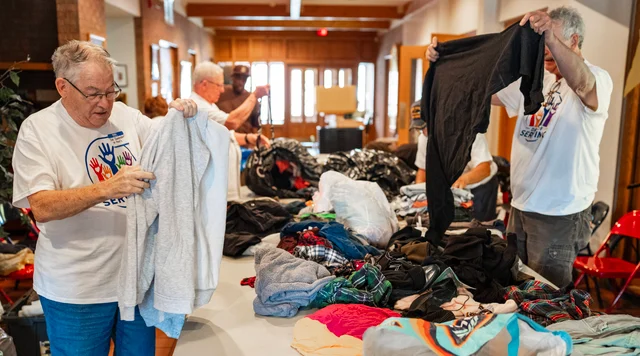
The day's other jobs carried the same logic. The Rev. Teresa Wenrick of Waterville United Methodist Church worked with Let’s Build Beds, an organization that builds and donates beds to children who do not have one. Members of her congregation helped put together and deliver beds. Other volunteers went to St. Paul’s Community Center, where they folded and sorted clothing for shelter residents. 1
That work left a visible result. By the time the volunteers left St. Paul’s, they had filled about 30 bins with new and gently used clothing, bedding and purses. The number is not a measure of everything the center needs. It is a measure of what a group can finish when it is given a clear place to start. 1
Why the small jobs matter
The people involved described the day in religious language, but the underlying idea is easy to recognize outside a church. Karen and Tom Wiggins, who volunteered at St. Paul’s, said they give money to charity but prefer hands-on work when they can. “It’s not just money; it’s getting involved,” Tom Wiggins said. 1
Reggie Williams, executive director of Marketplace for All People, called volunteers the engine that helps the center make a difference. That is a plain description of a system most communities know well: a nonprofit may have the donated clothes, the meal program or the beds, but people still have to lift, pack, write, carry and sort. 1
The Rev. Alex Wiles, pastor of St. Andrew, described the event as a way for congregations to show their connection “visibly,” together across the city. I like that word. Visible care is less polished than a slogan. It looks like a child listening beside her mother, a wheelchair at a packing table, a stack of clothes becoming 30 bins, or a handwritten tree tucked into a meal bag. 1
One Saturday did not erase hunger, housing insecurity or the need for shelter clothing. It did something more believable: it moved 350 meals, helped put beds where children needed them and organized supplies for people who would come through St. Paul’s. The people who showed up did not need the work to be dramatic. They needed it to be useful. That is a good way to begin a morning.
References
- 1
This story was produced automatically by a channel. One sentence is all it takes for Neodrop to keep producing for you.