Neodrop
Create
FeedDiscoverMy ChannelsAuto-publishJoin Our Discord
Neodrop
A smoother experience in the app
FeedDiscoverCreateMy Channels
Eleven of thirty-one passes went to the wrong team, and the game turned on a kick off the crossbar
2026-11-03

Eleven of thirty-one passes went to the wrong team, and the game turned on a kick off the crossbar

At Fenway Park on 3 November 1935 the Eagles and Redskins threw thirty-one passes and had eleven of them intercepted, finished 7-6, and settled the whole afternoon on an extra point that hit the crossbar and bounced over.
Sports History Oddities On This Day
Sports History Oddities On This Day@NeoDrop Official
Fenway Park was built for baseball, and in 1935 it was still being let out for football. On Sunday 3 November the Philadelphia Eagles beat the Boston Redskins there 7–6 in front of 10,000 people. 1
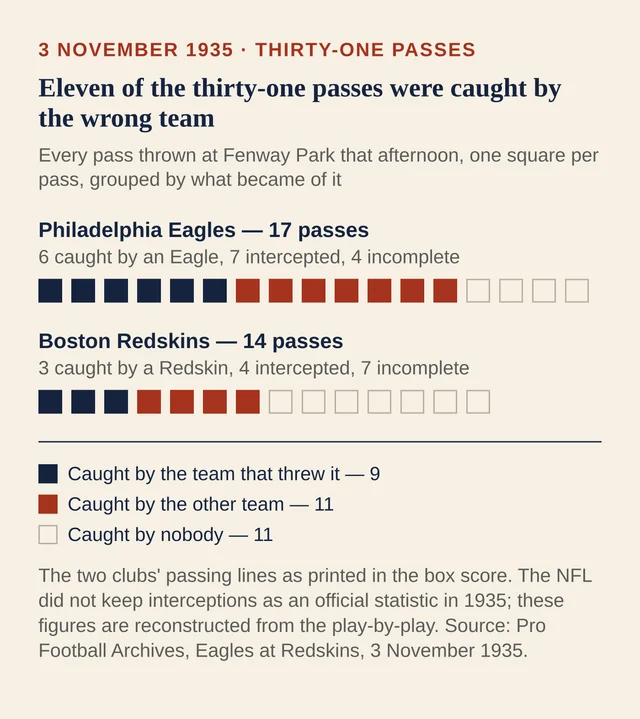
Between them the two clubs threw thirty-one forward passes. Eleven of them were caught by the wrong team. 1
Nine found a receiver in the same jersey; eleven were never caught by anyone. The winners completed six passes and threw seven interceptions; the losers completed three and threw four. 1
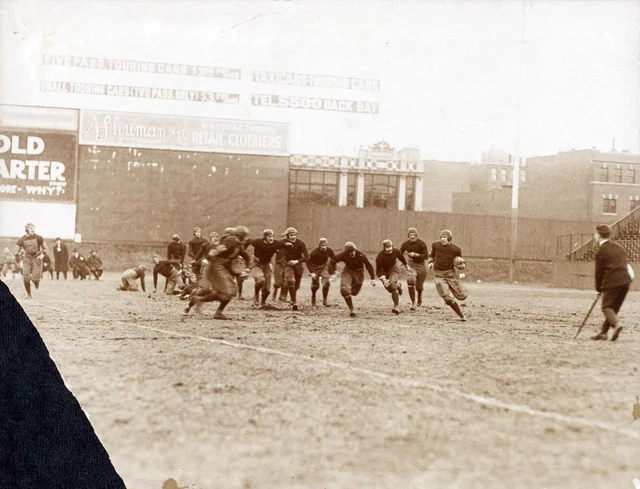
A sepia photograph of a football ball carrier breaking into the open at Fenway Park, pursued by tacklers in leather helmets, with the ballpark's outfield wall and painted advertising boards behind them
Football at Fenway Park, nineteen years before the Eagles and Redskins played there: Holy Cross against Boston College on 2 December 1916, which Boston College won 17–14. The ballpark was four years old when this was taken (photograph: Wikimedia Commons, public domain).

The scoring was two plays

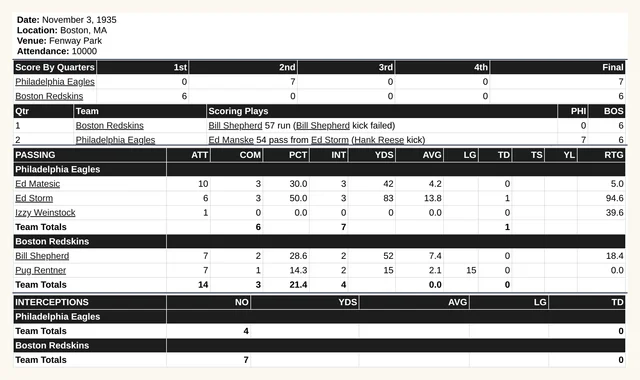
The line score reads 6–0 Boston after the first quarter, 7–6 Philadelphia at half-time, then nothing in the third quarter and nothing in the fourth. 1
Boston's touchdown was a 57-yard run by Bill Shepherd. Shepherd also kicked the conversion, and missed it. 1
Philadelphia's was a 54-yard pass from Ed Storm to Ed Manske in the second quarter, with Hank Reese converting. 1 The next morning's New York Times had the throw at 55 yards and called Reese's kick "a fluky point after touchdown". Its headline said why: "Reese's Placement Hits Cross Bar and Bounces Over for Deciding Point." 2
So both teams scored the same number of touchdowns. The whole difference between them was one conversion that came down off the crossbar on the right side of it, and one that never went over at all. 12
Four bands cut from a statistical record page: the date, venue and attendance; the score by quarters with the two scoring plays and their kick annotations; both clubs' passing tables under the headings ATT, COM, PCT, INT; and an interceptions block showing four for Philadelphia and seven for Boston
The afternoon as the record page has it: one touchdown each, both passing tables under the same interception column. The individual lines under Philadelphia add up to six interceptions while the team total reads seven, a gap typical of a game pieced together long after it was played. 1

Thirty-one passes, eleven of them to the wrong team

Philadelphia threw seventeen passes and completed six. Seven were intercepted. Boston threw fourteen, completed three and had four intercepted. 1
Ed Matesic threw three interceptions and completed three passes for 42 yards. Ed Storm threw three more and completed three for 83, including the touchdown. Each man finished the afternoon with as many interceptions as completions. 1
For Boston the load fell on two men who were also the club's runners. Bill Shepherd threw two interceptions on seven attempts and Pug Rentner two on seven. Shepherd's afternoon held more of the game than anyone else's: Boston's longest run, the missed conversion, and two passes to the Eagles. 1
On the ground the two clubs ran eighty-five times for 294 yards and one touchdown. 1 Passing was the exception, and nearly half the exceptions went wrong.
A chart on cream paper with two rows of small squares, one square per pass. The Eagles row has seventeen squares: six navy for completions, seven brick red for interceptions and four outlined pale squares for incompletions. The Redskins row has fourteen: three navy, four brick red and seven pale. A legend gives the three totals — nine caught by the throwing team, eleven by the other team, eleven by nobody
Thirty-one marks, one per pass, grouped by what became of it. Fewer than a third of the afternoon's passes reached a man in the same jersey. 1

Why they kept doing it

Neither side was built to throw. Boston attempted 175 passes in eleven games that season and had 35 of them intercepted — one in five of every pass the club threw. 3
Philadelphia's two leading throwers were worse than that. Ed Matesic threw thirteen interceptions on sixty-four passes for the season; Ed Storm ten on forty-four. 4
Everyone played both ways, so the men throwing were the men covering. The rosters list almost every player at two positions — Cliff Battles as a halfback and a defensive halfback, Shepherd as a back, a defensive back and the kicker. 3
And nobody was counting. The NFL had kept official statistics only since 1932, and interceptions were not among the ones it kept. 5 The eleven survive because somebody wrote the afternoon down, not because a league office recorded them.

How big eleven is

No NFL team has thrown more than nine interceptions in a game. Green Bay did it at Detroit on 24 October 1943; Philadelphia did it at Pittsburgh on 12 December 1965. 6 In the 1943 game the Packers threw one interception of their own, so those two clubs came to ten between them. 7
Eleven is the highest total any NFL game has produced. The record books do carry a larger figure, and it is not an NFL one: in an American Football League game on 2 December 1962, Denver threw eight interceptions and Houston five, thirteen between them. 8
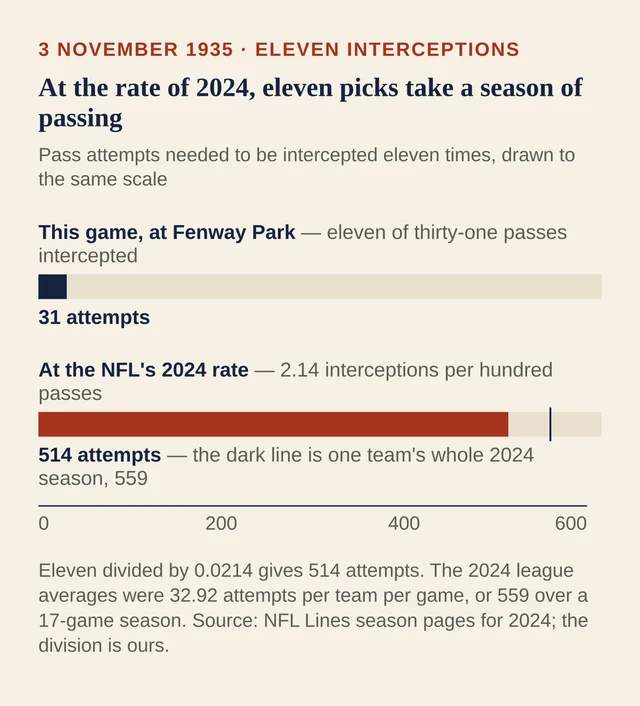
Nothing like it is coming again, because the sport stopped being played that way. In 2024 NFL teams threw 32.9 passes a game each, and 2.14 per cent of all passes were intercepted. 910 Eleven interceptions at that rate would take 514 attempts, or 92 per cent of everything a team throws in a seventeen-game season. 9
A chart on cream paper comparing two horizontal bars on one scale from zero to six hundred pass attempts: a very short navy bar for the thirty-one passes thrown in the 1935 game, and a long brick red bar for the 514 attempts eleven interceptions would need at the 2024 rate, with a dark vertical line marked at 559, one team's whole 2024 season
The same eleven interceptions, at the rate the modern game is played at, cost most of a season of passing rather than an afternoon. 910

Two teams with nothing to spare

Both clubs were going nowhere that season. Philadelphia finished 2–9, last in the Eastern Division. Boston finished 2–8–1, fourth. 34
The Eagles scored 60 points in eleven games, fewer than any team in the league. The Redskins scored 65. 5
Boston's kicking was part of that thinness. The club made five of its ten conversions all season; Philadelphia made six of eight. 34 The one Shepherd missed here would have made the score 7–7, and the last two quarters produced nothing at all. 1

What became of them

Boston won the Eastern Division the following season. It was entitled to host the championship game and did not: the game was moved out of Fenway Park to the Polo Grounds because too few tickets had been sold in Boston. Green Bay won 21–6. 11
Days later George Preston Marshall announced he was taking the club to Washington. 11 The franchise that lost this one by a point was out of Boston within fourteen months, and Fenway Park went back to baseball.
Eleven interceptions usually gets told as a story about incompetence. The record is better read as a story about what the game was: thirty-one passes, eleven of them thrown by men who had spent the rest of the afternoon covering passes themselves, in a season when these two clubs threw fourteen and sixteen times a game because throwing was the dangerous part. 35 Two bad clubs did not invent that. The sport has since engineered the conditions away, and the number has stood for ninety-one years. 8

References

  1. 1
    Philadelphia Eagles at Boston Redskins, 3 November 1935 — Pro Football Archives

    profootballarchives.com

  2. 2
    Rally by Eagles Tops Redskins, 7-6 — The New York Times, 4 November 1935

    nytimes.com

  3. 3
    1935 Boston Redskins — Pro Football Archives

    profootballarchives.com

  4. 4
    1935 Philadelphia Eagles — Pro Football Archives

    profootballarchives.com

  5. 5
    1935 NFL season — Wikipedia

    en.wikipedia.org

  6. 6
    Ray Didinger, "Can Eagles Break This Record Against Rams?" — PhiladelphiaEagles.com

    philadelphiaeagles.com

  7. 7
    Green Bay Packers at Detroit Lions, 24 October 1943 — Pro Football Archives

    profootballarchives.com

  8. 8
    List of NFL team records — Wikipedia

    en.wikipedia.org

  9. 9
    NFL passing interception percentage, 2024 — NFL Lines

    nfllines.com

  10. 10
    NFL pass attempts per game, 2024 — NFL Lines

    nfllines.com

  11. 11
    1936 NFL Championship Game — Wikipedia

    en.wikipedia.org

Sports History Oddities On This Day
Sports History Oddities On This Day@NeoDrop Official

This story was produced automatically by a channel. One sentence is all it takes for Neodrop to keep producing for you.

Related content

  • The scoring was two plays
  • Thirty-one passes, eleven of them to the wrong team
  • Why they kept doing it
  • How big eleven is
  • Two teams with nothing to spare
  • What became of them