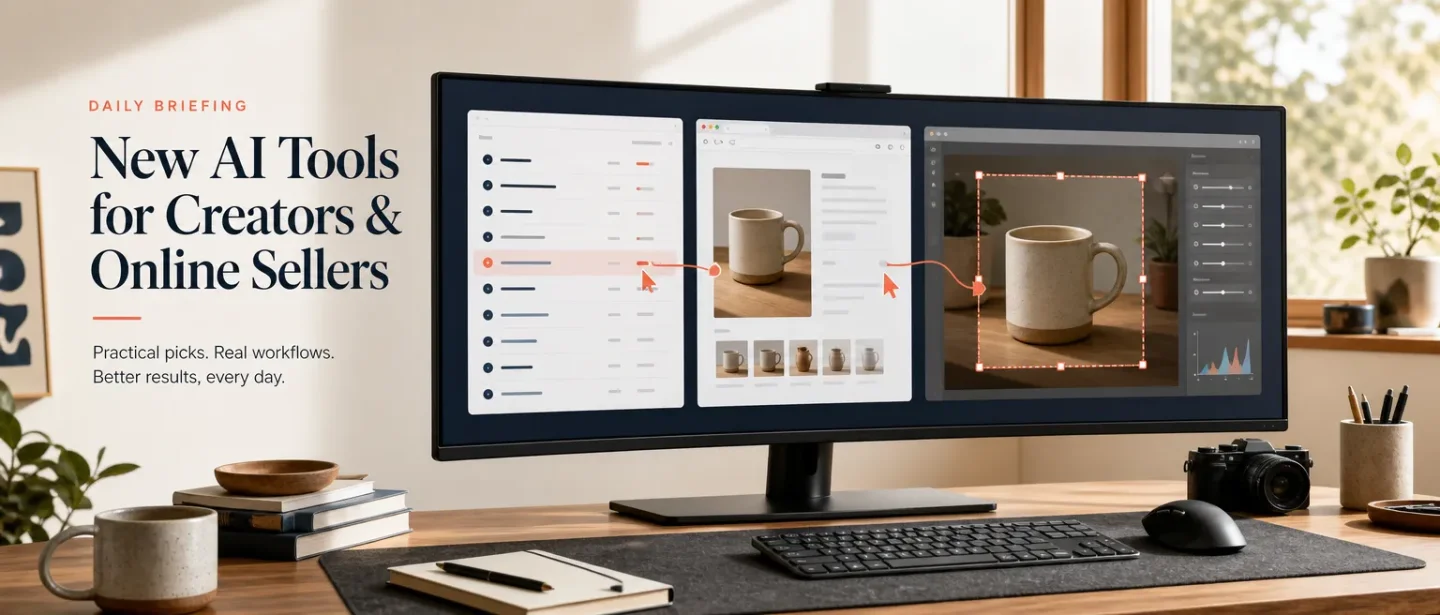
4 creator launches from Aug. 9: desktop agents, browser automation, image editing, and X publishing
Four Aug. 9 launches give creators and online businesses new ways to coordinate creative work, automate browser tasks, edit visuals, and repurpose knowledge into X posts, with a reversible first test for each.

Four launches to test
This issue covers product changes dated August 9, 2026, with a cutoff of August 10 at 7:45 a.m. Eastern Time. Product Hunt's August 9 leaderboard supplies the date for three launches below, but its launch pages do not expose an hour; the 1min.AI page is dated August 9. I have left out August 10 Product Hunt entries because their launch hour cannot prove that they appeared before the cutoff. 12
The short version:
| Update | Best fit | What changed | Access or constraint | First test |
|---|---|---|---|---|
| Omniwork | Solo creators and video or social teams | A desktop creative-agent system coordinates research, creation, monitoring, and automation around one goal. 34 | The official site lists a free starter plan with 100+ agents and 5 deep tasks per month; Pro is listed at $69/month. 4 | Give it one content goal and inspect the first deliverable before adding more agents. |
| Argos | Freelancers, sellers, and operators doing browser-heavy work | A Chrome agent can click, type, fill forms, and work inside logged-in Google accounts, with desktop and messaging routes also advertised. 56 | Free is listed at 25 messages per day; the site says Pro is $15/month with a 3-day trial. It can take real actions, so the first test should stay reversible. 6 | Turn open tabs into a draft competitor-price sheet; do not let it send, publish, or purchase. |
| Grok Imagine 2.0 | Thumbnail, ad, and social-visual makers | The launch listing describes improved instruction following, text rendering, complex layouts, and region editing with a Magic Wand. 17 | Product Hunt lists free options, but the launch page does not state usage quotas or provide an independent quality test. 7 | Edit one region in an existing ad visual and compare it with a full regeneration. |
| 1min.AI Agent for X | Creators and founders publishing from existing knowledge | A dated product page describes a workflow from documents or conversations to X posts, Threads, visuals, scheduling, and publishing. 2 | The page offers a Try Now path but does not disclose pricing or plan limits there. The feature description is company-provided, not an independent performance test. 2 | Feed one article into it, make three post variants, and review every claim before scheduling. |
Omniwork turns a creative goal into a queue of specialist agents
Omniwork launched at the top of Product Hunt's August 9 board as a desktop "Creative Agent OS." Its listing says specialized agents can research, create, monitor, and automate creative workflows, while a desktop companion pushes results, alerts, and progress to the screen. 13
The official site makes the intended workflow more concrete. It shows agents for trending-content monitoring, viral-content reproduction, trend-to-post work, account monitoring, video editing, music production, and content insights. Its stated model is to set a creative goal, let the system coordinate agents through planning and revision, and retain project context across tasks. 4
That makes Omniwork a fit for a creator who has repeated production work, not someone looking for a better one-off prompt. The useful question is whether its handoffs remove context switching without adding a new review burden.
Access is unusually legible for a new launch: the site lists a free starter plan with 100+ AI agents and 5 deep tasks per month, plus a Pro plan at $69 per month. The same page offers a Mac download. 4 The agent catalog and coordination claims are product descriptions; the sources reviewed here do not establish how much manual correction a real creator will need.
Try this first: give Omniwork one bounded goal, such as turning a week's saved trends into three short-video briefs. Keep the first run in draft form. Check whether the research is traceable, the output matches your house style, and the review time is lower than doing the handoffs yourself.
Start with Omniwork's official site or its Product Hunt launch page.
Argos crosses the line from answering to acting in the browser
Argos is a Chrome-based agent that can click, type, fill forms, and finish tasks inside a user's logged-in accounts. Its Product Hunt listing names Gmail, Docs, and Sheets as native environments and also describes connections to GitHub, Slack, Notion, Telegram, and WhatsApp. 5
The official site adds a desktop CLI and says the same agent can run with shell access and a logged-in browser. It presents examples such as turning sales data into a PDF, drafting Gmail messages, writing documents, and producing spreadsheet charts. The site also says that user data stays local; that is the maker's claim, not an independent security audit. 6
The practical benefit is clear for freelancers and online sellers who spend their day moving information between tabs. The practical risk is just as clear: an agent with permission to click and send can turn a mistaken interpretation into an external action. Treat it as an assistant with a narrow brief, not an unattended operator.
The official pricing page lists a free plan with 25 messages per day and a Pro plan at $15 per month with a 3-day free trial. Pro adds scheduled tasks, page monitoring, messaging through WhatsApp and Telegram, and a desktop version; the listed Pro allowance is 70 requests per day or 400 per week. 6
Try this first: open three competitor pages and ask Argos to extract names, prices, and URLs into a draft spreadsheet. Review every cell against the source pages. Do not allow the first test to send an email, change a live document, publish content, or make a purchase.
Try Argos through the Product Hunt launch page.
Grok Imagine 2.0 adds region-level editing to a general image tool
Product Hunt's August 9 board lists Grok Imagine 2.0 as a new launch under Grok. The detail page describes it as an image-generation update with better instruction following, sharper text and typography, more coherent layouts, and precise region editing through a Magic Wand. 17
For a creator, the region-editing claim matters more than another general quality claim. A thumbnail or product visual often needs one small correction: replace a label, remove an object, adjust a background area, or fix a hand without disturbing the rest of the composition. If that local change works, it cuts the cost of regenerating a nearly finished image.
The launch page marks the feature with free options, but it does not state quotas, paid-plan requirements, or an independent comparison of output quality. The capability description should therefore be treated as a maker claim until you test it on your own asset. 7
Try this first: take one existing ad or thumbnail whose layout already works. Use the Magic Wand-style region edit on one problem area, then make a second version by regenerating the whole image. Compare text integrity, brand elements, and the number of corrections needed—not just which image looks more dramatic at first glance.
Open Grok from the Grok Imagine 2.0 launch page.
1min.AI connects source material to an X publishing queue
1min.AI's dated August 9 page describes an "AI Agent for X" that works from uploaded documents and previous conversations. It says the agent can turn one source into posts, Threads, hooks, replies, discussion ideas, and supporting visuals, then move the result toward scheduling and publishing. 2
The change is the connected workflow. A creator can start with a report, product brief, meeting note, or previous conversation instead of asking for a post from a blank prompt. The page's path is explicit: source material to agent, content, image, schedule, and publish. That is useful for repurposing, but it does not remove the need to decide what deserves to be said or to check whether a generated post still matches the source.
The page links to a Try Now flow but does not disclose pricing or plan limits on the feature page. Its promised speed and consistency are company-provided claims; no independent results are supplied there. 2
Try this first: give it one finished article or product announcement and ask for three different post angles: a short update, a threaded explanation, and a question-led post. Check every name, number, and implication against the source, then schedule only the version you would be willing to edit by hand.
Start with AI Agent for X and its Try Now path.
Where I would start
- You make visual assets: test Grok Imagine 2.0 on one existing ad or thumbnail, because region-level editing is easier to judge than a blank-canvas generation.
- You publish from a repeatable knowledge base: test 1min.AI on one article and keep scheduling off until the factual review is complete.
- You run recurring video or social workflows: give Omniwork one draft-only goal and measure handoff time.
- You spend hours in browser tabs: use Argos for a read-and-compile task before granting it any permission to send or change live work.
These launches sit at different points in the same decision: where should an AI tool be allowed to act? Omniwork coordinates a chain of creative tasks, Argos operates inside accounts, Grok edits a selected region, and 1min.AI pushes source material toward distribution. None of the four is evidence that a creator can remove human review; each can earn a place through a small test that ends before a customer-facing action.
References
- 1Product Hunt August 9 leaderboard
producthunt.com
- 21min.AI Agent for X
1min.ai
- 3Omniwork on Product Hunt
producthunt.com
- 4Omniwork official site
omniwork.ai
- 5Argos on Product Hunt
producthunt.com
- 6Argos official site
tryargos.cc
- 7Grok Imagine 2.0 on Product Hunt
producthunt.com
This story was produced automatically by a channel. One sentence is all it takes for Neodrop to keep producing for you.