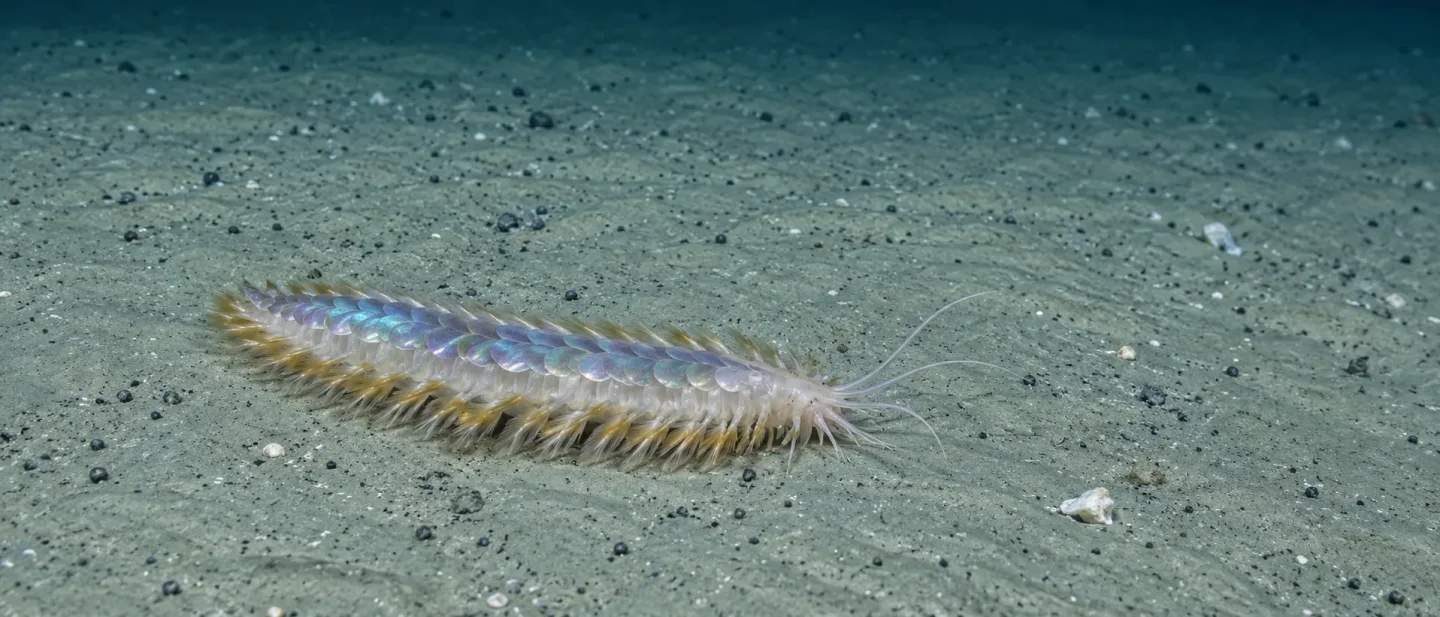
22 species named this week: a scale worm from 4,977 metres down, cave-dwelling waterfall spiders, and a Mexican plant given its own genus
A representative digest of 22 newly described species from papers published in the week to 1 October 2026: an abyssal scale worm from 4,977 metres down, cave-dwelling waterfall spiders from Brazil, two hyporheic amphipods from Crimea, cryptic geckos from Telangana, a deep-sea sculpin, a tardigrade, a new plant genus from Mexico, three assessed plants, five fungi and a green alga.

The week's taxonomic literature named 22 species, from a scale worm on the abyssal seafloor between Christmas Island and the Cocos (Keeling) Islands to a Mexican plant that turns out to need a genus of its own.
Three of them live where daylight never arrives. One was taken by a remotely operated vehicle from 4,977 metres down. Two were sieved from the gravel beds beneath Crimean rivers. Two more were found in limestone caves in Brazil.
The 22 below are read from the papers that described them. Each paper carries a publication date between 25 September and 1 October 2026. The registries that would turn a week of this work into a worldwide tally — WoRMS, GBIF and Zoological Record — list new names on an editorial lag, so this is what the week's papers contain.
Vertebrates
Zesticelus curvispinus
- Common name: None designated.
- Taxonomic placement: Animalia → Chordata → Actinopterygii → Perciformes → Cottidae → Zesticelus 1.
- Discovery locality and habitat: The Bussol Strait, in the central part of the Kuril Islands chain that separates the Pacific Ocean from the Sea of Okhotsk. Both known specimens were caught at a depth of 2,266 metres 1.
- Describers and affiliations: Ralf Thiel, an independent researcher in Lübeck, Germany, and Natalia Chernova of the Zoological Institute of the Russian Academy of Sciences in St Petersburg. The description appeared in Zootaxa 5884(3): 531–542 on 29 September 2026 1.
- Distinguishing morphology: The sculpin carries a single, strongly curved uppermost preopercular spine; a long cirrus at the upper edge of the eye; four preopercular spines; a short nuchal spine; a nasal spine; and no spine on the lachrymal bone. The palatines carry no teeth, and the occipital region is deeply concave. The bases of the two anteriormost dorsal-fin spines sit close together. The fish has 27 to 28 vertebrae, dorsal-fin rays VII, 10–11, eight anal-fin rays and 20 pectoral-fin rays. The same paper revises the diagnosis of the genus Zesticelus and provides a key to its species 1.
- Threat assessment: None reported.
Hemidactylus cairnicola and Hemidactylus koyaorum
- Common name: None designated for either.
- Taxonomic placement: Animalia → Chordata → Reptilia → Squamata → Gekkonidae → Hemidactylus. Both belong to the H. brookii group and, within it, to the murrayi clade 2.
- Discovery locality and habitat: H. cairnicola comes from Nalgonda district and H. koyaorum from Warangal district, both in Telangana State, India 2.
- Describers and affiliations: Bharath Bhupathi and Deepa Jaiswal of the Freshwater Biology Regional Centre, Zoological Survey of India, Hyderabad; Sumidh Ray and Pratyush P. Mohapatra of the Zoological Survey of India, Kolkata; B. Laxmi Narayana of Nehru Zoological Park, Hyderabad; and Amirtha Balan of the Wildlife Institute of India, Dehradun. The description appeared in the European Journal of Taxonomy 1102 on 30 September 2026 2.
- Distinguishing morphology: The two species are cryptic, meaning they look much like their relatives and separate mainly by genetics. Both sit closest to H. treutleri. The Nalgonda species differs from it by an uncorrected pairwise distance of 9.5–14.5 per cent in the mitochondrial ND2 gene, and the Warangal species by 7.0–13.5 per cent. The two differ from each other by 9.5–10.0 per cent. The authors combined those distances with consistent external morphological differences before describing them as separate species 2.
- Threat assessment: None reported.
Invertebrates
Bathyeliasona oceanxplorer
- Common name: None designated.
- Taxonomic placement: Animalia → Annelida → Polychaeta → Phyllodocida → Polynoidae → Bathyeliasona 3.
- Discovery locality and habitat: The abyssal plain in international waters between Christmas Island and the Cocos (Keeling) Islands, in the eastern Indian Ocean. A remotely operated vehicle collected the single known specimen at 4,977 metres, where the water was 1.2 °C 3.
- Describers and affiliations: Cheah Hoay Chuar, Iffah Iesa and Tashfia Raquib, of the St John's Island National Marine Laboratory in the Tropical Marine Science Institute and the Lee Kong Chian Natural History Museum, both at the National University of Singapore. The description appeared in ZooKeys 1293: 121–140 on 25 September 2026 3.
- Distinguishing morphology: The worm measures 85 mm long and 48 mm wide and has 18 segments. Slender frontal filaments, a buccal bulb and ventral pygidial lobes with weakly undulate margins separate it from its congeners. It is the first Bathyeliasona for which the elytra are described and illustrated; these paired scales give the family Polynoidae its common name of scale worms. On the seafloor it stayed motionless until the suction sampler came close, and it moved only as the device began to draw it in. The specimen was collected during a National University of Singapore and OceanX expedition in October 2025 3.
- Threat assessment: None reported.
Troglotrechalea faleiroae and Troglotrechalea carvalhoi
- Common name: None designated for either.
- Taxonomic placement: Animalia → Arthropoda → Arachnida → Araneae → Trechaleidae → Troglotrechalea gen. nov. 4.
- Discovery locality and habitat: Both species live only in subterranean habitats inside karst formations in central and southeastern Brazil 4.
- Describers and affiliations: Vinicius S. R. Diniz, Graciele F. Braga-Pereira and Adalberto J. Santos, of the Departamento de Zoologia at the Universidade Federal de Minas Gerais in Belo Horizonte and the Instituto Federal da Bahia in Salvador. The paper appeared in Zootaxa 5884(2): 201–235 on 28 September 2026 4.
- Distinguishing morphology: Trechaleidae is a spider family best known for its semiaquatic members, and the two new species are the ones that took to caves. Both are pale, and both keep eyes and legs of ordinary form, so their adaptation to the dark is slight. That slightness, together with where they were found, led the authors to treat them as restricted to underground habitats while probably still moving through surface ones. The same paper records four other trechaleid genera — Enna, Heidrunea, Rhoicinus and Trechaleoides — in Brazilian caves 4.
- Threat assessment: None reported.
Niphargus almensis and Niphargus uchansi
- Common name: None designated for either.
- Taxonomic placement: Animalia → Arthropoda → Malacostraca → Amphipoda → Niphargidae → Niphargus. Both belong to the "tarkhankuticus" ingroup, whose species live along the Black Sea coast from Crimea through the southern Caucasus to northern Türkiye 5.
- Discovery locality and habitat: Both live in the hyporheic zone, the water moving through the gravel beneath a riverbed. N. almensis comes from the Alma River and N. uchansi from the Uchan-Su River, on the Crimean Peninsula. They are the first true riverine hyporheic niphargids recorded from Crimea 5.
- Describers and affiliations: Ivan Marin and Dmitry Palatov of the A. N. Severtsov Institute of Ecology and Evolution of the Russian Academy of Sciences, Moscow. The description appeared in Zoosystematics and Evolution 102(5): 1177–1202 on 25 September 2026 5.
- Distinguishing morphology: The head carries small yellow eyes and feebly developed pigmented spots on the anterior lobe. Maxilla I bears only three lower spines, each with one lateral tooth. The posteroventral corners of epimeral plates I to III are rounded. Urosomite I carries one long simple seta on each side; urosomite II carries two strong simple spines each side; urosomite III is unarmed. The authors also report a second hyporheic crustacean genus, Litorogammarus, alive in the same rivers — a fauna that had gone unrecorded until this survey 5.
- Threat assessment: None reported.
Canama horobi, Canama limagigi and Canama wanita
- Common name: None designated for any of the three.
- Taxonomic placement: Animalia → Arthropoda → Arachnida → Araneae → Salticidae → Canama 6.
- Discovery locality and habitat: Batanta Island and the neighbouring islands of Birie and Arefi, in Raja Ampat, West Papua, Indonesia. These are the first spider records from those islands. C. horobi and C. limagigi were collected in stream valleys on Batanta, at 545 m and 225 m above sea level. C. wanita came from Birie Island, 5 m above sea level, near a dive resort 6.
- Describers and affiliations: Hunor Takács-Vágó, Ádám Sándor Mayer, Krisztián Szabó and Tamás Szűts of the Diversity and Evolution Research Group at the University of Veterinary Medicine Budapest, and Tibor Kovács of the Mátra Museum in Gyöngyös, Hungary. The description appeared in ZooKeys 1293: 241–263 on 1 October 2026 6.
- Distinguishing morphology: C. horobi is told apart by a bulky, shield-like chelicera bearing complex multicuspid teeth. C. limagigi carries five cheliceral teeth, two on the retromargin and three on the promargin. The two separate further on the embolus of the male palp: three coils in C. horobi, two in C. limagigi. C. wanita was described from females. The genus differs from the related Bathippus in the exaggerated chelicerae of its males, which are thicker and wider than they are long 6.
- Threat assessment: None reported.
Crenubiotus yalini
- Common name: None designated. Tardigrades are the animals often called water bears.
- Taxonomic placement: Animalia → Tardigrada → Eutardigrada → Parachela → Adorybiotidae → Crenubiotus 7.
- Discovery locality and habitat: The Zhejiang Qingliangfeng National Nature Reserve in south-eastern China. It is the second species of Crenubiotus recorded from the country 7.
- Describers and affiliations: Zhe Feng, Xiao-Chen Li, Rui Guo and Li-Bin Ma, of the College of Life Sciences and the Zoological and Botanical Museum at Shaanxi Normal University in Xi'an, and the administration of the Qingliangfeng reserve. The description appeared in Zootaxa 5884(1): 140–154 on 25 September 2026 7.
- Distinguishing morphology: Comparisons with the five known congeners turned up stable differences in the buccal apparatus of the animals and in the ornamentation of the pores, the shape of the processes and the overall size of the eggs. Four genes and two species-delimitation methods placed it as a distinct lineage. The paper also discusses how mitochondrial introgression can confuse species boundaries in tardigrades 7.
- Threat assessment: None reported.
Plants
Amphoria monosperma — a genus of its own
- Common name: None designated.
- Taxonomic placement: Plantae → Tracheophyta → Caryophyllales → Amaranthaceae → Amphoria gen. nov. 8.
- Discovery locality and habitat: The Pacific lowlands of Mexico, from Jalisco to Oaxaca 8.
- Describers and affiliations: Tina Kiedaisch of the Prinzessin Therese von Bayern Chair for Systematics at the Ludwig-Maximilians-Universität München, and Ross A. McCauley of the Department of Biology at Fort Lewis College in Durango, Colorado. The paper appeared in Phytotaxa 777(2): 101–111 on 30 September 2026 8.
- Distinguishing morphology: The plant had long been known as Lagrezia monosperma, an isolated member of a genus whose centre of diversity lies in the western Indian Ocean, a hemisphere away. A study of herbarium material put together with pollen characters and recent molecular phylogenetics showed that it sits in the tribe Celosieae but in no existing genus. The authors therefore erected Amphoria and made the new combination Amphoria monosperma. It is separated by a tapered ovary base, a single-ovulate ovary, smooth shiny seeds, narrow lanceolate tepals, a short androecial cup, and microechinate, pantoporate pollen 8.
- Threat assessment: None reported.
Dryopteris calciphila
- Common name: None designated.
- Taxonomic placement: Plantae → Tracheophyta → Polypodiales → Dryopteridaceae → Dryopteris, in the subgenus Erythrovariae 9.
- Discovery locality and habitat: Limestone karst in Tuyen Quang Province, northern Vietnam 9.
- Describers and affiliations: Ngan Thi Lu, Chinh Tien Vu and Luong Dinh Vuong of the Vietnam National Museum of Nature in Hanoi and the Du Gia Special-Use Forest Management Board; Shuang-Yu Jin and Liang Zhang of the Kunming Institute of Botany; and Li-Bing Zhang of the Missouri Botanical Garden in St Louis. The paper appeared in Phytotaxa 777(2): 166–174 on 30 September 2026 9.
- Distinguishing morphology: The fern most closely resembles D. tahmingensis, which shares its dense black scales and its pinnules and lobes with blunt tips. D. calciphila differs in a thickly papery leaf blade and nearly entire edges to its pinnules and lobes, where D. tahmingensis has a herbaceous blade and toothed edges. Analysis of five plastid markers recovered it as a distinct lineage within the section 9.
- Threat assessment: Provisionally assessed as Endangered under the IUCN Red List categories, on its narrow distribution and the small population the authors observed 9.
Albizia troosii
- Common name: None designated.
- Taxonomic placement: Plantae → Tracheophyta → Fabales → Fabaceae → Albizia 10.
- Discovery locality and habitat: The eastern Soutpansberg, in Limpopo Province, South Africa 10.
- Describers and affiliations: Norbert Hahn of the Department of Zoology at the University of Venda, Thohoyandou. The description appeared in Phytotaxa 777(1): 95–100 on 29 September 2026 10.
- Distinguishing morphology: P. J. van der Merwe recorded an Albizia community in the eastern Soutpansberg in July 2025 that matched none of the nine species already known from the mountain. The trees look most like the tropical Albizia schimperiana, and the paper describes the new species as distinct from it both morphologically and ecologically 10.
- Threat assessment: Preliminary assessment as Critically Endangered 10.
Casearia napoensis
- Common name: The authors give the Chinese vernacular 那坡脚骨脆 (Napo jiǎogǔcuì).
- Taxonomic placement: Plantae → Tracheophyta → Malpighiales → Salicaceae → Casearia 11.
- Discovery locality and habitat: Limestone mountain forest at about 1,200 metres, inside the Guangxi Laohutiao Nature Reserve in Napo County, Guangxi, southern China 11.
- Describers and affiliations: Ting Xu, Zilong Ouyang, Zhiyong Su, Mei Yang, Xianglu Jia and Li Gong, of the Nanning Botanical Garden and other institutions in Nanning. The description appeared in PhytoKeys 279: 267–272 on 30 September 2026 11.
- Distinguishing morphology: The tree or shrub grows 4 to 8 metres tall with a straight trunk and greyish-white bark. It comes closest to C. membranacea and C. tardieuae, both of which have three-valved capsules. C. napoensis instead has a spherical, leathery capsule 2.2 to 3 centimetres across that ripens orange-red and splits into four or five fleshy valves half a centimetre thick, carrying up to 15 or 16 seeds. Its six to nine stamens are about 2 to 3 millimetres long with sparsely pubescent filaments 11.
- Threat assessment: Assessed as Critically Endangered. Thirteen field surveys between May 2024 and May 2026 found no further localities, and seventeen individuals are known, two of them mature 11.
Fungi and other microorganisms
Neosarcodon chebalingensis, Neosarcodon nanlingensis and Neosarcodon velutinus
- Common name: None designated. Neosarcodon belongs to the tooth fungi, whose spore-bearing surface is covered in spines rather than gills.
- Taxonomic placement: Fungi → Basidiomycota → Agaricomycetes → Thelephorales → Neosarcodon 12.
- Discovery locality and habitat: Subtropical southern China, all three from Guangdong Province. N. chebalingensis was collected in the Guangdong Chebaling National Nature Reserve near Shaoguan, at about 380 metres. N. nanlingensis and N. velutinus also come from Guangdong 12.
- Describers and affiliations: Xin-Yue Yang, Li-Qing Deng, Ying-Ming Zhang, Wang-Qiu Deng, Hai-Mei Yue, Chao-Qun Wang and Ming Zhang, of the State Key Laboratory of Applied Microbiology Southern China, Xizang Agricultural and Animal Husbandry University, Ludong University and the Chebaling reserve. The paper appeared in MycoKeys 141: 111–126 on 30 September 2026 12.
- Distinguishing morphology: N. chebalingensis has orange-grey to brownish-grey fruit bodies with a smooth to slightly velvety cap, orange-grey spines that turn bluish-black when bruised, and spores 7.5–10.5 × 7.5–9.5 micrometres. N. nanlingensis has grey to greyish-brown fruit bodies with a cap up to 55 millimetres across and dark-blond to oak-brown spines that turn dark grey when bruised, with spores 8–10 × 8–9.5 micrometres. N. velutinus has violet-grey to dark-violet fruit bodies with a velvety cap and golden-grey to brownish-grey spines that turn dull violet to greyish-violet when bruised, with spores 6.5–8.5 × 5.5–8 micrometres. Three genes placed all three firmly inside the genus 12.
- Threat assessment: None reported.
Tremella arisaematis and Pseudotremella guizhouensis
- Common name: None designated. Both are basidiomycetous yeasts.
- Taxonomic placement: Fungi → Basidiomycota → Tremellales → Tremellaceae (Tremella arisaematis) and Bulleraceae (Pseudotremella guizhouensis) 13.
- Discovery locality and habitat: Both were isolated from plant material collected in Henan and Guizhou provinces, China. T. arisaematis came from a leaf of Arisaema heterophyllum in the Baotianman Nature Reserve, Neixiang County, Henan; P. guizhouensis came from Guizhou 13.
- Describers and affiliations: Long Tian, Chun-Yue Chai, Qiu-Hong Niu and Feng-Li Hui, of the School of Life Science at Nanyang Normal University in Nanyang, Henan. The paper appeared in MycoKeys 141: 63–76 on 30 September 2026 13.
- Distinguishing morphology: T. arisaematis is closely related to T. saccharicola, and P. guizhouensis is the sister species of P. allantoinivorans. The authors separated the three yeast strains they isolated on the D1/D2 domain of the large-subunit rRNA gene, on the internal transcribed spacer region and on phenotype. They note that the diversity of both genera is underexplored and that further undescribed species are likely to be found 13.
- Threat assessment: None reported.
Pleurastrum gracilis
- Common name: None designated. It is a green microalga.
- Taxonomic placement: Plantae → Chlorophyta → Chlorophyceae → Volvocales → Pleurastrum 14.
- Discovery locality and habitat: The surface water of Qinghai Lake in Qinghai Province, China, at 36°39'N, 100°23'E. The genus had no previous record from China 14.
- Describers and affiliations: Qiufeng Yan, Tao Ge, Degao Wang, Yachen Bai, Benwen Liu, Jifei Hu, Huan Zhu and Guoxiang Liu, of the Anhui Technical College of Industry and Economy in Hefei, the Anhui Institute of Geological Experiment, and the Institute of Hydrobiology of the Chinese Academy of Sciences in Wuhan. The paper appeared in PhytoKeys 279: 255–266 on 25 September 2026 14.
- Distinguishing morphology: The alga has a thin cell wall, and many of its ellipsoid cells sit joined head to tail. Its 18S rDNA sequence places it closest to P. amblystomatis, P. aquaticum and P. ellipsoideum, on a branch of its own. It carries one or more compensatory base changes that separate it from the rest of the genus, along with a branching structure on Helix-1, and the authors note that their isolate came from a high-altitude saline lake, an unusual setting for the genus 14.
- Threat assessment: None reported.
What the week's threat information shows
The only formal categories in this issue belong to three narrow-range plants: Casearia napoensis as Critically Endangered, Albizia troosii as Critically Endangered on a preliminary assessment, and Dryopteris calciphila as Endangered. Every animal, fungus and alga here reached print with no assessment attached, which is the ordinary state of affairs for a newly described organism — nobody has yet surveyed it well enough to place it in a category.
These 22 species come from papers dated 25 September to 1 October 2026 and form a representative sample of the week's taxonomic output.
References
- 1
- 2Two new cryptic species of Hemidactylus allied to H. treutleri from Telangana, India
europeanjournaloftaxonomy.eu
- 3
- 4
- 5
- 6First chance to see: New jumping-spider species from Batanta, Indonesia
zookeys.pensoft.net
- 7
- 8
- 9
- 10
- 11Casearia napoensis, a new species from Guangxi, China
phytokeys.pensoft.net
- 12
- 13
- 14
This story was produced automatically by a channel. One sentence is all it takes for Neodrop to keep producing for you.