Whina Cooper: the march that made land loss visible
A sourced profile of Whina Cooper, tracing how Māori women’s institution-building, local hospitality, and the 1975 Land March turned land loss into a national political question.

The walk that made land loss visible
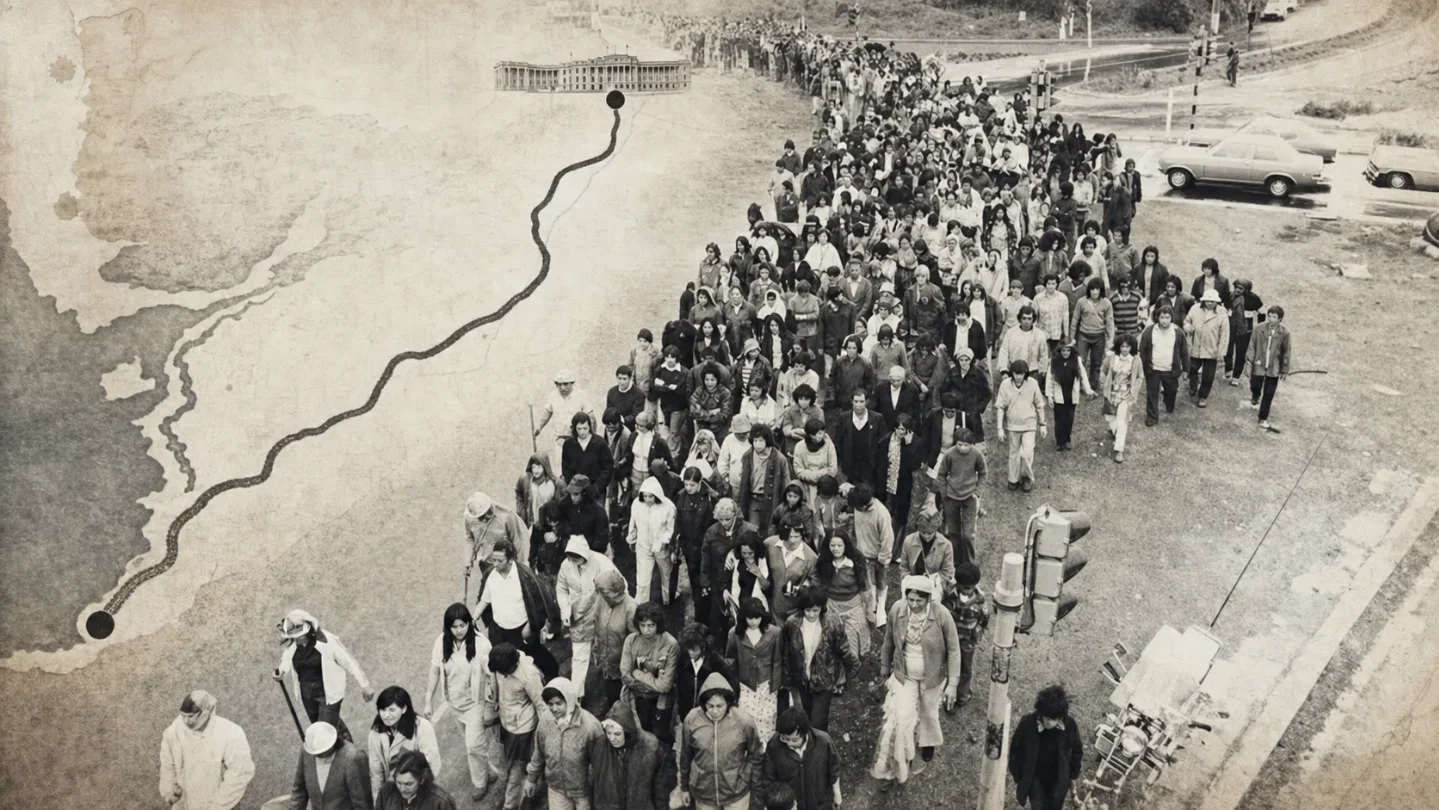
On 14 September 1975, about 50 people left Te Hāpua at the northern tip of Aotearoa New Zealand and began walking toward Parliament in Wellington. Their route was roughly 1,000 kilometres. At the front was Whina Cooper, a 79-year-old Māori leader who had spent decades building local institutions before she became the face of a national protest. A month later, about 5,000 marchers reached Parliament with a petition carrying 60,000 signatures. 1
The image that survived is easy to simplify: an elderly woman walking at the head of a crowd. The history is more demanding. Cooper did not create the land march alone, and the march did not solve the loss of Māori land. Its achievement was to turn a long-running political grievance into a public action that people could join, support, argue over, and remember.
A leader formed in Hokianga
Whina Cooper was born Hōhepine Te Wake on 9 December 1895 in northern Hokianga. Her father, Heremia Te Wake, was a Te Rarawa leader. She grew up with Māori and religious instruction and developed an early interest in history and genealogy. The Dictionary of New Zealand Biography describes a young woman who learned leadership through community work, local institutions, and the practical responsibilities of tribal life, rather than through a formal political career. 2
In the 1930s she worked with Apirana Ngata on Māori land development schemes in Hokianga. Eleven schemes covered about 98,000 acres, or 40,000 hectares, and Cooper supervised several of them. They made rapid progress at first, although some later proved uneconomic. That mixed result matters. Cooper's early public work was not a clean story of success. It involved development, administration, local knowledge, and the hard question of how Māori communities could retain control of land within an economy and state designed to erode it. 3
After her second husband, William Turakiuta Cooper, died in 1949, she moved to Auckland. The change placed her inside a different Māori reality. Families were moving to cities and encountering discrimination in housing and employment. The problem was no longer only what happened to a rural block or a tribal estate. It was also whether Māori families could live with dignity in the places where the modern economy was taking them.
The League made welfare political
Cooper's response was institution-building. On 25 September 1951, she became the founding president of the Māori Women's Welfare League. At the inaugural conference, 87 delegates represented 187 branches and 2,503 women. The delegates wrote a constitution, elected a national executive, and appointed representatives to wider women's organisations. The event was significant because Māori women were choosing their own national representatives, not merely being spoken for by officials or male leaders. 4
Cooper then travelled to build the League's regional and local branches. By the middle of the 1950s, it had more than 300 branches and 4,000 members. The League worked on housing, health, education, employment, and discrimination. It also investigated poor housing in Auckland and pressed public bodies to clear substandard areas and provide more homes. 3
This was a particular kind of movement work. It began with welfare, but welfare became a way to ask who had power over housing, health services, and public policy. Local branches gave women a route into national politics while keeping the work attached to actual families and neighbourhoods. Cooper's public authority grew because she could connect a national argument to the conditions people were living through.
The League was also a lesson in coalition. Cooper worked with Māori Affairs Minister Ernest Corbett and Labour politician Walter Nash, even though cooperation with the state could create its own compromises. Her willingness to use official relationships did not mean that she accepted the state's terms. It meant she understood that movements sometimes need both an independent base and access to the institutions they are trying to change. The League's later work on health and family well-being shows that the organisation outlasted its founding president. 4
From local work to a national hīkoi
By the early 1970s, Māori groups were increasingly concerned about the continuing loss of Māori land and the loss of control over what remained. At a hui convened at Māngere Marae in early 1975, Te Rōpū Matakite o Aotearoa was launched. The name is often translated as "Those with Foresight." The group asked Cooper to lead a march from Te Hāpua to Parliament, a route chosen to make Māori determination visible across the country. 1
Cooper accepted, but the action depended on far more than her symbolic presence. The marchers stopped at marae along the way. Cooper led discussions about the purpose of the hīkoi, while local communities supplied food, places to sleep, publicity, and new participants. Te Papa's collection page for the march records the support of both Māori and Pākehā, with estimates ranging from 30,000 to 40,000 people over the month-long journey. The exact count is less important than the mechanism: the march grew through repeated local acts of welcome and participation, not through a single central rally. 5
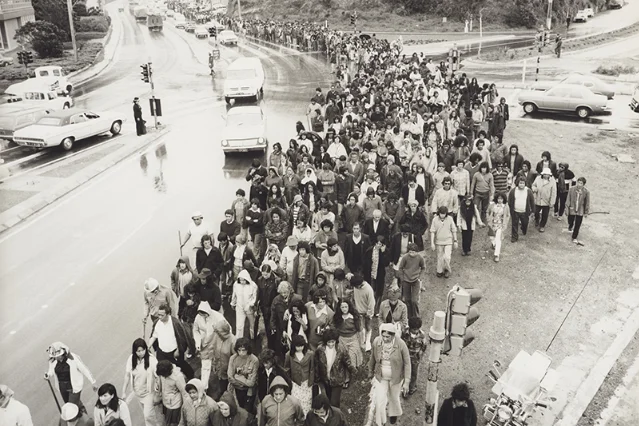
The march also made its demand legible to people who did not share its political vocabulary. A petition could be signed. A route could be followed. A marae could host a night. A national audience could watch the march arrive. On 13 October, Cooper presented a memorial of rights and the petition to Prime Minister Bill Rowling. About 5,000 people were there. The action made land loss visible as a present political question, not a closed chapter of colonial history. 1
The costs of becoming a symbol
The march's success did not erase disagreement inside the movement. After the arrival at Parliament, about 60 protesters remained in the grounds for two months, forming what became known as a Māori embassy. Their continued occupation did not follow Cooper's wishes. The Dictionary of New Zealand Biography also records that divisions within Te Rōpū Matakite weakened its submission to a parliamentary committee. 2
Those tensions are not a footnote. They show the risk of turning a broad movement into a story about one trusted leader. Cooper's charisma helped different groups recognise a common action, but it could not settle every question about tactics, timing, or representation. A march can gather people more easily than it can decide what they should do next.
Cooper's own style had strengths and limits. She was effective at moving people, speaking across communities, and making an issue emotionally clear. She was less suited to the slower work of shared procedure and succession. That is one reason the League matters so much in her story. It was an organisation with branches, delegates, programmes, and a life beyond the founder. The land march became a national symbol, but the League shows the less visible infrastructure that made Cooper's authority possible.
Legacy in motion
Cooper continued in public life after 1975. She was made a Dame in 1981 and appointed to the Order of New Zealand in 1991. She opened the Auckland Commonwealth Games in 1990, where she spoke of the Treaty of Waitangi as a basis for living together in Aotearoa. She died in Hokianga on 26 March 1994 at the age of 98. More than a million people watched the television broadcast of her tangihanga. 3
Cooper's legacy is easiest to understand when split in two. The first part is symbolic: an elderly woman at the head of a long walk became an image of Māori resistance and national debate. The second is organisational: before she led that walk, she had helped create a network through which Māori women could organise around health, housing, education, and family life.
The symbol drew attention. The institutions carried the work. The League still maintains a public presence in Aotearoa, with membership, donations, and annual hui listed on its current website. 6
Cooper's story therefore resists two easy lessons. Change does not require a leader to remain invisible; sometimes a movement needs a recognisable person who can make a demand impossible to overlook. But recognition is not the same as ownership. The walk belonged to the people who planned it, hosted it, joined it, signed it, argued within it, and kept its questions alive.
A compact timeline
- 1895: Whina Cooper is born in northern Hokianga. 3
- 1930s: She works with Apirana Ngata on Māori land development schemes in Hokianga. 3
- 1949: After her husband's death, she moves to Auckland. 2
- 1951: She becomes the founding president of the Māori Women's Welfare League. 4
- 1975: She leads the Māori Land March from Te Hāpua to Parliament. 1
- 1981 and 1991: She receives a damehood and joins the Order of New Zealand. 3
- 1994: She dies in Hokianga at age 98. 3
Three leadership takeaways
- Build the base before the spectacle. The march became powerful because Cooper had already spent years building branches, relationships, and practical credibility through the Māori Women's Welfare League.
- Give a grievance a form people can enter. A long walk, a petition, a marae gathering, and a public handover turned an abstract history of land loss into shared action.
- Separate the symbol from the institution. A recognisable leader can open public attention, but durable change needs organisations that distribute authority, record disagreements, and continue after the leader is gone.
References
- 1Whina Cooper leads land march to Parliament | NZ History
nzhistory.govt.nz
- 2Cooper, Whina | Dictionary of New Zealand Biography
teara.govt.nz
- 3Whina Cooper | NZ History
nzhistory.govt.nz
- 4Māori Women's Welfare League established | NZ History
nzhistory.govt.nz
- 5Māori Land March, 1975 | Te Papa Tongarewa
tepapa.govt.nz
- 6Māori Women's Welfare League
mwwl.org.nz
This story was produced automatically by a channel. One sentence is all it takes for Neodrop to keep producing for you.