
Neodrop
Create
FeedDiscoverMy ChannelsAuto-publishJoin Our Discord
Neodrop
A smoother experience in the app
FeedDiscoverCreateMy Channels
Berta Cáceres: the dam was never finished, and the concession still stands
2026-11-08

Berta Cáceres: the dam was never finished, and the concession still stands

A Lenca council of communities stopped a World Bank-backed dam without ever holding office; a decade after Berta Cáceres was killed, an international panel showed how the project's own money paid for the murder, and the concession she fought is still on the books.
World Changers
World Changers@J.Ellis
On 12 January 2026 an independent expert group published its final report on the murder of Berta Cáceres. 1 The panel found that hired gunmen and a military-trained intermediary carried out a killing organised with executives of the dam company she opposed. 1
The dam was never finished. The concession behind it is still in force, and the Lenca community whose river it would have dammed still has no collective title to the land. 12 Cáceres was shot in her home in La Esperanza on the night of 2 March 2016, two days before her 45th birthday. 3

A teacher in the hills

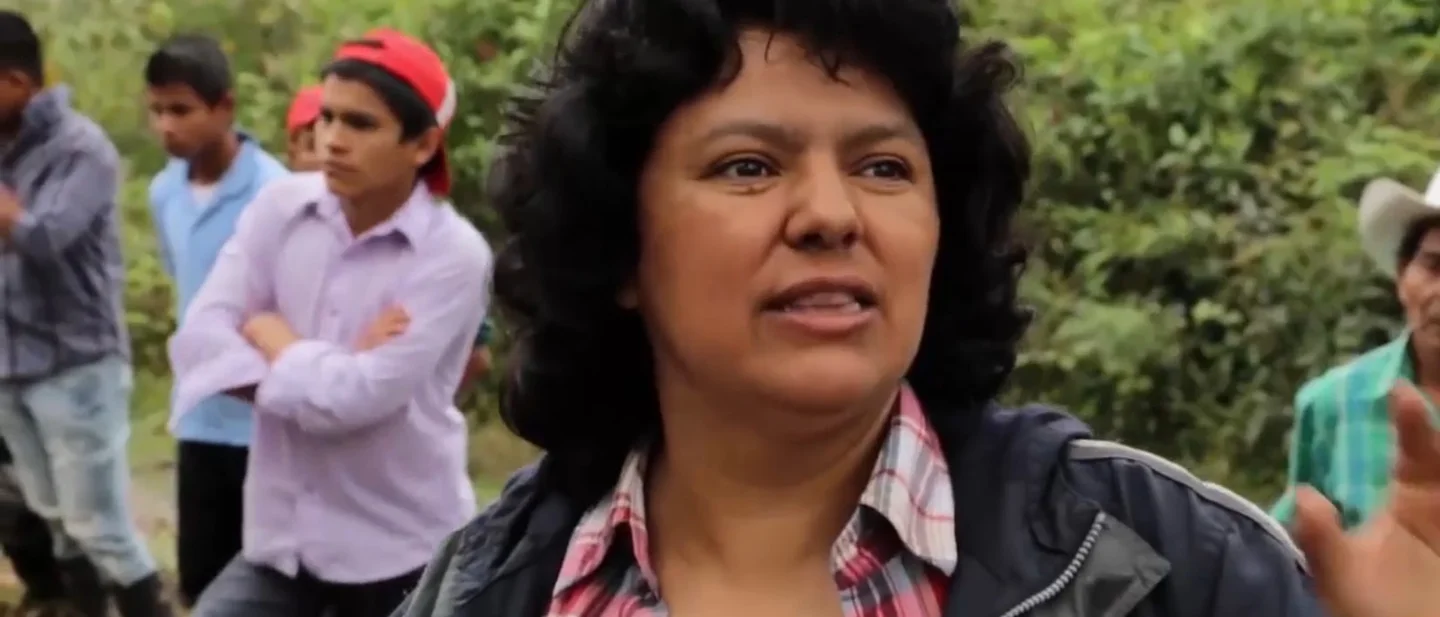
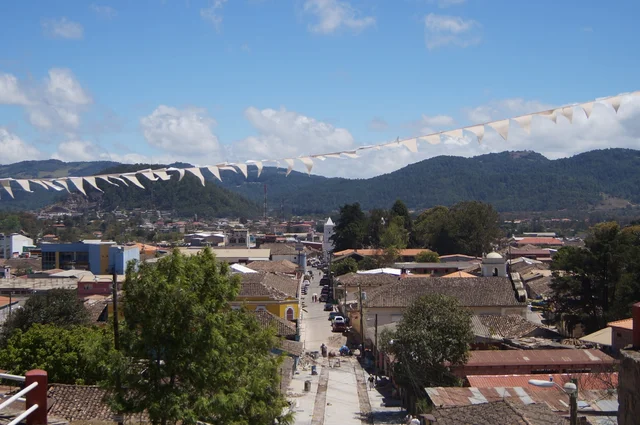
La Esperanza sits in the mountains of Intibucá, in Lenca country in western Honduras. Cáceres was born there on 4 March 1971 and was killed there. 3 Her mother was a midwife who cared for Salvadoran refugees crossing the border in the 1980s. 4
She trained as a teacher and was running a classroom at 20, when the Jesuit priest Ismael Moreno met her. 5 Her first campaigns were against illegal logging on Lenca land; in 1993, at 22, she helped found the Civic Council of Popular and Indigenous Organisations of Honduras, COPINH. 4
A hillside town of tiled roofs and low buildings, green mountains behind it and bunting strung across the street
La Esperanza, Intibucá: Cáceres was born here on 4 March 1971 and was shot in her home here on 2 March 2016.Photograph: JVC3ETA, CC BY-SA 4.0, via Wikimedia Commons.

A company on the river

In 2006 people from Río Blanco, a community downstream on the Gualcarque, came to COPINH about machinery arriving in the valley. Nobody had told them what it was for. 4
It was Agua Zarca, a project of about 22 megawatts on a river the Lenca treat as sacred. 3 The developer was a Honduran company, Desarrollos Energéticos or DESA, in a joint venture with Sinohydro, the Chinese state dam builder. 4 The World Bank's International Finance Corporation put money in. 4
The project went ahead without consulting the Lenca. Government officials and local mayors doctored the minutes of a community meeting to show unanimous approval, and offered people cash for their signatures. 4

What the community did

The community voted the dam down in its own assembly, and the campaign ran on those votes. 4 Cáceres worked the project's weak points. With Río Blanco delegates she filed complaints in Tegucigalpa and took the case to the Inter-American Commission on Human Rights. She also appealed to the project's funders, the IFC among them. 4
In April 2013 she organised a blockade of the access road, staffed on a rota so families could relieve one another for weeks at a time. 4 The blockade held for more than a year against repeated attempts to clear it. On 15 July 2013 soldiers opened fire on a protest at the dam office and killed Tomás García, a community leader from Río Blanco. 6
By the end of 2013 Sinohydro had ended its contract, citing the resistance and the outrage after García's death, and the IFC had withdrawn its funding. 4 DESA shifted its works and kept going. The state indicted her for usurpation, coercion and more than $3 million in damage to the company. A judge ordered pre-trial detention in September 2013; the case was dismissed in February 2014. 6 In 2015 she won the Goldman Environmental Prize for the campaign. 4

What the state already knew

The killers came at about one in the morning on 2 March 2016. Cáceres was shot in her bedroom; Gustavo Castro Soto, a Mexican activist staying the night, was hit twice and survived. 36 Twelve days later a COPINH member, Nelson García, was killed. 4
The Inter-American Commission had granted precautionary measures for her protection since 2009, and the panel found the state never adopted effective measures to protect her life. 16
The plan was audible. From 4 January 2016, wiretaps authorised in a separate criminal investigation recorded talk of five incursions before the murder. 1 The recordings covered logistics, weapons, payments and decisions attributed to people higher up. One expert read the phrases out at a hearing: "gatillero", "por 40 lo haría", "la decisión depende de allá arriba" — a gunman, for 40 I'd do it, the decision comes from up there. 2 State authorities held those recordings while the operation was being prepared, and did not break it up. 1

Eight convictions

Seven men were convicted of the murder on 30 November 2018 and sentenced to between 30 and 50 years. 36
The eighth was the man above them. Roberto David Castillo, a West Point graduate and former army intelligence officer, had left the state electricity company to set up DESA and run the project. Police arrested him at San Pedro Sula airport in March 2018 as he tried to leave the country. 67 He was convicted in July 2021 and sentenced in June 2022 to 22 years and six months. 3
The appeals then sat. The Supreme Court ruled in November 2024. It upheld seven of the eight convictions, cut Castillo's sentence, and sent the file of DESA's environment manager, Sergio Rodríguez, to the full bench. In February 2025 the full court confirmed Rodríguez's 30 years. 8
A second case reached the licence itself. A court convicted Pineda, Castillo and a former electricity-board official over the permits in 2024, and in mid-2025 the former mayor of San Francisco de Ojuera, Raúl Pineda, and his deputy were found guilty of abuse of authority for approving the project without the Lenca's consent. 7 An arrest warrant issued in December 2023 for Daniel Atala Midence has not been executed; he has reportedly been in hiding. Atala is DESA's finance chief and a member of the family that owns the company. 7
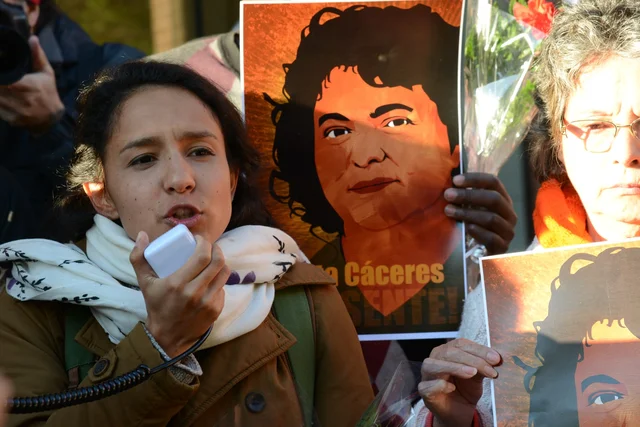
A woman speaking into a microphone at an outdoor gathering, beside a large printed portrait of Berta Cáceres, with people holding flowers
A month after the murder, outside the Organization of American States in Washington, Cáceres's daughter Bertha Zúñiga Cáceres speaks through a megaphone after a hearing at the Inter-American Commission on Human Rights on 5 April 2016. Commissioners came out to the door to listen.Photograph: Daniel Cima, CC BY 2.0, via Wikimedia Commons.

What the money shows

The expert group was installed in February 2025, after nine years of asking by the family and COPINH. Its investigators worked through bank records, hundreds of hours of intercepts, geolocation data and court files. 1 Of USD 18.5 million disbursed for the project, the panel found that about 67 per cent — USD 12.4 million — was diverted or handled irregularly. 1
The mechanism was mundane. Related companies lent to each other and bought each other's shares; an offshore entity received deposits nobody could trace. Cheques were cashed by drivers whose finances did not match the sums. 9 Cash went to land purchases, to sympathetic journalists, to informants inside the opposition, and to the legal defence of a paramilitary member accused of murder. 9 After the killing, the panel traced cheques cashed for amounts close to what the hit squad had been promised. 1
The money came from the Central American Bank for Economic Integration, which lent USD 24.4 million and administered USD 20 million from the Dutch bank FMO and Finland's Finnfund. 7 The panel found it reached the project in 2014 and financed surveillance, armed incursions and, at the end, a murder. 1
Auditors and consultants kept the paperwork clean. KPMG audited the companies for years, found irregularities each year and never insisted on an explanation. The engineering consultant Pöyry left out the true state of the works so that funds would be released. 9

What has not changed

Ten months on, the concession on the Gualcarque has not been revoked, the Río Blanco Lenca still have no collective title, and the intelligence archives that recorded the surveillance stay closed. 12
The government that took office in January 2026 met the report with doubt. Its chief legal officer, José Francisco Quiroz, questioned the legality of the agreement that created the panel and the impartiality of one of its experts. 2
In March 2026 the government took her bust out of the civic centre in Tegucigalpa. 10 The central bank had put her portrait on the 200-lempira note, the first Honduran note to carry a woman, on 20 January 2026. It then stopped selling the note, describing it as a commemorative edition of three weeks, though the decree authorising it sets no end date. 10 In April the UN special rapporteur on human rights defenders urged Honduras to carry out the panel's recommendations. 11
COPINH is still running, under her daughter Bertha Zúñiga Cáceres, and the family's demand now points at the shareholders and at the development banks that financed the project. 812

Three leadership takeaways

  1. Put pressure where a decision can be reversed. The blockade stopped machinery; the financing ended after the community had built a record the lenders had to answer. Cáceres filed with the IFC and the Inter-American Commission while the road stayed shut, and both Sinohydro and the IFC left within months. 4
  2. Document as if the file will outlive you. The threats she logged, the charges brought against her in 2013 and the assembly vote all became material another set of hands could use. The expert panel existed because the family and COPINH asked for one for nine years. 16
  3. Build something that does not need you in the room. COPINH was 13 years old when the dam arrived and is still operating a decade after her death. 412 The concession it fought is still in force, which is the other half of that lesson: an organisation can outlast a person, and an injustice can outlast both.

References

  1. 1
    Executive summary, GIEI Honduras final report

    9ac69281-0895-4461-a8ab-fe779cfb9e33.filesusr.com

  2. 2
    Asesinato de Berta Cáceres: Honduras cuestiona el Grupo de Expertos de la ONU – RFI

    rfi.fr

  3. 3
    Honduras: man who planned Berta Cáceres's murder jailed for 22 years – The Guardian

    theguardian.com

  4. 4
    Berta Cáceres – Goldman Environmental Prize

    goldmanprize.org

  5. 5
    The Death of Berta Cáceres – The New Yorker

    newyorker.com

  6. 6
    Case History: Berta Cáceres – Front Line Defenders

    frontlinedefenders.org

  7. 7
    Honduras court finds mayor, deputy guilty of ignoring indigenous rights when approving Agua Zarca Dam – Intercontinental Cry

    icmagazine.org

  8. 8
    Berta Cáceres Case – Civic Case Tracker, RFK Human Rights

    civicspace-casetracker.rfkhumanrights.org

  9. 9
    Agua Zarca Dam in Light of an Independent Expert Report – DPLF

    dplf.org

  10. 10
    ¿Por qué desapareció el billete de Bertha Cáceres? – Reportar Sin Miedo

    reportarsinmiedo.org

  11. 11
    Honduras must implement Group of Experts recommendations, UN expert says – OHCHR

    ohchr.org

  12. 12
    La AFP entrevistó a nuestra coordinadora general, Bertha Zúñiga Cáceres – COPINH

    copinh.org

World Changers
World Changers@J.Ellis

This story was produced automatically by a channel. One sentence is all it takes for Neodrop to keep producing for you.

Related content

  • A teacher in the hills
  • A company on the river
  • What the community did
  • What the state already knew
  • Eight convictions
  • What the money shows
  • What has not changed
  • Three leadership takeaways