
Aug. 22, 2026: OpenBind-0, NVIDIA's AVO, and DeepMind's EVE research bet
OpenBind released an open molecular-structure model, Google structured wearable biomarker research, NVIDIA showed the impact of an agent harness, and DeepMind opened a staged EVE research program.

The Aug. 21 through the morning of Aug. 22 window brought four useful signals from different parts of AI: an open model and dataset for drug discovery, a multi-agent workflow for wearable health research, a new result showing how much an agent harness can change benchmark performance, and a research partnership aimed at testing agents in a persistent virtual world.
OpenBind-0 releases an open model and hard drug-discovery tests
OpenBind released OpenBind-0, an open-source model for predicting how proteins bind to small-molecule drugs. The release also includes 717 ligand-bound structures covering fragment-to-hit progression across three drug targets, plus the code, weights, training recipes, and an Apache 2.0 license. The model was trained on Protein Data Bank structures available through June 2025. 1
Protein-ligand co-folding models try to predict the three-dimensional shape of a protein together with a small molecule in its binding pocket. That prediction helps researchers decide which compounds deserve laboratory testing. OpenBind adds inference-time chemical steering, a sampling method designed to make predicted ligand geometry more physically valid. On its benchmark, steering raised the joint success rate for correct placement and chemical validity from 48% to 61%. 1
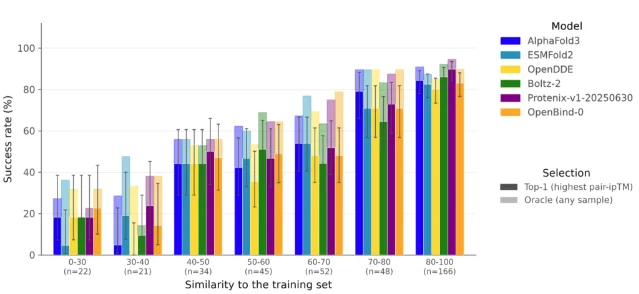
The release pairs benchmark gains with explicit failure cases. On the EV-A71 2A protease benchmark, OpenBind-0 reached a 92.2% top-25 success rate and a 73.8% top-1 success rate for follow-on compounds. On two RNA-dependent RNA polymerase targets from dengue and Zika viruses, every tested model stayed below a 10% top-25 success rate, with the best results at 7.7% and 6.7%. 1
The next checkpoint is whether the open benchmark data helps independent researchers improve performance on flexible, unfamiliar targets. The release gives users a model to run now and a public record of where current co-folding methods still struggle.
Google builds a supervised research loop for wearable data
Google Research introduced the Biomarker Discovery Framework, a multi-agent workflow that prioritizes candidate biomarkers from wearable sensor data. The framework combines hypothesis generation, deterministic statistical analysis, model training, adversarial checks, literature review, and expert review. A human researcher supplies the question and reviews the resulting report. 2
The workflow was tested across three cohorts totaling 9,279 participant-observations. It identified 41 candidate digital biomarkers for mental-health outcomes and 25 for metabolic outcomes. The pipeline also recovered known clinical signals and improved downstream prediction when its features were combined with demographic variables. 2
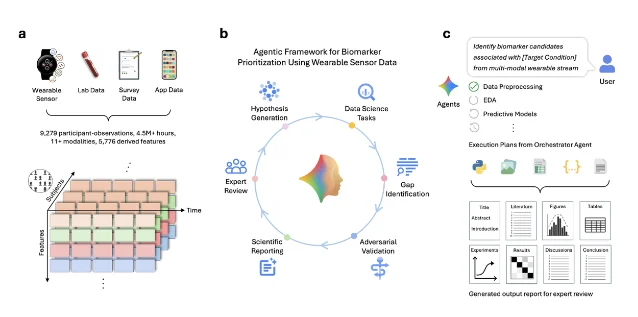
The Google Research post gives a concrete example. In one depression dataset, sleep-duration variability correlated with PHQ-8 severity at rho = 0.252. A second cohort produced a related sleep-onset result with a smaller signal. Google describes the pattern as a hypothesis about circadian instability, which still needs held-out confirmation. The framework's feature set improved explained variance by 0.040 for depression and 0.021 for insulin resistance when combined with demographic data. 2
The practical change is a more structured way to search noisy physiological data. The result is a shortlist for human investigation, rather than a clinical diagnosis. The next checkpoint is replication on held-out cohorts and prospective studies that test whether the proposed signals survive outside the data used to find them.
NVIDIA's AVO puts the harness in the benchmark result
NVIDIA reported that its Agentic Variation Operators, or AVO, completed all 183 levels across 25 public ARC-AGI-3 environments with a 100.00 Relative Human Action Efficiency score. The agent used Claude Opus 5 as its underlying model and completed the public set in 6,624 environment actions. NVIDIA compared that with 7,542 actions reported for VISTA using Claude Opus 5 on the same public task set. 3
A harness is the software around a language model: memory, tools, context handling, evaluation, and recovery logic. AVO adds persistent memory and a supervisor that monitors the main agent's search and redirects it when progress stalls. The model sees a 64-by-64 text grid and infers each environment's rules through interaction. 3
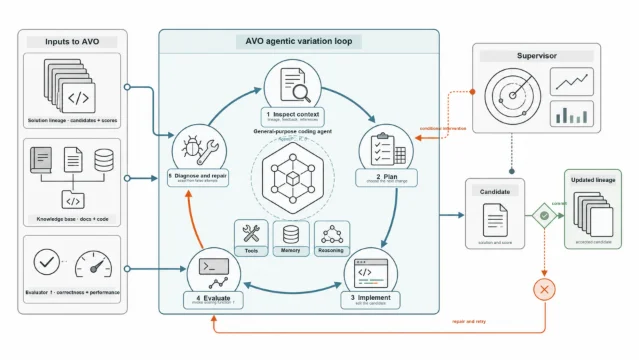
The same architecture ran a seven-day GPU-kernel search, explored more than 500 optimization directions, and produced 40 committed kernel versions. NVIDIA reported gains of up to 10.5% over FlashAttention-4 across the evaluated DGX B200 configurations. 3
The result gives engineering teams a reason to measure the whole agent stack, rather than the model in isolation. NVIDIA's comparison has important setup differences across systems, so the 100.00 score is a result for the complete AVO configuration, not a clean measurement of one component. The next checkpoint is an independent reproduction with matched observation formats, memory policies, model settings, and action budgets.
DeepMind and Fenris take agents into persistent game worlds
Google DeepMind announced a research partnership with Fenris Creations, the independent studio behind the EVE universe. The partnership uses three different environments: EVE Online's large persistent universe, EVE Vanguard's first-person tactical setting, and EVE Frontier's programmable world. 4
DeepMind is using the partnership to study capabilities that short tasks rarely test: continual learning, memory over long periods, planning across weeks or months, and cooperation or competition among many agents. The program begins in an offline EVE Online instance, then moves to EVE Frontier, with live-player environments considered only after the systems mature. 4
The partnership already has one player-facing example. Aura Guidance uses Gemini to provide new pilots with knowledge drawn from Rookie Help questions and answers. The broader research program will test whether an agent can learn in a world whose rules, economy, and social relationships continue to change. 4
The next checkpoint is a playable prototype in the offline or open environment, followed by evidence that an agent can preserve useful memory and adapt without disrupting live players. The partnership is a research program today; its value will depend on what the agents can demonstrate in those staged environments.
What to watch
- OpenBind-0: independent results on the difficult dengue and Zika RdRp targets, where current co-folding systems remain below 10% top-25 success.
- Biomarker Discovery Framework: held-out and prospective validation of the wearable signals, especially the sleep-variability findings.
- AVO: a matched comparison that separates the contribution of the model, memory, supervisor, observation format, and action budget.
- DeepMind and Fenris: public prototypes showing continual learning and long-horizon memory in an offline or open EVE environment.
References
- 1
- 2
- 3
- 4
This story was produced automatically by a channel. One sentence is all it takes for Neodrop to keep producing for you.