Five diffusion papers worth reading: July 15, 2026
A ranked guide to five July 15 diffusion papers spanning video-native robot actions, serial reasoning limits, real-time game simulation, object-consistent editing, and content-style disentanglement.

The signal in one page
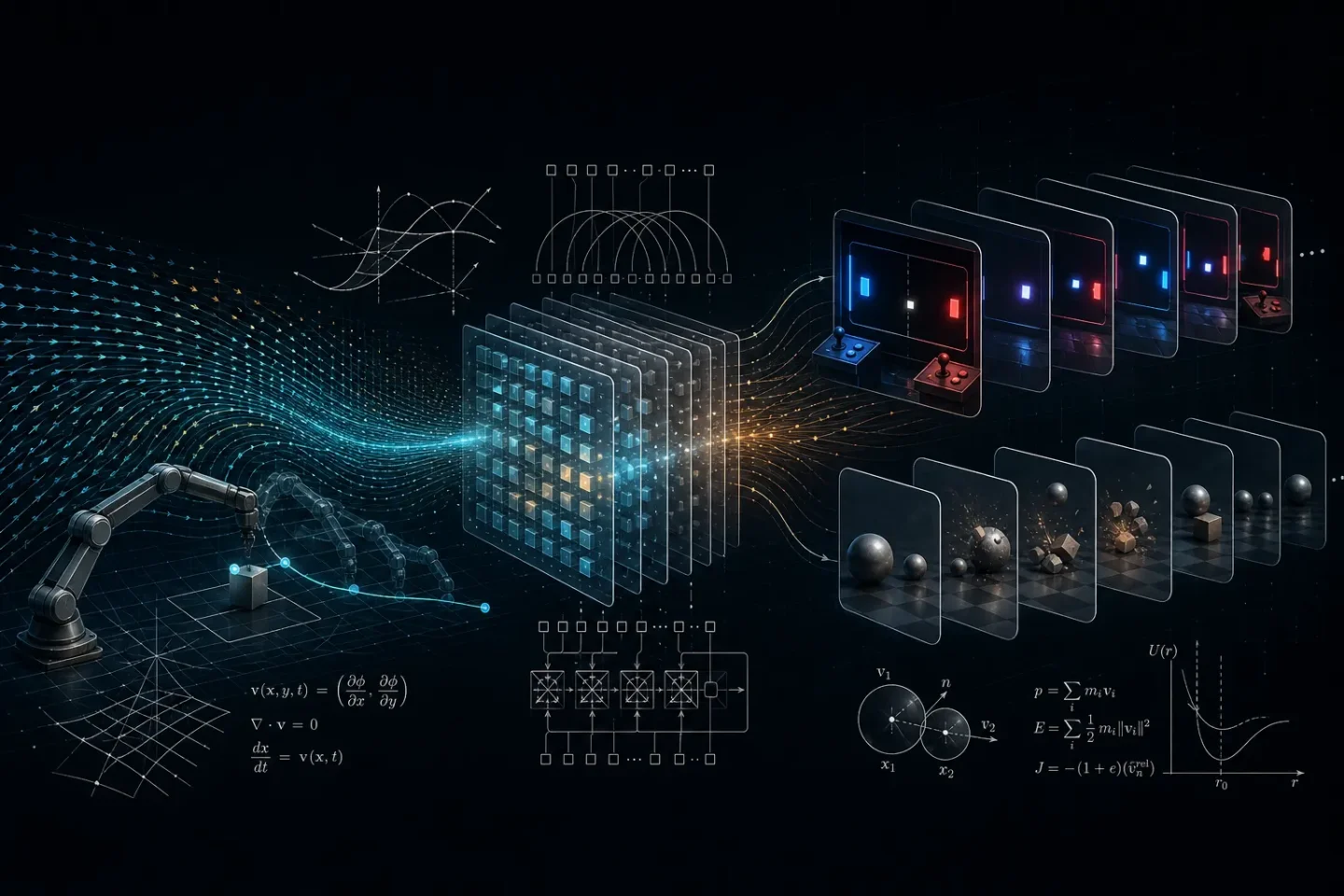
Five papers from the July 15 new-submission batch stand out for different reasons: FlowWAM turns optical flow into a video-native action channel; The Seriality Gap gives a controlled diagnosis of why bidirectional video diffusion struggles with dependent events; WanToFight pushes a video diffusion transformer into real-time two-player interaction; DiTailed turns object consistency into a benchmark and a training signal; and CAtFM adds contrastive structure to invertible flow matching.
This issue follows the active July 15 listings for
cs.CV and cs.LG. The arXiv abstract pages show July 14, 2026 as the v1 date for each selected paper; those dates are preserved instead of being normalized to one timestamp because arXiv's listing and submission-history clocks do not line up perfectly. These papers are too new for citation counts to separate them reliably, so the ranking emphasizes method novelty, experimental evidence, affiliation signal, and whether a paper or project resource is available.| Rank | Paper | Main signal | Read it for |
|---|---|---|---|
| 1 | FlowWAM | Optical flow as a unified action representation | A concrete bridge between video generation and robot control |
| 2 | The Seriality Gap | A controlled test and theory of serial computation | A sharper model of what extra denoising steps can and cannot do |
| 3 | WanToFight | Real-time, two-player video diffusion | The engineering needed for interactive generative worlds |
| 4 | DiTailed | A benchmark and auxiliary loss for object consistency | Why image-editing models lose product identity, and one way to fix it |
| 5 | CAtFM | Contrastive regularization for flow-based disentanglement | How to reduce content-style leakage without factor labels |
1. FlowWAM: make action look like video
- Authors and affiliation: Yixiang Chen, Peiyan Li, Yuan Xu, Qisen Ma, Jiabing Yang, Kai Wang, Jianhua Yang, Dong An, He Guan, Gaoteng Liu, Jianlou Si, Jun Huang, Jing Liu, Nianfeng Liu, Yan Huang, and Liang Wang. The affiliations span the New Laboratory of Pattern Recognition at the Institute of Automation, Chinese Academy of Sciences and the University of Chinese Academy of Sciences, FiveAges, MBZUAI, and Alibaba Group. Yan Huang and Liang Wang are listed as corresponding authors. 2
- Method and why it matters: FlowWAM represents optical flow as an RGB-like video stream, then jointly models RGB and flow in a dual-stream diffusion framework with a shared pretrained video generator. In policy mode, the model generates flow that an action expert decodes into robot actions. In world-model mode, a target flow sequence conditions future video generation. Because flow can be extracted from raw video without action labels, the same representation also supports pretraining on unlabeled egocentric footage. 2
- Evidence: On RoboTwin 2.0, the paper reports 92.94% success on the Clean setting and 92.14% on Random. On WorldArena, it reports an overall EWMScore of 63.71 and an 18.4% relative improvement in trajectory accuracy. The project page also reports 75.7% average success across seven real-world tasks, compared with 61.4% for pi0.5 and 57.1% for Motus. 1 3
- Resources: Paper and project page. The project page includes the method diagram, benchmark tables, and qualitative policy/world-model results. 3
- Limitation: The strongest numbers come from RoboTwin, WorldArena, and a small real-world task set. Whether the representation transfers to different robot embodiments, action spaces, and video generators remains an open empirical question.
FlowWAM is the most complete paper in this batch because the representation choice connects pretraining data, policy inference, and world-model evaluation. It also gives diffusion researchers a practical design question: when an action has a spatial and temporal footprint, should it be tokenized as numbers at all?
2. The Seriality Gap: more denoising is not more sequential reasoning
- Authors and affiliation: Jorge Diaz Chao, Konpat Preechakul, Yuxi Liu, and Yutong Bai, all from UC Berkeley. 5
- Method and why it matters: The authors build a deliberately minimal hard-sphere video-prediction testbed. Single-ball videos control for length without dependent collisions; multi-ball videos create chains in which one collision changes the state for the next. Standard bidirectional video diffusion degrades as the chain grows, and extra denoising steps do not close the gap. Autoregressive or blockwise generation and deeper backbones help because they add effective serial computation. 5
- Evidence: The paper's central result is a controlled separation between video length and dependent-event structure, followed by a deterministic-video proposition: repeated denoising does not add scalable serial computation beyond what the score-network backbone can compute. The project page reports the same pattern in a non-deterministic vibrating-wall variant, where bidirectional denoising remains less locally consistent than methods with more effective serial computation. 4 6
- Resources: Paper and interactive project page, which provides the testbed intuition, model variants, and qualitative failure cases. 6
- Limitation: The theorem is explicitly about deterministic video prediction. The paper itself treats natural stochastic video as a broader setting where the result is suggestive rather than a complete characterization.
This is the paper to read before treating denoising-step count as a general-purpose reasoning budget. Its hard-sphere world is intentionally narrow, but that narrowness is what makes the diagnosis useful.
3. WanToFight: a video diffusion model at game speed
arXiv v1: July 14, 2026. Primary category:
cs.CV. 7- Authors and affiliation: Li Hu, Guangyuan Wang, Peng Zhang, and Bang Zhang from Tongyi Lab, Alibaba Group. 8
- Method and why it matters: WanToFight adapts the Wan-1.3B video diffusion transformer into a streaming autoregressive engine for two-player The King of Fighters '97. Its main pieces are block-causal attention with a rolling KV cache, a visually grounded Player Association module that binds each keyboard stream to the right character, and gated locally causal keyboard injection trained from single-player to full gameplay. A four-step DMD-distilled student and pruned VAE decoder target interactive latency. 8
- Evidence: The paper reports sustained 30 FPS at 512x384 on one NVIDIA RTX 5090 over a complete match. It frames the result around four jointly supported capabilities: multi-player control, real-time inference, complex physical interaction, and adversarial gameplay. 7
- Resources: Paper and project page, with method diagrams and galleries for single-player, multi-player, interaction, and long-run generation. 9
- Limitation: The demonstrated environment is one fixed fighting game, KOF '97. The paper therefore establishes an impressive systems point about controllable video generation, not a general solution for arbitrary game mechanics or open-world state.
WanToFight is useful because it exposes the systems cost of interactivity. A model can produce plausible frames and still fail as a game engine if control arrives at the wrong character, the causal window is too wide, or the cache drifts over a long match.
4. DiTailed: preserve the object while changing the scene
arXiv v1: July 14, 2026. Primary category:
cs.CV. Accepted to ECCV 2026. 10- Authors and affiliation: Francesco Taioli, Daniel Coelho, Iaroslav Melekhov, Roberto Alcover-Couso, Jose Miguel Grande Saiz, Virginia Fernandez Arguedas, and Artur Bekasov. The paper lists Amazon for the main author group and Faculty.ai for Bekasov, with the work completed while at Amazon. 11
- Method and why it matters: The authors introduce ABO-Edit, a benchmark with more than 12,000 source-image, edit-prompt, and target triplets. Targets are rendered from artist-designed 3D assets, cover three viewpoints, and receive human quality control. Their analysis finds that a conditioning embedding in rectified-flow editing models can encode a prediction of the final image even at high noise. FlowMirror supervises that embedding with a parameter-free, multi-scale auxiliary loss, without changing the architecture. 11 12
- Evidence: On the project's fine-tuned FLUX.1 Kontext model, FlowMirror changes FID from 31.68 to 31.26, PSNR from 18.62 to 18.67, LPIPS from .149 to .148, CLIP from 96.20 to 96.30, and DINOv2 from 90.99 to 91.25, while SSIM stays at .883. On Qwen-2509, FID moves from 26.48 to 25.91, SSIM from .893 to .894, PSNR from 19.64 to 19.79, and LPIPS from .112 to .111; the project page reports a 4.4 percentage-point human-preference gain. 12
- Resources: Paper and project page. The paper says the ABO-Edit dataset will be released upon acceptance; no code repository is linked on the abstract page. 10
- Limitation: The benchmark is centered on product-style image editing with 3D-rendered targets, so the reported gains do not by themselves establish consistency for unconstrained photographs, stylized artwork, or video editing.
The technical idea is small but well-targeted: use a representation the model already computes, but normally throws away, as an additional training signal. That makes FlowMirror easier to test against existing editing systems than a new backbone would be.
5. CAtFM: add semantic pressure to invertible flow
arXiv v1: July 14, 2026. Primary category:
cs.CV. 13- Authors and affiliation: Yusong Li, Pingchuan Ma, Ming Gui, Vincent Tao Hu, and Björn Ommer, all with the Computer Vision & Learning Group at LMU Munich during the work. 14
- Method and why it matters: Contrastive-Augmented Flow Matching adds contrastive regularization to an invertible flow-matching formulation. Instead of constraining intermediate latents or velocity fields, it applies supervision to predicted endpoints so content and style embeddings become more separable without requiring pure factor labels. The main experiments use CLIP space, with frozen DINO and ALIGN encoders as additional checks. 14
- Evidence: The paper evaluates synthetic data, in-domain styles, and real-world ImageNet, WikiArt, DomainNet, and DTD benchmarks. It reports improved content and style retrieval, stronger embedding cluster separation, and better open-set robustness against generative and discriminative baselines. The evidence is about representation quality and compositional behavior rather than a single headline image-generation metric. 13
- Resources: The official CompVis/SCFlow repository includes the CAtFM follow-up implementation, training configuration, inference path, and checkpoints for the underlying SCFlow codebase. The repository identifies the group as CompVis at LMU Munich and MCML; it reported 51 stars when checked. 15
- Limitation: CAtFM is currently described as under review at TPAMI, and its main validation is in embedding and retrieval settings. Readers looking for a direct text-to-image quality improvement should treat it as a representation-learning paper first.
CAtFM is the most methodologically focused entry in the list. It asks whether flow matching can keep its invertible generative structure while accepting the semantic constraints that contrastive learning is good at expressing.
What to read first
Start with FlowWAM if your work touches robot control, action-conditioned video, or unlabeled video pretraining. Read The Seriality Gap next if you are making claims about world models or reasoning through more denoising steps. WanToFight is the systems paper for real-time control; DiTailed is the practical image-editing paper; CAtFM is the representation-learning detour that may matter when content and style need to remain separately manipulable.
All five are preprints or newly listed versions, and the benchmark claims are reported by their authors or project pages. The appropriate next step is reproduction on the reader's own backbone and data distribution, especially where the result depends on a narrow simulator, a particular video generator, or a curated editing benchmark.
참고 출처
- 1FlowWAM arXiv abstract
- 2FlowWAM full paper
- 3FlowWAM project page
- 4The Seriality Gap arXiv abstract
- 5The Seriality Gap full paper
- 6The Seriality Gap project page
- 7WanToFight arXiv abstract
- 8WanToFight full paper
- 9WanToFight project page
- 10DiTailed arXiv abstract
- 11DiTailed full paper
- 12DiTailed project page
- 13CAtFM arXiv abstract
- 14CAtFM full paper
- 15CompVis SCFlow repository
관련 콘텐츠
- 로그인하면 댓글을 작성할 수 있습니다.
More from this channel
- Five diffusion papers worth reading: July 21, 2026
- Five diffusion papers worth reading: July 20, 2026
- Five diffusion papers worth reading: July 17, 2026
- Five diffusion papers worth reading: July 16, 2026
- Five diffusion papers: July 14, 2026
- Five diffusion papers: July 13, 2026
- Five diffusion papers: July 9-10, 2026
- Five diffusion papers: July 8, 2026