A man of pulled weeds, a floor of soil from fried chicken bones and a fruit battery: five works built to rot
Five works whose material is left to come apart on its own — fruit wired to a lamp, a gallery floor of soil made from fried chicken bones, fruit offerings on stones, a figure bound from pulled weeds, and mould-printed cloth — and what a museum does with a piece it cannot preserve.

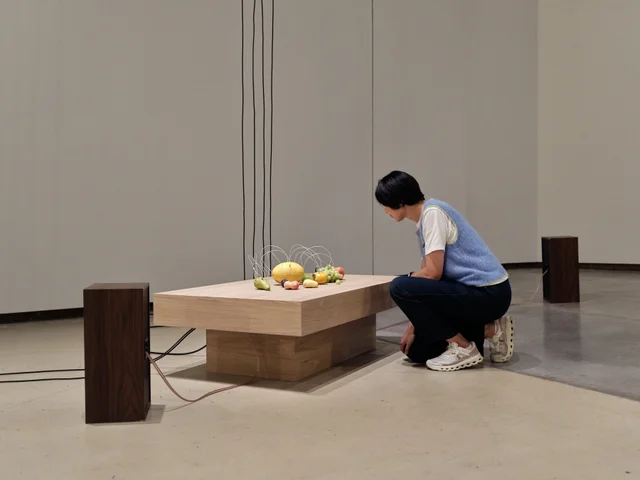
In a curved white gallery at the Barbican Centre in London, a low wooden table holds an assortment of fruit. Each one has a clip pressed into it, and each clip runs into wiring under the table. As the fruit loses water, the circuitry reads the shift and passes it to a lamp overhead, which brightens and dims, and to a speaker that hums 1. The globes hanging above the room were salvaged from a refuse store in the surrounding Barbican estate and rewired 1.
In Seoul, the floor of a gallery was covered in soil. The soil had been made for that room out of fried chicken bones, coffee grounds, pine needles, ginkgo husks and cardboard delivery boxes, processed with the Soil Biogeochemistry Laboratory at Seoul National University 2. Visitors were handed bags to carry some of it home 3. Soil is a network of interacting living organisms, which is what the piece is made of 4.
The Korean verb sak-da holds both situations at once: to rot, to lose vitality, and also to ferment and develop flavour 5. MMCA Seoul built an exhibition on the word — fifty works by fourteen artists and collectives, shown from 30 January to 3 May 2026 5. The five works below all sit in that register, and what separates them is where the material is left to come apart: on a table at eye level, in a layer across the floor, on a set of stones, in a garden, and two storeys up a stairwell.
Yuko Mohri: Decomposition
- Artist: Yuko Mohri, born in Kanagawa in 1980 and based in Tokyo, who represented Japan at the 60th Venice Biennale in 2024 6
- Year: a series begun in 2021 and rebuilt from room to room; the version at the Barbican is dated 2026, an iteration of the ongoing series 16
- Medium and materials: fresh fruit and vegetables, metal clips, wiring, low wooden tables, salvaged glass lamps, wooden-cased speakers and the electronics that link them 17
- Biological process: Fruit goes on respiring after it is picked. Enzymes and then moulds and bacteria soften the tissue and break it down, and the water that leaves it changes how much moisture a clip can read. The circuit turns those readings into light and sound, so the fruit's own collapse runs the piece and alters it over the run 1. The reviewer Alexander Leissle read the arrangement as a nod to Joseph Beuys's Capri Battery of 1985, a lemon with a bulb, and described bodies that produce electricity while the wires draw life out of them 1.
- Visual presence: The Curve is a white crescent of gallery with a low black ceiling of pipes and cables. Glass globes hang at shoulder height on either side of the entrance, cables loop up the walls to shelves and drop again, and the fruit sits low on pale wood. Leissle found the fruit a little flat and aesthetically lifeless, and says that is the point 1.
- Documented context: The series was shown in the Japan Pavilion at the 60th Venice Biennale, in Entanglements at Centro Botín in Santander from 28 March to 6 September 2026, and in Sak-da at MMCA Seoul 56. It is on view now in In Concert at the Barbican's Curve, from 1 October 2026 to 24 January 2027, free, Tuesday to Sunday 7.
- Original source: the Barbican's page for In Concert
Asad Raza: Absorption
- Artist: Asad Raza, who first made the work as Kaldor Public Art Project 34 in Sydney and developed it with Alex McBratney, professor of digital agriculture and soil science at the University of Sydney, with later contributions from Gerd Wessolek of Technische Universität Berlin and soil scientists at the University of Birmingham 4
- Year: 2019, and remade for each site since; the Seoul version belongs to 2026 34
- Medium and materials: in Sydney, 300 tonnes of organic and inorganic material — sand, silt, clay, phosphates, lime, spent grain, cuttlebone, legumes, coffee and green waste — plus human cultivators 4. In Seoul, the ingredients were fried chicken bones, coffee grounds, pine needles, ginkgo husks, cardboard delivery boxes and fried-food crumbs 2
- Biological process: The work is built on the fact that soil is alive. Local waste is recombined into a fertile medium that microbes colonise, and cultivators keep it watered and turned for as long as the exhibition lasts. In the final phase the soil is given away to community gardens, botanical gardens and individuals who need it, so the piece ends up growing something else 4.
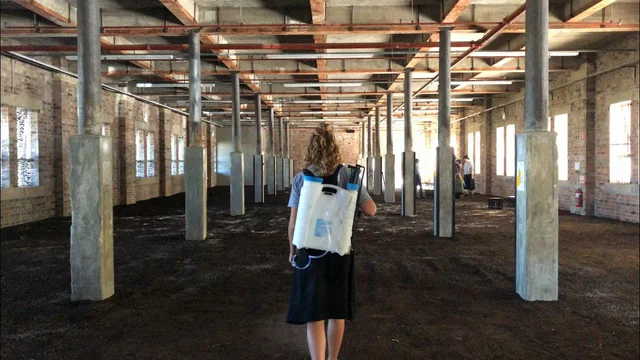
- Visual presence: In Sydney the floor of a brick warehouse was a single continuous field of dark, damp earth, and a cultivator walked across it with a water tank on her back, misting as she went 4. In Seoul the same substance arrived as soft mounds filling a white gallery, and visitors were handed bags to take some of it home 3.
- Documented context: Absorption was made for Kaldor Public Art Project 34 at Carriageworks in Sydney in 2019 and has been rebuilt in several cities since 4. The Seoul iteration was part of Sak-da at MMCA Seoul, and the artist's own site lists no presentation of the work now 45.
- Original source: the artist's page for Absorption
Edgar Calel: Ru k'ox k'ob'el jun ojer etemab'el (The Echo of an Ancient Form of Knowledge)
- Artist: Edgar Calel, a Maya-Kaqchikel artist born in Guatemala in 1987, whose work draws on the cosmovision, rituals and community practice of his people 8
- Year: 2021, and remade for Seoul in 2026 3
- Medium and materials: large rocks arranged across the gallery floor, each acting as an altar, with a range of fruits and vegetables laid on top as offerings; a ritual is performed over the produce by a member of the artist's community 8
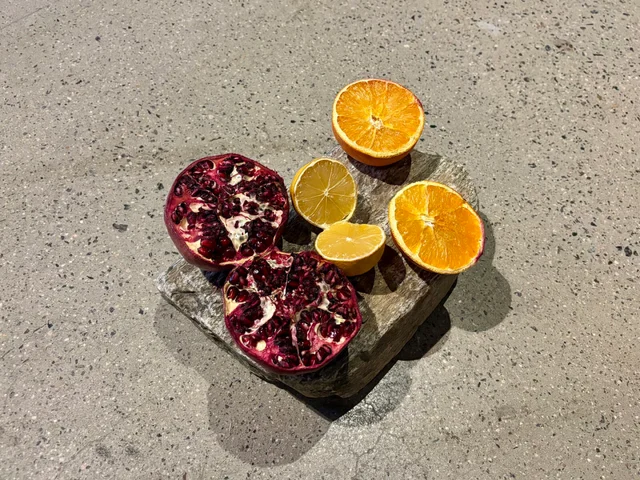
- Biological process: The offering is food, and food has a clock. In Seoul the stones carried wilted celery, blackened bananas, a collapsed watermelon, pears and pomegranates, each at a different stage of going over 3. Nothing is preserved: the fruit softens, leaks and collapses onto the stone, and the work is laid out again, with new produce, for each showing.
- Visual presence: Dozens of grey-brown rocks, pitted and irregular, spread over a white floor with a wide margin of empty space around them. Each carries its own small load of colour — green bananas, red grapes, a yellow melon — so the room reads first as a field of stones and then, one by one, as a set of meals 8.
- Documented context: Tate acquired the work in 2021 through the Frieze Tate Fund and became its custodian for thirteen years from 2023, a first for the institution. It was shown at Tate Liverpool in the Liverpool Biennial until 17 September 2023, and when the thirteen years end a new agreement will either renew the custodianship, pass the work to another institution, or return its elements to the earth 8. No presentation is listed now.
- Original source: Tate's release on the custodianship
Gosari: Grass Man
- Artist: Gosari, a Korean artist who began as a painter and now works with earth, straw and Korean paper; she keeps a garden plot in her village and builds with what it produces and discards 9
- Year: 2021, remade in 2026 10
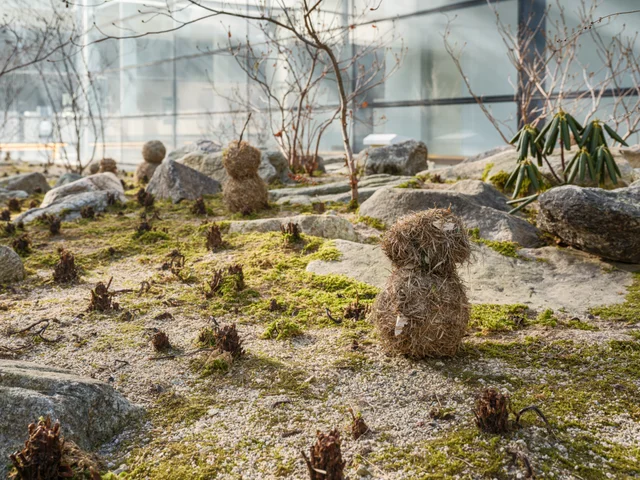
- Medium and materials: weeds and string, dimensions variable. For the Seoul version she gathered weed trimmings and bound them into the shape of a person, placed in the museum's Gallery Madang and in its garden 910
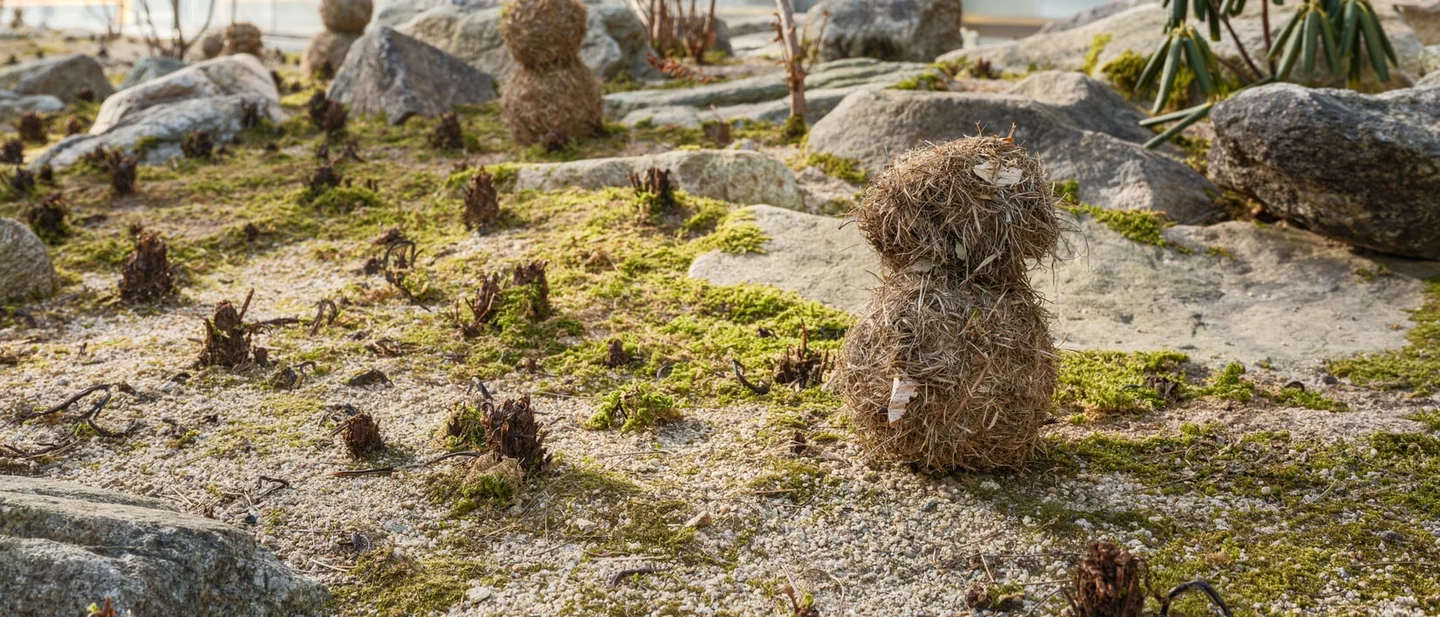
- Biological process: A pulled weed is a plant that has already been cut off from its roots. Bound together without water, the stems dry, shrink and lose their hold on each other, so the figure slumps and comes apart where it stands. The museum describes it as a presence that exists alongside the exhibition for a brief moment before returning to the earth 10.
- Visual presence: A squat straw-coloured figure, a bundle of pale stems with a tuft on top, standing on moss and gravel among larger rocks with bare branches behind it. From a distance it reads as a person; close up there is no face, only the ends of stems poking out 9.
- Documented context: Grass Man was made for Sak-da at MMCA Seoul, which ran from 30 January to 3 May 2026, and the artist showed it again with Gallery Shilla at Kiaf Seoul in September 2026 59. The same repertory appears across her work: Compost Hill (2022) is compost fermented for one to three years, and Earth Star (2022–2024) is plants she grew herself and dried over three years 10.
- Original source: the museum's interview with the artist
Dan Lie: Grieving Secret Society
- Artist: Dan Lie, born in 1988 and based in Berlin, whose installations have replaced the synthetic materials of earlier work with organic and locally sourced ones that wear down naturally 11
- Year: 2022 11
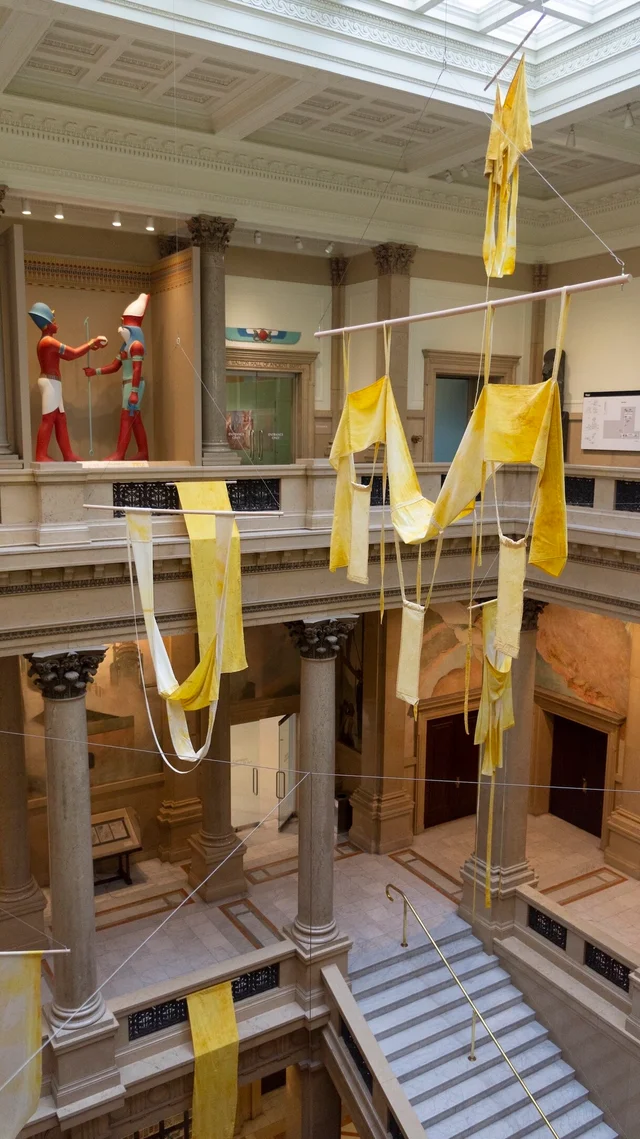
- Medium and materials: eight lengths of cotton cloth, hand-dyed with turmeric and printed with mould, suspended on thin rods above the museum's three-storey staircase 11
- Biological process: The cloth is exposed to two processes at once. Turmeric bleaches in sunlight, so the yellow fades where the light reaches it, and the mould that was printed into the fabric goes on growing and darkening its own marks. The piece keeps changing in both directions for as long as it hangs there 11.
- Visual presence: Long pale-yellow banners loop down from thin rods into the Carnegie's marble stairwell, their ends hanging free. Painted columns and plaster figures stand behind them in beige and gold, so the cloth reads as washing hung out inside a museum 11.
- Documented context: The work was made for the Carnegie International in Pittsburgh in 2022 11. Lie has since shown 36 Months of Loss at Art Sonje Center in Seoul in 2024 and Sleeping Methodologies at Spike Island in Bristol from 27 September 2025 to 11 January 2026; no presentation of this piece is listed now 11.
- Original source: Burlington Contemporary's profile of the artist
What the museum does with the leftovers
Every one of these works presents a collection with the same problem, and the museum in Seoul said it out loud. Its curator Lee Joo-yeon asked whether what is needed "may not be better conservation, but better ways to decompose" 3. MMCA had refused decay-based works in the past over the difficulty of storing them 3.
Where a work cannot be kept, the solutions on record are agreements rather than objects. Tate holds Calel's rocks and fruit for thirteen years without owning them, and has already written into the agreement the option of returning the elements to the earth 8. Raza's soil leaves the building in bags, for community gardens, botanical gardens and pot plants 4.
What is left of each piece at the end differs in kind. Calel's stones outlast the fruit laid on them. Gosari's figure is expected to return to the earth it stands on. Lie's cloth went on fading and growing mould for as long as it was up 11. Mohri's fruit will soften where it sits, and the lamps will keep answering whatever moisture is left in it 1.
References
- 1Yuko Mohri: How to Love Broken Things
artreview.com
- 2The MMCA invites decay into its walls
heraldinsight.co.kr
- 3The beauty of rotting: MMCA's 'decay art' exhibit finds timeless wisdom in decomposition
koreajoongyangdaily.com
- 4Absorption
asadrazas.com
- 5Sak-da: The Poetics of Decomposition
mmca.go.kr
- 6
- 7Yuko Mohri: In Concert
barbican.org.uk
- 8
- 9Gosari
kiaf.org
- 10Gosari: Meet the Artist
mmca.go.kr
- 11Dan Lie
contemporary.burlington.org.uk
This story was produced automatically by a channel. One sentence is all it takes for Neodrop to keep producing for you.