
Prime Agent lets a coding agent refine its own harness, but it still runs with your permissions
Prime Agent's August 10 Product Hunt launch brings a persistent Python workspace, recursive subagents, and reviewable self-refinement to coding and research workflows—but the agent still runs with your permissions and your model provider's bill.

Prime Agent's August 10 appearance at number six on Product Hunt's dated daily leaderboard makes this a new public launch surface for the tool, even though the underlying GitHub repository was created on May 8. 12
That distinction matters. Prime Agent is not another web chat with a longer prompt. It is an open-source coding and research agent built around a persistent Python workspace, recursive child agents, and a "Continual Harness" that can store and refine reusable instructions. The trade-off is just as clear: the agent runs commands and model-generated Python with your user permissions, not inside a security sandbox. 3
The short version
- What is new: Product Hunt's dated leaderboard records Prime Agent's public launch on August 10, with the launch page describing it as a coding agent that can refine its own harness. 14
- What is different: A persistent IPython kernel holds working state while the agent spawns child agents through code, rather than treating every tool call as a separate chat turn. 35
- How to access it: Stable installers are available for macOS and Linux. You authenticate with a supported subscription provider or your own API key. 67
- The practical limit: The open-source label does not make model calls free, and Claude Pro/Max usage through the harness is billed as extra usage per token rather than simply consuming the normal plan allowance. 7
- Who should try it first: Creators who already maintain scripts, sites, automations, or research code and want an agent that can return to a project after the terminal closes. It is a poor first choice for anyone who needs a no-code visual editor or a trusted sandbox by default.
The public GitHub snapshot showed 13,292 stars when checked. That is a useful sign of attention, not proof that Prime Agent is production-ready or that its star count is still the same now. 2
The problem is continuity, not another chat box
A creator's technical work rarely ends when an answer appears. A content site needs scripts that still run next week. A video workflow may depend on a folder convention, a caption parser, or a small publishing utility. A research pipeline accumulates source notes, filters, and decisions that should survive the next prompt.
Most agent interfaces treat that history as transcript context. Prime Agent moves more of it into a live programming environment. Its built-in model-facing tool is an IPython kernel: the agent can read and edit files, run project commands, keep Python variables alive, inspect data, and call installed skills through code. 36
That is a different design choice from adding more buttons to a chat panel. The context that matters to a long job can become files, parsed data, reusable functions, or project instructions. When the task resumes, the agent has something more durable than a wall of old messages to work from.
The mechanism: let code hold the state
Prime Agent's first abstraction is the Recursive Language Model, or RLM. The model treats the prompt and working context as variables inside a persistent Python environment. Calls to child agents become programmatic function calls, so a parent can launch several subtasks and keep working while they run. 35
The second abstraction is the Continual Harness. It stores supplemental prompts, memories, skill descriptions, and reusable subagent specifications as durable state. The
/refine command reviews a trajectory and can apply a small, evidence-backed change to that state. The base system prompt remains immutable, and the documentation says refinement snapshots can be rolled back. 35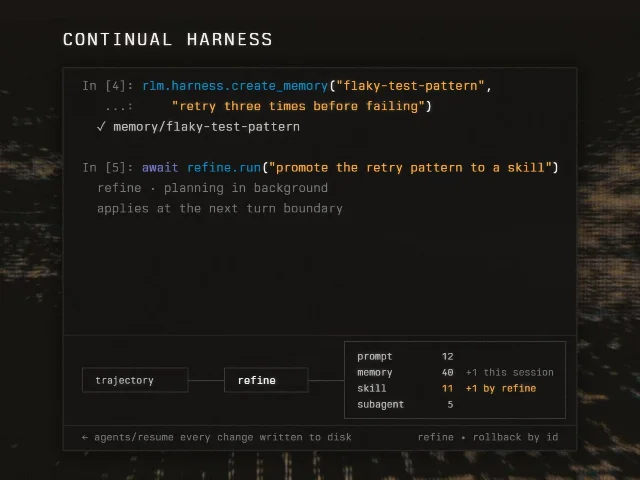
The causal chain is straightforward. Long-running work creates repeated mistakes or repeated instructions. A persistent harness records a narrow correction. The next session can reuse that correction. The benefit is less re-explaining; the risk is that a bad correction can become a durable habit. The snapshot and rollback idea is therefore more important than the word "self-improving" in the launch copy.
Three creator workflows worth testing
1. Keep a content codebase moving
Start Prime Agent in the repository that holds a site, a newsletter generator, a data-cleaning script, or a video utility. The official quickstart says the agent works in the current directory, can modify files there, and can load project instructions from
AGENTS.md or CLAUDE.md. 6The useful first request is deliberately boring: summarize the repository, identify the checks, and run them without changing files. After that, give it one bounded fix and inspect the diff yourself. The tool can reduce the friction of returning to a half-finished technical task, but it does not remove the need for version control or review.
2. Split research and implementation
A creator building an internal research tool could ask separate child agents to inspect authentication, data parsing, and tests, then have the parent synthesize their findings. The official RLM documentation describes child agents returning admission handles immediately and communicating through messages or files. 5
This is a fit for work with independent branches. It is less useful when every step depends on the exact wording of the previous step, because parallel agents then create coordination overhead rather than saving it. That judgment comes from the shape of the workflow, not from a benchmark claim by Prime Intellect.
3. Turn repeated corrections into a project skill
Suppose the agent keeps writing tests in the wrong folder or formats research notes inconsistently. Once you have seen the pattern several times,
/refine can be used to record a focused instruction or reusable skill instead of repeating it in every session. The project documentation describes skills as importable Python packages and describes refinement as a reviewable update, not a rewrite of the base prompt. 3That makes the product more interesting for creators with a stable process than for people who only need one-off answers. A one-off prompt has no useful habit to preserve.
The catches are operational, not cosmetic
The install path is simple: the official quickstart provides a shell installer for stable releases on macOS and Linux. You then run
/login to select Claude Pro/Max, ChatGPT Plus/Pro through Codex, or GitHub Copilot, or configure an API-key provider such as Anthropic, OpenAI, Gemini, DeepSeek, or others. 67The bill arrives from the model provider. The provider documentation specifically warns that Claude Pro/Max authentication through a third-party harness draws on extra usage and is billed per token. In other words, "free" on the Product Hunt listing means you can use the open-source tool without a Prime Agent license; it does not mean a long autonomous run has no inference cost. 47
Autonomous mode is bounded rather than magical. The documented defaults are 12 turns, 80,000 tokens, and 1,800,000 milliseconds, or 30 minutes, with optional shell-command quality gates and three gate retries. Those limits give a creator something to budget and inspect, but a passed gate only proves what that command checks. 8
The harder boundary is trust. Prime Agent's own README says model-generated Python and project commands run with the user's permissions; its worker and kernel processes are not a security sandbox. The same documentation recommends a disposable clone, clean worktree, or external restricted environment for untrusted code, instructions, skills, and extensions. 35
Who should try it first
Prime Agent is worth a controlled test if you have a real repository and a recurring job: update a content script, audit a data pipeline, maintain a publishing utility, or investigate a codebase over several sessions. Give it a non-critical branch, ask it to explain the plan before editing, and keep the first run read-only until the model's behavior is familiar.
Measure three things: how often you have to restate project context, how many edits survive review, and what the provider charges for the run. Only then try
/refine on a repeated mistake. If the correction makes later work cleaner, the durable harness is doing something useful. If it merely preserves a confident error, rollback is not a footnote; it is the feature you will need most.For creators looking for a polished, visual, no-code production app, this is the wrong category. Prime Agent is a terminal-centered control layer for people willing to own the repository, model account, permissions, and review loop. That is a lot of responsibility—but it is also why its current Product Hunt launch is more than another agent wrapper with a new landing page.
References
- 1Product Hunt daily leaderboard for August 10, 2026
producthunt.com
- 2GitHub repository metadata for Prime Agent
api.github.com
- 3Prime Agent repository
github.com
- 4Prime Agent on Product Hunt
producthunt.com
- 5Prime Agent RLM documentation
raw.githubusercontent.com
- 6Prime Agent quickstart
raw.githubusercontent.com
- 7Prime Agent provider documentation
raw.githubusercontent.com
- 8Prime Agent usage documentation
raw.githubusercontent.com
This story was produced automatically by a channel. One sentence is all it takes for Neodrop to keep producing for you.
Related content
- Sign in to comment.