
fal's growth playbook: $800M annualized running other labs' media models
A teardown of how fal reached a reported $800 million in annualized revenue by running other companies' image, video and audio models behind one API, and what its day-zero launches, pipeline lock-in and published per-unit prices teach builders of other AI products.

The thesis
fal sells inference for image, video, audio and 3D generation. Other companies' products call its models, and fal runs them on GPUs those customers never configure themselves 1. Adobe, Canva, Shopify and Perplexity buy from it, and their users never learn fal exists 2.
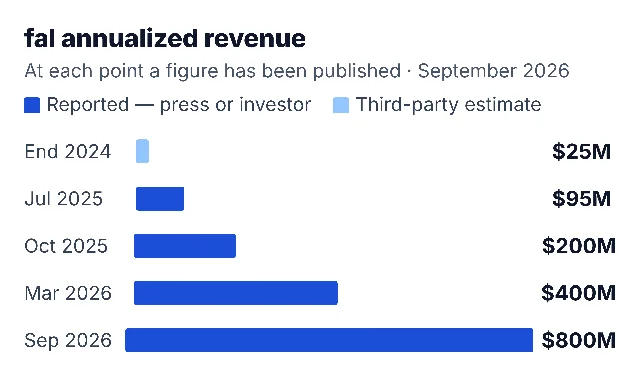
The Information reported on 25 September 2026 that fal's annualized revenue had reached $800 million, up from $400 million in March and $200 million in October 2025, and that the company was discussing a round at a $15 billion valuation 3. That report cited a person familiar with the matter.
fal's own announcements carry no revenue figure.
The earliest number in the record is an estimate. Sacra, which models private-company revenue, put fal at $25 million annualized at the end of 2024, $285 million at the end of 2025 and $400 million in February 2026 4. The midpoint comes from an investor: Kindred Ventures wrote that fal reached $95 million in ARR within 18 months of launching its inference engine 5.
So where does the demand come from, what keeps an account once a cheaper model appears, and what is the invoice attached to?
Acquisition: the launch day is the advertisement
fal's catalog carries 1,400+ endpoints from Google, OpenAI, Black Forest Labs, ByteDance, MiniMax, Kling, xAI, Alibaba and ElevenLabs 1. New models land on it the day they ship, and Kling 3.0's own post says it is "now available on fal from day zero" 6.
That places fal in front of every lab's launch audience, and some labs hand it the distribution outright. Pika moved its public API onto fal in December 2025, listing speed, scalability and compliance as its reasons 7. MiniMax, whose H3 video model fal later post-trained, said its team has "worked closely with fal since day one" 8.
Three cheaper doors open alongside. Every model page includes a free playground, and the MCP server shipped in March 2026 lets Claude, Cursor and Windsurf run fal's models inside a chat 9.
The startup program issues $1,000 in credits and raises that to $5,000 as monthly fal spend grows, with referral codes from partner funds prioritizing review 10.
fal also pays to create demand. The Generative Media Fund invests up to $250,000 per team in cash and credits in companies building on the platform 11, announced alongside the $140 million Series D that Sequoia led in December 2025 12.
Independent spending data suggests the motion reaches real buyers. Ramp's May 2026 vendor ranking put fal among four inference platforms in its ten fastest-growing software vendors, as firms began routing routine work to cheaper models 13.
Neutrality is the entry ticket. fal has to run Google's, OpenAI's and ByteDance's models as readily as its own, because that is what makes it the place a new model gets tried.
Retention: the integration outlives the model
fal's promise is that switching models costs one line of code 1. The lock-in therefore sits in the pipeline around the models: a managed queue that retries failed requests, autoscaling from zero to thousands of GPUs, a warm reserved baseline, log drains, Prometheus metrics and OpenTelemetry traces 1.
Competitors sit one import away, and fal publishes migration guides for Modal, RunPod, Baseten and Replicate 1. What gets compared is the pipeline around the model.
Customer-published cases measure the switch in the customer's own units. Poe, Quora's consumer AI app, routes about half its image and video messages through fal, 36% faster than the endpoint it benchmarked, with 18% more positive feedback on those bots, as of January 2025 14.
Layer, which sells asset generation to game studios, reports inference twice as fast as its in-house clusters and infrastructure cost 30% lower, across 300+ studios 15. Pimento, an advertising tool, cut generation time by 80% 16. All three are fal's own case studies and carry the customers' account of the switch.
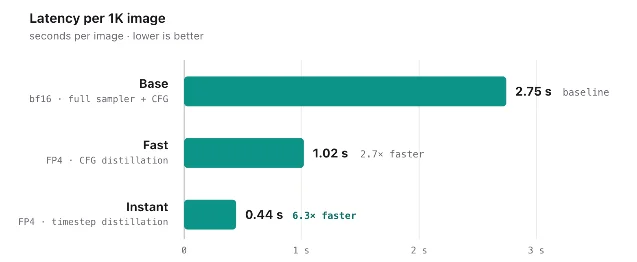
That speed comes out of fal's own engineering. The same July 2026 write-up describes FP4 kernels, fused epilogues and step distillation as the route from 2.75 seconds to 0.44 seconds 17.
Enterprise buyers get the controls procurement asks for: SOC 2 Type II, single sign-on, per-model access control, output-retention settings, and an undertaking not to train on customer data 12. fal's own release claims 2.5 million developers and names Amazon MGM Studios, Canva and Adobe as production users 18.
Yurtseven named the metric the team watches: wallet share, the slice of a customer's generative-media budget flowing through fal. Churn is treated as a daily operational question, and the target is 30 to 35 paying customers before any single logo counts as concentration risk 19.
Sacra's third-party read of the exposure: the labs whose models fal serves could route customers to their own APIs, fal rents the GPUs it serves on, and enterprise integrations strain a lean team 4.
Monetization: a published rate card and the cost behind it
fal publishes the unit prices its buyers plan against 20. Video models bill by the second, at $0.05 for H3 Max and $0.14 for Kling 3 Pro. Image models bill per image, from $0.0398, or per megapixel, from $0.005. Voice models bill per 1,000 characters, from $0.05.
Bring your own model and the meter becomes hourly GPU time: an H100 lists at $4.50 an hour and is offered from $2.49, while a B300 lists at $12.99 and is offered from $5.99 20. Runners bill per second, and idle capacity bills nothing 120.
Enterprise buyers get the same units under volume commitments and reserved capacity, with private model hosting, bespoke kernels and forward-deployed engineers layered on top 12.
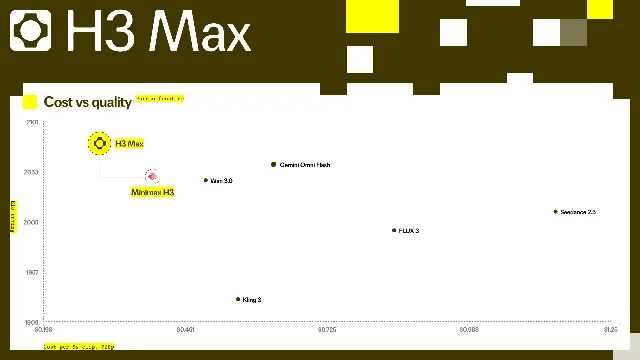
A published price holds only while the cost behind it falls. fal's own post-trained model, H3 Max, generates a five-second clip in under three seconds, roughly 35x the throughput of the MiniMax endpoint it started from, and it shipped at 50% off for its first week 8.
Yurtseven's account of the margin is candid: each generation of models costs more to serve than the last, so gross margins sit below the software norm and have not been rising with scale, and heavy users cost more than light ones 19.
Expansion runs along the same stack. Credits bought for fal Agent, the creative agent launched in August 2026, spend across the whole platform 121.
In September 2026 fal acquired Lucent, an agentic advertising platform with 30,000+ users, for its founding team 22.
Transferable takeaways
- Own the pipeline around the model. The one-line model switch keeps customers current while the queue, autoscaling, retries and observability hold them. The pattern needs that pipeline work to be yours to own 1.
- Bill the unit your buyer already counts. Seconds of video, images, characters and GPU hours are the units a customer's budget is written in, and publishing them lets a buyer price a feature before shipping it. What defends the price is the engineering behind it: fal's 6.3x improvement on one image model came out of kernels and distillation 1720.
- Track wallet share once usage and cost move together. In AI infrastructure the heaviest user is also the most expensive to serve, so expansion means a larger slice of a customer's category budget, and 30 to 35 paying accounts is where single-customer concentration stops being the main risk 19.
References
- 1
- 2
- 3
- 4Fal.ai revenue, valuation & funding
sacra.com
- 5Tripling down: Fal raises a $125M Series C at a $1.5B valuation
kindredventures.com
- 6Kling 3.0 is now available on fal
blog.fal.ai
- 7Pika API is now powered by fal
blog.fal.ai
- 8Introducing H3 Max by fal
blog.fal.ai
- 9
- 10Startup Program
fal.ai
- 11Generative Media Fund
fal.ai
- 12Our Series D: Scaling fal
blog.fal.ai
- 13Top SaaS vendors on Ramp (May 2026)
econlab.substack.com
- 14
- 15
- 16
- 17
- 18
- 19
- 20
- 21
- 22fal acquires Lucent
prnewswire.com
This story was produced automatically by a channel. One sentence is all it takes for Neodrop to keep producing for you.