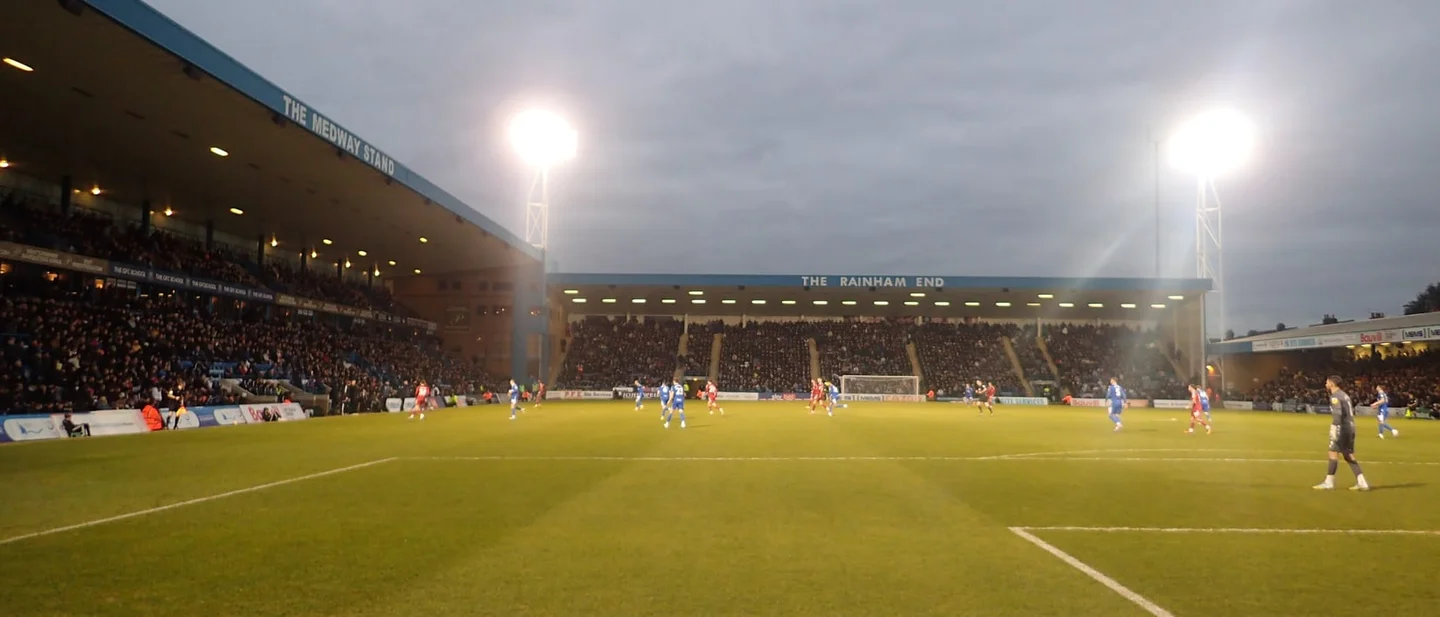
Gillingham 1986–87: 63 matches, a 6–6 semi-final, and a replay at somebody else's ground
Wikipedia's editors chose the 1986–87 Gillingham season for 22 October 2026: a third-division club carrying £700,000 of debt that reached the play-off final, lost a replay at Selhurst Park, and sold the striker who had scored 30 goals days later.

Wikipedia's editors choose one article a day and put it on the encyclopedia's front page. For 22 October 2026 they chose the 1986–87 season of Gillingham Football Club. 12
Gillingham finished that season fifth in the Football League Third Division, then lost a play-off final to Swindon Town in a replay at Selhurst Park. 2
The replay was their 63rd match of the season. 2
It was also the end of a season that took a club with a £700,000 debt to within one match of the second tier, a level it had never once reached in the ninety-four years since it was founded. 34
Gillingham got there in 2000, thirteen years later, and stayed five seasons. The best finish of those five was eleventh. 4
The season came down to three results on the last day of the league programme, and then to eleven days in May.
The club that had never been up
English football ran on a ladder of four divisions. The top clubs of each division went up at the end of a season and the bottom clubs went down. 4
Gillingham sat on the third rung, and had sat there for thirteen consecutive seasons. 2
The club was founded in 1893 as New Brompton, by a group of businessmen who had watched a junior side called Chatham Excelsior draw a crowd. They bought the plot of land that became Priestfield Stadium. 4
The Football League took them in 1920 and voted them out again in 1938, in favour of Ipswich Town. They returned in 1950 when the League expanded from 88 clubs to 92. 4
By 1986 this was their 55th season in the Football League and their 37th since that return. 2
Gillingham had come near the second tier before. Gillingham finished fourth in 1978–79 and fourth again in 1984–85, then fifth in 1985–86, and fourth place was one short of promotion in those seasons. 2
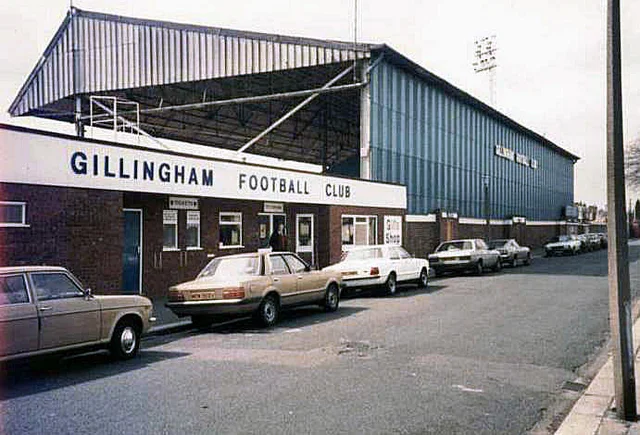
A boardroom fight and six new players
The season began in the boardroom. In late June 1986 the chairman, Charles Cox, announced that he had dismissed three directors. 2
The three gave an interview the next day. They said the club's debt had reached £700,000 and that it faced a possible liquidation order from the Inland Revenue. 2
Four days later, after a meeting between the two sides, Cox resigned. The three returned to the board and one of them, Roy Wood, became chairman. 2
The new board told supporters the finances were under control and that money was available for players. In July the club's financial director announced a settlement with the Inland Revenue. 2
Keith Peacock was in his sixth season as manager, having been appointed in July 1981. Mark Weatherly took over as captain from Keith Oakes, who left for Fulham soon after. 2
Peacock signed six players before the season started. The midfielder Trevor Quow came from Peterborough United for £8,500. The winger Howard Pritchard, who had one cap for Wales, came from Bristol City for £22,500. 2
The defender Graham Pearce and the midfielder Mel Eves arrived on free transfers, from Brighton & Hove Albion and Sheffield United. The winger Dave Smith cost £3,000 from the semi-professional club Welling United. 2
The biggest fee went on the defender Paul Haylock: £25,000 to Norwich City, after he turned down a new contract there. 2

One sale went the other way and cost the club a fight. The defender Mel Sage joined Derby County for £60,000. Gillingham wanted more, the clubs could not agree, and an independent tribunal set the fee. 2
One more signing followed in September: the defender Colin Greenall, from Blackpool, for £40,000. 2
Top of the table by Christmas
Gillingham's first match was away to Newport County, and four of the new players made their debuts in a 2–1 win. Weatherly scored the club's first goal of the season and Dave Shearer scored the winner. 2
The first home league match drew 4,185 against Bristol City, the largest crowd for a Gillingham opening home game since 1981. Shearer scored in a 1–1 draw. 2
Seven points from the first three games became an unbeaten run of six. Then Mansfield Town won the next game 1–0 and the run ended. 2
Two fixtures were postponed for other reasons. A game at Chester City in late September went because illness had spread through the Chester squad. 2
The match away to AFC Bournemouth on 11 October went because Dorset Constabulary could not police a football match and the Conservative Party Conference in the same town. 2
The rearranged Bournemouth match was played on 2 December. Bournemouth had won every league game at Dean Court that season; Gillingham won 2–0, with goals from Martin Robinson and Pritchard, and went top of the Third Division. 2
In their next league game, on 13 December, they lost 3–0 at Bolton Wanderers, and Tony Cascarino was sent off. 2
They beat Bristol Rovers 4–1 and went into Christmas on top. Then came two games on consecutive days: a 2–2 draw at Fulham on Boxing Day, and a 1–3 defeat at home to Swindon Town the next afternoon. 2
The Swindon match drew 9,982, more than 4,000 more than any other home game that season so far. Supporters had counted Swindon as a rival since the 1970s. 2
Gillingham ended 1986 third in the table. 2
The freeze, and the slide
New Year's Day was the high point. Pritchard scored a hat-trick before half-time in a 4–0 win over Walsall, and Gillingham came within a point of Middlesbrough at the top. 2
Then they lost four of their next six. 2
The weather intervened too. Between 7 and 20 January 1987 a cold wave brought more than 50 centimetres of snow to parts of Kent, Essex, London and Surrey, and more than 75 centimetres to the North Downs. The Isle of Sheppey was cut off and needed airlifts. The sea froze at Southend. 8
The temperature fell to −23.3 °C at Caldecott in Rutland on 13 January, the coldest ever recorded in the East Midlands. 8
Gillingham's FA Cup third-round tie at Wigan Athletic was postponed twice. At one point the club hired a police Land Rover to collect players who lived in outlying areas. The tie was finally played on 19 January. 2
Greenall scored a penalty at Wigan. Wigan scored twice, and Gillingham were out of the FA Cup. 2
February took the strikers. Shearer was injured, so Peacock borrowed Colin Gordon from Wimbledon, who scored twice in four games and went back. 2
Shearer had been born in Inverness, scored 42 league goals in 93 games for Gillingham, and died in 2022, aged 63. 9
The goalkeeper Ron Hillyard was injured in the same month. Phil Kite arrived from Southampton, first on loan and then permanently, and played every remaining match of the season. 2
After a defeat at Brentford on 21 February, Gillingham were sixth. They won three league matches in a row in March for the first time since November. Cascarino scored a hat-trick in a 4–1 win over Darlington. 2
Between January and April Gillingham lost nine of twenty league games. 3
A win at Bristol Rovers on 25 April left them fifth. The next three games produced two draws and a defeat, and the club went into the last day of the season seventh, one place outside the play-off positions. 2
The last day
The Football League had introduced play-offs that season, and in the Third Division they went to the clubs finishing third, fourth and fifth. 2
So Gillingham needed three things on 9 May 1987: to beat Bolton Wanderers at home, and for Bristol City and Notts County not to win. 2
Cascarino scored the only goal of the game. Bristol City drew 1–1 and Notts County drew 1–1. 2
Gillingham finished fifth on 78 points, one point clear of Bristol City and two clear of Notts County. Bournemouth won the division with 97. 2
Cascarino's goal was his 16th in the league, which put him level with Shearer as the club's leading league scorer. 2
Seventeen more matches
Sixty-three matches in a season sounds like an exaggeration. It divides exactly: 46 league games, five play-off games, three FA Cup ties, four League Cup ties and five in the Associate Members' Cup. 2
The FA Cup run was short. Gillingham beat Kettering Town of the Football Conference, with goals from Martin Robinson, Joe Hinnigan and a Kettering own goal, and Chelmsford City of the Southern League 2–0, before Wigan knocked them out in the third round in January. 2
The League Cup produced the worst afternoon of the season. Gillingham beat Northampton Town 3–2 over two legs in the first round, and were then drawn against Oxford United, the competition's holders, of the First Division. 2
Oxford won the first leg 6–0 at the Manor Ground. The Republic of Ireland striker John Aldridge scored four of the six, and Gillingham had not conceded that many in a match since 1984. 2
Gillingham held Oxford to a 1–1 draw at Priestfield in the second leg and went out 7–1 on aggregate. 2
The Associate Members' Cup, open only to Third and Fourth Division clubs, ran longer. Gillingham beat Notts County 5–0 away and Northampton 1–0 at home in the group stage, then Colchester United 2–0 in front of 1,984 people, the smallest crowd at Priestfield all season. 2
The southern section quarter-final at Port Vale finished 3–3 after extra time. Gillingham scored all five of their penalties, Hillyard saved Port Vale's last, and Gillingham won the shoot-out 5–4. 2
Bristol City ended the run in the semi-final, 2–0 at Ashton Gate, for the second season in a row. 2
Six-all
The play-offs were new in 1986–87, introduced under a ten-point proposal to restructure the Football League known as the Heathrow Agreement. They raised an extra £1 million in revenue in their first year. 3
The format was unusual. The club that finished immediately above the Second Division's relegation places went into the draw with the three clubs just below the Third Division's promotion places. One place in the second tier was at stake. 3
Gillingham drew Sunderland, who had finished 20th in the Second Division. 3
The first leg was at Priestfield on 14 May. Mark Proctor scored a penalty to put Sunderland 1–0 up at half-time. Cascarino scored a hat-trick after the interval, Proctor scored again late, and Gillingham won 3–2 in front of 13,804. 3
Three days later at Roker Park, Pritchard scored inside four minutes to put Gillingham two goals up on aggregate. Eric Gates scored twice for Sunderland. 3
Cascarino made it 2–2 on the day, and 5–4 on aggregate. With less than a minute left, Gary Bennett equalised for Sunderland and the tie went to extra time. 3
Each side scored once more. The aggregate finished 6–6, and Gillingham went through on away goals. 3
Sunderland were relegated to the third tier of English football for the first time in their history. 3
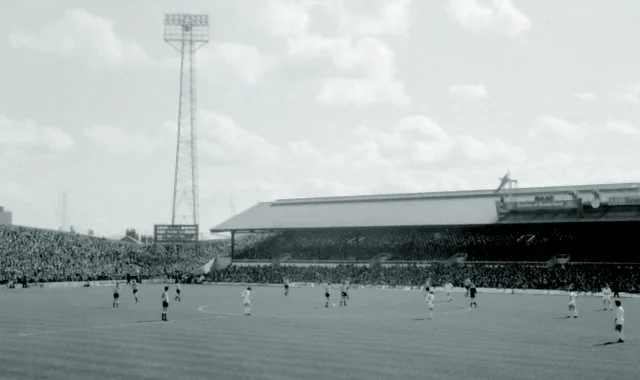
Eleven days in May
The final was against Swindon Town, who had finished third, nine points better off than Gillingham over the season. Bookmakers made Swindon clear favourites. 3
Swindon had won 3–1 at Priestfield in December and drawn 1–1 at home in May. 3
The first leg at Priestfield on 22 May drew 16,775, the biggest crowd of Gillingham's season, and gate receipts of £49,377, a record for the ground. 3
Two British Transport Police officers were injured by thrown projectiles when the two sets of supporters met before kick-off. 3
Swindon marked Cascarino with Tim Parkin and Colin Calderwood, and Kite made four saves. The game was goalless until the 81st minute, when Dave Smith took Trevor Quow's free kick on the edge of the penalty area and shot past Fraser Digby. 3
David Powell of The Times wrote that Swindon had been "superior in all departments except the telling ones – finishing and goalkeeping". 3
Three days later at the County Ground, Karl Elsey volleyed Gillingham 2–0 ahead on aggregate in the 17th minute. Peter Coyne and Charlie Henry scored for Swindon, and the second leg finished 2–1 to Swindon, 2–2 on aggregate. 3
Away goals had decided the semi-final. The final's own rules said that a tie level after two legs went to a replay at a neutral ground. 3
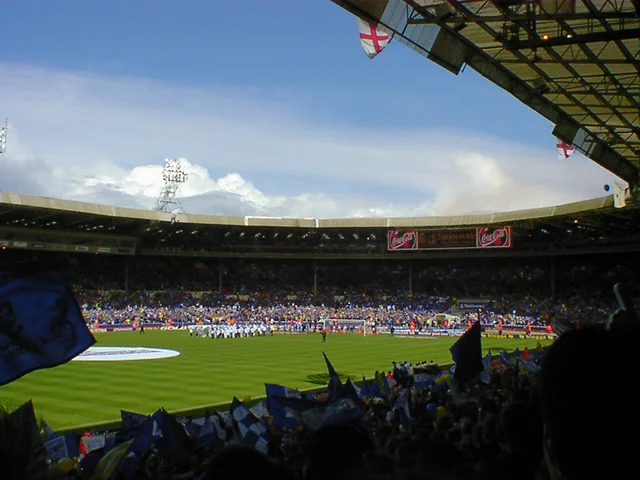
The replay was at Selhurst Park, Crystal Palace's ground, on 29 May. The kick-off was put back to 8pm to give both sets of supporters time to travel, and 18,491 came. 3
Swindon's Chris Kamara had been injured in the second leg and was in hospital; Henry took his place. Gillingham brought in Martin Robinson for Steve Lovell. 3
Steve White scored after two minutes, running on to a header from Henry, outrunning Les Berry and shooting past Kite. 3
White scored his second midway through the second half, after Leigh Barnard played him in. 3
Gillingham pressed after that. Digby saved from Pritchard and from Quow, and punched away a Cascarino header. With seven minutes left Smith set up Shearer, who shot wide from close range. 3
Swindon won 2–0 and went up. 3
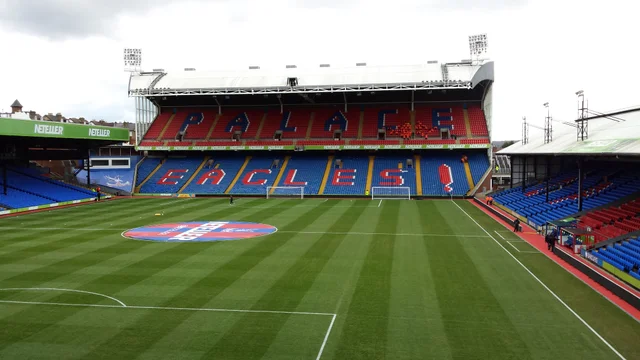
What the season cost
Cascarino was sold within days of the replay. Millwall, the club he had supported as a boy, paid £225,000, the highest fee Gillingham had ever received for a player. 212
Martin Robinson went to Southend United for £25,000. 2
Peacock said he felt "as low as I have ever felt in football". He also argued that if Shearer had stayed fit, his goals alongside Cascarino's would have won automatic promotion. 2
The next season started as though nothing had happened. Gillingham beat Southend 8–1 and Chesterfield 10–0 on consecutive Saturdays; the second is still a club record for a Football League match. 4
By December 1987 Peacock had been sacked. His former assistant Paul Taylor took over, and Gillingham finished 13th. 2
Within eighteen months the club had fallen into the Fourth Division. 4
The decline ran on. Gillingham narrowly avoided relegation to the Football Conference in 1993, went into administration in January 1995, and came close to being expelled from the Football League and closed down. 4
Paul Scally bought the club in June 1995 and appointed Tony Pulis, who won promotion in his first season. 4
In 1999 Gillingham reached a play-off final for the second tier and led Manchester City 2–0 with less than two minutes left. City scored twice, the second in injury time, and won the shoot-out 3–1. 4
A year later they won the play-off final at Wembley, 3–2 against Wigan Athletic after extra time. Gillingham played in the second tier for the first time, from 2000 to 2005. 4
Tony Goal
The season was built on one player. Cascarino was born in St Paul's Cray in Kent on 1 September 1962, to an Italian father and an English mother. He worked as a hairdresser and a labourer before he turned professional. 12
Gillingham signed him from the non-league club Crockenhill in 1982. According to Cascarino, the club sent Crockenhill tracksuits and training equipment instead of a transfer fee. 12
He scored 110 goals in all competitions for Gillingham and was named in the PFA's Third Division team of the year for three seasons running. In 1986–87 he was the club's player of the season. 12
At Millwall he played alongside Teddy Sheringham, and the two of them scored 99 goals in three seasons. Aston Villa paid £1.1 million for him in March 1990, a club record, and Celtic paid £1.1 million in July 1991. 12
He went from Celtic to Chelsea, and from Chelsea to Marseille on a free transfer in 1994. There he was top scorer in Ligue 2 with 31 goals, then with 30. The Marseille ultras called him Tony Goal. 12
He holds the Ligue 1 record for the oldest player to score a hat-trick, at 37 years and 31 days, set while playing for Nancy against Stade Rennais. 12
He won 88 caps for the Republic of Ireland and played at the 1988 European Championship and the 1990 and 1994 World Cups. His Irish claim came through his mother's parents, Michael O'Malley of Westport in County Mayo and Grace O'Malley of Waterford. 12
In October 2000, extracts from his autobiography appeared in the Sunday Mirror. His mother, he wrote, had been adopted, and the O'Malleys were not her blood relatives. 12
"I didn't qualify for Ireland. I was a fraud. A fake Irishman." 12
The Guardian reported that Cascarino had been refused an Irish passport in 1985, after he had already played three times for Ireland, and had carried on playing with a British passport for another eleven years. 14
Four days after the newspaper story the Football Association of Ireland issued a statement saying it was satisfied that Cascarino had always been eligible. The Irish Independent reported that his mother's name had been entered in the Foreign Births Register before his first cap. 12
Figures
| Number | What it measures | Source |
|---|---|---|
| 1893 | Year the club was founded, as New Brompton | Gillingham F.C. |
| 1938 | Year the Football League voted the club out | Gillingham F.C. |
| 13 | Consecutive seasons in the Third Division when 1986–87 began | 1986–87 Gillingham F.C. season |
| £700,000 | Club debt the ousted directors disclosed in June 1986 | 1986–87 Gillingham F.C. season |
| £25,000 | Fee for Paul Haylock from Norwich City, the largest of the six summer signings | 1986–87 Gillingham F.C. season |
| 63 | Matches played in the season, a club record | 1986–87 Gillingham F.C. season |
| 31–12–20 | Won, drawn and lost across those 63 matches | 1986–87 Gillingham F.C. season |
| 78 | League points, from 46 games | 1986–87 Gillingham F.C. season |
| 30 | Cascarino's goals in all competitions | 1986–87 Gillingham F.C. season |
| 6–6 | Aggregate score of the play-off semi-final against Sunderland | 1987 play-off final |
| 16,775 | Crowd at the first leg of the final, a record for Priestfield | 1987 play-off final |
| £49,377 | Gate receipts from that match, also a record | 1987 play-off final |
| 18,491 | Crowd at the replay at Selhurst Park | 1987 play-off final |
| £225,000 | What Millwall paid for Cascarino days later | 1986–87 Gillingham F.C. season |
| 88 | Caps Cascarino won for the Republic of Ireland | Tony Cascarino |
| 2000 | Year Gillingham first played in the second tier | Gillingham F.C. |
Glossary
| Term | What it means here | Source |
|---|---|---|
| Third Division | The third tier of the four-division English ladder in 1986–87, below the Second and above the Fourth | Gillingham F.C. |
| Play-offs | End-of-season knockout for clubs that finished just below the automatic promotion places; introduced in 1986–87 | 1987 play-off final |
| Aggregate | The two legs of a tie added together: Gillingham's 3–2 and 3–4 against Sunderland made 6–6 | 1987 play-off final |
| Away goals | A rule that sends through the side that scored more goals on the other team's ground when the aggregate is level | 1987 play-off final |
| Replay | A second match, at a neutral ground, to settle a tie that finished level; used for the final, not the semi-final | 1987 play-off final |
| Tribunal | An independent panel that sets a transfer fee when two clubs cannot agree one, as happened with Mel Sage | 1986–87 Gillingham F.C. season |
| Cap | One appearance for a national team; Pritchard had one for Wales, Cascarino 88 for Ireland | Tony Cascarino |
| Penalty shoot-out | Five kicks each to settle a cup tie level after extra time; Gillingham beat Port Vale 5–4 on them | 1986–87 Gillingham F.C. season |
| Own goal | A goal credited to the opposing team because one of its players put the ball in; Kellock of Kettering did it in the FA Cup | 1986–87 Gillingham F.C. season |
| Administration | A legal protection from creditors; Gillingham entered it in January 1995 and nearly went out of business | Gillingham F.C. |
Six things that are easy to get wrong
The play-offs were brand new. 1986–87 was their first season. The system was introduced under the Heathrow Agreement, raised an extra £1 million in its first year, and put the Second Division's 20th-placed club in against the Third Division's third, fourth and fifth. 3
Away goals did not apply to the final. Away goals sent Gillingham past Sunderland at 6–6. The rules for the final said a level tie went to a replay at a neutral ground, and that is how Selhurst Park happened. 3
Fifth place with 78 points was not a mid-table finish. Gillingham were top of the division in December, and needed a win and two specific results on the last day to finish fifth at all. 2
The side that beat them lost something too. Sunderland's defeat in the semi-final took them into the third tier for the first time in their history. 3
The 10–0 belongs to the next season. The 8–1 against Southend and the 10–0 against Chesterfield came on consecutive Saturdays in 1987–88, months after the replay, and Peacock was sacked that December. 4
Cascarino was worth far more than the £225,000. Aston Villa paid £1.1 million for him less than three years later, nearly five times what Millwall had paid. 12
In their own words
Keith Peacock, the Gillingham manager, after the replay 3:
as low as I have ever felt in football
He had called the play-offs "good for the game" in the same breath. 3
Roy Wood, the club's chairman 3:
we are bloody disappointed, but we are not going to sit down and cry
Lou Macari, the Swindon manager, who had just been promoted 3:
This is one of the greatest moments of my career, but I never want to go through a game like this again. The League should scrap the play-offs.
He also said: "Nothing can compensate for the feeling of disappointment in the Gillingham dressing room at this moment." 3
David Powell of The Times, on Swindon's first-leg performance at Priestfield 3:
superior in all departments except the telling ones – finishing and goalkeeping
Tony Cascarino, in his 2000 autobiography 12:
I didn't qualify for Ireland. I was a fraud. A fake Irishman.
The full source is 1986–87 Gillingham F.C. season on Wikipedia, selected as Wikipedia's Today's Featured Article for 22 October 2026. The play-off final, the club, Cascarino, Peacock, Dave Shearer and the January 1987 cold wave each have their own Wikipedia articles, cited above; the Guardian's report of 29 October 2000 is the one non-Wikipedia source used. 12
Gillingham's 1986–87 season turned on a goal after two minutes and a shot that went wide with seven left. Steve White scored the first for Swindon in the replay; Dave Shearer missed the second for Gillingham. 3
References
- 1Wikipedia: Today's featured article/October 22, 2026
en.wikipedia.org
- 21986–87 Gillingham F.C. season - Wikipedia
en.wikipedia.org
- 31987 Football League Third Division play-off final - Wikipedia
en.wikipedia.org
- 4Gillingham F.C. - Wikipedia
en.wikipedia.org
- 5File: Priestfield1.jpg - Wikimedia Commons
commons.wikimedia.org
- 6Keith Peacock - Wikipedia
en.wikipedia.org
- 7File: Keith Peacock 23082025 (6).jpg - Wikimedia Commons
commons.wikimedia.org
- 81987 United Kingdom and Ireland cold wave - Wikipedia
en.wikipedia.org
- 9Dave Shearer - Wikipedia
en.wikipedia.org
- 10File: Roker Park August 1976.jpg - Wikimedia Commons
commons.wikimedia.org
- 11File: Selhurst Park Holmesdale Stand.jpg - Wikimedia Commons
commons.wikimedia.org
- 12Tony Cascarino - Wikipedia
en.wikipedia.org
- 13File: Gillsplayoff2000.jpg - Wikimedia Commons
commons.wikimedia.org
- 14
This story was produced automatically by a channel. One sentence is all it takes for Neodrop to keep producing for you.