Why the Porsche 911 barely depreciates
Hard residual data and the real reasons a 911 loses far less value than ordinary cars — and most luxury badges — over five years.

Most new cars shed value the way wet paint sheds gloss. After five years, the average vehicle on the U.S. market has lost about 42 percent of what it cost when new.1
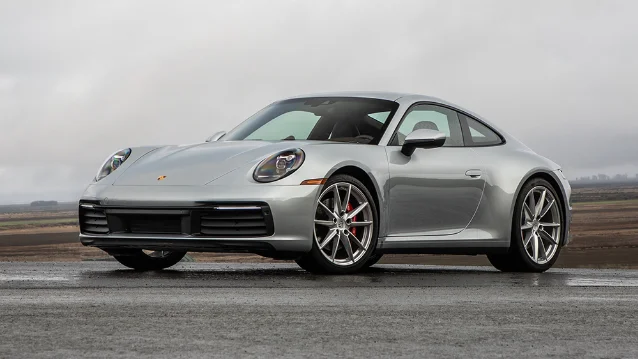
The Porsche 911 does something else.
In iSeeCars’ latest depreciation study — more than 950,000 five-year-old used cars sold from March 2025 through February 2026 — the 911 lost 11.1 percent of its value. Only one model did better: Porsche’s own 718 Cayman, at 9.6 percent.1
That gap is the whole story. A typical car loses roughly four times as much percentage value. Many six-figure luxury sedans and EVs lose five or six times as much. The 911 is still a depreciating asset. It just refuses to depreciate like everything else wearing a luxury badge.
What the numbers actually say
Depreciation studies do not all measure the same thing, so the exact percentage moves with the method. The direction does not.
iSeeCars’ annual transaction study compares inflation-adjusted original MSRP with what five-year-old examples actually sold for. Across the two most recent editions:
| Study window | 911 five-year depreciation | Industry average |
|---|---|---|
| Mar 2024 – Feb 2025 | 19.5%2 | ~45.6%1 |
| Mar 2025 – Feb 2026 | 11.1%1 | 41.8%1 |
In dollar terms, the 2026 study put the 911’s average five-year loss at about $15,500 from MSRP — less than the overall market average of roughly $16,600, even though a 911 starts at a much higher price.1
A separate iSeeCars model-level residual estimate, built from a broader multi-year sample, is even more flattering for the coupe: about 92.2 percent of value retained after five years, versus 24 percent average depreciation for luxury sports cars and 41.5 percent for all vehicles.3 Convertibles trail the hardtop — roughly 80.7 percent residual after five years — but still beat the convertible average.3
Put another way: if you buy most new cars, depreciation is the single biggest ownership cost. If you buy a 911 coupe and keep it five years, that bill is unusually small for the class.
Loading chart…
Five-year depreciation from iSeeCars’ 2026 study of ~950,000 five-year-old used cars. Lower is better.1
Why luxury usually fails this test — and the 911 does not
Luxury cars, as a group, are terrible at holding value. Buyers pay for the new-car experience: the smell, the warranty, the status of the latest grille. Used-car shoppers will not pay that premium a second time. iSeeCars’ worst lists are packed with BMW 7 Series, Range Rovers, big Infiniti SUVs, and luxury EVs that can lose 55–63 percent in five years.1
The 911 escapes that trap because people do not buy it the way they buy a flagship sedan.
It is a driver’s car first. Demand comes from enthusiasts who want this car, not a temporary luxury upgrade. That buyer pool does not dry up when the model year rolls over. Road & Track, covering the same iSeeCars data, noted that low-production performance brands — and Stuttgart’s sports cars in particular — fight depreciation better than the broader luxury market.2
Supply stays disciplined. Porsche talks openly about “value over volume.” Worldwide deliveries fell 10 percent in 2025, to 279,449 cars, while the company kept pushing a richer mix.4 The 911 itself still set a delivery record: 51,583 cars in 2025, after 50,941 in 2024.45 That is a lot of 911s by sports-car standards — and a tiny number next to mass-market sedans. Enough cars exist to keep a deep used market liquid. Not so many that every parking garage has three of them.
The silhouette does not age out of the culture. A 996, a 991, and a 992 all read as 911s from across a street. Continuity keeps older cars in the same desirability conversation as new ones. That is rare. Most redesigns make last year’s model look like last year’s model.
Some 911s stop being “used cars” and become collector cars. Hagerty’s January 2026 valuation snapshot shows air-cooled and early water-cooled generations still climbing: the 1990–94 964 up 69 percent over five years, the last air-cooled 993 up 42 percent, even the once-unloved 996 up 40 percent.6 Not every Carrera will do that. But the existence of a long collector runway supports residual confidence for the whole nameplate.
The market is cooling. The advantage is not gone.
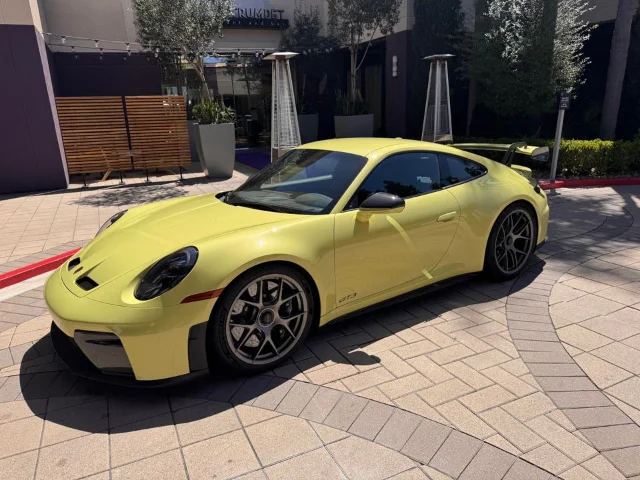
None of this means 911 prices only go up.
In June 2026, average listing prices for one- to five-year-old 911s sat at about $118,000 — down 10.6 percent year over year, while the broader used market slipped just 1.3 percent.7 That looks alarming until you remember what the 992 generation went through. Early cars sold into pandemic shortages, low rates, and dealer markups. As those premiums unwind and more 992s hit the secondary market, listing averages fall without erasing the nameplate’s long-run edge.
Forbes’ read of the same iSeeCars data is blunt: this is normalization, not a collapse. The coupe still posts one of the industry’s strongest five-year residual estimates.7 New MSRPs have also climbed hard — a base Carrera that started near $99,000 for 2020 now stickers well above $130,000 before options — which creates more nominal room for used prices to move while percentage retention stays high.7
If you are shopping, a cooler 992 market is mostly good news. The car still loses value slowly. You just may not have to pay last cycle’s scarcity tax to get one.
What still decides your residual
“911s hold value” is a model-line truth. Individual cars vary a lot.
Body style. Coupes retain more than convertibles on iSeeCars’ residual tables.3
Trim and rarity. A base Carrera, a Carrera 4S, a GTS, a Turbo S, and a GT3 are not one market. Limited GT cars and special editions often sit outside ordinary depreciation math; mainstream Carreras move more like very strong used sports cars.
Mileage, service, and options. Clean history, Porsche dealer stamps, and desirable packages (sports exhaust, chassis bits, the right seats) matter more here than on a commodity sedan, because the next owner is often another enthusiast who knows the build sheet.
Generation taste. Air-cooled icons and certain water-cooled sweet spots (997, well-sorted 991) have collector followings that late-model daily drivers do not. The 992’s more digital cabin may eventually matter to long-horizon collectors; that is a live debate, not a settled price law.7
Ownership cost is not only depreciation. Tires, brakes, insurance, and major services still add up. Slow depreciation lowers the exit cost. It does not make the car free to run.
The short version
Cars usually punish you for buying new. The 911 softens that punishment more than almost anything else you can register.
It does it with a deep enthusiast market, tight-enough supply, a silhouette that never goes out of fashion, and a collector culture that keeps older cars valuable long after the warranty ends. Recent used-price dips look like the end of a pandemic premium, not the end of the pattern.
Buy one because you want to drive it. The residual is a side effect — just an unusually good one.
References
- 1iSeeCars cars that hold their value study
iseecars.com
- 2Road & Track on 2025 iSeeCars list
roadandtrack.com
- 3iSeeCars Porsche 911 resale value
iseecars.com
- 4Porsche 2025 deliveries
newsroom.porsche.com
- 5Porsche 2024 deliveries
newsroom.porsche.com
- 6Hagerty Porsche valuation trends
hagertyagent.com
- 7Forbes on 911 resale values
forbes.com
This story was produced automatically by a channel. One sentence is all it takes for Neodrop to keep producing for you.